On a quiet spring morning in 1942, a German staff car turned onto an ordinary street in Nazi-occupied Prague. Inside was one of the Third Reich’s most feared men, a figure so brutal the Czech people called him the Butcher. What he didn’t know was that just ahead of him, weapons hidden beneath their coats, a handful of assassins lay in wait. They’d trained for months for this moment, knowing that once they acted, there would be no turning back.
But how did they come to be standing on that street? What unfolded in the seconds that followed? And how far would the consequences reach? Using rare Gestapo and SS reports documenting those events in meticulous detail, along with eyewitness testimony and modern technology, we’ll investigate moment by moment the story of Operation Anthropoid, the assassination of Reinhard Heydrich.
But who was he? Well, in short, Heydrich was not a good guy. The tall, blond-haired, blue-eyed 38-year-old SS Obergruppenführer not only looked the part of a typical Nazi villain, but played it, too. Highly intelligent and utterly ruthless, Heydrich had been the mastermind behind the infamous Einsatzgruppen that unleashed a wave of destruction on civilian populations in Central and Eastern Europe.
More important for our story, Heydrich had been appointed Reich Protector of Bohemia and Moravia in September 1941, effectively in charge of the occupation of what is today the Czech Republic. He had immediately unleashed a reign of terror, deporting tens of thousands of Jews, instituting rationing and forced labor, and systematically looting the country. For all Czech patriots, Heydrich symbolized the ruthless oppression of their country and its people.
And so, it was perhaps no surprise that he became the number one target for assassination by the exiled Czech government in Britain. And there were plenty of people willing to risk their lives to have even a chance at ending his. Let’s meet a few.
First, Jozef Gabčík. 29 years old in 1939, he’d fled his home on the outbreak of war and had served in the French Foreign Legion and Czechoslovak division in France, earning the Croix de Guerre and the Czechoslovak War Cross for his efforts. Popular with his comrades, he was known for his sharp temper and direct communication.
In contrast, his 28-year-old friend and comrade Jan Kubiš was a quiet and soft-spoken man. Like Gabčík, Kubiš had also fought in the French Foreign Legion and the Czech division and had earned the Czechoslovak War Cross. Both men were proud patriots and willing to do whatever was required to strike a blow for their country.
But how? Enter the Special Operations Executive. Created in June 1940 on the orders of Winston Churchill with the broad but explicit remit to set Europe ablaze, the SOE was a clandestine body of highly trained secret agents dropped into occupied Europe to gather intelligence, organize resistance, conduct sabotage, and on occasion carry out assassinations.
It was with SOE that Kubiš and Gabčík, alongside a number of other Czech agents, found themselves in August 1941 undergoing rigorous training in all manner of clandestine warfare for what would ultimately become Operation Anthropoid. In its most simple form, the mission was to jump into occupied Czechoslovakia, meet up with the local resistance, locate Heydrich, and kill him. And ideally live to tell the tale.
A fascinating set of photographs exist taken at Porchester House in London, headquarters of the Czech military intelligence. It seems to have been something of a rite of passage for all agents after receiving their orders to be photographed at the back of the building against a brick wall. On the 18th of December, it was the turn of Warrant Officers Jan Kubiš and Jozef Gabčík. Over the following weeks and months, a number of other agents, Adolf Opálka, Jozef Valčík, Jan Hruby, Jaroslav Schwarz, and Karel Curda would do likewise. Their paths would cross again.
With training complete, 11 days later and alongside Colonel Moravec, head of Czech intelligence, Kubiš and Gabčík arrived at an aerodrome near Tangmere where they boarded an adapted Halifax bomber bound for occupied Czechoslovakia. With Gabčík’s parting words to his commander, “You can rely on us, Colonel. We shall fulfill our mission as ordered.”
By 10:00 p.m. the pair, along with a small arsenal of weapons and explosives, and six other Czech agents, each with their own missions, were airborne and soon over occupied Europe. Three and a half hours later, following a close shave with German night fighters over Darmstadt, Flight Lieutenant Ron Hockey dropped down to 900 ft and at 2:24 a.m. on the signal, Gabčík and Kubiš leapt into the night.
Unfortunately, heavy snowfall and darkness had led the pilot astray. Instead of landing to the southeast of Pilsen, the agents had actually been dropped outside the village Neveklov, 70 mi off target, only 12 mi from Prague. But, they had arrived.
Within a few days, they’d made contact with the local resistance and before long were established in the bustling city. The support they received from local families was vital. Whether it was the Novák family in Libeň district or Mr. and Mrs. Fafek on Kolínská Street, with Josef and Marie Svatoš in the Old Town, local resistance leader Jan Zelinka-Hajský on Biskupcova Street, or most frequently over the road in the second-floor apartment at the home of the Moravec family, where Marie hosted the agents and gathered supplies whilst her son Vladimír, known as Ota, helped plan the assassination.
But, just how and where would they do it? Let’s explore. Since early April, Heydrich had relocated to a manor situated in the nearby village of Panenské Břežany, north of the city. The residence, stolen from local Jews, have been turned into a high-security zone with guard posts and patrol dogs making extremely secure no-go. Heydrich’s main office was located here in the impressive Prague Castle in the heart of the city. Naturally, it too was heavily defended, and the chance of success was minimal.
Various other options were considered including derailing his personal train on route to Berlin, and even sniping at him with an anti-tank rifle, but none proved viable. There was though seemingly one vulnerability, the route between his home and his Prague office. That journey, a distance of some 15 mi, took the Reichsprotektor through this area of northern Prague along the main roads into the city.
Regular observations showed that Heydrich, whether through arrogance or naivety, rarely varied his route and preferred to travel without an escort, just he and driver Oberscharführer Johannes Klein in his open-top Mercedes 320 Touareg. After months of scouting and research, the agents finally identified the ideal location for an ambush right here.
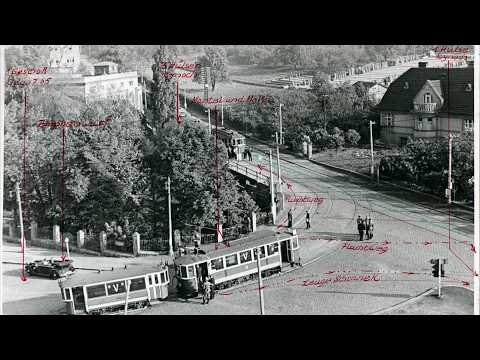
Let’s take a look. The problem is that the road layout today has changed significantly from how it was in 1942, so understanding it is tricky. But by investigating wartime aerial imagery along with these highly detailed Gestapo diagrams of the area immediately after the attack, then virtually recreating the road layout, and anchoring it to common points on the map that have not changed, and blending it onto the modern satellite view, we get a true understanding of exactly where those events took place.
It’s worth pointing out how much the 1942 layout differs from the modern view. Today, this two-lane slip road connecting two dual carriageways is the main feature, and at a glance, it does look similar to the shots many of us have seen of what happened here, but really it’s not. The actual road here at the time was this one, which ran northwest-southeast, but with a sharp right-hand turn here towards Prague.
As this overlay shows, it was actually located right here on the modern view, around what’s today a memorial to Operation Anthropoid, but back then was a wooded garden area enclosed by iron fencing and stone pillars, around which was a footpath. Also missing on the modern view, but important in 1942, are several tram lines, along with a complex array of posts and power lines, which crossed the road in this area.
The key, though, is this tight right-hand turn, which Heydrich’s driver would have to make en route to the city, which had to be taken at very low speeds, an ideal position for an ambush. Let’s map out the plan.
So, Gabčík and Kubiš were to loiter on the curb here, while the third agent, Adolf Opálka, would wait across the street in this location. The fourth man, Josef Valčík, armed with a mirror, was to stand about 100 yards up this road and signal when Heydrich’s car came into view. That was the sign for Gabčík to prepare his Sten gun, and for Kubiš to ready his custom-made grenades.
When Heydrich’s car entered the bend, Opálka would cross the road in front of it, ensuring that the car would be slow enough for the attack. When, at almost point-blank range, Gabčík’s Sten and Kubiš’s grenades would put an end to Reinhard Heydrich. At least, that was the plan.
Now that we’ve set the stage, let’s turn to the 27th of May, 1942. Using those investigative images of the crime scene, which include a reconstruction created immediately after the attack, we can follow events with precise detail.
On that morning, Gabčík and Kubiš left the Moravec apartment, picking up two bicycles en route, and traveled to the attack site. Kubiš left his here against this post on the other side of the road, while Gabčík propped his with an attaché case and spare Sten magazine against this one, a little further away. By 8:45, all four agents had arrived and were in position around the intersection.
Gabčík, wearing a raincoat under which he’d concealed his Mark II Sten gun, took up his position just here. Kubiš, with a coat and flat golfer’s cap, stood just beyond him, ready with a modified Type 73 British anti-tank grenade in his brown leather attaché case. Both men also carried a .32 caliber Colt pistol. Now they waited.
Directly over the road, standing about here, was Adolf Opálka. And as agreed, 100 yards up this road was Josef Valčík. Heydrich was due to arrive about 9:20 a.m. as he did regularly when commuting into the city.
The minutes ticked by. 9:20, 9:25, 9:30, but no Heydrich. The men couldn’t have known it, but the Reichsprotektor was taking it easy that morning, enjoying a late breakfast and family time in the garden.
Finally, at 10:00 a.m., Heydrich joined the waiting driver Klein outside his home, and climbing into the front passenger seat, the pair set off for the city. They passed a series of static police checkpoints along the route, but were otherwise alone on their journey.
32 minutes later, and at the point of giving up, Valčík spotted Heydrich’s Mercedes approaching down what was then Kirschmayerstraße. Turning to his left and flashing his mirror down the road, he warned the others who approached the roadside. Seconds later, Heydrich’s car, top down, came into view, and as planned, began to slow to make the sharp right turn towards Prague.
It was now or never. Let’s walk through the ensuing chaos second by second.
As the Mercedes reached this point in the turn, it slowed down greatly and at the same time a tram entered the intersection here, moving in the opposite direction. Just then, Opálka took his chance and dashed across the street, forcing the car to brake.
In that crucial moment, only feet from Heydrich, Gabčík raised his Sten, pulled the trigger, and nothing. His weapon clicked and clicked as he stood fixed to the spot, but it didn’t fire. One can only imagine that split second when Heydrich and Gabčík surely looked at each other in mutual shock.
Recovering quickly, an enraged Heydrich shouted something to his driver who slowed to a stop, not knowing that Kubiš was on the scene with his grenade. In the same instant, he held the bomb, which exploded on impact above the running board just forward of the right rear wheel.
There was a huge blast, so powerful that it shattered the windows of the passing tram, ripping through the bottom of the car door and sending metal fragments directly through Heydrich’s seat, which lodged in his back. Utter chaos erupted as terrified tram passengers spilled into the street.
Kubiš turned and ran past Gabčík to his bike left here and threw down his cap and began pedaling away as fast as he could, firing a single shot over his shoulder as he did so. Heydrich and Klein both managed to stagger out of the smoking wreckage, pistols in hand, with the former probably firing a single shot before his Luger jammed.
Gabčík had been jolted back to his senses by the explosion and now dropped the Sten, later photographed where it fell, and fumbled to draw his own pistol. With his planned route of escape by bicycle now blocked by the stationary tram and its disgorging passengers, Josef turned left and fled round the corner onto Kirschmayer Street.
It was now that witnesses report that Heydrich, apparently feeling the full impact of his injuries, doubled over in pain onto the hood of the car, ordering Klein to follow as the assassin made a break for it. The chase was on.
While Kubiš, Opálka and Valčík scattered in different directions, Gabčík was in the footrace of his life. Let’s follow his route street by street.
Sprinting uphill with Klein in pursuit, Gabčík turned and fired, then ducked into a butcher shop—only to find no rear exit. He burst back out, shot Klein in the thigh, and vanished into the gardens as a sunbather watched him run, tie flying, revolver in hand.
Kubiš, bleeding from his own grenade, cycled to Palmovka, where Mrs. Nováková hid him and sent her daughter to retrieve his bloodstained bicycle. All four agents slipped away—but Prague would pay dearly.
Heydrich lingered eight days before sepsis from the car’s upholstery killed him on June 4. Operation Anthropoid had succeeded. The Nazis answered with thousands of arrests and executions, yet the seven agents sheltered in a church crypt would soon make their legendary last stand.
Heydrich’s grave lies forgotten today—but was the ambush worth the terrible reprisals that followed? Tell us what you think below.
Report this article
Select a reason for reporting:






