She was born from the ink of a treaty meant to prevent war, yet she would go on to leave her mark on every ocean and every theater of the greatest conflict in human history. HMS Nelson, named after Britain’s greatest naval hero, was a battleship like no other—armed with the biggest guns ever mounted on a Royal Navy warship, shaped by compromise, and destined for glory. From the stormy North Atlantic to the shores of Normandy and the surrender of Japanese forces in Southeast Asia, her story is one of resilience, controversy, and ultimate triumph.
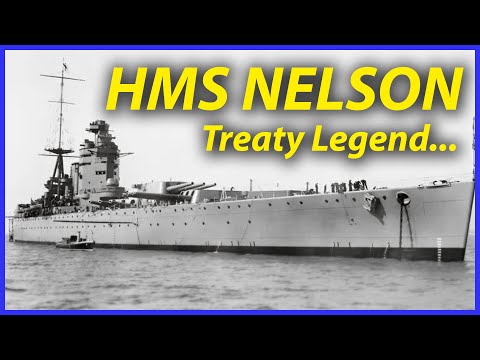
But Nelson’s path to legend was anything but smooth. Designed under the strict limits of the 1922 Washington Naval Treaty, she was a gamble—a radical design that packed unprecedented firepower into a hull that barely met the restrictions. Her unique silhouette, with all three main gun turrets clustered forward, earned her nicknames like “the Queen’s Mansions” and even “the Ugly Sisters.” Yet beneath that unconventional exterior lay a warship of immense power and surprising adaptability.
Laid down in 1922 and commissioned in 1927 at a cost of over £7.5 million—equivalent to more than £500 million today—Nelson quickly became the flagship of the Atlantic Fleet, a visible symbol of Britain’s naval might. But her early years were not without drama. She grounded off South Sea in 1934, collided with a merchant ship in thick fog, and even saw her crew play a central role in the Invergordon Mutiny, a rare act of defiance that sent shockwaves through the Admiralty.
When war broke out in 1939, Nelson was thrust into the fray. She hunted German blockade runners in the North Atlantic, escorted convoys through treacherous waters, and narrowly escaped disaster when a U-boat’s torpedoes failed to detonate. But luck would not always be on her side. In December 1939, she struck a magnetic mine, tearing a massive hole in her hull and putting her out of action for months. Then, in 1941, an Italian torpedo bomber struck her bow, causing severe flooding and reducing her speed. Each time, her crew’s skill and determination brought her back.
Nelson’s finest hours, however, were yet to come. She played a pivotal role in Operation Torch, bombarding Vichy French defenses in North Africa, and supported the invasions of Sicily and mainland Italy. It was aboard her decks that the Italian armistice was signed in September 1943, a moment that cemented her place in history. Then came Normandy. On D-Day, her 16-inch guns unleashed hell on German coastal defenses, providing crucial support to Allied troops storming ashore. But disaster struck again when she hit two mines off the coast, forcing her to limp away for repairs in the United States.
Returning to service in 1945, Nelson joined the Eastern Fleet and witnessed the formal surrender of Japanese forces in Malaya and Southeast Asia, bringing the war to a close. After the war, she served briefly as a training ship before meeting a sobering end as a target for aerial bomb tests—a final testament to the changing nature of naval warfare.
HMS Nelson was never elegant, but she was resilient, powerful, and indispensable. From treaty limits to wartime legend, her story is one of innovation, adaptation, and the indomitable spirit of those who sailed her. This is the story of a battleship that defied expectations and left an indelible mark on history.
But to understand why Nelson mattered so much, you have to understand the gamble she represented. The Washington Naval Treaty of 1922 was a desperate attempt to stop an arms race that threatened to bankrupt empires. It capped battleship displacement at 35,000 tons and gun caliber at 16 inches, and Britain—exhausted and cash-strapped after the Great War—was only too happy to comply.
The result was a ship that broke every convention. Where other navies spread their main batteries along the centerline, Nelson’s designers crammed all nine 16-inch guns into three triple turrets, all mounted forward of the superstructure. Turret B sat in a superfiring position above Turret A, with Turret C behind and below them. The arrangement saved weight, shortened the armored citadel, and concentrated her firepower into a devastating forward arc.
It also made her look, frankly, strange. With her high freeboard, blocky superstructure, and that cluster of guns at the bow, she was unmistakable on any horizon. Sailors called her “the Queen’s Mansions”—a nod to the towering blocks of flats then rising in London. Others, less charitably, lumped her and her sister Rodney together as “the Ugly Sisters.”
Yet there was nothing ugly about her hitting power. Her nine 16-inch breech-loading guns could hurl a shell weighing over a ton more than twenty miles. Backed by a secondary battery of twelve 6-inch guns in twin turrets aft—three on each side—she could engage smaller warships and screen herself from torpedo craft. And her fire control, with its towering directors and massive rangefinders, was among the most advanced of its era.
What the treaty could not control was the march of technology. When Nelson was designed, the airplane was still a curiosity. By the time war came, it was a lethal threat. Her original anti-aircraft armament—six 4.7-inch guns and eight single two-pounder pom-poms—was quickly exposed as inadequate. So she was rebuilt, again and again.
Oerlikon 20mm cannons sprouted from her decks like steel weeds. Multi-barreled pom-pom mounts replaced the single guns, throwing up dense walls of fire. Later came quadruple Bofors 40mm mounts, far more effective against fast, low-flying attackers. By war’s end, she bristled with more than sixty anti-aircraft guns of varying calibers—a porcupine of steel and flame.
Below the waterline, she carried a pair of submerged 24.5-inch torpedo tubes, one per side. In practice they were rarely used—battleship-launched torpedoes were a relic of interwar doctrine—but their presence spoke to the uncertainty of the age, when navies still imagined great gunnery duels decided at close range.
Her machinery was equally workmanlike. Two Brown-Curtis geared steam turbines produced 45,000 shaft horsepower, driving her to just over 23 knots—no speedster, but enough for the line of battle. With a range of 7,000 nautical miles, she was built for the wide oceans, for long patrols and distant stations.
And distant stations were exactly where the war would take her. When the fighting began, Nelson was already a veteran of fleet reviews and diplomatic cruises, her crew drilled to a fine edge. But nothing could have prepared them for what lay ahead—the hunting of raiders, the minefields, the torpedo strikes, and the slow, grinding work of keeping a damaged battleship in the fight.
Her first great test came not from an enemy shell, but from the sea itself. In the storm-lashed waters of the North Atlantic, she patrolled for German blockade runners, her massive hull shouldering aside the waves. Then, in October 1939, a U-boat found her.
Three torpedoes sped toward the battleship. Two struck home. For a heartbeat, the crew braced for catastrophe—but the torpedoes failed to detonate, their fuses faulty. Nelson sailed on, untouched, a stroke of luck that would not repeat itself.
That luck ran out on the 4th of December 1939. As Nelson approached the entrance to Loch Ewe in Scotland, a magnetic mine laid by U-31 detonated beneath her hull with a shattering roar. The blast tore a ten-by-six-foot hole near A turret, flooding forward compartments and sending a shudder through the entire ship. Seventy-four men were injured, though miraculously none were killed.
She limped into Portsmouth, where she would remain out of action until August 1940—months of repair work that came at the worst possible moment. The Royal Navy needed every capital ship it could get, and one of its most powerful was laid up in dry dock while the war raged on.
When she returned to service, Nelson threw herself back into the fight. She escorted convoys through the Arctic twilight, hunted German surface raiders, and stood ready to intercept any breakout into the Atlantic. But the Mediterranean was calling, and in September 1941 she found herself off Gibraltar, part of a high-risk operation to run supplies to Malta.
That was when the Italians struck. SM.84 torpedo bombers came in low over the water, skimming the waves to slip past the screening destroyers. One of them broke through. Its torpedo slammed into Nelson’s bow, tearing a massive hole and flooding the forward compartments, including the torpedo room.
Her speed dropped sharply. For a moment, it seemed the great ship might have to withdraw. But her crew worked frantically below decks, shoring up bulkheads and containing the flooding. Nelson held her station, concealing her damage from enemy reconnaissance—a calculated deception to deny the Axis the satisfaction of knowing they had hurt her.
She was still under repair when the Allies began planning their first great counterstroke. Operation Torch, the invasion of North Africa, would need heavy naval gunfire—and Nelson, battered as she was, was too valuable to leave behind.
In November 1942, as flagship of Force H, she steamed into the Mediterranean and turned her 16-inch guns on Vichy French coastal defenses. The bombardment was devastating. Shells weighing over a ton crashed into shore batteries and fortifications, silencing them one by one as Allied troops stormed ashore in Morocco and Algeria.
Then came Sicily. In July 1943, Nelson patrolled the Ionian Sea alongside other Royal Navy capital ships, a looming presence that helped deter the Italian fleet from intervening. Her guns roared again during Operation Baytown and Operation Avalanche, the landings on mainland Italy, hammering shore batteries and paving the way for advancing Allied forces.
But it was a ceremony, not a battle, that would etch her name deepest into the history books. On the 29th of September 1943, Marshal Pietro Badoglio of Italy came aboard Nelson’s decks to sign the formal armistice. General Dwight Eisenhower looked on as Italy formally exited the Axis. The ship that had been born from a treaty meant to prevent war now hosted the document that removed one of Britain’s enemies from the fight.
But the war was not over, and neither was Nelson’s work. In June 1944, she returned to the front lines for the greatest amphibious operation in history—the Normandy landings. Her 16-inch guns thundered over the beaches, smashing German fortifications and artillery positions as Allied troops fought their way inland. For a brief, terrible moment, she was the spearhead of liberation.
Then disaster struck again. On the 18th of June, while maneuvering off the coast, Nelson hit two naval mines in quick succession. The explosions tore into her hull, breaching compartments and sending water rushing in. Temporary patches were rushed into place, and the great battleship limped away under her own power—battered, but alive.
The damage was severe enough to send her across the Atlantic to the Philadelphia Naval Shipyard. There, American workers repaired the wounds that British steel had endured. By the time she returned to service in 1945, the war in Europe was nearly over. Nelson joined the Eastern Fleet at Ceylon, resuming her role as flagship in the Indian Ocean.
And it was there, in the closing months of the war, that she witnessed history. On the 2nd of September 1945, Japanese forces in Malaya formally surrendered on her decks in Georgetown, Penang. Ten days later, she was present at the broader surrender of all Japanese forces in Southeast Asia at Singapore. The ship born from a treaty to prevent war had hosted the ceremonies that ended it.
After the war, Nelson served briefly as flagship of the Home Fleet before being converted into a training ship in 1946. For just over a year, new generations of sailors learned their trade aboard her storied decks. Then, in October 1947, she was placed in reserve at Rosyth.
Her final duty was a sobering one. From June to September 1948, she served as a target ship for aerial bomb tests, assessing the effectiveness of 2,000-pound armor-piercing bombs against battleship-grade protection. The trials gathered crucial data on blast effects and structural resilience—and foreshadowed the obsolescence of heavily armored warships in the age of air power.
In January 1949, HMS Nelson was formally handed over for scrapping. She arrived at the shipbreaking yard at Inverkeithing in March of that year, bringing to an end the life of one of Britain’s most unique and iconic battleships.
HMS Nelson was never elegant. Her silhouette was blocky, her layout unconventional, her design a compromise. But she was resilient, powerful, and ultimately indispensable. From Atlantic convoys to Mediterranean bombardments, from Normandy’s shores to the surrender of Japan’s empire, she left her mark on every theater she sailed.
She was the embodiment of interwar innovation and wartime adaptation—a battleship that defied expectations and carved her name into history.
What do you think was HMS Nelson’s greatest moment—the Italian armistice, the Normandy bombardment, or the Japanese surrender? Share your thoughts in the comments below.
Report this article
Select a reason for reporting:






