The silence before dawn on June 22, 1941, was shattered by the roar of thousands of engines and the scream of artillery shells. Along an 1,800-mile front, over three million German soldiers surged forward into the Soviet Union, launching the largest invasion in human history. It was a gamble of staggering proportions, designed to crush the Soviet state in a matter of weeks. Instead, it would become the most catastrophic mistake of Adolf Hitler’s life, a decision that would ultimately seal the fate of the Third Reich and cost millions of lives.
How did it come to this? Just two years earlier, Hitler and Stalin had stunned the world by signing a non-aggression pact, carving up Eastern Europe between them. But beneath the surface of this unholy alliance, mutual distrust festered. Hitler viewed the Soviet Union as his ideological and racial nemesis, while Stalin saw the pact as a desperate bid to buy time. By 1941, with Western Europe under his heel, Hitler turned his gaze eastward, convinced that a swift victory would secure the living space and resources needed for his thousand-year Reich.
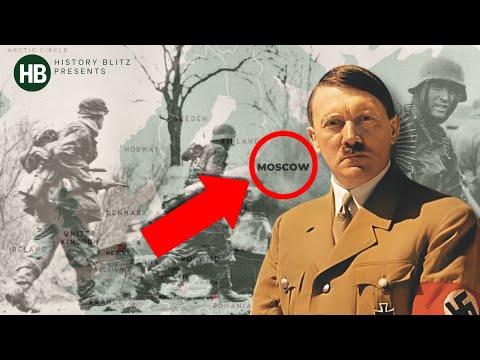
The initial onslaught was devastating. Blitzkrieg tactics, honed in Poland and France, shattered Soviet defenses. German panzers raced across the steppes, encircling entire armies. Cities fell in rapid succession—Minsk, Smolensk, Kiev. The Red Army, crippled by Stalin’s purges of its officer corps, seemed powerless to stop the German juggernaut. Within weeks, German troops were hundreds of miles inside Soviet territory, and the road to Moscow lay tantalizingly open.
But not everyone shared Hitler’s confidence. His generals, haunted by the vastness of the Russian landscape and the looming winter, urged caution. “The vastness of the territory and the harsh climate could stretch our forces too thin,” warned Field Marshal Fedor von Bock. Hitler, however, dismissed their concerns, believing the Soviet Union to be a “colossus with feet of clay” that would collapse under a single, decisive blow. His overconfidence would prove fatal.
As autumn rains turned roads into rivers of mud, the German advance slowed. Then came the winter—a merciless ally for the Soviets. Temperatures plunged to -40°C, freezing tanks, weapons, and men alike. Soldiers, still in summer uniforms, suffered frostbite and starvation. Supply lines, stretched to the breaking point, collapsed. The Blitzkrieg had stalled, and the war of attrition had begun.
Meanwhile, the Soviet Union mobilized every ounce of its strength. Factories were moved east, out of reach of German bombers, and new armies were raised. The spirit of the Soviet people, hardened by centuries of hardship, refused to break. “Not one step back!” became the rallying cry, and partisans harassed German supply lines relentlessly. The invaders, once greeted as liberators by some, now faced a population united in defiance.
By December 1941, German troops stood at the gates of Moscow, the capital within their sights. Victory seemed imminent. But Hitler’s fateful decision to divert forces to other fronts had weakened the main offensive. The Soviet capital was heavily fortified, its defenders prepared for a last stand. Then, in a stunning counteroffensive, fresh Siberian troops, equipped for winter warfare, smashed into the exhausted German lines. The myth of German invincibility shattered.
The Battle of Moscow marked the first major defeat of the Wehrmacht in World War II. It was the turning point that Hitler had feared, the moment when the tide began to turn. But the nightmare was far from over. To the south, another battle was brewing, one that would become synonymous with human suffering and the limits of endurance: Stalingrad. And in the north, Leningrad was enduring a siege of unimaginable horror. The Russian bear had not only survived the first blow—it was preparing to strike back.
The spring of 1942 brought a deceptive calm to the Eastern Front. Both sides, bloodied and exhausted, used the thaw to regroup. Hitler, stung by the failure before Moscow, was determined to regain the initiative. His gaze now shifted south, toward the oil fields of the Caucasus—a prize he believed would cripple the Soviet war machine and win the war.
The plan, codenamed Case Blue, was ambitious: a massive offensive toward the Don River and the Caucasus. But Hitler’s obsession with the oil fields led to a fateful split of his forces. Army Group South was divided into two prongs—one driving toward the Caucasus, the other toward Stalingrad. This dispersal of strength would prove disastrous.
Stalingrad, a city on the Volga bearing Stalin’s name, became a symbol of defiance for both sides. “If the Germans capture Stalingrad, they will cut the Volga and strangle our supply lines,” Stalin reportedly told his commanders. “We must hold it, no matter the cost.” And hold it they did, with a ferocity that stunned the Wehrmacht.
The battle that unfolded was unlike anything the German army had ever faced. Street by street, house by house, room by room, the fighting raged. The Germans called it Rattenkrieg—the rat war. Soldiers fought for every stairway, every cellar, every pile of rubble. The city was reduced to a moonscape of shattered concrete and twisted steel, yet the Soviets refused to yield.
Among the German troops, the initial confidence had long since evaporated. “We have fought for weeks for a single building,” wrote one soldier in his diary. “The Russians are not men. They are something else.” Supplies ran dangerously low. The Luftwaffe, stretched thin, could not deliver enough food, ammunition, or medicine. Winter was approaching once more, and with it, the ghosts of Moscow.
On the Soviet side, General Georgy Zhukov was planning something far more ambitious than mere defense. He saw an opportunity: the German Sixth Army, led by General Friedrich Paulus, was overextended, its flanks protected by weak, ill-equipped Romanian and Hungarian divisions. Zhukov’s plan, Operation Uranus, called for a massive double envelopment—a pincer movement that would encircle the entire German force.
On November 19, 1942, the Soviets struck. Soviet tanks and infantry smashed through the Romanian lines north and south of Stalingrad, meeting at the town of Kalach four days later. The Sixth Army was trapped—over 300,000 men encircled in the frozen ruins of the city. Hitler, in a fit of hubris, forbade any retreat. “The Sixth Army will hold Stalingrad!” he thundered. “I will not abandon the Volga!”
Goering promised that the Luftwaffe could supply the trapped army by air. It was a lie. The airlift failed miserably, delivering only a fraction of what was needed. Inside the pocket, soldiers starved, froze, and died by the thousands. Paulus pleaded for permission to break out, but Hitler refused. “Surrender is out of the question,” he insisted. “The Sixth Army will fight to the last man.”
By early February 1943, it was over. Paulus, promoted to Field Marshal by Hitler in a final, bitter irony—no German Field Marshal had ever surrendered—was captured. Of the 300,000 men who had entered the cauldron, only 91,000 remained alive to march into Soviet captivity. Of those, fewer than 6,000 would ever see Germany again. The defeat at Stalingrad shattered the myth of German invincibility forever.
The news from Stalingrad rippled across the globe like a thunderclap. For the first time, the world saw that the German war machine could be broken. Churchill called it a miracle; Hitler called it a betrayal. In Berlin, the Führer retreated into his bunker, his rages growing more violent, his grip on reality loosening with every passing day.
But the catastrophe on the Volga did not end the war—it merely changed its character. The Wehrmacht, once the aggressor, was now in retreat. Yet the retreat was anything but orderly. Hitler’s infamous “no retreat” order turned every lost kilometer into a bloodbath, as German soldiers were forbidden to fall back even when encirclement loomed. Entire divisions were sacrificed for the sake of a Führer’s pride.
The summer of 1943 brought the next great clash: Kursk. Hitler, desperate to reclaim the initiative, massed his finest armored formations for a massive pincer attack against a salient in the Soviet lines. It was to be the greatest tank battle in history. But the Soviets, warned by intelligence and hardened by two years of war, had dug in deep. Minefields, anti-tank guns, and eight successive defensive belts awaited the German panzers.
On July 5, 1943, the German offensive began. It was a disaster from the start. The new Panther tanks broke down in the mud; the Ferdinand tank destroyers proved vulnerable to infantry assault. Every meter of ground was bought with rivers of German blood. At Prokhorovka, hundreds of tanks clashed in a swirling melee so dense that gunners could not miss. When the dust settled, the Wehrmacht had lost its last great armored reserve. From that moment on, the initiative on the Eastern Front passed to the Red Army—permanently.
What followed was a relentless Soviet advance westward. The Red Army, now a formidable force of experience and numbers, rolled across Ukraine and Belarus. The liberation of Kiev, the crushing of Army Group Center at Minsk, and the push toward the pre-war Polish border became a drumbeat of victories. Stalin’s generals, men like Zhukov, Rokossovsky, and Vatutin, now outmatched their German counterparts in the art of operational warfare.
Behind the German lines, another war raged. Soviet partisans, numbering in the hundreds of thousands, derailed trains, ambushed convoys, and struck at the fragile supply arteries of the retreating Wehrmacht. Entire German garrisons vanished into the forests, never to be seen again. The Russian people, who had suffered so terribly under occupation, exacted a terrible vengeance.
By June 1944, exactly three years after the invasion began, the Red Army launched Operation Bagration—a blow so devastating that it dwarfed even the D-Day landings in Normandy. Army Group Center, once the pride of the Wehrmacht, was annihilated. In a matter of weeks, the Soviets advanced over 400 miles, reaching the Vistula River and the gates of Warsaw. The road to Berlin now lay open.
In his Wolf’s Lair headquarters, Hitler stared at the maps with hollow eyes. The same maps that had once shown German panzers sweeping toward Moscow now showed Soviet armies massing on the Oder, barely fifty miles from the Reich Chancellery. The gamble of June 22, 1941, had come full circle. The hunter had become the hunted, and the Russian bear was now at the door.
The final act was played out in the smoke and rubble of Berlin. Soviet soldiers raised the red flag over the Reichstag on May 2, 1945, and a week later, Germany surrendered unconditionally. The Thousand-Year Reich had lasted twelve years; the invasion meant to secure it had destroyed it.
Hitler had gambled that the Soviet Union was a rotten structure that would collapse with a single kick. Instead, he had awakened a nation that fought with a ferocity he could never comprehend. Operation Barbarossa cost the Soviet Union over twenty-seven million lives—soldiers and civilians alike—but it cost Germany everything.
The numbers remain staggering to this day. Four out of every five German soldiers killed in World War II died on the Eastern Front. The Wehrmacht, once the terror of Europe, was ground to dust in the vastness of the Russian steppe, the snows of Moscow, and the ruins of Stalingrad.
In the end, Hitler’s greatest gamble became his greatest defeat. The colossus with feet of clay did not crumble—it rose and marched all the way to Berlin. The lesson of Barbarossa is etched into history: no army, however mighty, can conquer a people determined to survive.
What do you think was the single most decisive moment that doomed Hitler’s invasion—the failure before Moscow, the catastrophe at Stalingrad, or something else entirely? Share your thoughts in the comments below.
Report this article
Select a reason for reporting:






