The desert night was absolute, broken only by the distant crackle of gunfire and the soft whisper of boots on sand. Outside the wire, 14,000 Australian soldiers waited—not to defend, but to hunt. They were surrounded by 45,000 elite Axis troops, men who had crushed armies across Europe and Africa. By every rule of war, Tobruk should have fallen in weeks. Yet, for 241 days, it held. And the Germans learned to fear the darkness.
They called them the Rats of Tobruk—a name the Australians wore like a badge of honor. But these rats had teeth. Every night, small bands of men slipped into the desert, crawling miles in silence to strike German positions with savage precision. The Afrika Korps, led by the legendary Desert Fox, Erwin Rommel, found themselves bleeding in the sand, unable to crush a garrison they had dismissed as colonial rabble.
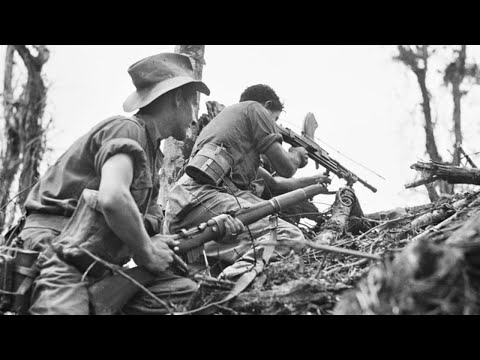
“They materialize from the sand itself,” a German lieutenant wrote in his diary, his words trembling with fear. “Demons who fight without human sounds.” The Australians moved like ghosts, their faces blackened, boots wrapped in cloth, weapons silenced. They appeared from nowhere, killed in close quarters, and vanished before the enemy could react. The psychological toll was devastating. German soldiers stopped sleeping, their nerves shattered by the constant threat of night raids.
Inside the besieged port, Lieutenant General Leslie Morshead, a former schoolteacher, broke every rule of conventional warfare. While British commanders urged caution, Morshead ordered his men to attack. “We will not sit and wait to be pounded into dust,” he told his officers. “We will make Rommel afraid of the dark.” And they did. With no tanks, only 52 field guns, and dwindling ammunition, the Australians relied on stealth, aggression, and sheer audacity.
The first major raid on Hill 209 set the tone. One hundred fifty Australians crawled 800 yards in pitch darkness, surrounded by German sentries. For 90 minutes, they moved without a sound, then rose from the sand like a nightmare. Grenades flew, bayonets flashed, and in seven minutes, 37 Germans lay dead. The Australians lost 12 men. They returned to their lines and immediately planned the next raid. “Keep raiding,” Major General John Lavarack signaled. “You have my full support for unorthodox methods.”
By June 1941, the raids had become routine—15 to 20 patrols a week. The Australians killed six Axis soldiers for every one of their own lost. German war diaries described an army coming apart. “The garrison never sleeps,” one sentry reported. “Attacks come without warning or pattern.” The Desert Fox himself was baffled. His casualty reports made no sense. A single port city, held by colonial troops, was bleeding his army white.
The raids forced Rommel to commit 15,000 additional troops to maintain the siege—soldiers who should have been advancing toward Egypt. The Australians had flipped the script. A weaker force was dominating a stronger one through superior night operations and relentless psychological pressure. The legend of the Rats of Tobruk was born, and it would echo far beyond the North African desert.
The psychological war cut deeper than any blade. German soldiers sat in their foxholes after dark, eyes wide, jumping at every shifting rock. Was that the wind, or a boot scraping through sand? Exhaustion bred mistakes, and mistakes got men killed. One Italian sentry confessed he would rather face punishment from his own officers than face the Australians in the darkness. Even the veteran Ariete Division, conquerors of Ethiopia and Greece, reported that Australian infantry was superior in night fighting to any European force they had ever met.
Then came the night of August 8th. At two in the morning, bagpipes suddenly screamed across the desert from the Australian lines. German sentries scrambled, machine guns swung toward the sound, artillery crews braced for a major assault. The pipes played for ten minutes—then stopped. Nothing came. Confused scouts crept forward and found only empty sand.
Three kilometers away, on the opposite side of the German lines, thirty Australians had already slipped up to a fuel depot while every Axis soldier stared at the bagpipes. They planted charges on drums holding 50,000 liters of gasoline. The depot erupted at 2:20 a.m., flames shooting two hundred feet into the air, burning for six hours. Rommel lost enough fuel to run his tank divisions for three days.
The captured diaries told the rest. A German lieutenant wrote of Australians who fight like demons in darkness, appearing as if materializing from the sand itself. Three separate entries in his journal mentioned suicide. Two officers in his unit had shot themselves rather than face another month of night raids.
And the reputation did not stay in North Africa. When Australian divisions redeployed to the Pacific in 1942 and 1943, Japanese intelligence issued warnings to their troops, describing these men as white devils who had defeated Rommel. Japanese officers told their soldiers that Australians did not fight like other Western armies—they fought with aggression and a willingness to die, but they were bigger, better equipped, and they never stopped coming.
By October 1941, when relief forces finally reached Tobruk, the Australians had conducted over six hundred documented raids. They had captured 240 prisoners in night operations alone and destroyed equipment worth roughly two million Reichsmarks—though the true cost to German operations ran far higher. Rommel’s advance into Egypt had been delayed by six months. Six months that gave the British time to dig in at El Alamein.
Inside the crumbling walls, Lieutenant General Leslie Morshead walked the lines one last time before the rotation. The schoolteacher from Melbourne looked at men with dust in their hair and sand in their teeth, men who had learned to hunt in the dark and had taught the world’s most feared army to fear it too. He said little. There was little left to say.
But the lessons of Tobruk were already spreading. The British Special Air Service, formed in North Africa that same July, sent its founder, David Stirling, to watch the Australian patrols prepare. He studied how they moved, how they planned, how they struck and vanished. Those observations shaped SAS doctrine for decades—small teams, surprise over firepower, calculated risks that conventional officers called reckless.
By 1943, American Ranger training had absorbed the Tobruk methods. Manuals on silent movement, night navigation, and aggressive raiding read like copies of Australian field reports. The tactics proved themselves again at Milne Bay in New Guinea, where Australian troops used the night-fighting techniques born in the desert to hand Japanese land forces their first defeat of the war.
Yet for all the honors that followed, the men who lived it carried something the medals could never capture. They had learned a truth about war that no academy taught—that a surrounded force with its back to the sea could reach out and strangle the army that held the rope. The siege had reversed the meaning of being trapped. Rommel’s 45,000 men were the ones who could not sleep, could not rest, could not advance or retreat without bleeding.
Leslie Morshead received his knighthood quietly, as was his way. King George VI made him a Knight Commander of the Order of the Bath in 1942, and he went on to command Australian forces in the brutal New Guinea campaign, where mud and malaria killed more men than bullets ever did. When the war ended, he retired as one of the most successful defensive commanders in modern military history—and one of the least famous.
The history books favored the flashier names. Patton racing across France. Montgomery at El Alamein. MacArthur island-hopping across the Pacific. These men had better publicity and larger egos. Morshead was a quiet schoolteacher who happened to understand how ordinary soldiers could do extraordinary things when properly led. That kind of leadership does not make dramatic headlines.
But the soldiers never forgot. After the war, they formed the Rats of Tobruk Association, and the reunions were unlike any other veterans’ gathering. Old men who had crawled through sand together as young soldiers met every year to remember friends who never came home. They retold the same stories their families had heard a hundred times—the raid on Hill 209, the bagpipes that fooled an entire German line, the morning they woke to find Rommel pulling back because he could no longer afford the losses.
The Australian War Memorial in Canberra now holds a section of wall from Tobruk’s defenses. The stone is pockmarked with thousands of shell holes from eight months of Axis artillery. It stands behind protective glass, carefully preserved, with a small plaque beneath it bearing a single line: They did not wait to be defeated. They made defeat impossible.
Visitors stand before that wall and try to imagine it. The heat of North African days and the cold of desert nights. The whistle of incoming shells. The fear before a raid, and the savage joy of striking the enemy in their own territory and slipping away clean. The absolute certainty that surrender was never an option, because these men would rather die fighting than live on their knees.
Stone cannot talk. But eight decades later, it still bears witness. The tactics born in that desperate siege—initiative over caution, aggression over defense, darkness as a weapon—became fundamental to modern infantry warfare. The British SAS, the American Rangers, and the Australian Army itself all traced doctrine back to those frantic nights outside Tobruk’s wire.
And yet the deepest lesson was never written into any manual. Sometimes the only way to survive impossible odds is to stop playing defense and start hunting the hunters. That lesson cost over six thousand Axis soldiers their lives to learn—and it changed warfare forever.
In the decades that followed, Australian soldiers in Korea, Vietnam, Iraq, and Afghanistan carried the same expectation into every fight: that they would punch above their weight, that they would never wait passively for the enemy to dictate terms, that being outnumbered simply meant being smarter and meaner. These attitudes traced directly back to eight months in 1941, when fourteen thousand men decided that the rules of siege warfare were written by men who had never been surrounded.
The last of the Rats have mostly gone now. But on quiet evenings, when the desert wind picks up and the light fades to that particular shade of orange, the story still circulates—passed from grandfather to grandson, from barracks to barracks. A story about a schoolteacher and his fourteen thousand hunters, who looked at an impossible situation and refused to accept the arithmetic.
The men who came home rarely spoke of it to strangers. But ask any Rat about the night raids, and you’d see it in their eyes—that flicker of something feral, something that never quite left the sand. “We didn’t fight like soldiers,” one veteran said decades later. “We fought like men who’d already died and decided to take company with us.”
That was the secret Morshead’s schoolteacher mind had unlocked. Not tactics alone, but the psychology of men who had stopped calculating survival and started calculating damage. When you no longer fear death, you become something the enemy cannot model, cannot predict, cannot break.
Rommel never did take Tobruk. He would go on to greater battles, greater fame, and eventually his own tragic end. But in his private papers, he reportedly called the siege his greatest frustration—a fortress that should have fallen in weeks but instead devoured his men, his fuel, and his timetable. The Desert Fox had met something the desert had not yet taught him: that a cornered rat will turn and bite.
The wall in Canberra still stands. The plaque still reads its quiet defiance. And the lesson endures: when the world says you are surrounded, sometimes the only answer is to make the darkness your ally and the hunters your prey.
So tell me—if you were trapped behind that wire, outnumbered three to one, with nothing but sand and nerve, would you wait for rescue? Or would you slip out into the night and make your enemy learn to fear the dark?
Report this article
Select a reason for reporting:






