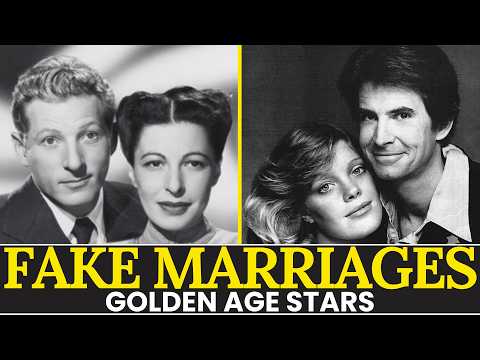
They called them lavender marriages. While fans swooned over Hollywood’s golden couples, the truth was far darker. Studios literally forced their biggest stars into fake weddings, threatening to destroy careers if they refused. One star chose love over fame and walked away from millions. Another’s wedding night ended with a locked hotel room door.
Today, we’re exposing the real stories behind Hollywood’s most shameful secret.
Rudolph Valentino was the ultimate Latin lover, but his first marriage was Hollywood’s most brutal awakening to lavender arrangements. Gene Aker was already more famous than him when studio executives decided both their reputations needed protection. The night of their wedding, Aker reportedly slammed the door in his face, and they never consummated their marriage. Valentino failed to understand his wife’s true orientation and continued writing her love letters for months.
Studio heads panicked when Valentino started taking less traditionally masculine roles like in Monsieur Beaucaire in 1924. They pushed him into a second lavender marriage with costume designer Natasha Rambova in 1923, who was already in a lesbian relationship with actress Alla Nazimova. By the time his marriage to Rambova ended in 1925, people were calling Valentino “the pink powderpuff” due to his roles. The poor guy was trying to be himself in an industry that demanded he become someone else entirely.
Rock Hudson was the type of Hollywood star who always had women flocking around him. But Hollywood insiders knew the truth despite his three-year marriage to Phyllis Gates in the 1950s. His problems began in 1955 when reporters from Confidential magazine threatened to publish a piece exposing his hidden relationships with other men. To salvage his career, Hudson’s agent quickly organized a marriage between the actor and his pretty secretary.
What made Hudson’s situation even more tragic was the era’s moral clauses that prevented actors from being involved in any scandals that would alienate the public. Despite Gates’s regular insistence that the marriage was real, many people had contrary beliefs. It was Gates who confronted Hudson about his orientation, and the conversation was tape recorded by a private investigator named Fred Otash, whom Gates hired to follow Hudson. After the wedding ceremony, Taylor refused to kiss his new bride and went home to spend the night at his mother’s place.
Hudson maintained the charade for three years, but they separated after rumors of his true orientation and relationships began circulating. The marriage collapsed, but it had served its purpose for the studio system. Hudson continued hiding until AIDS forced the truth into the open in 1985, making him one of the first major celebrities to die from the disease.
Barbara Stanwyck was reportedly Hollywood’s biggest closeted lesbian according to biographer Axel Madsen. While Robert Taylor also faced persistent rumors about his orientation, MGM encouraged them to marry after a January 1939 Photoplay magazine article about Hollywood’s unmarried couples named Taylor and Stanwyck alongside other famous pairs. The Taylor-Stanwyck union was essentially an arranged marriage with studio arrangements for their May 1939 wedding, and the only say Taylor had in it all was, “I do.”
At the conclusion of the wedding ceremony, Taylor refused to kiss Stanwyck and went home to his mother’s house for the night. Robert Taylor told Shelley Winters over dinner that Barbara was a lesbian and that they had separate beds. Even though they were officially married for 18 years, biographer Axel Madsen revealed that their marriage only truly lasted a few months.
Robert Taylor continued to see other women during his marriage, including affairs with Ava Gardner and Eleanor Parker. In 1950, Taylor spent most of the year in Rome making Quo Vadis and had a very public relationship with Italian starlet Lia De Leo. When Stanwyck flew to Rome to confront him and ask for a divorce, to her horror, he accepted. Their arranged partnership had run its course, and neither could pretend anymore. The divorce was finalized in February 1951, ending one of Hollywood’s most carefully orchestrated fake marriages.
Danny Kaye was not the rugged, powerful leading man type. Despite his popularity as a performer, he was frequently placed in roles that portrayed him as weak, cowardly, and effeminate. During his vaudeville days, Kaye was romantically linked with several men. Both Fine and Kaye met while working on a short-lived Broadway show, The Straw Hat Revue, where Fine wrote the lyrics and music.
They were married on January 3rd, 1940, in Fort Lauderdale, Florida, and their partnership lasted until Danny’s death in 1987. The couple had one daughter, Dena, born December 17th, 1946, but they also had a temporary separation that occurred around September 1947. Danny realized their marriage had lost its deepest meaning, and Sylvia admitted she used to control Danny, even changing octaves while playing piano to influence his singing.
Many people believed that this marriage was nothing more than a farce. But unlike other lavender marriages, this one somehow endured for nearly five decades. They reunited seven months after their separation and remained married until his death. Whether it was genuine affection, mutual benefit, or simply habit, the Kayes managed to make their arrangement work longer than most real Hollywood marriages. The entertainment industry had forced them together, but they found a way to make it function on their own terms.
Janet Gaynor married Hollywood costume designer Adrian on August 14th, 1939 in what has been called a lavender marriage since Adrian was openly gay within the film community while Gaynor was rumored to be gay or bisexual. Before her marriage to Adrian, Janet was linked to co-star Margaret Lindsay and people whispered that Gaynor’s marriage to Adrian was a smokescreen to hide her relationship with Lindsay. Actress Louella Rener remembered Adrian saying, “You know, I’ve fallen in love.” I said, “Well, that’s wonderful.” “Who?” he said, “I fell in love with a woman.” He was flabbergasted himself.
Both Adrian and Gaynor went on record to say they were happily married, and they remained so until his death in 1959. Gaynor and Adrian had one son, Robin, born July 6th, 1940. The couple traveled frequently with Gaynor’s close friend, Mary Martin, and her husband, Richard Halliday. Actor Bob Cummings allegedly once quipped, “Janet Gaynor’s husband was Adrian, but her wife was Mary Martin.” They even briefly lived with their respective husbands in Brazil in the 1950s and 1960s at a ranch. The foursome created the perfect arrangement where everyone’s secrets were protected.
When Adrian suffered a fatal heart attack in 1959 while working on Broadway’s Camelot, Gaynor was left alone, but not forgotten. She eventually married producer Paul Gregory in 1964, continuing the pattern of convenient partnerships that defined her adult life.
Cary Grant met and moved in with dashingly handsome fellow actor Randolph Scott in 1932, and the two would live together off and on for 11 years. Following a 1933 magazine article profiling the cohabitants which used nudge-nudge-wink-wink language to hint that their relationship went beyond mere housemates, Grant married actress Virginia Cherrill. Cherrill left him after seven months citing abuse, Grant’s constant drinking, and lack of romantic interest as cause whereupon Cary resumed rooming with Randy.
The domestic arrangement finally ended when Grant entered the second of his five marriages to the world’s wealthiest woman, Barbara Hutton, in 1942. Fashion critic Mr. Blackwell, who lived with Grant and Scott for a time, wrote in his autobiography that they were “deeply, madly in love, their devotion complete. Behind closed doors, they were warm, kind, loving, and caring, and unembarrassed about showing it.” Studio press tried to spin their living situation as two confirmed bachelors simply enjoying each other’s company, but private photos told a different story.
The re-evaluation of Cary Grant’s lavender marriages occurred through Scotty Bowers’s memoir, Full Service: My Adventures in Hollywood and the Secret Sex Lives of the Stars, which contained explicit details about several Hollywood relationships. Grant’s multiple marriages throughout his life were likely attempts to throw the press off the scent of his true relationship with Scott, but their decade-long domestic partnership remains one of old Hollywood’s most enduring love stories, even if it had to be hidden behind a facade of friendship.
Anthony Perkins was a married father of two, but rumors circulated that Perkins had many affairs with men throughout his marriage, most prevalently with fellow actor Tab Hunter. Perkins spent years trying to cure himself through therapy before marrying photographer Berry Berenson in 1973 at age 41. The marriage produced two sons and seemed to provide him the conventional life he desperately wanted.
Hollywood pimp Scotty Bowers claimed Perkins always wanted someone different and would ask, “Who do you have for me for tomorrow night that will surprise me?” Despite his marriage, those close to Perkins knew the union didn’t erase his past relationships with men. His marriage to Berenson appeared genuine on the surface, but it represented his final attempt to conform to societal expectations rather than embrace his true nature.
Tragically, Perkins died from AIDS-related pneumonia in 1992, just before he was ready to go public with his story. His widow, Berry, later revealed he had hidden his diagnosis for two years, even from close friends, saying he wanted to protect his family. In a heartbreaking twist, Berry herself died in the 9/11 attacks just nine years later, leaving their children orphaned. Perkins’s story shows how the pressure to conform destroyed not just individuals, but entire families caught in the web of Hollywood’s homophobia.
Tab Hunter was discovered at 17 years old and became a poster boy for the wholesome all-American young man during the 1950s and 60s. Often cast as the dashing soldier and object of female desire, Warner Brothers’ publicity department churned out made-up stories about his relationships with female co-stars and friends, including Natalie Wood and Debbie Reynolds. Hunter wrote that he was living two lives and that it was difficult for him.
Hunter dated fellow star Anthony Perkins and later went on to have a more than 35-year partnership with his husband, film producer Allan Glaser, that lasted until Hunter’s death in 2018. His immense popularity with young female fans is precisely why he kept his orientation a secret for most of his life. Unlike many of his contemporaries who were forced into lavender marriages, Hunter managed to avoid the altar while maintaining his career.
He is one of the few old Hollywood stars who were able to marry their longtime partners once marriage equality was legal in California. Hunter was able to talk about his orientation openly later in his life, which many other huge stars were not able to do. His 2005 memoir, Tab Hunter Confidential, finally told his truth, and he was celebrated rather than shunned. Hunter’s story proves that some stars found ways to resist the studio system’s worst demands, even if it meant living in shadows for decades.
Cole Porter was rather openly gay, according to the Encyclopedia Britannica, but at 28, he married wealthy divorcee Linda Lee Thomas, who was 8 to 14 years his senior. They met at a January 1918 wedding reception at the Paris Ritz Hotel, where Linda had just escaped a miserable marriage to newspaper heir Edward R. Thomas. As part of their divorce, Thomas had paid her $1 million to keep quiet about his cruelty and infidelities.
Although Cole and Linda shared deep emotional ties and friendship throughout their marriage, Cole preferred both long-term intimate relationships and physical encounters with men. Porter had passionate affairs with men throughout their 34-year marriage, including composer Lawrence Hart and fellow actors. Linda was well aware of his orientation and provided him the perfect cover while he composed some of America’s greatest songs.
The couple married on December 18th, 1919, and lived together until Linda’s death in 1954. Their marriage was described as a genuine love story between a woman married to a gay man, even though they had no conventional name for their relationship. Linda once said, “Just because a love between two people may be difficult to define, that doesn’t mean it didn’t exist.” They lived a lavish lifestyle, moving between Paris, New York, and Los Angeles as his fame and success grew.
They were best friends and deeply devoted to each other, even though Cole carried on multiple romantic affairs. Porter later told friends he preferred spending time with his own kind, meaning other gay men. Linda died from emphysema in 1954 after years of what she called smothering spells, and Cole passed away a decade later in 1964, having lost his most devoted companion and protector.
William Haines was Hollywood’s number one box office star in 1930, but he was also openly living with his male partner Jimmy Shields. In 1933, Haines was arrested in a YMCA with a sailor he had picked up in Los Angeles’s Pershing Square. Studio head Louis B. Mayer delivered the ultimate ultimatum: choose between a sham lavender marriage or his relationship with Shields. Haines looked Mayer straight in the eye and stated, “But I am already married,” referring to his seven-year relationship with Jimmy.
What made Haines revolutionary was his authenticity. He refused to give up the man he loved, telling Mayer, “I’ll give up Jimmy when you give up your wife.” Mayer fired him on the spot, ending his film career forever. By this time, Haines and Shields were inseparable, married in everything but name.
Haines chose Shields, and they remained together for nearly 50 years until Haines’s death in 1973. Drawing on the huge affection their Hollywood friends felt for them, they opened William Haines Designs, an interior decorating company that became wildly successful. Joan Crawford, one of their oldest friends, hired them to completely transform her home and called their relationship “the happiest marriage in Hollywood.”
Their love story had a tragic end after nearly five decades together. When Haines died of lung cancer in 1973, Shields was inconsolable. Three months later, Shields took his own life, leaving behind a note: “I now find it impossible to go it alone. I am much too lonely.” They rest together in Woodlawn Memorial Cemetery in Santa Monica, proving that some love stories were worth more than all the fame in the world.
These lavender marriages weren’t love stories. They were survival tactics in an industry that chose profits over people. Some couples found genuine friendship within their arrangements. Others endured decades of misery. The real tragedy isn’t just the individuals forced to deny themselves, but an entire entertainment system built on lies and threats.
Which story shocked you most? Did any of these couples actually find happiness together, or were they all prisoners of the studio system? Drop your thoughts below. Because here’s the real question: if Hollywood was this controlling over love and marriage, what other secrets are still buried in those studio vaults?
Report this article
Select a reason for reporting:






