The sky over Brocklesby, New South Wales, was a canvas of calm on September 29, 1940—until it wasn’t. Two Avro Anson aircraft, flying in tight formation at 3,000 feet, were on a routine cross-country training flight. Inside, four young airmen focused on their navigation exercises, unaware that in a heartbeat, their lives would collide in a deafening crunch of metal and propeller.
Suddenly, a terrific grinding noise tore through the air as the upper Anson’s propellers bit into the engine cowlings of the lower aircraft. “The jolt was so great I would have been tossed right out of my seat and away from the controls if I hadn’t had my safety belt on,” pilot Leonard Fuller later recalled. In that instant, two planes became one—a grotesque, locked-together machine spiraling toward the ground.
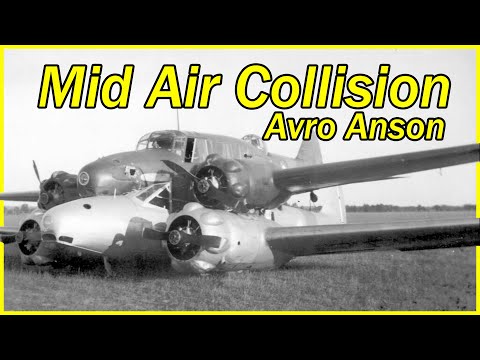
Fuller, 22, looked out his side window and was horrified to see the crushed cockpit of the other Anson, piloted by 19-year-old Jack Houston. Houston’s back was badly injured when the propeller sliced through his fuselage, but he thrust his still-turning engines to full power and locked his controls. “Bail out!” he ordered his navigator, Hugh Fraser, who promptly jumped. Fuller, seeing Houston crawl out and deploy his parachute, then ordered his own navigator, Ian Sinclair, to bail out. Sinclair followed, leaving Fuller alone in the crippled upper aircraft.
Fuller now faced a gut-wrenching dilemma: should he follow his crew and parachute to safety? The two locked Ansons were not tumbling out of the sky but flying almost steady, thanks to Houston’s engines and Fuller’s control surfaces. Yet Fuller knew bailing out could send the wreckage crashing into the town of Brocklesby, risking innocent lives. “I realized that bailing out would carry a serious risk of causing casualties on the ground,” he later said. Drawing on his training, he looked for a suitable landing spot—a farmhouse with a large paddock caught his eye.
Despite the heavy controls and the lower Anson’s engines beginning to fail, Fuller carried out a couple of circuits to lose height and determine his approach. He then made a textbook emergency landing, putting the stacked Ansons onto its belly and sliding along the field for about 180 meters before coming to a rest. He had flown the two aircraft for approximately eight kilometers from the collision point. His commanding officer later called the improvised runway “perfect” and the landing “a most wonderful effort.”
But the story doesn’t end there. The aftermath would reveal the fates of all four airmen, the international attention that thrust Brocklesby into the limelight, and the remarkable legacy of Leonard Fuller’s courage—a legacy that would be honored decades later by the very town he saved.
News of the accident spread quickly, and within days the small town of Brocklesby found itself thrust into international headlines. Fuller’s bravery, quick thinking, and flying skill had averted a very possible disaster—damage to the town, or worse, killing or seriously injuring people on the ground. He was also credited with saving both Avro Ansons.
His aircraft, N4876, was repaired and returned to flying service. Houston’s aircraft, L9162, was also repaired but never regained airworthiness; instead, it became an instructional airframe. Houston himself spent time in hospital due to his back injury but returned to graduate from No. 2 SFTS later in 1941. He went on to gain a commission and, following the war, was discharged as a flight lieutenant in 1946.
LAC Sinclair also graduated and survived the war, gaining a commission and reaching the rank of flight lieutenant. LAC Fraser would make the journey to Great Britain in the RAF and was posted to 206 Squadron as a commissioned officer, flying as a pilot officer based out of Aldergrove in Northern Ireland. Tragically, he was killed along with his crew when his Lockheed Hudson collided with a tree and crashed on January 1, 1942.
Fuller was promoted to sergeant soon after his successful forced landing and graduated from No. 2 SFTS in October 1940. He received a commendation from the Australian Air Board citing his presence of mind, courage, determination, and landing the locked Ansons without serious damage to the aircraft under difficult conditions.
Sergeant Fuller went on to serve on the front line for the Royal Australian Air Force before being posted to the RAF, flying Wellington bombers for No. 37 Squadron. Following a bombing raid over the Italian port of Palermo on March 2, 1942, he was decorated with the Distinguished Flying Medal and was commissioned into the officer ranks in September 1942.
He returned to Australia and was posted to Sale, Victoria, following being assigned to instructor duties for No. 1 Operational Training Unit in 1943. However, in 1944, whilst riding his bicycle in Sale, he was hit by a bus and was killed.
The story of Leonard Fuller’s actions has not been forgotten—and not just within the archives of the Royal Australian Air Force. The town and the people of Brocklesby, New South Wales, remember his heroic actions of that day in sparing their town a potential disaster.
In 1990, on the 50th anniversary of the collision, the townspeople gathered at the site of the crash landing and erected a simple marker in the paddock where the stacked Ansons had come to rest. It was a quiet, heartfelt tribute to a young pilot who had chosen duty over his own safety.
Seventeen years later, on January 26, 2007—Australia Day—a more permanent memorial was unveiled: a polished Avro Anson engine, mounted on a stone plinth, standing as a silent testament to Fuller’s skill and courage. Locals and aviation historians attended the ceremony, and the story was retold once more for a new generation.
Yet beyond the memorials, the deeper legacy of that day lives on in the lessons it taught. Aviation investigators would later study the incident closely, and the collision highlighted the dangers of close-formation flying in training environments. The fact that two aircraft could remain locked together and still be landed safely was considered almost miraculous—a testament to Houston’s instinct to lock his controls and Fuller’s steady hand on the yoke.
Fuller’s own words, recorded years later, reveal a man of remarkable humility. “I just did what I had been trained to do,” he said in an interview. “There was no time to be frightened. You either acted or you didn’t.” That quiet resolve would define the rest of his short life, from the bombing raids over Palermo to the training fields of Victoria.
His death in 1944, struck by a bus while riding his bicycle in Sale, came as a cruel twist of fate—a man who had survived mid-air collisions and enemy fire, taken by a mundane accident on a quiet street. He was just 26 years old.
Today, the Avro Anson engine memorial stands as a quiet sentinel on the edge of Brocklesby, its polished metal catching the sunlight. Passing motorists sometimes stop, drawn by the unusual sight, and read the plaque that tells of two planes locked together and a pilot who refused to bail out.
For the people of Brocklesby, the story is more than history—it’s a part of their identity. “He saved our town,” a local farmer once said, gesturing toward the paddock where the Ansons came to rest. “We don’t forget that.”
Fuller’s legacy also lives on in the archives of the RAAF and in the memories of aviation enthusiasts who study the incident. His Distinguished Flying Medal and commendation are reminders of a man who twice defied death—once in the air, and once on a bicycle in Sale.
But perhaps the most enduring tribute is the simplest: a small town that still gathers on Australia Day, not just to celebrate the nation, but to remember a young pilot who, on a September morning in 1940, chose to risk everything to save strangers.
As the sun sets over the paddock, the Avro Anson engine casts a long shadow—a shadow that stretches back to a time when courage was measured in seconds and the difference between disaster and deliverance was a steady hand on the yoke.
What would you have done if you were in Leonard Fuller’s shoes that day—would you have bailed out, or would you have stayed at the controls?
Report this article
Select a reason for reporting:






