The fog over Rechicourt, France, on the morning of September 19, 1944, was so thick that a man could not see a tank at fifty yards. Out of that suffocating gray came the Panzers of the 113th Panzer Brigade, hunting an American armored column they believed was blind and asleep. They were half right.
On a low rise called Hill 246, four American tank destroyers waited in silence. In the next few minutes, those four vehicles would destroy fifteen German tanks and lose only three of their own. The Germans never understood what had killed them. It was not thicker armor or a bigger gun. It was a voice on a radio—and a system behind that voice that could drop an entire battalion of artillery onto a single field in the time it takes to read this sentence.
To understand why those four tank destroyers won, you have to understand how badly the Americans should have lost. By the autumn of 1944, the fighting in Lorraine had settled into a brutal arithmetic of steel. The German Panther carried a long-barreled 75-mm gun with a savage muzzle velocity, a weapon that could punch clean through the front of an American Sherman at ranges beyond a mile. The Sherman’s own gun could not return the favor.
After the war, American ordnance officers lined up captured Panthers at a place called Isigny and fired at them under ideal conditions just to be certain. The verdict was blunt. The Sherman’s standard gun could not penetrate the front of a Panther at any range at all.
The men inside the Shermans had learned this long before the testers confirmed it. They had learned it in Normandy that summer, in the hedgerow country where a single well-placed Panther or an 88 dug into a bank of earth could stop an entire company cold. Every field in that country was a walled box, and any one of them could be a trap.
The Germans built their whole way of fighting in the west around that fact. On September 15 near the fog-shrouded town of Luneville, a German 88 opened up on the lead armored car of C Troop, 42nd Cavalry. The M8 went up in a single flat crack and a rising column of smoke. The men who survived never saw the gun that killed their vehicle.
That was the pattern. Find a firing position, let the Americans come, kill the first vehicle before anyone even knew a battle had started.
Think about what that meant from inside an American tank. Every tree line you approached might hold a gun that would kill you before you heard the report. Every crossroads could be sighted in advance. The German commander did not need more tanks than you. He needed one tank in the right place that fired first.
In that kind of fighting, the machine with the thicker armor and the longer gun does not simply hold an advantage. It writes the rules of the engagement, and it decides where and when the killing starts.
So here was the problem facing every American tank commander in Lorraine. You are driving a tank that cannot kill the enemy’s tank from the front. The enemy knows the ground, holds the cover, and shoots first. By every measure a tank designer cares about, you are going to lose.
And yet, again and again, it was the Germans who ended these battles as burning wreckage in the fields. The reason was not on any specification sheet. It was bolted into the turret of every single Sherman, and it did not fire a shell.
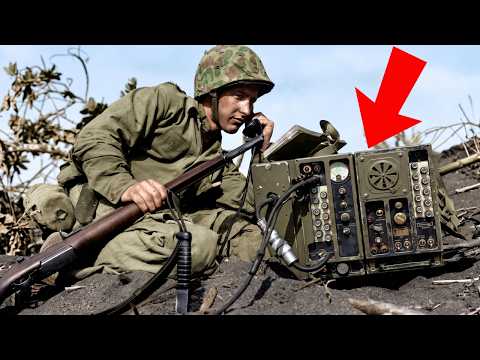
What every Sherman carried—and what almost no one outside the tank crews ever thought about—was a radio. Not a crude receiver, but a full two-way set, the SCR-508 family, built by American industry and installed as standard equipment in tank after tank rolling off the production lines.
It ran on frequency modulation, the same principle that gives FM radio its clean sound today, and it was chosen for exactly that reason. The roar of a tank engine and the crackle of its ignition drowned older radios in static. The American set cut straight through the noise.
A commander could press a switch and speak, and every other tank in his platoon, his company, his battalion could hear him clearly over the din of battle. The set held a handful of channels chosen in advance, so a commander could switch from his platoon’s net to his company’s with the turn of a dial, and it could reach other tanks miles away.
There was one real limit, and honesty demands naming it. The tank radios and the infantry and artillery radios did not all speak on the same band, so a call for artillery usually ran through a liaison officer or a forward observer rather than straight down one universal channel. But within the armored force itself, the net was total.
Read that again, because it is the whole story. Every tank could talk. Every tank could listen.
When one Sherman spotted a muzzle flash in a tree line, the man in the turret did not have to wave a flag or fire a flare or wait for a runner on foot. He keyed his microphone and told everyone all at once, in the same second, where the gun was, what it was, and where to move.
The American armored formation was not five tanks or fifteen tanks. It was a single organism that could see through many eyes and strike as one body.
But the radio in the tank was only the nerve ending. The real weapon was what those nerves connected to, and to see it working, you have to leave Lorraine for a moment and go back to a hilltop in Normandy in August.
When the Germans launched a great counterattack toward the town of Mortain, trying to cut the American breakout in two, a battalion of the 30th Infantry Division—the Old Hickory men—was cut off on a piece of high ground marked on the maps as Hill 314.
Surrounded, running low on everything, they held one asset the Germans could not see. Two artillery observers, Lieutenant Robert Weiss and Lieutenant Charles Barts of the 230th Field Artillery, lay on that hill with a radio and a clear view of every road the Germans had to use.
What happened next was not a battle in the way the movies show battles. It was mathematics delivered by high explosive. The lieutenant looked down at a German column forming up, spoke a string of map coordinates into his radio, and somewhere behind the lines a room full of men at plotting tables turned his words into firing data for gun after gun after gun.
Over six days on that hill, the observers called in 193 separate fire missions, at times as often as one every fifteen minutes, working from a single radio whose batteries were slowly dying. At the peak, roughly a dozen field artillery battalions were dropping their shells wherever those two men pointed.
German attacks came apart before they could start. Columns that should have crushed the American breakout were caught out in the open and torn apart on the roads, shattered by guns whose crews they never saw and could never reach. Weiss was awarded the Silver Star, and the reason he lived to receive it is that he could talk to the guns and the guns would listen.
That room full of men at plotting tables had a name. The Fire Direction Center. And it, far more than any tank or any gun, was the true American secret weapon of the ground war.
Now, there is a story that gets told about all of this, and it is worth stopping to correct, because the truth is better than the myth. The story goes that the Americans had radios and the Germans did not. That the Panzers rolled into battle half blind, signaling with flags while the Shermans chattered away on the air.
It is a satisfying story. It is also wrong.
The Germans did not lack radios. They had invented the idea of putting radios in tanks years before the war, while other armies were still arguing about whether it was worth the trouble. Every German tank at Arracourt carried a proper transmitter and receiver, and their command tanks carried more powerful sets on top of that.
The image of the flag-waving Panzer belongs to an earlier war, against the French in 1940 and the early Soviet tanks the following year. Machines that genuinely did fight half mute. It does not belong to the Germans who faced the Americans in Lorraine.
So if both sides had radios, where did the American advantage actually come from? It came from two things the Germans could not match.
The first was sheer density. American industry could afford to put a good two-way radio in every tank, down to the lowest vehicle in the platoon, so that everyone could both speak and be heard.
The second, and the decisive one, was what the radio was wired into. A German tank commander who spotted an enemy could tell the other tanks in his company. An American tank commander who spotted an enemy could, through the right channels, reach the artillery—and the artillery could answer with the massed fire of dozens of guns landing together.
The Germans had a conversation between tanks. The Americans had a conversation between tanks and the entire weight of an army’s firepower.
That was the gap. Not the presence of a radio, but everything standing behind it. Which brings us back to the fog near Arracourt.
The German force sent to smash the American bridgehead was the Fifth Panzer Army under General Hasso von Manteuffel, one of the more capable armored commanders Germany ever produced. But Manteuffel had been handed a broken instrument.
His tanks came from two freshly raised units, the 111th and the 113th Panzer Brigades, thrown together in a hurry and rushed to the front. Their crews had trained for roughly two weeks. Many could barely read a map. They had almost no reconnaissance to scout ahead of them, little artillery of their own, and barely enough fuel to maneuver.
They were driving some of the finest tanks in the world, and they had almost no idea how to fight them as a team.
Facing them was Combat Command A of the 4th Armored Division under Colonel Bruce Clark, holding a thin and dangerous salient. Clark had fewer tanks and worse tanks than the force coming at him. What he had instead was everything the Germans lacked: trained crews, reconnaissance out front, a radio in every vehicle, and behind him, the guns.
The fog that morning was so thick it should have favored the attacker, and at first it did. Groups of Panthers loomed up out of the murk and pushed straight into the American outposts. But the fog cut both ways. It brought the Panzers in close, into the exact knife-fight range where the Sherman’s weaknesses stopped mattering, and the German advantages in gun range and armor became almost meaningless.
At two hundred yards in the mist, a Sherman’s gun could kill a Panther through the side just fine.
On Hill 246, Captain William Dwight had placed a platoon of four M18 tank destroyers led by Lieutenant Edwin Liper. The M18 was a strange machine, thin-skinned enough that its crews worried about rifle fire, but faster than anything else on tracks anywhere on the battlefield, and it mounted a 76-mm gun. It was built for precisely this—not to slug it out, but to dart, flank, and strike.
Liper’s crew sat silent in the fog and listened, and when the Panthers rolled across their front at close range, they fired into the flanks. In roughly five minutes, the platoon destroyed five German tanks. Then, as the survivors swung to face this new threat, the tank destroyers killed ten more.
Fifteen Panzers wrecked in minutes at the cost of three vehicles. It was the opening act, and it set the pattern for everything that followed.
There was a cold logic to why this kept working. The Panther’s great slab of frontal armor protected only its front. Its sides were far thinner, open to exactly the guns the Americans were bringing to bear. A Panther that turned to face one threat automatically showed its flank to another.
In the fog, blind and half-trained, the Germans could not guard their own sides. The Americans, talking to each other without pause, always seemed to know where the next shot would come from.
While that platoon fought on the hill, the Shermans of the 37th Tank Battalion went hunting under a short, cigar-chewing officer named Creighton Abrams. He fought from the turret of his own Sherman, a tank he called Thunderbolt, and his tanks talked constantly—calling out Panzer positions, coordinating who would pin the enemy while others swung wide.
A German crew would be firing at one Sherman to their front, never hearing the two more that the net had just vectored around to their flank.
Back at Clark’s command post, the fighting got so close that a battalion of self-propelled howitzers lowered their guns and fired directly at the Panthers through open sights. Tank destroyers on the hill. Shermans in the fog. Howitzers at the command post. Every piece of the American force was killing Panzers, and every piece was talking to every other piece.
Over the days that followed, the two proud panzer brigades were ground down until neither could function as a unit. When the accounting was done, the outgunned Americans had lost around 55 tanks and tank destroyers. The Germans had lost more than 200 Panzers and assault guns.
The side with the better tanks had been destroyed by the side with the better conversation.
Go back one last time to that low rise in the fog. Four thin-skinned tank destroyers against the Panzers of a great armored army. On paper they should have died there. Instead they broke an attack because they were never really four vehicles at all. They were four vehicles and every gun for miles behind them, and one clear voice tying the whole thing together.
The Germans brought the better tanks to Lorraine. The Americans brought the better war.
So here is the question worth arguing over: if you had to choose between the better tank and the better radio, which one would you trust with your life?
Report this article
Select a reason for reporting:






