In the late summer of 1897, a Navajo excavation crew working the ruins of Pueblo Bonito in Chaco Canyon lifted a stone floor and found a step beneath the sand. The step was not natural—its edges were straight, cut by hands, not by water or wind. 63 steps ran down through the rock into the dark. At the bottom, a round chamber opened, and at its exact center stood a fluted machine, four men tall, its point aimed straight up.
The oldest man on the crew stopped at the top of the stairway and would not go down. He said one sentence to the interpreter: “The Navajo know this. It was left behind.” The walls of the chamber had been cut from living rock, as wide as the inside of a church. The machine was not stone—it was copper. Every scrap of copper ever found in the thousand-year-old ruins of Chaco could have fit in the palm of one hand.
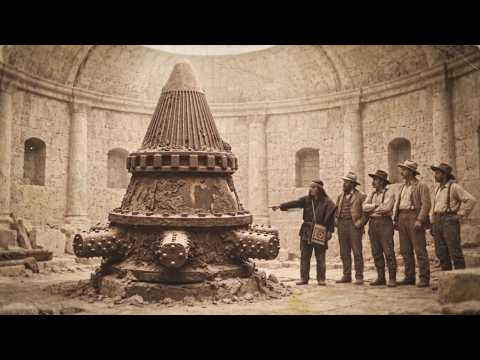
They asked him who had left it. “The ones who lived here before us,” he said. And then he told them why. The leader of the excavation, Richard Wetherill, heard that sentence. The field director, George Pepper, wrote the measurements into his notebook, but that chamber never appeared in any published report on Pueblo Bonito. One autumn morning, the stairway was filled with sand again. That is where this case begins.
Before we can understand what was found, we need to understand the canyon itself. Chaco Canyon is a narrow, shallow cut in a dry tableland in northwestern New Mexico. It runs about 9 miles. Along its floor runs the Chaco Wash—dry most of the year, but a brown flood within an hour when summer rains come. It looks like the last place anyone would choose to build a city. There are no trees, no firewood. Winter nights fall below zero; summer afternoons climb past 100°.
And yet, 900 years ago, the largest stone buildings in North America rose inside this canyon. Archaeologists call them great houses. The largest is Pueblo Bonito: a half-moon-shaped building, four floors high, with more than 600 rooms. It was raised between 850 and 1150, over generations, out of thin, finely dressed sandstone. Inside are more than 30 round rooms—kivas—sunken circular chambers made for ceremony and council. The building stands against the north wall of the canyon, and directly behind it rises an enormous slab of rock, split away from the cliff, weighing some 30,000 tons. Later arrivals named it Threatening Rock. The builders of Pueblo Bonito had laid bracing walls beneath it. They knew the danger, and they built there anyway.
Around 1150, the canyon emptied. The building stopped. The people moved north and south. Their descendants live today in the Hopi, Zuni, and Rio Grande Pueblos. Then another people came to the canyon—the Navajo. They call themselves Diné. They grazed their sheep on the tablelands around Chaco and set their hogans near the ruins. But they did not go inside the great houses. In Navajo tradition, the houses and the dead of the old people are not disturbed. What stays there, stays there.
In 1849, an American military survey passed through the canyon and put the ruins on a map for the first time. For half a century after that, no one dug. Then, in 1896, a rancher came down from Colorado. Richard Wetherill had grown up on the Alamo Ranch near Mancos. He was not much known in town, but he was known at Mesa Verde. On a snowy day in December 1888, riding after stray cattle, he looked across a canyon and saw an entire stone city tucked beneath the overhang of the far wall—the place now called Cliff Palace. From that day on, his life belonged to the ruins.
In 1896, two wealthy young brothers from New York, Talbot and Fred Hyde, agreed to fund Wetherill’s work at Chaco. Their family fortune came from soap. The excavation took the name Hyde Exploring Expedition. Everything it found was to go to the American Museum of Natural History in New York. The museum wanted a scientist in charge. Frederick Ward Putnam of Harvard put forward one of his own students, George Hubbard Pepper, from Staten Island, 23 years old, seeing the desert for the first time.
The digging was done by Navajo workmen. Wetherill hired them from around the canyon and paid them by the day. In the summer of 1897, the crew numbered 11. They started before the sun cleared the south wall and stopped when the afternoon heat became unbearable. Sand and rubble went out in wooden wheelbarrows to the plaza, where it was screened. Every screen passed under Pepper’s eyes. The Navajo crew agreed to work inside the Great House, but on their own terms. When a bone came out of a room, they put down their picks, walked out of that room, and did not come back that day.
Over the 1896 and 1897 seasons, the crew opened more than 100 rooms at Pueblo Bonito—cylinder jars, turquoise necklaces, macaw feathers, seashells, and a few small copper bells. Bells carried north from western Mexico, more than 1,000 miles hand to hand. That was all the copper there was at Chaco. A handful of bells. The largest of them would have sat inside a closed fist.
By the end of July 1897, the excavation had reached the back row on the north side of the building. A row of small, low-ceilinged rooms that sat in the shadow of Threatening Rock. So, what exactly was found beneath that row? The answer sits in the most ordinary document the excavation produced: the field director’s notebook. George Pepper lettered his field books. The one he carried in the summer of 1897 was field book C. Thick, black-bound, an engineer’s notebook with finely gridded pages. Pepper gave every room a number, took its measurements, and logged its floor, its walls, and every object that came out of it.
He gave this room the number 104. According to the entry, the room was small, 13 ft by 10. Its roof had fallen in, and it was full of sand. The Navajo crew emptied it in two days. Underneath was a floor of thin sandstone slabs. The floor was ordinary. On the first page, Pepper wrote down only its measurements. The next morning, the oldest man on the crew, a man of about 60 from the Escavada Wash, was clearing the joints between the slabs when he struck the floor with the handle of his pick. It sounded hollow. He struck it again. Hollow. One slab was lifted. There was no earth beneath it. There was clean, fine, yellow river sand, as if it had been sifted by hand. Not one stone in it, not one fleck of charcoal, not one broken sherd. Pepper wrote, “The sand did not form here. It was brought here.”
The sand was 2 ft deep. Beneath it, cut into the bedrock, a square opening appeared, 4 ft by 3, and from its edge, the first step going down. The step was cut from a single block of sandstone, 8 in high, 11 in deep. Its middle was hollowed out, like a threshold worn down by centuries of feet. Pepper measured the first step, then the second, then the other 61. 63 steps. The stairway ran straight north, turned sharply left at the 31st step, then ran straight again. The ceiling was low. A man could go down only stooping. In the walls, at shoulder height, handholds had been cut into the rock. Pepper counted those, too. 29 on the right wall, 29 on the left. The walls were smooth, no chisel marks. The vertical depth of the descent, by Pepper’s own reckoning, was 41 ft. No known room, no known kiva at Pueblo Bonito went that deep. No known structure in the canyon did.
And at the foot of the stairway, the air changed. Pepper noted that as well. The air was dry and cold. It had no smell. After the August heat of the canyon, it was not like going down into a cellar. It was like going down into winter. Three men made the descent: Wetherill, Pepper, and the crew’s interpreter, a Navajo man of about 20, who had learned his English at the government school at Fort Defiance. Each carried a kerosene lantern. Pepper had a compass on a cord around his neck and a 50-ft steel tape in his pocket. The old digger and the rest of the crew waited above in the doorway of the room.
At the foot of the last step, the lantern light reached out ahead of them and touched nothing. Wetherill set his lantern down. For a while, he said nothing. According to Pepper’s entry, he said only this: “We did not find this. Someone left it for us.” Pepper did not know what he meant. Wetherill believed he did.
Pepper did not go back to camp that night. He sat in the doorway of room 104 under a kerosene lamp and wrote nine pages into field book C. Those nine pages are the only detailed description we have of the chamber and of what stood inside it.
First, he wrote down the chamber. It was a perfect circle. He measured it twice, north to south and east to west. Both measurements came out at 78 ft. The largest kiva in Pueblo Bonito was half that size. The ceiling was flat. It was not a dome. It had been cut level out of the bedrock in one piece, 31 ft above the floor. No supporting column, no beam. 31 ft overhead, a span of rock 78 ft across, held itself up against nothing.
At the foot of the wall, a low bench ran around the entire chamber, 2 ft high, 3 ft deep. In Pueblo kivas, benches like this are made for sitting, but Pueblo benches are built of laid stone. This bench had been cut out of the rock together with the wall. Above the bench, a row of niches had been cut into the wall. Pepper counted them: 14 niches, all the same size, all evenly spaced, 14 in wide, 18 in high, a foot deep. Every one of them 4 ft above the floor. Every one of them empty.
Pepper looked closely at the top of the bench as well. In the kivas of Pueblo Bonito, the benches are worn—sat upon for centuries, their edges rounded, patched here and there. The edge of this bench was sharp, not one sign of wear, not one scratch. No one had ever sat here. But the steps of the stairway were worn hollow in the middle. Someone had gone down and come back up those steps many, many times. And once they were inside the chamber, they did not sit.
The floor was laid in rings that narrowed toward the center—nine rings. The slabs of each ring a little smaller than the ring before. At the center of the rings was a low, round platform. And on the platform, the machine.
Pepper described it from the bottom up. The platform was a round slab, 14 ft across. On it sat a broad collar that ringed the base of the machine, like a millstone. The collar was 12 ft across with 36 round bosses along its rim. Pepper called them rivet heads. Four arms came out of the base—short, thick, square at the ends. Each one 5 ft long and 2 ft 4 in thick. Their faces were covered in rows of round studs.
Above the collar rose the body, swollen, heavy, narrowing as it climbed. The lower half of the body was coated in a dry, hard, reddish clay. The clay had set into a crust and had flaked away in places. Where it had fallen away, dark metal showed beneath. Pepper broke off a piece of the clay and crumbled it between his fingers. The ground in the canyon is a fine yellow sand. This clay was red, dense, almost greasy. Nowhere in the chamber, nowhere on the stairway, nowhere in the building above, was there any other trace of it.
And the crust was not random. It ended at exactly the same height all the way around the body, just below the second collar, in a dead straight line. Below the line, crust. Above it, bare metal. Like the line left on the rocks at the edge of a lake when the water has gone down. At some point, the machine had been buried in clay up to that line, and someone had dug it back out.
10 ft above the floor, a second collar wrapped the body. Around this collar, set like the teeth of a gear, were square blocks. 24 square blocks. And above the second collar, the cone began. 11 ft high, narrowing to its tip, fluted from top to bottom with vertical ribs. Pepper spent an hour counting them. 72 ribs. The tip of the cone was not sharp. It was blunt and rounded, about the size of a fist. From base to tip, 23 ft. Four men standing on each other’s shoulders.
Then Pepper tested the metal. From a corner of the body where the clay had fallen away, he scraped a small shaving with his pocketknife. Back at camp, in a porcelain dish, he let a single drop of nitric acid fall on the shaving. The liquid turned green. He added ammonia. The liquid turned a deep, clear blue. It was the simplest test a field archaeologist knew in 1897. And the result meant only one thing. Copper.
Pepper worked out the weight. He treated the body as a rough cone set on a cylinder and assumed it was solid. He multiplied by the weight of copper. The answer was somewhere around 60 tons. 60 tons of copper. Put every copper bell ever found at Chaco on one scale, and they would not weigh 2 lb.
But there was a stranger line in Pepper’s notebook than the weight. That night he climbed out and sighted on the North Star to fix true north. The next morning he went back down, stretched a cord along each of the arms, and measured the angles. The four arms pointed to the four directions. North, south, east, west. By Pepper’s measurement, within half a degree.
And last of all, he looked up. Directly above the blunt tip of the cone in the ceiling, there was a round hole. 3 ft across. The hole was not open. It was stopped with a thick round disc of sandstone that sat perfectly in its seat. The disc was flush with the ceiling. In the lantern light, it showed only as a thin flawless circle. Pepper drew the hole. Beside it, he drew a question mark. And that question mark was never answered anywhere else in Field Book C.
There was dust on the chamber floor—fine, even, untouched. On that first descent, Pepper saw no prints but their own. From the foot of the stairway to the machine, across 40 ft of dust, there was not a single mark made before them.
Pepper tried to photograph the chamber, too. The expedition had a camera and a box of glass plates. He brought magnesium powder down into the chamber and fired it four times. With each flash, the chamber filled for an instant with white light, and then the smoke rolled up toward the ceiling. The four plates were developed in camp the next day. All four came out black. The smoke that kept the light from ever reaching the machine. So, there is no photograph of the machine. There are only three views drawn by a young man on gridded paper—from the front, from the side, from above.
Could all of this be a mistake? Could the measurements have been exaggerated? The test misread? The question has to be asked. Because there is a reasonable explanation that can account for this excavation, and for this chamber, too.
The first part of that explanation is Chaco itself. The people of Chaco were masters of round rooms. The canyon holds what archaeologists call great kivas—sunken ceremonial chambers 40 to 60 ft across. Over the centuries, some of them were deepened and some were built one on top of another. An unusually deep great kiva, cut down into bedrock, does not fall outside Chaco’s own architectural language.
The second part is the copper. Metalworking was known in Western Mexico from about the 7th century. Smiths there melted copper and cast it by the lost-wax method. The bells that reached Chaco were their work. Centuries, macaws, cacao, shells, and bells moved between Chaco and the South. A remarkable prestige object from far away sits inside the known limits of that trade.
The third part is Pepper himself. He was 24. It was his first major excavation. Nine pages written in one night by lamplight in a state of excitement. One shaving and one drop of acid. It would be easy to understand a young man overstating the weight of his first great find.
This account may be correct, but it does not explain everything. The largest work of the Western Mexican metalsmiths to survive to our time is an axe weighing a few pounds—not 60 tons, not even 100 pounds. There is no known copper deposit in the San Juan Basin. The nearest large copper country lies hundreds of miles to the south in Arizona and Southern New Mexico. And one measurement is too simple to be blamed on Pepper’s excitement. The mouth of the stairway was 4 ft by 3. The collar at the base of the machine was 12 ft across. The machine was not carried down that stairway. It could not have been. Either the chamber was cut around it or it was there before the chamber.
Pepper wrote down neither possibility, but up above, the old man waiting in the doorway of the room said he knew which one it was.
That evening, Wetherill walked over to one of the hogans beside the excavation camp. The young interpreter went with him. The old digger was sitting by the fire. Wetherill asked him about the stairway. Pepper was not there that night, but the next morning Wetherill repeated to him everything he had been told, point by point, and Pepper wrote it into the back pages of Field Book C, apart from the drawings of the machine, under a heading of its own. The heading was only this: What the old man said.
It was not written as a legend. Pepper wrote it the way a clerk takes down a witness. Who spoke, on which evening, in which language, through whose mouth it was translated. What Pepper wrote about the old man is brief, but it is exact. His hogan stood north of the canyon, on the bank of the Escavada Wash. He grazed his sheep on that tableland. He had worked for Wetherill for two seasons, and on the crew he was the first to walk out of a room when a bone came up, and the first to go back to work. The other men deferred to him. His grandfather had lived on the bank of that same wash. So had his grandfather’s father. So what Pepper recorded was not something one man had invented. It was something one family had carried along the bank of one wash for at least three generations.
That evening, the interpreter got stuck. The old man used a word that had no English equivalent. The interpreter thought for a long time, and then told Wetherill that the nearest he could come to it was this: The thing that holds a door shut. Pepper wrote that phrase down inside quotation marks.
The old man spoke first about the stairway itself. The people who built the great houses did not dig it, he said. When they came here, the stairway was already there. The chamber was already there. And the thing below was already there. They built their houses over it, to guard it. They said only a few ever went down. Always from the same family. Always in the same season. They said those who went down did not sit in that room. They did not go down to sit. They went down to do something. They said the thing below has four arms that face four ways and it is taken hold of by its arms.
Wetherill asked what it was taken hold of for. The old man was quiet for a while. Then over the fire, he slowly turned his two hands as if he were turning something very heavy. To close it, he said. Close what? The world beneath.
In Navajo tradition, the people did not begin in this world. They came up from below, from worlds stacked one beneath the other, rising one world at a time. Each world was an age. Each world came to an end and the people climbed into the next. Navajo elders had been telling this for a very long time. By the end of the 19th century, there were white men writing it down. What the old man described came after that climb. They said that once the people had come up, the way they had come could not be left open. The world below was finished. But it had not closed all the way and that thing was left behind to keep it closed.
Wetherill asked who had left it. The old man said only, those before us. Those who came before the people who built the great houses.
And then the old man turned to the best known of all the Navajo accounts of Chaco: the Gambler. That account is not a detail invented for this case. It is on record. An army surgeon named Washington Matthews heard it from Navajo elders while stationed at Fort Wingate in the 1880s and he published it in the Journal of American Folklore in 1889. In Matthews’ version, the Gambler came down from the sky and settled at Chaco. He won everything the people had at play. Their goods, their turquoise. In the end, the people themselves, and he forced the people he had won to build him a great house. Matthews wrote that the Navajo called that house Kintiel, the broad house. He thought it might be the ruin known today as Chetro Ketl, a few hundred yards east of Pueblo Bonito. In the end, a young man helped by the gods beat the gambler at his own games. The gambler was shot up into the sky, and the people went free.
In the version Matthews published, there is no stairway and no chamber. In the old man’s version, there is. They said that what the gambler truly wanted was not the turquoise, not the house. The gambler wanted the thing beneath the great house. He wanted to take it by its arms and turn it the other way. They said that on the day the gambler was beaten, the people shut the stairway. They carried sand up from the river. They sifted it by hand so that not one stone was left in it. They filled the stairway with that sand. Over it they built a room, and over the room a floor. And the old man said one last thing. Pepper underlined it. The round stone above its head is not to be touched.
The old man had never gone down that stairway. He did not go down that day, either. He had not seen Pepper’s drawing. He did not know about the hole in the ceiling, or at least no one could say that he knew.
The next morning, Pepper wanted to test it. Through the interpreter, he put the old man’s words to the other Navajo men on the crew, each of them separately. What is down there? Who made it? Why was it shut? Two of the men did not answer. They put down their picks and did not come back to camp that day. A third said only this: The old man knows. What he says is true. Do not ask more than that.
Pepper did not ask. But he added one more line to the field book: The account does not come from one man alone. The crew knows it and confirms it.
Now place the two records side by side. Pepper measured with a steel tape, a compass, and the North Star. The old man sitting by a fire described a chamber he had never entered. When Pepper lifted the floor, he found clean river sand sifted as if by hand without a single stone in it. The old man said the people carried sand from the river and sifted it so that no stone would be left. Pepper found not one mark of wear on the bench around the chamber. No one had ever sat there. The old man said that those who went down did not go down to sit. Pepper measured the four arms of the machine and found them facing the four directions within half a degree. The old man said the four arms face four ways. Pepper drew a hole stopped with a round stone in the ceiling above the tip of the cone and put a question mark beside it. The old man said the round stone above its head is not to be touched.
They measured it. They drew it. They wrote it down. And the two records described the same chamber.
That night, Wetherill went down the stairway alone. Pepper learned of it the next day and made a short note. Wetherill had stayed below for two hours with a lantern. When he came back up, the only thing he spoke of was a touch. He had knelt beside the arm that faced north and laid his hand on it. The face of the arm was covered in rows of studs. But along the top of the arm, in a band about a hand’s width across, there were no studs. They had been worn away. The metal there was smooth, almost polished. Wetherill went to the other three arms. Every one of them had the same band in the same place. As if hands had gripped each arm at that same spot for centuries.
Then he had lowered his lantern to the floor, to the foot of the collar at the base. The light showed a thin black line between the collar and the platform, a gap finer than the back of a knife blade, all the way around. The machine did not sit on top of the platform. It stood inside it, like an axle in its socket. Wetherill told Pepper only this: They turned it. Pepper asked, Which way? Wetherill did not answer.
Pepper, for his part, did not stop looking at the ceiling. The following week, he measured the hole again from the floor with a theodolite. When the lantern light struck the disc from the side, he picked out a fine line cut into its face, a line that ran all the way around the disc. And on that line, in four places, evenly spaced, four short notches—north, south, east, west. Pepper went back to his own drawing and compared the two. The four notches in the disc lined up with the four arms of the machine below. The north notch sat directly above the arm that faced north. So, the disc, like the machine, had been set into place turned to a particular bearing. And it had been made so that it could be turned.
Pepper wanted to lift the disc. There was no ladder that would reach a ceiling 31 ft high. A wooden scaffold would have to be built. Wetherill would not allow it. The expedition did not carry his name. It carried the Hyde brothers’ name, but the crew was his. And the crew had told him that if a scaffold went up, they would not come back the next morning.
In early September, Pepper wrote to his teacher, Putnam, in New York. He asked for an engineer, a scaffold, and lifting tackle. The answer to that letter never reached Chaco. The old man had said what the thing below was. He had said what it was for, but no one said who had last turned it, or when, or which way. And that summer, no one asked what lay on the other side of the round stone in the ceiling.
In the middle of September 1897, the season of the Hyde Exploring Expedition came to a close. Pepper went back to New York. Wetherill stayed in the canyon, and in the last week of the dig, the Navajo crew filled the stairway of room 104 again. They hauled sand up from the river. They sifted it. They filled all 63 steps with sand down to the very bottom, and they laid the slabs back over the top. Wetherill had allowed it. It would be truer to say he had asked for it.
In the years that followed, the canyon changed. Wetherill opened a trading post right beside Pueblo Bonito. In 1901, he tried to file the land that held the ruins as a homestead in his own name. An investigator came out from Washington. In 1906, Congress passed the Antiquities Act. In March 1907, President Theodore Roosevelt proclaimed Chaco Canyon a national monument. The digging stopped. And on the 22nd of June, 1910, Richard Wetherill was shot dead in the canyon after a dispute. He was buried at the foot of the cliff, just west of Pueblo Bonito. His grave is still there today.
Of the two men who could have spoken about room 104, one could no longer speak. In 1921, a new excavation came to the canyon. The National Geographic Society, under a Smithsonian curator named Neil Judd, began to dig Pueblo Bonito from end to end over seven seasons. Judd’s crews also included Navajo and Zuni workmen. And in the summer of 1924, the surveyor on that crew was drawing the plan of the north back row of Pueblo Bonito. His name was Harlan Voss, 26 years old, born in Lincoln, Nebraska, a civil engineer just out of the University of Nebraska. His job was to measure the walls, the floor levels, and the doorways of every room, and complete the plan. He kept his readings in numbered level books. Room 104 is in book six.
Voss noticed that the floor of this room was not like the others. The slabs did not look like the fine, careful work of Pueblo Bonito. They were thicker, set down in a hurry. There was no mortar between them. Voss wrote, Floor relaid at a later date. And in the doorway of the room, a Navajo workman from Judd’s crew, 47 years old, stood watching him. Voss did not know him, but the man knew Voss’s room. He was the young man who had interpreted for Wetherill in the summer of 1897, the young man who had learned his English at Fort Defiance, the grandson of the old digger from the Escavada Wash.
According to Voss’s level book, the man said one thing to him: If you open this, the closing of it is yours as well. Voss asked what he meant. The man told him, briefly, what his grandfather had said in 1897—the stairway, the four arms, the round stone above its head. And he added one thing more. On the day the stairway was filled in 1897, his grandfather had poured the last bucket of sand with his own hands into a stairway he had never once gone down.
Voss wrote it all down in three lines, in the dry language of an engineer. But beneath those three lines, in the margin, he penciled a date: July 9th, 1924. Voss and two workmen lifted the slabs. Underneath was sand—clean, sifted river sand. For four days, they carried it up in buckets and cleared the first 30 steps. The steps matched Pepper’s measurements exactly. 8 in high, 11 in deep, worn hollow in the middle. On the 31st step, where the stairway turns left, they found a board in the sand. A thick pine plank had been wedged across the stairway at the turn. A few words had been cut into it with a knife. Voss copied them letter for letter into his book: Filled, September 1897. R. Wetherill. Wetherill had not only filled the stairway, he had left a note for whoever came next.
Voss did not dig below the plank. Instead, he went back up and set up his theodolite. He measured the bearing and the slope of both flights of the stairway. He took Pepper’s depth of 41 feet and Pepper’s diameter of 78, and he worked out exactly which point on the surface lay over the center of the chamber. It took him two evenings at a camp table, by lamplight, with a slide rule. The answer came in two parts.
First, the center of the chamber fell directly beneath the line of the Great Wall that cuts the plaza of Pueblo Bonito in two, running north to south. Anyone who has studied Pueblo Bonito knows that wall. It was laid out on an almost perfect north-south line. So, the best-known axis of the whole building passed straight over the center of the machine below.
The second part was stranger. The calculated position of the stopped hole in the ceiling fell on the floor of a small kiva that Judd’s crew had excavated the year before, in 1923. Voss pulled the notes on that kiva. In the middle of its floor, the crew had recorded a round pit 3 feet across, lined with stone. The pit was covered by a round sandstone lid. They had measured the lid, drawn it, and left it in place. In their notes, it was a floor feature. The hole in the ceiling was 3 feet across. The pit in the floor of the kiva was 3 feet across.
In the kivas of the Pueblo peoples, there is a small hole in the middle of the floor. The Hopi call it the sipapu. It marks the place where the people came up from the world below into this one. Voss did not know that. But in his book, he drew a line to connect them. From the floor of the kiva down through 10 ft of rock to the ceiling of the chamber below. And from that ceiling to the blunt tip of the cone.
That same week, Judd read Voss’s report and had the stairway closed again. His reason is on record and it is a sound one. His crews were measuring the lean of Threatening Rock in those years and the rock was creeping slowly forward. Opening a deep void beneath the north back row could weaken the ground under its foot. Judd would not take that risk. The stairway was filled with sand one more time. Wetherill’s plank was left where it was and the 47-year-old Navajo workman sifted the sand with his own hands.
Room 104 is not the only way down into the earth at Chaco. In 1931, a young archaeologist named Gordon Vivian, working with students from the University of New Mexico, excavated a great kiva that stands by itself on the south side of the canyon across from Pueblo Bonito. Its name is Casa Rinconada. It is 63 ft across inside. The largest kiva ever excavated in the canyon. Its wall holds 34 niches—28 in an upper ring evenly spaced, six set lower down. And under its floor runs a passage. The passage starts in a small antechamber on the north side. Runs 39 ft beneath the ground. And ends inside the floor of the kiva in an opening that leads up. 3 ft deep, almost 3 ft wide. Archaeologists still argue over what it was for. The most common view is that it lets someone in a ceremony enter the kiva unseen and then rise suddenly up out of the floor. Someone coming up from beneath the earth through the floor of a kiva.
To the north, on the Animas River at the ruin now called Aztec, an archaeologist named Earl Morris excavated another great kiva in 1921. In its floor, he found two large masonry vaults and four great stone sockets for pillars. Morris rebuilt the kiva in 1934 and today it can be walked into. What the floor vaults were for is still argued as well.
To the west in Arizona, close to where the Little Colorado River runs into the Grand Canyon, a round dome of travertine rises on the riverbank. At its top is a hole filled with water. The Hopi call it sipapuuni. In Hopi tradition, it is the place where the people came up into this world from the world below. The Hopi hold it sacred to this day and no one goes there without permission. The small hole in the floor of every Hopi kiva is an echo of that place. So, all around this country, the same idea stands in stone. A world below, a way out above and at the mouth of the road between them, a hole.
And the pattern does not belong to America alone. In 1963, in the middle of Turkey, in the town of Derinkuyu in Cappadocia, a man knocked down a wall while he was repairing his house. Behind the wall was a passage. The passage went down, then further down. The underground city known today is cut into soft volcanic rock in level after level, reaching at least 280 ft below the surface. It has rooms, wells and air shafts and its passages are closed with round stones. Stone doors cut like millstones more than 3 ft across, weighing hundreds of pounds. Each can be rolled into place only from the inside into a seat of its own, like a lid.
Who began digging during Chaco and when is still not known for certain. A stairway, a chamber beneath the ground, and a round cut stone closing the way up.
This file has three parts and all three of them, in one way or another, went to the wrong place. The first part is an investigator’s report. In the autumn of 1901, after Wetherill’s land claim, the General Land Office sent a special agent named Stephen Holsinger to Chaco. Holsinger spent weeks crossing the canyon, recording the ruins, the irrigation ditches, the ancient roads, and on the 5th of December, 1901, he sent a long report to Washington. That report became one of the stones on the road to the Antiquities Act 5 years later. The report had a handwritten attachment, a single page. On it, Holsinger listed the rooms the Hyde crew had opened and closed. Near the bottom of the list is one line: Room 104, stairway filled with sand. Navajo laborers will not approach. Wetherill declines to open. When the report was typed in Washington, the attachment was not copied. The original page was slipped into another file, the folder of a different land claim in New Mexico. It stayed there for 70 years.
The second part is Pepper’s book. Pepper did not publish the results of the Pueblo Bonito excavation until 23 years later in 1920 in the anthropological papers of the American Museum of Natural History. The book runs close to 400 pages. It goes room by room. For room 104, there is a single line: filled, not excavated. Nine pages of Field Book C were not in Field Book C. In 1979, a 27-year-old graduate student from Northern Arizona University, Nora Lindquist of Flagstaff, was working through the ledgers of the Hyde Expedition’s trading posts in the museum archive in New York. Her subject was the wages paid to Navajo weavers. At the bottom of a box of accounts, between two ledgers, she found nine loose pages—finely gridded, Pepper’s handwriting, a drawing, a question mark, and on the back pages, a heading: What the old man said. Lindquist copied the pages and wrote to the park staff at the canyon. She asked what condition room 104 was in today. The reply was short. Room 104 had not existed for 40 years.
That was the third part. On the 22nd of January, 1941, Threatening Rock, the slab the builders of Pueblo Bonito had braced with walls eight centuries earlier, finally fell forward. 30,000 tons of sandstone came down on the north back wall of the building and crushed the rooms behind it. Park records say more than 30 rooms were destroyed. Room 104 was in that row.
Lindquist looked for one more thing: the letter Pepper wrote to Putnam in September, 1897. It was among Putnam’s correspondence at Harvard. So was Putnam’s answer. A two-page draft dated October, 1897. Putnam asked Pepper to send the chamber’s measurements and a sample of the metal to New York and wrote that an engineer would be sent for the scaffold the following season. But the answer had never been sent to Chaco. Mail reached the canyon only by a weekly wagon by way of Farmington. Putnam had sent the draft to the Hyde brothers’ office in New York to be forwarded. Someone in that office filed it among the business correspondence of the Hyde Exploring Expedition. The next season, Pepper’s plans changed. The engineer never came. No one hid it. No one destroyed it. No one ever followed it up.
Lindquist finished her thesis in 1981. Its subject was Navajo weavers. Room 104 appears once in a single footnote on page 147.
There is a version of this case in which everything resolves into comfortable categories. And that version deserves to be told at its strongest. First, the Hyde Exploring Expedition was not a neutral scientific dig. It ran trading posts. While finds went to New York, Navajo blankets and pottery were being sold back east. Holsinger’s 1901 report accused Wetherill of digging the ruins for his own gain. The field notes of a dig like that carry a strong motive to inflate a sensational find.
Second, the people of Chaco built deep round rooms. There is a passage beneath the floor of Casa Rinconada. There are stone vaults in the floor of the great kiva at Aztec. An unusually deep kiva cut into bedrock would push the limit of what Chaco’s own builders could do. It would not break it.
Third, the copper. Trade between western Mexico and Chaco is well documented. A large ceremonial metal object from far away, even one far larger than any known today, could have ended up at the end of a trade route. And a field test made with one shaving and one drop of acid cannot cleanly tell copper from some other alloy.
Fourth, the conduct of the Navajo crew. Navajo tradition teaches people to keep away from the houses and the dead of the old ones. Keeping away from a dark sealed chamber under the ground makes complete sense inside that tradition. The old man’s words may not describe a machine at all. They may be the language of respect and of caution.
Fifth, there is no physical evidence. There is no photograph of the machine. No sample of the metal ever reached a laboratory. The chamber lies under 30,000 tons of rock. What remains is nine pages, a few words cut into a plank, and one line in an investigator’s handwriting.
And sixth, the silence of Wetherill’s own family. His wife, Marietta Wetherill, more than 40 years after his death, spent hours in the 1950s telling a researcher named Lou Blatchly about her years at Chaco. Those conversations were recorded. She talked about life in the canyon, her Navajo neighbors, the digs, the trading post. Nowhere in the recordings is there a single sentence about a stairway or a copper machine. A chamber that a woman who lived beside Wetherill for years never heard of was either never there at all or it was the one thing Wetherill never spoke of to anyone.
These are serious objections and they may be right. But this version does not explain everything either. It does not explain how a collar 12 ft across came down through a stairway mouth 4 ft by 3. It does not explain why the four arms Pepper measured faced the four directions or how the old man could say so without ever setting foot in the chamber. And it does not explain why, 27 years later, a 3-ft hole in that ceiling turned out to lie directly beneath a 3-ft stone lid in the floor of the kiva above.
No institution hid this chamber. No institution buried the truth. Records went into the wrong folders. A letter went to the wrong office. A rock finally fell. The file was not suppressed. It was simply never followed up. That is not a weakness in the record. It is the record.
Today, Chaco Canyon is Chaco Culture National Historical Park. It took that name in 1980. In 1987, UNESCO placed it on the World Heritage List. In June 2023, Washington closed a 10-mile belt around the park to new oil and gas leasing for 20 years. Navajo communities still live on the tablelands around it. Sheep still graze along the Escavada Wash. The north back row of Pueblo Bonito, though, has lain beneath the broken pieces of Threatening Rock since 1941. The pieces were never removed. They cannot be. The fallen rock is now part of the ruin itself, and it is protected.
And there is a second door closed on digging there today. Since the Native American Graves Protection and Repatriation Act of 1990, any work that goes below the ground at Chaco is carried out in consultation with more than 20 tribes and pueblos whose ties to the canyon are recognized. From the Hopi to the Zuni, from Acoma to the Navajo Nation. For many of those communities, Chaco is not a dig site. It is a living place. No one can open a chamber beneath that rock without first asking whose chamber it is. That is not a ban. It is a form of respect. And its result is the same thing the old man asked for in 1897.
The passage beneath the floor of Casa Rinconada is ringed by a railing that visitors may not cross. The Great Kiva at Aztec can be walked into today. Some of the round stone doors of Derinkuyu still stand in their seats. Pepper’s nine pages went back into the box where they were found in 1979. Holsinger’s handwritten attachment sits in the National Archives in Washington in the folder of someone else’s land claim. Wetherill’s plank, if it is still there, lies on the 31st step in sand that was sifted twice at the turn where the stairway bends left. And the round stone lid in the floor of the small kiva, measured and drawn in 1923, has never been lifted.
In the late summer of 1897, a Navajo crew lifted the floor of a small room at Pueblo Bonito and found a step beneath the sand. That day, it looked like a stairway—a way down. Now it looks different. 63 steps filled with sand twice, marked with a plank, buried under 30,000 tons of rock. Perhaps that stairway was never made for going down at all. Perhaps it was made for reaching what lay below and turning it and closing it. And perhaps whoever filled it with sand each time knew that one day someone would go down again. The old man said the machine was left behind to keep that place closed. He did not say who left it. He did not say which way it was last turned, and he never went down himself.
A name can be misfiled in a county ledger. It cannot be misfiled in the mouth of a living person. So, what do you think? Was the thing Pepper measured a ceremonial object carried from a distant land? Or was it what the old man said it was—the thing that holds a door shut? Tell us what you think in the comments, and if you want us to keep following records like this one, subscribe to the channel. And one last question: in those 10 ft of rock between the round stone in the ceiling and the lid in the kiva floor, what is waiting there today?
Report this article
Select a reason for reporting:






