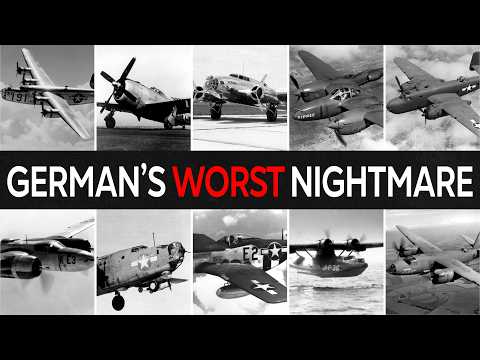
They called them Verräter—traitors—and worse things when no one was listening. From the frozen sky over Berlin to the waves of the Bay of Biscay, these American bombers didn’t just drop bombs; they rewrote fear. To the Luftwaffe, they were puzzles with wings. To German soldiers, they were a countdown without a clock. These weren’t just planes. They were nightmares with serial numbers. And the worst part? There were 25 of them.
So buckle in, because these are the 25 American bombers the Nazis feared the most—and not one of them came in peace.
The Boeing B-17 Flying Fortress didn’t just fly over Europe. It loomed—a metal leviathan dragging entire cities into smoke and ruin. It wasn’t feared because it dropped bombs. It was feared because it didn’t stop. No matter how many holes were punched through its skin, no matter how many gunners slumped lifeless behind their .50 calibers, the Flying Fortress just kept coming.
Its name wasn’t ironic. It was aspirational. And somehow, it worked. To the Luftwaffe, it was less an aircraft and more a math problem with no solution: 20 hits from 20mm cannons to bring one down—and that was assuming the pilot didn’t coax the wreckage home on sheer spite and cigarette smoke.
In the cold arithmetic of war, the B-17 tilted the balance sheet toward obliteration. Its combat box formation—a geometric ballet of mutual protection—turned the skies into kill zones. Even seasoned German pilots approached these formations like a man stepping into a wood chipper with a butter knife. They called it the flying porcupine—an unflattering nickname, unless you were the one trying to shoot it down.
To be in the gunner’s sights of a B-17 meant you had already made a mistake. To be under its bombs meant it was already too late.
But if the B-17 was the enduring face of American vengeance in daylight, then its deadlier, deeper-reaching cousin was the long-range beast that gave no place to hide. Not in the sky, not on the sea, and certainly not in the fuel-soaked dreams of German generals.
The Consolidated B-24 Liberator was the scalpel that stabbed behind the lines. Sleeker, faster, longer-legged, and far less forgiving to fly, the Liberator was the quiet workaholic of strategic bombing. It didn’t get the movies. It didn’t get the monuments. But it got the job done—and far deeper into the Reich.
Its wings, thin and long like the arms of a desperate saint, carried fuel that let it reach where the Flying Fortress couldn’t. That same design also meant it was easier to ignite—something Luftwaffe pilots knew well. They went after Liberators first, not because they were more dangerous, but because they were more flammable. Even in the firestorm of war, fear has a hierarchy.
And yet, what the B-24 lacked in durability, it made up for in ubiquity. It was everywhere. Over Ploiești, where its bombs threatened to run Hitler’s tanks dry. Over the Atlantic, where U-boats turned from predators into prey. In the Mediterranean, where it painted the skies with the ruins of Axis logistics. U-boat crews didn’t call it a bomber. They called it the end. When it loomed on the horizon, surfacing became a gamble—and gambling with oxygen never ends well.
But while the B-24 struck from high above, the real terror for German soldiers came screaming from the treetops. Brash, low-flying machines that didn’t just bomb your city—they ruined your day.
The Republic P-47 Thunderbolt sounded like rolling thunder, and by the time you heard it, it had already loosed hell. The P-47 wasn’t elegant. It was enormous, crude, and powered by a radial engine that sounded like it had personal anger issues. Designed as a high-altitude escort, it instead found its true calling much lower—ripping through trees, rail yards, and convoys like a chainsaw wielded by a caffeinated god.
You didn’t see the P-47. You felt it. A sudden roar, a flash of silver, then fire. German troops coined the term Jabo—a phrase that roughly translates to hit the dirt and pray. It wasn’t fear of the bomb. It was fear of not even getting a chance to shoot back.
The Thunderbolt dove in, dropped ordnance, and strafed the survivors with .50 cals that could punch through locomotives. Then it was gone, already hunting the next target. It was also infuriatingly hard to kill. Air-cooled and overbuilt, it took more punishment than some tanks. The Luftwaffe couldn’t match its brutality. Ground troops just called it unstoppable. A captured German general once admitted they simply stopped trying to move by daylight.
But if the Thunderbolt was the sound of thunder, the next aircraft was the lightning that followed—the elegant devil with twin tails and silent fury.
The Lockheed P-38 Lightning didn’t announce itself with brute noise or mass formation. It arrived like a bad thought—quiet, precise, and already too close. Twin booms slicing the sky. A central pod packed with cannon and intent. The Lightning was a machine that looked wrong to German eyes. Aircraft weren’t supposed to look like this, and they definitely weren’t supposed to kill this efficiently.
Its weapons were clustered in the nose, which meant no convergence problems, no hopeful sprays of bullets. When a P-38 fired, everything went exactly where the pilot was looking. For German radar stations, supply depots, and command posts, this was not comforting news.
The Lightning specialized in popping up where it wasn’t expected, unloading destruction, and vanishing before anyone could agree on what had just happened. On low-level runs, it used skip bombing—bombs skittering across water or ground like thrown stones, turning harbors and bridges into puzzles missing key pieces. In Italy and North Africa, it strangled supply lines with methodical cruelty. Trucks burned. Trains stopped. Officers learned that maps were now suggestions, not guarantees.
German crews gave it a name that stuck: the fork-tailed devil. Not because it was supernatural, but because it behaved like something that enjoyed the hunt. It was fast, heavy-hitting, and unnervingly calm in execution. You didn’t fight a P-38. You endured it—if you were lucky.
But even the devil had a partner in crime. One that didn’t just strike targets—one that made sure the bombers above survived long enough to end the war altogether.
The North American P-51 Mustang was the moment the Luftwaffe realized the rules had changed and nobody had told them in advance. For years, German pilots waited patiently beyond the range of Allied escorts, knowing the bombers would soon be alone. Then one day, Mustangs showed up over Berlin, and that comforting assumption evaporated like fuel in a punctured tank.
With its long-range legs and predatory grace, the P-51 didn’t just escort bombers—it haunted them. German fighters scrambled only to find themselves hunted instead. And when there was nothing left in the air to kill, the Mustangs went shopping on the ground. Low-level rhubarb missions turned airfields into scrapyards. Parked aircraft burned before their pilots finished breakfast. Fuel dumps became landmarks.
Briefly, German radio warnings spoke of Indians deep inside the Reich, as if naming the threat might somehow tame it. It didn’t.
What made the Mustang truly terrifying wasn’t speed or firepower. It was inevitability. It was there at the start of the mission, and it was still there at the end—circling like a debt collector who does not forget. Hermann Göring understood the implication immediately: if American fighters could roam freely over Germany, then Germany itself was now a target. Every mile of it.
The skies belonged to the Allies now, which meant the war moved downward—onto bridges, rail yards, and the arteries of an empire. And for that kind of work, there was a bomber the Germans learned to hate on sight.
The Martin B-26 Marauder had a bad reputation before it ever met the enemy. Pilots called it unforgiving. Engineers called it efficient. But the Germans called it something else entirely: trouble. Fast trouble. Precise trouble. The kind that arrives, destroys exactly what it came for, and leaves before retaliation finishes warming up.
Flying in tight, disciplined formations, the Marauder was built for surgical strikes. Bridges vanished. Rail hubs collapsed. V-1 launch sites quietly stopped launching anything at all. It didn’t loiter. It didn’t grandstand. It simply erased the infrastructure Germany needed to function.
Its speed was its shield. German fighters struggled to line up clean attacks, and flak gunners found their windows of opportunity brutally short. Even high-ranking Luftwaffe officers admitted it was an aircraft they preferred not to engage—not because it was flashy, but because it was reliable. And reliability in war is terrifying.
By the time Allied armies pushed into Western Europe, the damage was already done. Trains didn’t run on schedule. Supplies arrived late or not at all. Retreat routes became traffic jams waiting to be bombed again. The B-26 didn’t win battles directly. It made sure the enemy arrived to those battles tired, hungry, and out of options.
But speed and precision are only one way to fight a war. Sometimes terror comes not from above at altitude, but from aircraft willing to dive lower—close enough to see faces. And the next machines perfected that kind of fear.
The North American B-25 Mitchell was never meant to be subtle, and it never tried to be polite. It was a bomber that behaved like it had somewhere to be and didn’t care who was standing in the way. Medium-sized, brutally adaptable, and endlessly practical, the Mitchell became the aircraft German ground commanders learned to dread—not for its symbolism, but for its persistence.
Wherever German supply lines tried to breathe, B-25s showed up to suffocate them. They came in low—sometimes insultingly low—skimming terrain like they were personally offended by it. Parafrag bombs stitched airfields with shrapnel. Strafing runs chewed up trucks, rail cars, and anything else foolish enough to move during daylight. There was no elegance to it, just repetition—again and again and again.
In North Africa and the Mediterranean, Rommel’s forces learned that the sky itself had turned hostile. The Mitchell didn’t need perfect weather or elaborate planning. It just needed targets, and the German army provided those generously. Every convoy became a gamble. Every resupply run felt like flipping a coin with too many losing sides.
The B-25’s greatest sin, from the German perspective, was versatility. You couldn’t predict how it would be used tomorrow because yesterday’s rules no longer applied. High altitude, low altitude, bombing, strafing—surprise appearances where nobody had requested them.
But even the Mitchell had limits. When the war demanded speed over flexibility, when targets shrank and defenses thickened, another aircraft took its place—one that flew so low and fast it barely seemed fair.
The Douglas A-20 Havoc didn’t bomb from the heavens. It assaulted from the margins. Flying at treetop level, the Havoc arrived below the comfort zone of heavy flak and above the panic threshold of everyone on the ground. It was the kind of aircraft that made German gunners realize their training manuals had lied to them.
Fast, compact, and mercilessly direct, the A-20 specialized in targets that required accuracy rather than spectacle. Barges, bunkers, trains paused just long enough to regret it. By the time defenses reacted, the Havocs were already gone, leaving behind smoke, confusion, and the uncomfortable realization that nowhere was truly safe.
German crews struggled to track them. At that altitude, everything happened too quickly. By the time you saw the aircraft, the bombs were already falling. And because they operated in places where heavy guns were ineffective, the usual reassurance of layered defenses evaporated.
Known as Bostons by the Allies, the A-20s carved open the road to Normandy long before the beaches filled with soldiers. They softened targets that would otherwise have cost thousands of lives. They made resistance expensive before it even began.
But war doesn’t stop evolving. By 1944, speed alone wasn’t enough. The Allies wanted something faster, heavier, and far more intimidating—an aircraft that felt less like an attacker and more like a closing door.
The Douglas A-26 Invader arrived late to the war and immediately made everyone uncomfortable. German intelligence reports didn’t describe it with flowery language. They called it what it was: a problem. Too fast, too well-armed, too modern for a Luftwaffe already running out of answers.
The Invader blurred categories. It was called a light bomber, but it flew faster than fighters sent to intercept it. It carried guns like it expected resistance—and then dared anyone to try. When it appeared over retreating German columns in 1945, panic followed. This wasn’t harassment. This was enforcement.
Columns scattered. Trains stopped moving altogether. The A-26 turned movement itself into a liability. You didn’t wait for orders when Invaders were nearby. You hid and hoped they chose someone else. What made it especially terrifying was confidence. The A-26 didn’t sneak. It didn’t rush. It flew like it knew the war was already decided and that it was simply delivering the final invoices.
It replaced older bombers, not because they failed, but because the future had arrived—and it was faster than anyone expected. Yet even the most advanced land-based aircraft had rivals that hunted where roads ended and oceans began.
Because while armies can hide in forests, navies have nowhere to disappear. And in the Atlantic, the fear took on wings with patience measured in hours.
The Consolidated PB4Y-1 Liberator wasn’t just a B-24 with a Navy paint job. It was the long shadow that stretched across the Atlantic, marking the place where U-boats came to die. By 1943, the Marine’s quiet confidence in the open ocean had started to fracture, and it was these bombers—slow and patient—that pried it apart.
Modified for maritime patrol, the PB4Y-1 traded high-altitude formations for low-altitude hunting. It flew alone, often far beyond radio contact, stalking the waves like a predator with wings. U-boats, once the silent killers of the sea, found themselves forced to surface in a sky that now watched back. When they rose to breathe, the Liberators were waiting.
What made the PB4Y-1 terrifying wasn’t speed—it was inevitability. A sudden dot on the horizon, a growing hum, then bombs, depth charges, and a final flash of foam. U-boat commanders began to avoid entire zones once the Liberators took up patrol. Sailors spoke of the Bloody Biscay, where the Bay of Biscay turned into a graveyard with wings circling overhead.
But while the PB4Y-1 closed the open ocean, it wasn’t the only aircraft that could haunt the seas. There was another one—slower, older, and somehow even more relentless.
The Consolidated PBY Catalina flew like it had nowhere to be, and that’s what made it dangerous. It wasn’t built to impress. It was built to endure. A flying boat with the patience of a monk and the range of a migrating bird, it made the Atlantic feel small and every U-boat commander feel watched.
The Catalina didn’t need to find you quickly. It just needed to find you eventually. And once it did, it didn’t let go. Sometimes it would shadow a U-boat for hours—silently tracking, waiting for the perfect moment, or more often for a destroyer to come deliver the punchline. Being tailed by a Catalina was like being followed by a librarian with a sniper rifle: calm, methodical, merciless.
Its real weapon wasn’t its bombs. It was its eyes—radar, long loiter time, the ability to make the enemy wait for their own destruction. German logs mentioned the frustration of being unable to surface, unable to run generators, unable to move because somewhere out there, a Catalina was watching—and watching—and still watching.
But not every bomber played the long game. Some brought the fight down to the waves, riding off carriers, striking fast and vanishing before the sea could even settle.
The Grumman TBF/TBM Avenger wasn’t sleek, it wasn’t fast, and it wasn’t pretty. It was, in every practical sense, an airborne sledgehammer. Dropping from escort carriers in the Mid-Atlantic, this torpedo bomber had one job: ruin a submarine’s day.
Operating as part of hunter-killer groups, the Avenger brought with it new tools and new fears. The most unnerving: a homing torpedo that could listen. Once dropped into the water, it hunted by sound, chasing the echo of submarine screws like a bloodhound with a grudge. For U-boat crews, it was a horror story wrapped in a math problem. You couldn’t outrun it, and you couldn’t outthink it.
What made the Avenger worse was its teamwork. It rarely came alone. Wildcats strafed from above, keeping the flak crews down while the Avenger moved in for the kill. Even when the initial attack missed, the U-boat was forced to dive—sometimes into waiting sonar nets, sometimes into more depth charges, but always into darkness.
No single aircraft sank the U-boat fleet. But the Avenger proved that air power didn’t stop at the shoreline. And as German naval power began to wither, a new threat emerged—one that struck closer to home, faster than ever before.
The Lockheed PV-1 Ventura was what happened when the US Navy decided reconnaissance needed teeth. Fast for its class, armed like it expected a fight, and built to take punishment, the PV-1 was never meant to be gentle. Originally a civilian design turned war machine, it became a coastal predator that hit harder than anyone expected.
Unlike the flying boats that cruised in wide, lazy arcs over the ocean, the Ventura operated with tempo. It could catch U-boats on the surface before they had time to dive. And if they tried, depth charges and rockets made the descent a short one. The Germans had seen patrol bombers before, but not like this. The Ventura didn’t watch. It attacked.
Its favorite haunts were the Atlantic coasts and Mediterranean shipping lanes—places where U-boats once hunted and now learned to hide. In this new underwater chessboard, the Ventura made sure Germany kept losing pieces. And when it wasn’t sinking submarines, it went after railways, ports, and supply convoys. Wherever soft targets dared to show themselves, the Ventura replaced older patrol bombers with speed and aggression.
But then came its bigger, meaner sibling—an aircraft that took the Liberator’s concept and decided it needed even more firepower and just one tail.
If the PB4Y-1 was a modified B-24, the Consolidated PB4Y-2 Privateer was its final form. Longer, heavier, nastier. Gone were the twin tails of its predecessor, replaced by a single towering fin like a dorsal blade. It wasn’t a redesign. It was a declaration. This was not a bomber dabbling in maritime patrol. This was a purpose-built U-boat killer.
With an extended range and an absurd number of gun turrets—twelve to be exact—the Privateer flew low and slow with the confidence of something that didn’t expect to be challenged. It hunted over the Bay of Biscay, where German submarines once surfaced freely. But with the Privateer prowling above, that freedom became a liability.
U-boat captains who tried to fight it off learned quickly: this was not the same beast they were used to. Its machine guns covered every angle. Its bombs fell with accuracy. And its crews knew exactly where to find you. By the time it joined the war in 1944, the tide had already turned. The Privateer just made sure it stayed that way.
And while the oceans became a graveyard for the Wolfpacks, the land war demanded a new breed of precision—a dive bomber with the face of a fighter and the scream of judgment.
Before the Mustang soared high and fast, it screamed straight down. The North American A-36 Apache, a lesser-known cousin of the P-51, was never designed to dogfight. It had dive brakes. It had bombs. And it had exactly one mission: make German tanks and trains wish they hadn’t left the depot.
Used extensively in Sicily and Italy, the Apache brought terrifying accuracy to the battlefield. It didn’t just drop bombs—it placed them. From thousands of feet up, it would dive steeply toward the target, brakes out, engine howling, guns flashing. It didn’t aim to flatten cities. It aimed to snap supply lines, break open armor columns, and turn crucial choke points into smoking dead ends.
German troops in Italy began associating the scream of an incoming A-36 with the sudden urge to find cover. Any cover. Even Rommel’s seasoned veterans, already weary from P-40s and B-25s, found the Apache an unwelcome evolution. It was a Mustang that had traded glory for gravity.
And while it made a name in daylight, its darker cousin came out after sunset—a twin-engine phantom designed to punish anything that moved at night. Silent, stalking, and painted in black.
The Northrop P-61 Black Widow didn’t chase glory. It stalked shadows. Nicknamed the Black Widow, it was America’s first purpose-built night fighter, and it wore that title like a threat. Painted obsidian, shaped like something out of a fever dream, and equipped with early airborne radar, the Widow wasn’t just ahead of its time. It was a time bomb for anything that moved after dark.
German forces relied on the night. Retreats, resupply runs, train movements—they all depended on darkness for protection. And for a while, it worked. Then came the Widow. It could find you in the black. It could follow you in silence. And when it was close enough, you wouldn’t hear it—just the sharp hammering of its cannons and the realization that the night no longer belonged to you.
The Black Widow dropped bombs, yes, but more than that, it dropped morale. Night intruder missions targeted trains, trucks, and rail junctions with eerie precision. Darkness, once a tactical ally, had turned hostile. German troops began describing the night not as a cloak, but as a trap.
And while the Widow ruled the night sky, another aircraft was rewriting the rules of tactical bombing during the day—one that had already made history in the Pacific and now came to settle scores in North Africa.
The Douglas SBD Dauntless was built for the sea, but in North Africa, it proved it could punch above its weight on land, too. Originally hailed for its performance at Midway, the Dauntless made a quieter, deadlier appearance over Vichy and German positions during Operation Torch. Here, in the dusty chaos of the North African campaign, it found new purpose and new enemies.
What made the Dauntless dangerous wasn’t speed or flash—it was certainty. Dive bombers had one job: hit the exact thing they were pointed at. The Dauntless didn’t miss. It came in steep, nearly vertical, with dive brakes screaming and bomb doors yawning open. Then silence—briefly—before a surgical detonation sent shock waves through whatever had dared to stay still.
Against German coastal batteries, ships, and scattered resistance pockets, the Dauntless delivered exacting punishment. No guesswork. No wide spreads. Just hard, deliberate impact. And although it never flew in vast numbers over Europe, those who encountered it remembered it—a reminder that the tools of Pacific War could and would be repurposed wherever necessary.
And before the heavier bombers arrived in force, another lean machine had already been carving its name into the Atlantic’s early battles. Light, fast, and full of bad intentions.
Long before the Liberators filled the sky and the Privateers prowled the waves, there was the Lockheed A-29 Hudson. It didn’t look like much—modest, under-armed, a relic of earlier war days. But it was the first American aircraft to draw blood against a U-boat. And that mattered, because in 1941 and 1942, symbolism was survival.
Built from a civilian airliner design, the Hudson was adapted quickly for patrol and reconnaissance. What it lacked in muscle, it made up for in timing. When the U-boat threat surged and the Allies had too few tools to answer, the Hudson stood in the gap. It flew from Iceland, the UK, and the eastern seaboard, plugging holes in the leaky convoy defense system.
German submarine captains had no respect for it at first. But that changed. The Hudson was fast enough to surprise them, armed enough to damage them, and everywhere enough to make them nervous. They couldn’t stay up, they couldn’t stay down, and they couldn’t know which radar blip would turn into an attack. It wasn’t pretty. It wasn’t famous. But it bought time—and that time was used to build bigger, better machines, like the flying gunboat that brought war to the warm waters of the Caribbean and South Atlantic.
The Martin PBM Mariner was a flying contradiction. Massive, slow, and somehow always in the right place at the wrong time. German U-boat crews, particularly in the Caribbean and the South Atlantic, had little reason to expect trouble at first. These were distant waters, far from the convoys and chaos of the North Atlantic. But then came the Mariner, and suddenly nowhere was safe.
It was built like a boat with wings, capable of long, lumbering patrols over endless ocean. What it lacked in glamour, it made up for in persistence. With powerful radar and an arsenal that included bombs, depth charges, and sometimes even rockets, the PBM didn’t just scout for targets—it finished them.
U-161 and U-129, both feared among Allied shipping, were either destroyed by or harassed relentlessly by these hulking sea-born hunters. Mariner patrols made it increasingly difficult for U-boats to operate near oil-rich zones and critical supply routes. The message was clear: there would be no safe theater, no quiet corner of the ocean.
But as the Mariners stalked the southern seas, the Germans faced a different kind of menace from above—smaller, faster, and often the last thing seen before a sudden screaming descent.
The Grumman FM-2 Wildcat was not an aircraft designed to impress. It was compact, underpowered by later war standards, and often overshadowed by its successor, the Hellcat. But in the Mid-Atlantic, flying from the decks of small escort carriers, it earned its place through sheer effectiveness.
It wasn’t there to win dogfights. It was there to make life miserable for submarines. Operating in tandem with Avengers, the Wildcat’s job was to strafe—fast, low, and deadly. It cleared decks, kept anti-aircraft gunners pinned, and turned surfaces into death traps. It didn’t need to sink the submarine. It just needed to make sure the Avenger had a clear shot.
And it was hard to hit. Small, nimble, and familiar with rough carrier launches in high seas, the FM-2 was the kind of opponent that slipped past expectations. For U-boat gunners, it was a headache. For the crew below decks, it was the loud announcement that their last surface moment had ended. Wildcats were not glamorous, but they were relentless.
And as the war pressed into Europe’s soft underbelly, another older fighter-bomber joined the fray. Rugged, unsophisticated, and stubbornly hard to kill.
The Curtiss P-40 Warhawk had already seen too much war by the time it arrived in North Africa. Outclassed in dogfights, bypassed in fame, and often relegated to second-string roles, it should have been retired. But war doesn’t care about pedigree. It cares about availability and reliability. And the P-40 was both.
What it lacked in finesse, it made up for in brute-force utility. It could carry bombs, it could take damage, and it could return the favor. The Warhawk became a workhorse of the Mediterranean campaign, dropping ordnance on Rommel’s tanks, striking supply columns, and reminding German troops that even second-tier air power could still kill you on time and under budget.
Its thick frame and rugged build made it ideal for desert conditions. Sand chewed up engines. Visibility was poor. But the P-40 just kept flying. German pilots might have mocked it in the skies, but ground units didn’t laugh when they saw one coming in low with a full payload and bad intentions.
And yet, the Warhawk wasn’t the strangest American bird Germany had to face. That title belonged to a stubby, oddball aircraft with a cannon in its nose and a grudge in its wiring.
The Bell P-39 Airacobra was an aircraft built in contradiction. It had no turbocharger, placing a ceiling on its performance at high altitudes—and yet it was one of the most fearsome low-altitude attackers of the war. Its engine sat behind the pilot. Its tricycle landing gear looked strange. And its primary weapon: a 37mm cannon in the nose, because subtlety wasn’t on the design brief.
In the Mediterranean theater, the US Army used the P-39 for ground attack, low-level strikes, and coastal patrols. It wasn’t a dogfighter’s dream, but if you were a German in a lightly armored vehicle, you didn’t care about altitude charts. You cared about whether that cannon shell would hit you or the guy next to you.
In the hands of Soviet pilots, especially on the Eastern Front, it was a tank killer. And Germany learned that the little Cobra, as it was called, was disproportionately lethal at treetop level. While never glamorous, the Airacobra found a second life where other aircraft couldn’t go: low, close, and vicious.
But before the war could be won by advanced machines, it had to be held by obsolete ones. And one old bomber did just that—against all odds and better judgment.
By the time World War II truly began, the Douglas B-18 Bolo was already a relic. Based on a civilian airliner, it was slow, under-armed, and under-protected. In theory, it wasn’t even supposed to be in combat. But theory didn’t matter when U-boats were sinking tankers in the Caribbean and the Allies had nothing else to send. So they sent the Bolo—and somehow, it worked.
Flying out of hastily built bases, the B-18s patrolled key shipping lanes and oil routes under constant threat. They weren’t fast enough to outrun fighters. They weren’t tough enough to take a hit. But they had range, they had eyes, and they had bombs. For German U-boat commanders who had grown used to near-complete impunity in the Caribbean during Operation Neuland, the sudden appearance of these bombers was a rude—and sometimes final—awakening.
The Bolo didn’t win the war, but it stopped the bleeding. It bought time for better aircraft to arrive and for convoys to survive. In 1942, that was enough. And when those better aircraft finally did arrive, one of them carried a bigger payload, dived like a hawk, and finished what the Bolo had only begun.
The Curtiss SB2C Helldiver was often called the Beast—and not always affectionately. Pilots criticized its handling. Crews cursed its maintenance demands. But German ground forces didn’t care about its quirks. They only cared about its payload and the fact that it was coming down on them like the sky itself was angry.
Designed to replace the aging Dauntless, the Helldiver could carry twice the bomb load and still perform steep, accurate dives. Though more famous in the Pacific, it played a lesser-known but critical role in Atlantic operations during the war’s final years, especially in support of hunter-killer groups targeting U-boats and their coastal infrastructure.
German defenders on the Atlantic coast learned that the Helldiver meant trouble. Its bombs were heavier, its dives were steeper, and its accuracy was brutally consistent. In coordinated attacks with Avengers and Wildcats, it helped clear out the last hiding places of the Marine—bunkers, sub pens, coastal flak batteries. Nothing stayed safe for long.
But if the Helldiver brought power, the next aircraft brought dominance. A sleek carrier-borne fighter-bomber that crashed through Europe’s back door with the swagger of a Pacific veteran and the payload of a very bad day.
The Germans weren’t supposed to see the Grumman F6F Hellcat. It was meant for the Pacific—the shark-mouthed nemesis of Zeros, born for island-hopping warfare and carrier decks drenched in salt and sun. But by 1944, the Hellcat appeared somewhere unexpected: the skies over southern France. And what it brought with it wasn’t just firepower. It was an entirely different rhythm of war.
During Operation Dragoon, the Allied invasion of southern France, Hellcats were flown from escort carriers just off the coast. Their targets weren’t Japanese fighters. They were German flak batteries, supply columns, and retreating forces clinging to the shrinking edges of occupied Europe. The Hellcat carried rockets, bombs, and enough .50-caliber ammunition to turn trucks and halftracks into steel confetti. It came in fast, low, and mean—offering no warning and leaving no chance.
To German defenders, it was disorienting: an American naval aircraft in France. The Hellcat made the war feel closer, wider, and more unpredictable. Its presence was proof that the Allies didn’t just have air superiority—they had air versatility. Wherever there was a battlefield, the Hellcat could show up and ruin your plans.
And with that, the final chapter of the bombing campaign closed—not with a whimper, but with an engine roar that crossed oceans. The war in Europe was ending, but its skies would never forget the sound of American bombers overhead.
So now we turn it over to you: Which of these 25 American bombers would you least want to hear roaring toward your position—and why?
Report this article
Select a reason for reporting:






