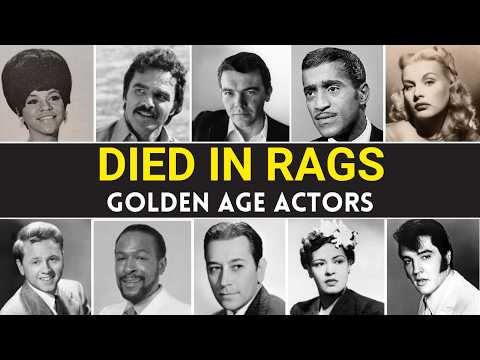
They had it all—fame, fortune, and the adoration of millions. Yet, when the final curtain fell, many of Hollywood’s Golden Age legends died penniless, their once-glittering fortunes reduced to dust. The stories of these stars are not just about money lost, but about dreams shattered, trusts betrayed, and the cruel irony of a industry that celebrates youth and success while abandoning its aging icons.
In this second part of our series, we delve into the lives of actors and singers who, despite earning millions, ended their days in financial ruin. Their tales are as heartbreaking as they are cautionary, revealing the dark side of stardom and the personal demons that often accompany it.
George Raft was the epitome of the tough guy on screen, but off screen, his generosity and gambling habit drained his wealth. Known for turning down iconic roles like The Maltese Falcon and Casablanca, Raft’s decisions haunted him. By 1966, he declared bankruptcy, and when he died in 1980, he was broke.
Marvin Gaye’s velvet voice made him a legend, but his finances were a mess. Alimony and tax debts forced him to surrender royalties from his album Here, My Dear. His life ended tragically in 1984, shot by his own father, and he died penniless.
Elvis Presley, the King of Rock and Roll, earned hundreds of millions, but his extravagant spending and drug addiction left him with only $5 million at his death—and double that owed to the IRS. His ex-wife Priscilla worked tirelessly to save Graceland and the estate.
Bobby Driscoll, a child star who won an Oscar at 12, saw his career vanish with puberty. Drug addiction and poverty consumed him, and he died alone in an abandoned tenement at 31.
Burt Reynolds, the charismatic leading man, declared bankruptcy in 1996 with $10 million in debt. He lost his ranch and confessed to reckless spending, dying in 2018 with far less than he earned.
Anita Ekberg, the Swedish bombshell, lived lavishly but lost everything to bad investments and personal tragedies. In her final years, she applied for charity, dying in poverty in 2011.
Sammy Davis Jr., the ultimate entertainer, earned millions but owed $7 million in taxes at his death in 1990. His love for luxury and gambling left him broke.
Mickey Rooney, a star for nine decades, earned millions but died with only $18,000, a victim of financial mismanagement and family exploitation.
Meatloaf sold 43 million albums but faced 45 lawsuits and bankruptcy. He bounced back with Bat Out of Hell II, but his financial rollercoaster never truly ended.
Billie Holiday, the voice of jazz, died with $750 in her bank account, her earnings stolen by managers and her health destroyed by addiction.
Florence Ballard, a founder of The Supremes, was on welfare when she died at 32, her contributions to the group forgotten.
Joe Louis, the Brown Bomber, earned $4.6 million but owed $1.2 million in taxes. He died penniless, his funeral paid by President Reagan.
These are the stories of stars who shone brightly but fell into darkness—a reminder that fame is fleeting and fortune can vanish in the blink of an eye.
But the list doesn’t end there. Beyond the marquee names, a deeper tragedy unfolded—one that reveals how the machinery of Hollywood quietly devoured its own.
Veronica Lake, the peek-a-boo blonde who seduced audiences in I Married a Witch and Sullivan’s Travels, earned a staggering $4,500 a week at her zenith. Yet by the 1950s, her star had faded, her marriages had collapsed, and her struggle with alcoholism had become tabloid fodder. She took a job as a barmaid at the Martha Washington Hotel in New York, serving drinks to women who had no idea they were being waited on by a screen goddess.
When she died in 1973 at just 50, her estate was valued at less than $1,000—a cruel punchline to a career that had once rivaled Rita Hayworth’s.
Then there was Clara Bow, the original “It Girl” whose silent-era sensuality made her a phenomenon. At her peak, she received over 45,000 fan letters in a single month and commanded salaries that would translate to millions today. But the transition to sound pictures, combined with a devastating gambling habit and a series of betrayals by those she trusted, left her hollowed out.
She retreated to a small ranch in Nevada, living in near-seclusion. When she died in 1965, her modest savings had been eaten away by years of medical bills and poor investments. The woman who had defined the Roaring Twenties died with barely enough to cover her own headstone.
And who could forget the tragic case of Frances Farmer, the brilliant, rebellious actress whose refusal to play the studio game led to a horrifying descent? After a very public arrest and a forced stay in a mental institution, Farmer emerged broken and forgotten. She spent her final years working as a hotel receptionist in Indianapolis, unrecognized by the guests she checked in.
She died of esophageal cancer in 1970, her bank account nearly empty and her name reduced to a footnote in the very history books that should have celebrated her.
The pattern is chillingly consistent. In nearly every case, the downfall began not with a single catastrophic event, but with a slow, steady erosion—a manager who skimmed a little too much, a spouse who demanded more than was earned, a tax bill ignored until it became a monster.
And then there was the industry itself. Studios that had once protected their investments in a star’s image abandoned them the moment their box-office appeal waned. There was no safety net, no pension plan for the aging icon, no loyalty for the performer who had once filled theater seats.
Perhaps the most heartbreaking detail is how many of these stars continued to work—not out of passion, but out of sheer desperation. Joe Louis climbing into a wrestling ring. Burt Reynolds taking any role offered. Anita Ekberg begging a foundation for help. They were prisoners of a system that had used them up and spat them out.
Their stories force us to ask an uncomfortable question: What do we owe the artists who gave us so much, only to be left with nothing?
Yet the question lingers, unanswered, as we turn to more names whose endings were just as brutal—and whose stories are often forgotten even by the industry that made them.
Take Buster Keaton, the stone-faced genius of silent comedy. He earned a fortune in the 1920s, commanding complete creative control and a salary that made him one of Hollywood’s highest-paid stars. But his insistence on artistic independence clashed with the studio system, and when MGM took over his contract, they stripped him of his autonomy and saddled him with a drinking problem that wrecked his career.
By the 1930s, Keaton was reduced to writing gags for other comedians—uncredited. He declared bankruptcy in 1933 and lost his beloved mansion, watching as his wife’s alcoholism and his own demons dragged him further down. He clawed his way back to respectability in later years, but when he died in 1966, his estate was modest at best, a far cry from the millions he had generated.
Then there was Peg Entwistle, a promising young actress from Wales who never quite broke through. After a handful of minor film roles and a string of rejections, she climbed to the top of the Hollywood sign—the letter H—and jumped to her death in 1932. She was 24. Her pockets held only a few coins and a note that read, in part, “I am afraid I am a coward.” She had no savings, no safety net, and no one to catch her fall.
Her story became a grim symbol of the desperation that lurked beneath the glamour, a reminder that for every star who made it, dozens more were discarded without a second thought.
And then there was John Barrymore, the legendary “Great Profile” of the stage and screen. He earned vast sums during his heyday, living like a prince with yachts, mansions, and a wine cellar that would make a sommelier weep. But his alcoholism and extravagant spending consumed everything.
By the time he died in 1942 at 60, Barrymore was broke, his once-magnificent voice reduced to a rasp, his fortune squandered on booze and bad deals. His final years were spent in near-poverty, relying on the charity of friends and the grudging support of his ex-wives. The man who had once been the highest-paid actor in Hollywood couldn’t even afford his own medical care.
The pattern repeats with sickening regularity. Oscar Levant, the brilliant pianist and wit who stole scenes in An American in Paris, earned a fortune but gambled it away and spent years in and out of mental institutions. When he died in 1972, his finances were a shambles, his health destroyed by addiction and paranoia.
And Gene Tierney, the haunting beauty of Laura and Leave Her to Heaven, suffered a series of personal tragedies—a daughter born with disabilities, a broken marriage, and a long battle with bipolar disorder—that drained her resources and left her dependent on the kindness of friends. She died in 1991 with little to show for her years of stardom.
Each of these names carries the same weight: a career that glittered, a fortune that evaporated, and an industry that looked the other way.
The litany of loss goes on. Fatty Arbuckle, once the highest-paid comedian in Hollywood, was destroyed by a scandal he was ultimately acquitted of—but the trials and blacklisting left him bankrupt, and he died in 1933 with barely a dime to his name.
Mabel Normand, the pioneering comedienne who helped build Mack Sennett’s empire, saw her fortune vanish into bad investments and a notorious shooting scandal; when she died of tuberculosis in 1930 at 37, she had almost nothing left.
And Ramon Novarro, the silent-era Latin lover who earned millions, was murdered in 1968 by two hustlers who ransacked his home for cash he no longer kept—his wealth long since squandered on lavish living and poor advice.
These stories share a brutal arithmetic: the more they earned, the faster it went. Trusted advisors turned out to be predators. Studios wrote off their aging stars as tax deductions. And the taxman never forgot a debt, even when the public did.
What remains is a haunting question. We applaud their performances, quote their lines, stream their music—yet we rarely ask who cared for them when the lights went out. Hollywood sold us dreams; it never promised the dreamers a happy ending.
So the next time you watch a classic film or hear an old song, remember the face behind the fame—and ask yourself: when the credits roll on a legend’s life, who should be left holding the bill?
Report this article
Select a reason for reporting:






