In the summer of 1944, the Soviet Union achieved a victory so devastating that it would go down in history as one of the worst defeats in German military history. Operation Bagration, a massive Soviet offensive in Belarus, annihilated Army Group Center and inflicted nearly half a million German casualties in just a few weeks. The Red Army’s triumph was so complete that it tore the heart out of the German army in the east. But Stalin had something even more dramatic in mind—a spectacle that would turn Hitler’s own dream of a victory parade in Moscow into a humiliating nightmare.
Three years earlier, in 1941, German soldiers had joked about who would be first to march through Red Square. Hitler had planned to personally inspect a grand parade in Moscow after capturing the city. But the Soviets halted the German advance at the gates of Moscow, and that dream died. Now, in 1944, Stalin decided to grant the Germans their long-desired parade—but in a way they never imagined.
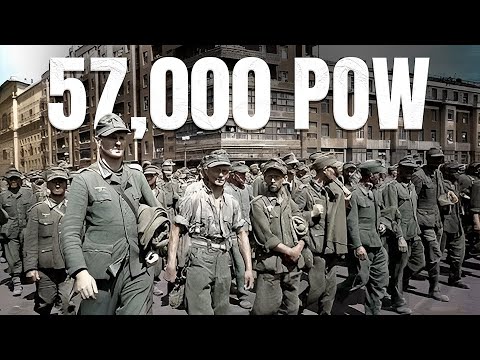
The operation was called Operation Grand Waltz, a name borrowed from a popular American musical film. It was organized in complete secrecy by the NKVD. The plan was simple but shocking: nearly 57,000 German prisoners of war—wounded, dirty, and exhausted—would march through the streets of Moscow under Soviet guard. More than 120,000 civilians would watch. This was not a traditional victory parade; it was a parade of the defeated, designed to show the Soviet people and the world the true scale of the Red Army’s success.
Preparations began in mid-July 1944. Trains loaded with German prisoners started arriving in Moscow. They were housed in places like the Moscow Central Hippodrome and Dynamo Stadium. The prisoners were given food but were forbidden to wash. They had to appear in deplorable conditions—wearing the same clothes they were captured in, some even barefoot. Each prisoner underwent a rigorous medical examination, and only the moderately healthy were selected for the march. The most robust men were chosen, those capable of enduring a several-kilometer procession through the capital.
On the morning of July 17, 1944, the prisoners were given a final meal of porridge, bread, and lard. At 11:00 a.m., they were divided into two groups. The first group of 42,000 soldiers marched along Leningradsky Highway, passing through important streets and squares like Gorky Street and Mayakovsky Square. The second group of about 15,600 men marched along the Garden Ring. At the head of the columns were 19 German generals and six colonels, allowed to wear their uniforms and decorations. Behind them came over 1,000 officers and then the infantry soldiers.
The Muscovites gathered in great numbers, watching in silence. Some prisoners showed open hatred toward the spectators, others curiosity, but most remained indifferent. The crowd was kept under control by thousands of Red Army troops and about 12,000 NKVD agents hidden among them. Any attempt to throw stones was immediately stopped. One German soldier, Bernhard Braun, later recalled: “I wondered, do I feel humiliated? Probably not. Worse things happen in war. We were used to following orders.” A young Muscovite, Roman Shenko, said, “We were watching the Germans very closely in stony silence. No one said a word. Neither they nor we.”
The parade ended at 7:00 p.m., and the prisoners were loaded into cattle wagons bound for camps in Siberia. Cleaning trucks then passed through the streets, symbolically cleansing Moscow of the “moldy green filth,” as Pravda put it. The event sent shockwaves around the world. Some leaders called it humiliating and unacceptable, while others recognized the overwhelming power of the Soviet army. But for Stalin, it was a perfect propaganda victory—a walk of shame that would be remembered for generations.
The international reaction was swift and divided. British and American newspapers ran photographs of the columns with headlines that mixed awe with unease. “The Russians have shown the world what they intend to do with Germany,” one London editorial noted, while a U.S. senator privately called the spectacle “a warning shot across Europe.” The Western Allies had long doubted the scale of Soviet victories, but the parade made the Red Army’s power undeniable.
Inside Germany, the propaganda machine scrambled to respond. Berlin radio dismissed the event as a “Bolshevik circus,” but the images were already circulating. For many ordinary Germans, the sight of their own generals marching in defeat was a psychological blow that no amount of rhetoric could soften. The myth of the invincible Wehrmacht cracked a little further with every step those prisoners took.
Yet the parade was not the end of the story. The 19 captured generals who remained in Moscow were not merely trophies. Soviet intelligence officers began interrogating them almost immediately, seeking details about German defensive plans and troop dispositions. Some, like General Müller, were pressed for information about the Vistula line and the crumbling southern front. Their knowledge would feed directly into the next Soviet offensives.
Meanwhile, the prisoners sent to Siberia faced a different kind of ordeal. Cattle wagons packed with men rolled east for days, with little food and water. Many did not survive the journey. Those who did found themselves in camps where the war’s end was still a distant hope. The parade had been a show of power, but the aftermath was a grim reality of cold, hunger, and silence.
Back in Moscow, Stalin’s inner circle quietly celebrated. The operation had achieved everything the Kremlin wanted: it had lifted Soviet morale, impressed the allies, and humiliated the enemy. But it also sent a message within the Soviet system itself. Anyone who doubted the Red Army’s strength now had a visual reminder of what Soviet power could do.
The parade of the defeated faded from Western memory in the decades that followed, overshadowed by D-Day and the later horrors of the Holocaust. Yet in Russia, it remained a symbol—a moment when the tide of war was made visible. For the men who marched that day, it was a humiliation they would never forget. For the Muscovites who watched, it was a silent reckoning.
As the last wagons disappeared into the east, the streets of Moscow returned to normal. The cleaning trucks moved on, and the crowds dispersed. But the image of those columns—ragged, silent, and defeated—lingered. It was a parade that Hitler had dreamed of, but not the one he had imagined. And for the Soviet Union, it was proof that the road to Berlin was now open.
But the story of Operation Grand Waltz did not end with the cleaning trucks. In the weeks that followed, the NKVD carefully curated the footage for maximum effect. Soviet cameramen had captured every angle—the generals in their medals, the barefoot infantry, the silent crowds—and now that film was edited into newsreels shown in cinemas across the country. For millions of Soviet citizens who had never seen a German soldier except as a distant threat, the images were electrifying. Here, at last, was the enemy made flesh and rendered powerless.
The newsreels were screened alongside reports from the front lines, where the Red Army was already pushing toward the Vistula. The message was unmistakable: the same soldiers who had marched through Moscow in shame would soon be followed by Soviet tanks rolling through Berlin. In factories and collective farms, the footage sparked a surge of patriotic enthusiasm. Production quotas were exceeded in the weeks after the parade, and volunteers flooded recruitment offices. The Kremlin had calculated correctly—humiliation of the enemy was a potent fuel for the Soviet war machine.
Yet the parade also had consequences beyond propaganda. The Western Allies, already uneasy about Soviet intentions in Eastern Europe, now saw a darker side to their eastern partner. Some British intelligence officers quietly noted that the event bore the hallmarks of a regime that knew how to stage-manage cruelty. The goodwill of the alliance remained intact, but the seeds of postwar suspicion had been planted.
Among the German prisoners who marched that day, one man’s story would later surface in a memoir published in the 1950s. His name was Erich Stahl, a corporal from Silesia who had been captured near Minsk. Stahl described the march in stark, unemotional terms—the heat, the thirst, the faces of the Muscovites. “What I remember most,” he wrote, “was a woman in the crowd who crossed herself as we passed. She was the only one who showed us anything but silence.” That small gesture, he said, stayed with him through the years of captivity.
Stahl also recalled the moment the column passed the Kremlin. The prisoners had been told nothing about their route, and the sight of the red walls and golden domes drew a murmur from the ranks. “Some of the younger soldiers actually smiled,” he wrote. “They had been promised Moscow for three years. Now they were seeing it as prisoners, not conquerors.” The irony was not lost on them.
For the Soviet authorities, the parade was a success, but it also created logistical headaches. The 57,000 men had to be dispersed to camps across Siberia and Central Asia, and the railway system was already strained by the demands of the front. Some trains carrying prisoners were delayed for weeks, and reports of deaths from overcrowding reached Moscow. The NKVD quietly filed these reports away, and no official inquiry was ever held.
Meanwhile, the 19 generals held in Moscow proved useful in unexpected ways. During interrogations, several of them revealed details not only about German defensive positions but also about the growing rift between Hitler and his senior commanders. One general, a veteran of the Eastern Front, spoke bitterly of Hitler’s interference in tactical decisions. Soviet intelligence officers passed this information up the chain, where it was used to shape the propaganda campaign that would accompany the final push into Germany.
By the time autumn arrived, the parade had become part of Soviet folklore. Children in Moscow schools were taught about it as a symbol of the turning tide. Songs were written, and a documentary film was produced for international distribution. In the villages of Belarus, where the German occupation had left scars that would never fully heal, the footage of the parade was shown with particular intensity. For those who had survived the occupation, the sight of German officers marching under Soviet guard was a form of justice, however partial.
The parade also marked a shift in how the Soviet Union presented itself to the world. No longer content to be seen as a victim of aggression, the Kremlin now projected an image of ruthless strength. Stalin’s message was clear: the Soviet Union had not only survived the German onslaught but had emerged as a power capable of shaping the postwar order. The parade of the defeated was a preview of the Cold War to come—a demonstration that the Soviet Union would not be content with mere victory. It intended to dominate.
In the decades that followed, Operation Grand Waltz remained a footnote in Western histories, yet in Russia it never truly faded. Veterans of the Moscow crowds told their grandchildren about the silent columns, and the newsreels were replayed on anniversaries. For them, the parade was not cruelty—it was justice made visible. The men who had burned their villages had finally walked in shame.
Erich Stahl’s memoir ended with a simple admission. After the war, he returned to Silesia and never spoke of Moscow for years. Then one evening, watching a documentary, he saw himself in the crowd footage—a thin, barefoot figure staring ahead. “I realized then,” he wrote, “that we were the parade Hitler promised. We just arrived three years late and in the wrong direction.”
The cleaning trucks, the silent crowds, the generals in their medals—all of it became a single image of a war turning. Hitler’s dream of marching through Moscow had come true, but it was Stalin who directed the scene. The road to Berlin was open, and the parade of the defeated was its first step.
What do you think—was Operation Grand Waltz a justified act of retribution, or a propaganda spectacle that crossed a line? Share your thoughts in the comments below.
Report this article
Select a reason for reporting:






