Staff Sergeant Marcus Delgado had spent fourteen years in uniform, three combat deployments, and countless hours alongside the best soldiers on Earth. He had a precise internal scale for measuring men, and it did not move easily. Then, on a wet April morning in the Philippine jungle, that scale shattered.
He stood at the edge of the training area, watching the tree line where four Australian SASR operators had just vanished. Not walked away. Vanished. In broad daylight. In thirty-eight seconds. “I don’t think there’s a word for it,” he muttered to the young soldier beside him. The question that followed would haunt him for weeks: Should there be?
The exercise was Balikatan—Filipino for shoulder to shoulder. By 2025, it was no longer a training formality. With the South China Sea growing more contested by the month, thousands of troops from the US, Philippines, Australia, and Japan had gathered across Luzon for a rehearsal of something far more serious. The jungle phase was simple on paper: hunter teams had to reach a defended objective without being detected. The defenders had thermal imaging, working dogs, and two days of preparation. Experienced soldiers called the task close to impossible.
Delgado ran the outer security cordon—twelve American and Filipino special operators covering a three-kilometer perimeter in twenty-four-hour rotations. He was thorough in the way he was always thorough. Every logical approach was covered. Every sensor readout accounted for. Nothing moved through that jungle without his knowledge. Or so he believed.
On the second morning, his easternmost team reported movement at the tree line. A single figure, fifty meters out. Delgado sent reinforcements. They found nothing—just flat earth, leaf litter, and pooled rainwater. The thermal log showed a heat signature visible for eleven seconds before it simply… stopped. Not moved. Stopped. As if whatever produced it had melted into the jungle floor.
What Delgado didn’t know was that by the time his men reached the east side, the Australian team was already inside the cordon. All four of them. The single figure had been a deliberate flush—a timed exposure to identify which sector would draw reinforcement, and therefore which sectors would thin. Eleven seconds of thermal signature, calculated in advance as an acceptable price for information.
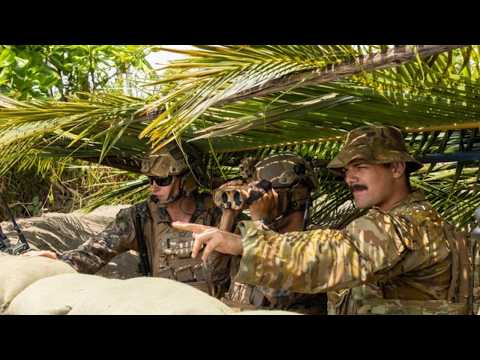
For the next twenty-two hours, the four-man team moved approximately eight hundred meters. Not because the terrain was difficult, but because they chose a rate the environment would absorb without registering. The team leader lay motionless for six hours in a shallow depression, watching the objective’s northern face. He counted guard rotations. He mapped a thirty-meter strip of dry vegetation the defenders had assessed as too exposed to cross. He crossed it at 03:30 on the third morning. Alone. On his stomach. Over forty-five minutes, coordinating each movement with the wind and the shifting insect noise. He reached a position twelve meters from the northern wall and took three photographs.
None of that was what stopped Delgado cold. What stopped him came after the exercise, when the Australian team leader walked to the map table and placed his marker. Delgado looked at the marker. He looked at the terrain. He looked at the marker again. The position was inside his inner security ring. Seventy meters from the defended objective.
One of Delgado’s soldiers—a twelve-year veteran named Torres—had eaten his lunch two days earlier approximately five meters from where the Australian had been lying. Torres had sat with his back against a tree root, scanned the jungle for movement, and seen nothing. He had been five meters from a man who arrived two hours before Torres sat down and remained motionless for three hours after Torres left.
Outside the briefing, Torres stood with Delgado in the humid afternoon air. “I sat five meters from him,” he said. “Yes, I was looking for movement.” He shook his head once, quietly, and went inside.
The Australian’s name was Tom Mackay. Twenty-eight years old. From Longreach in Outback Queensland, where his family had run cattle on forty thousand acres for three generations. He had learned to sit still before he was ten because movement alarmed the cattle. He read birds the way other people read clocks. He passed SASR selection at twenty-three and never discussed the details with his family. Some experiences, he had learned early, do not translate into language that lands correctly for people who were not inside them.
When Delgado found him later, cleaning equipment with unhurried efficiency, he asked how Mackay had identified the position near the pooled water. Mackay thought about it. “The guards looked at the high country when they were nervous. Never at the wet low terrain. People don’t think of wet earth as cover, so it’s always cover.” Delgado sat down across from him. “Torres has been doing this twelve years. He didn’t see you.” Mackay shrugged—not dismissively, but with no particular investment in how the information landed. “He wasn’t looking in the wrong direction. He was looking at the places you look. I was in the place nobody looks. That’s a different thing.”
They spoke for twenty minutes. Mackay answered everything directly, without decoration, and asked nothing back—not from indifference, Delgado sensed, but because he had already gathered what he needed from watching. Across days of observation Delgado had not known were happening.
Before the Australians packed out, Delgado watched them move into the tree line. He had a clear line of sight for sixty meters and was watching specifically for them. The four men disappeared in thirty-eight seconds. Not because they moved fast, but because they moved in a way the eye processed differently—a combination of pace and line and disrupted outline that did not trigger the same detection response. Thirty-eight seconds. Broad daylight. Jungle he had been standing in for four days.
And then they were simply gone.
Delgado flew home to San Antonio six days later. In the transit lounge at Ninoy Aquino International Airport, with four hours to fill, he opened his personal log and wrote a single line: “Australian SASR, four men, jungle phase. They were not what I expected.” The word he kept returning to, and could not replace with anything more precise, was native. They moved through that jungle like something native to it. That is not a technique. That is something else entirely.
Torres, back at his unit, told the story to anyone who would listen. Not as a complaint—as a correction to something he had assumed without examining. He had believed twelve years of hard training and genuine operational experience had given him a full picture of what an allied special forces soldier could do. “That man did not learn that in any building,” he kept saying. “He brought it from somewhere else entirely.”
What neither man fully grasped yet was how deep that somewhere else ran. The SASR had been operating in jungle since its founding as a company in 1957—Borneo during the Indonesian Confrontation, five years of long-range patrols in Phuoc Tuy province in Vietnam, more than six decades of continuous refinement. The regiment’s institutional memory held more combined hours of sustained jungle reconnaissance than almost any comparable unit in the Western alliance.
But institutional memory was only half of it. The other half walked into the recruitment office from places like Longreach—men shaped by country that did not forgive inattention, that demanded a daily relationship with patience and stillness. The Philippine jungle was close enough to the Borneo jungle in the ways that mattered: dense canopy, wet earth that held track sign for twenty-four hours, a living environment that rewarded patience without sentiment and without margin.
Delgado thought about this on the flight home and in the weeks after. He thought about what the regiment had found when it went looking for men like Mackay in 1957, and what it had built on top of what it found—exercise after exercise, deployment after deployment—until the thing being built became so absorbed into the institution that it stopped looking like something built. It started looking like something grown.
He thought about Mackay’s sentence: He was looking at the places you look. I was in the place nobody looks. Simple as it was, it held something worth sitting with. The most useful capability in a contested environment is not always the one that produces the largest immediate effect. Sometimes it is the capability that produces no visible effect at all—because it has positioned itself so completely inside the terrain that the terrain itself becomes the weapon.
Four men in the right position, seeing everything, costing the other side nothing to confirm and everything to discount. That is not a lesser form of military power. In the island chains and coastlines where the next serious test of this alliance will most likely be written, it may be the most decisive form available.
Australia’s investment in Balikatan had grown in the years before 2025, tracking almost directly with the rising tension to the north. Around 260 Australian Defence Force members participated that year, bringing conventional and special forces whose preparation for this specific environment ran far deeper than anyone on the other side of the exercise had anticipated. Canberra understood what it was sending. It was not sending it casually.
Three weeks after the exercise, Delgado received a brief email from a liaison officer he had met during the phase. Attached was a single photograph—taken on the exercise camera, the liaison explained, and cleared for release to participating units. It showed the northern wall of the defended objective from a distance of roughly twelve meters, framed low through wet grass. In the corner of the frame, barely visible, was a detail Delgado had to enlarge twice to confirm: the shoulder patch of one of his own soldiers, seated against a tree root, eating lunch.
The photograph had been taken from a position Torres had sworn was empty.
Delgado studied it for a long time. Then he forwarded it to Torres without comment. The reply came back within the hour, two words and nothing else: “I know.”
Delgado closed his laptop and sat in the quiet of his quarters, turning over the question Bressler had asked at the tree line, the one he had never answered. Should there be a word for it? He was beginning to think the Australians had a word already—they just didn’t use it, because to them it wasn’t remarkable. It was simply what the country had taught them before the army ever got the chance.
He picked up his log, opened to the last entry, and read it back. I would not want to go into that jungle against them. He decided it was still accurate. Then he added a second line beneath it, one he would spend the next exercise trying to understand: “And I am starting to think that is the whole point.”
He did not send the photograph to anyone else. Some lessons are not meant to be passed around like a briefing slide. They are meant to be carried, quietly, into the next patch of jungle.
Torres carried it differently. He started spending his off-hours reading about the Kimberley and Cape York, about spear grass and black soil and the way water behaves in country that has never been tamed. “I want to learn to look where nobody looks,” he told Delgado once, almost embarrassed. Delgado nodded. That was the whole correction, he realized. Not a technique. A direction of attention.
The next rotation came. New exercise, new country, same alliance. Delgado walked the perimeter at dusk and found himself doing something he had never done before: he stopped checking the places he would have checked. He started checking the places he would have ignored.
He found nothing, of course. That was the point.
Somewhere out there, four men were already inside his cordon, motionless, patient as stone, watching him look at all the wrong places. And for the first time in fourteen years, Marcus Delgado smiled at the thought.
What would you have done, standing at that tree line, watching them disappear?
Report this article
Select a reason for reporting:






