The photograph is grainy, but it stops you cold. A massive Australian soldier, uniform black with sweat and rain, leans forward under the weight of a wounded American slung across his shoulders. The man’s head lolls, his boots dangle inches above the jungle floor. Around them, the slopes of Mount Tamboo rise like a green wall, choked with mud and vines and unseen death. The soldier carrying him is Leslie ‘Bull’ Allen. The date is July 30, 1943. The place is New Guinea, one of the most brutal battlefields of the Second World War. And that single frame captures something far greater than bravery—it captures the instant one man chose humanity over fear, again and again, under fire.
By that point in the war, the Allied campaign in New Guinea had become a grinding nightmare. Steep, jungle-covered mountains replaced beaches and open ground. Soldiers fought not just the enemy, but disease, exhaustion, and terrain that punished every step. Rain turned paths into rivers of mud. Wounded men often lay where they fell because reaching them meant exposing yourself to enemy machine gun fire. On Mount Tamboo, American troops had been ordered to assault a well-defended Japanese position. The attack went badly. The enemy held the high ground. Machine guns raked the slopes. Mortars fell without warning. As the Americans were forced to pull back, wounded soldiers were left stranded on the hillside, crying out for help that no one could safely give.
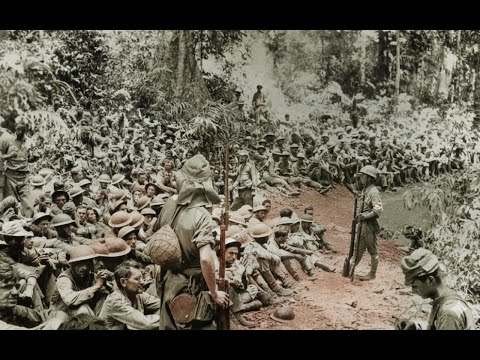
That was when Bull Allen stepped forward. He was not an infantryman. He carried no rifle. He was an Australian Army medic trained to save lives, not take them. He had already been wounded earlier in the campaign and evacuated, but had insisted on returning to the front. Big, powerfully built, and quiet by nature, Allen had earned his nickname not through aggression, but through sheer physical endurance and reliability. When he saw the wounded Americans trapped on the mountain, he did not wait for orders. He simply went up.
Through Japanese fire, up the muddy slope, Allen reached the first wounded soldier. He lifted him onto his shoulders and carried him down to safety. Most men would have stopped there. Allen did not. He turned around and went back up the mountain again and again and again. By the end of that day, 12 American soldiers were alive because one Australian medic refused to accept that they were beyond saving.
At the time, few people realized what had happened on that jungle hillside. There was no speech, no announcement—just exhausted men, wounded survivors, and one medic who finally collapsed from sheer physical exhaustion. But that photograph, taken moments after one of those rescues, would go on to define courage not as violence, but as compassion under fire. And that is where the story of Bull Allen truly begins.
While Europe burned and North Africa raged during World War II, another theater of war was unfolding in the steamy, disease-ridden jungles of the Pacific—a front that would become one of the most brutal campaigns fought by Australian troops: New Guinea. This wasn’t the war of grand tank battles or air raids over cities. It was a war of mud, mountain, and malaria. Fought in a place where every inch of ground came at the price of blood and exhaustion.
After the fall of Singapore in 1942, Australia realized it could no longer rely solely on Britain for defense. Japanese forces were pushing south, threatening New Guinea and eventually Australia itself. The Kokoda Track campaign had already shown how difficult jungle warfare could be. Now, in 1943, Australian and American troops were engaged in a grinding series of offensives to dislodge Japanese forces from key strategic positions, including the high ridges surrounding Salamaua and Lae. One of those positions was Mount Tamboo, a natural fortress towering over the jungle below, covered in slick clay, thick vegetation, and ideal defensive ground for the Japanese.
It was into this nightmare terrain that the 25th Australian Infantry Battalion, supported by elements of the US 32nd Infantry Division, was sent. The enemy was well dug in, their machine guns concealed in tree lines, mortars camouflaged under foliage. Every assault meant climbing uphill under fire with supply lines that barely functioned. Wounded men were often stranded because the slope was too steep or too exposed for stretchers. Helicopter evacuations were impossible. The only way down was on someone’s back.
It was here that Corporal Leslie ‘Bull’ Allen, a 26-year-old stretcher bearer from Ballarat, found himself. Unlike most soldiers, Allen didn’t carry a weapon. He carried a medic satchel, a bandage roll, and an iron determination to save lives. He had already proven himself on the track at Wau and Mubo, known for his strength and stamina, and for his quiet, unshakable nature. On July 30th, 1943, during a combined assault on Japanese positions near Mount Tamboo, US troops came under intense fire and were forced to fall back. Twelve wounded American soldiers were left on the slope—stranded, bleeding, unable to crawl out.
The situation was clear. To save them would mean almost certain death. And yet, Bull Allen didn’t hesitate. As mortars exploded nearby and bullets tore through leaves, he began climbing. Not once, not twice, but again and again through gunfire, mud, and exhaustion. His actions would be remembered not just for the number of lives he saved, but for the fact that no one asked him to. He simply saw men dying and did what others couldn’t or wouldn’t.
What made it possible? The answer lies not in his strength, but in his unshakable moral clarity—a belief that even in the worst hell, one man could still bring others out alive.
Before he became a legend in the mountains of New Guinea, Leslie ‘Bull’ Allen was just a quiet boy from Ballarat, Victoria. Born in 1916 into a life that was anything but easy, he grew up in the aftermath of the First World War and through the Great Depression. His family was working-class. Money was tight. Schooling was minimal. From a young age, he took whatever work he could find—farmhand, laborer, odd jobs in brutal conditions—anything that taught him how to endure and keep going when things got hard.
That endurance would become his signature. He joined the Australian Army in 1940, not out of glory or ambition, but out of duty. At first he served in a signals unit, but after showing an instinctive ability to stay calm under pressure—and possessing remarkable physical strength—he was reassigned as a stretcher bearer in the 20th Infantry Battalion. It was a role that demanded more than muscle. It required nerve, selflessness, and a tolerance for horror. Allen had all three.
He wasn’t loud. He wasn’t flashy. Fellow soldiers described him as a big, quiet bloke who always carried more than his share and never complained. When others faltered, Allen picked them up—sometimes literally. He wasn’t the kind of man who barked orders or delivered speeches. He simply did what needed doing, especially when things got ugly. He earned his nickname ‘Bull’ not because of rage or violence, but because of his sheer size, endurance, and quiet determination. Like a draft animal, he kept moving forward through jungle rot, enemy fire, exhaustion, and terrain that broke weaker men.
Before Mount Tamboo, Allen had already been wounded in action during the Wau campaign, and doctors had recommended he return to Australia to recover. He refused. Instead, he asked to rejoin his battalion. He didn’t want to abandon his mates, and he believed—as he would later say in a rare interview—that being there might mean someone else got to live. That belief became his code.
As a medic, Allen saw the worst of war. Men screaming in pain, lungs torn open, limbs gone. He carried them through mud, over ridges, down cliffs, often under fire. He didn’t hesitate, didn’t freeze, and didn’t need orders. He acted on instinct—one built from years of hardship, quiet responsibility, and deep personal courage. By the time the attack on Mount Tamboo came in July 1943, Allen had already proven himself to his battalion. But it was what he did over those few critical hours—going back up that deadly hill twelve times—that revealed the full extent of who he really was.
Bull Allen was never trained to fight like a hero. He was shaped to endure like one.
The sound of gunfire echoed like thunder across the jungle slopes of Mount Tamboo on the morning of July 30th, 1943. The combined Australian and American assault had stalled. US troops from the 32nd Infantry Division had launched an uphill attack against well-entrenched Japanese positions, only to be cut down by machine gun fire and mortars before reaching their objective. The terrain was a nightmare—steep, slippery clay, jungle foliage that hid death at every step, and heat that drained strength from even the fittest men.
Wounded Americans lay scattered across the muddy slope. Some cried out for help. Others lay still, too far gone to speak. Most were pinned down and helpless, trapped between enemy fire above and the distance to friendly lines below. To go out into that killing zone was to walk into certain death. But Corporal Leslie ‘Bull’ Allen didn’t hesitate.
With nothing more than a medic satchel, a Red Cross armband, and an iron will, he began to climb the slope alone, into the line of fire. He reached the first wounded soldier, slung the man over his broad shoulders, and began the treacherous descent. Enemy fire cracked around him. Bullets kicked up dust at his feet. Mortar shrapnel sliced into tree trunks nearby. But Allen didn’t falter. When he reached the bottom and handed off the wounded man to stretcher teams, he didn’t stop to rest. He went back up again.
And again.
By the fourth trip, his uniform was soaked with sweat and mud, his boots slipping on the blood-slick slope. Yet each time he crested the ridge and disappeared into the smoke, soldiers watching from below held their breath, fearing this would be the last time they saw him alive. But each time he came back with another man. One soldier was unconscious. Another had been shot in the leg. One had a collapsed lung. Allen didn’t care who they were—only that they were alive and needed to get off that mountain.
American soldiers on the ridge were stunned. “We thought he was done after number five,” one later recalled. “Then we saw him coming back up like a damn bull through the jungle.”
By the time Allen carried down the twelfth man, his legs buckled and he collapsed from exhaustion. He had climbed and descended a battlefield twelve times under direct fire, saving twelve lives that would almost certainly have been lost without him. He didn’t do it for a medal. He didn’t do it for recognition. In fact, when asked later why he had done it, Allen gave a simple answer.
“They were wounded. They couldn’t walk. I could.”
On a day when the jungle was filled with screams, smoke, and suffering, Bull Allen became a symbol of pure, selfless courage—the kind that doesn’t come from training, but from the heart. When he collapsed after the twelfth man, the battlefield fell into a stunned silence. American medics rushed to his side, fearing he was dead from sheer exhaustion. Then his eyes fluttered open, and through chapped lips he whispered, “Is that all of them?”
Word spread fast. One wounded American, meeting him days later, reportedly wept and said, “You gave me my life back.” The US Army awarded him the Silver Star, and Eleanor Roosevelt sent a handwritten letter of gratitude. Yet back in Australia, there was no medal, no parade—his actions were deemed part of his medical duties. Allen never complained.
The war left marks no metal could cover. He returned to Ballarat, struggled in silence with what we now call PTSD, and died in 1982, never embracing the fame. But the photograph endured—and history, as it often does, caught up.
So here is the question worth asking: if courage is measured not by the medals we wear but by the lives we carry, whose name deserves to be spoken in your home tonight?
Report this article
Select a reason for reporting:






