He was born in a palace, but he was never truly at home. Winston Leonard Spencer Churchill entered the world in November 1874 at Blenheim Palace, a 320-room monument to his ancestor the Duke of Marlborough. Yet from the very beginning, he was a boy in search of approval—especially from the father who saw him as a failure.
“I’m so wretched. Even now I weep,” young Winston wrote to his mother from boarding school. “Please do come to see your loving son.” But his parents were too busy with society and politics. He received barely one visit a year.
His father, Lord Randolph Churchill, was a brilliant, fiery politician who never missed a chance to belittle his son. Convinced Winston would never amount to anything, he steered him toward the military. It was an unintended gift. At Sandhurst, Winston excelled as a horseman, marksman, and swordsman. “You see, I’m not a good for nothing,” he seemed to say.
But the dream of standing beside his father in Parliament ended when Lord Randolph died of syphilis at 46, never having acknowledged his son. Winston was 20. From that day, he was a man on a mission—determined to accomplish something before death took him too.
He sought his baptism of fire across the British Empire—Cuba, India, the Sudan, where he took part in the last cavalry charge in British history. He would rather have a heroic death than be a nobody. And if he survived, he would make a name for himself equal to his father’s, if not greater.
It was in these wars that Winston truly became Churchill. He developed a lifelong taste for danger, alcohol, cigars, and writing. On every battlefield, the soldier doubled as a prolific war correspondent. His dispatches made his name.
In South Africa, he saved the crew of an armored train, was taken prisoner, and escaped. A price was put on his head: £25 dead or alive. After three weeks on the run, he hopped a freight train and arrived back at base in triumph. He returned home a hero.
At 26, he was elected to Parliament under the Conservative banner. His political career was meteoric. He fiercely defended his ideas, even switching parties—earning the nickname “the Blenheim rat” for his betrayal. But he took no heed. At 32, he entered government as its youngest member in half a century.
He married Clementine Hozier, a Scottish aristocrat ten years his junior, and wrote later, “I married and lived happily ever afterwards.” Ministerial posts followed until, at 36, he became Home Secretary. He was impossible to pin down—a liberal among conservatives, a conservative among liberals.
But it was in 1911 that England discovered just how determined and intriguing Winston truly was. During the Sidney Street siege, he rushed to the scene, ordered the building burned to the ground, and refused the fire brigade access. The insurgents died in the blaze. Photos of the minister were on every front page. To a colleague who reproached him, he replied, “Don’t be cross. It was such fun.”
Britain’s premier policeman was a soldier and would remain so all his life. He gave his all to creating the British Secret Service and regularly attended military maneuvers—including those of the German army alongside Kaiser Wilhelm II. For Churchill, there was no doubt: Germany was striding toward war.
He convinced the prime minister to appoint him First Lord of the Admiralty. On board the Admiralty yacht, he threw himself heart and soul into preparing the fleet. He modernized it, launched new warships, and even pioneered the Royal Naval Air Force. When war broke out in August 1914, the British fleet was ready.
But the First World War was a war of positions—mud, trenches, and tens of thousands of dead. For Churchill, holding back was inconceivable. He wanted to open a new front, take Germany by surprise by cutting it off from its Ottoman ally. The plan: force the Dardanelles Strait, the only access to Constantinople.
It was a disaster. The Turkish defenses were underestimated. All attempts to land ended in miserable failure. 100,000 Allied dead, 150,000 casualties. It was one of Britain’s greatest disasters of the war. And the politicians wanted Churchill to pay the price.
The Conservatives had not forgotten the Blenheim rat. They wanted his head. Rejected all round, he was forced to resign. The mighty Churchill had a long way to fall. Like his father before him, the heir to Marlborough had failed.
Left with nothing to do, he plunged into a terrible depression. He called it his black dog. For the first time in his life, Winston could see no future for himself. After 15 years of continuous ascent, everything had fallen apart. The former minister, soldier, writer, and MP drowned his sorrows in drink, tobacco, and an unexpected new pastime: painting.
But Churchill was consumed by the need for action. Now 40, he got himself assigned to the command of a Scottish battalion fighting in Flanders. Within six months, his old energy returned. He went back to London, where publication of the Dardanelles report restored his spirits. He was finally appointed Minister of Munitions.
In 1917, he equipped the half-million American soldiers who landed in Europe and had thousands of tanks built—the very tanks he had dreamed of as First Lord. In August 1918, they broke through the front and penetrated 400 kilometers behind German lines. It was the beginning of the end for the Kaiser’s army. And a personal triumph for Winston.
Three months later, the armistice was signed. Churchill would hold a succession of ministerial posts—war, aviation, the colonies—until fate and the vagaries of politics clipped his wings. His youngest daughter, Marigold, died of meningitis. Grieving, he faced a new election but was prevented from taking part by an attack of appendicitis. He had himself taken to vote in a wheelchair. Even that did not prevent him losing.
Much later, he wrote, “In the twinkling of an eye, I found myself without an office, without a seat, without a party, and without an appendix.” The blows came thick and fast, but Winston would rise above them.
Two years later, the Conservatives offered him a constituency and the post of Chancellor of the Exchequer—like his father 30 years before. Despite his earlier betrayal, Churchill returned to the bosom of the Conservative Party. He remarked, “Anyone can rat, but it takes a certain amount of ingenuity to re-rat.”
It was now 1925, and Churchill, the human whirlwind, had been in politics for a quarter of a century. He had become an orator without equal. When MP Lady Astor spat at him, “If I were your wife, I’d poison your coffee,” Churchill replied, “Madam, if I were your husband, I’d drink it.”
But Winston was a very poor Chancellor, and the crisis of 1929 swept the government out of power. The Conservatives held him responsible. Once again, he was a leper in his own party. Nobody had forgotten his intrigues, his inconsistency, his turncoat behavior. Along with his support for King Edward VIII, it made him the country’s most unpopular MP. Everyone, even his own family, agreed his political career was behind him.
And yet, like a drowning man who has to hit bottom before he can come back up, Churchill used the last of his strength to make himself heard again. Alone among the entire British political class, he warned Parliament of the danger of Hitler’s rise and the illusion of pacifism. He was one of the only MPs to criticize the Munich Agreement, which handed Hitler part of Czechoslovakia in exchange for a mere scrap of paper.
But his words went unheard. Prime Minister Neville Chamberlain returned from Munich triumphant. For the English, Chamberlain was the hero who had kept the peace. Then German troops marched into Prague, and any remaining pacifist illusions were shattered. The Munich Agreement was invalid. Churchill had been right.
Gradually, public opinion shifted. The newspapers announced, “We need Churchill.” When, six months later, Hitler invaded Poland, France and Britain finally entered the war. Chamberlain offered Churchill his old post, First Lord of the Admiralty. For most men, war is a disaster. But in Churchill, it awakened a passion. At 65, he was full of energy. The bulldog had become a lion.
Chamberlain proved a disastrous wartime prime minister, and he paid the price. On May 10, 1940—the very day Hitler launched his attacks on Belgium and Holland—Churchill finally took up the position he had always dreamed of. This, he felt, was the moment he had been living for.
The Royal Air Force, on which Britain now pinned all her hopes, was pioneered by him back in 1912. The hundreds of tanks awaiting the land invasion—he had upgraded them all in 1915. MI6, now in intense preparation, was created 32 years ago while he was Home Secretary. And the Royal Navy’s new ships were built by him as First Lord. For Winston Churchill, the war that had just been declared was a personal matter and the high point of his career.
The new prime minister’s main weapon, though, was not made of iron or steel, but of spirit. It was the remarkable eloquence he had sharpened over the last 40 years. Winston would find the words to awaken the British people and give them the courage to stand brave against all odds.
“I have nothing to offer but blood, toil, tears, and sweat,” he told the House. “You ask, what is our policy? I will say it is to wage war by sea, land, and air with all our might and with all the strength that God can give us. You ask what is our aim? I can answer in one word: Victory. Victory at all costs. Victory in spite of all terror. Victory, however long and hard the road may be.”
Listening to him, even the opposition were in tears. The British people were torn between fear and defeatism and the will to survive. The courage was there, but it had to be brought to the surface. And that is what Churchill had done.
Yet on that first evening, the new prime minister had his doubts. Greeted by a crowd shouting, “Good luck, Winnie. God bless you,” he broke down in tears in private and confided to one of his generals: “Poor people. They trust me, and I can give them nothing but disaster for quite a long time.”
The disaster arrived quicker than expected. Churchill was counting on France and its formidable army, but after six weeks of fighting, it collapsed. England stood alone. Alone against the greatest war machine Europe had ever known. The situation seemed so hopeless that some ministers were considering negotiating with Hitler. Churchill categorically refused. He would rather die sword in hand.
In the summer of 1940, the Battle of Britain began. Hitler wanted to invade the British Isles, but to do so, he first had to gain control of the skies. Hundreds of German bombers, escorted by Luftwaffe fighters, pounded military targets in southern England. A fierce battle for the skies ensued between the German Messerschmitts and British Spitfires and Hurricanes. The sky of Britain was aglow.
Yet despite the pilots’ bravery, within a fortnight, the Royal Air Force was near to losing control of England’s southern airspace. Then a fortuitous event changed the course of destiny. On August 24, a German pilot committed a navigational error and dropped his bombs on the outskirts of London. For Churchill, this was provocation. He ordered the bombing of Berlin to start the next day.
His generals tried to dissuade him. Berlin, they said, was too far away. But Churchill was determined—and now he was angry. Most of the planes were shot down or forced to turn around. Only a handful of pilots somehow managed to drop bombs on the outskirts of Berlin. It was a risky operation with totally unexpected consequences.
Hitler cracked. Berlin bombed—he would not tolerate it. In his fury, he ordered his air force to burn London and all major British cities to the ground. The operation was named Blitz—Lightning. Hitler was convinced England would be on its knees within days. But despite the rain of fire that struck the city, the apocalyptic scenes the population had to live through, and the tens of thousands dead, London survived.
Throughout the Blitz, Churchill was constantly on the move, keeping morale up in the worst-hit areas. The English were all behind him and beside him. Hitler had been convinced that the morale of the British would collapse, along with that of their leader. Not at all. The English and their leader were of one accord.
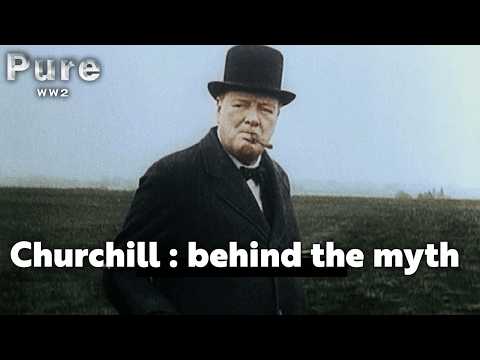
Churchill’s firmness, his imperturbable dignity, his unwavering faith in the future, his conviction that England would triumph—along with his smile, his hat, his cigar, and his fiery speeches—all made him a symbol of resistance against tyranny.
“We shall defend our island, whatever the cost may be,” he declared. “We shall fight on the beaches, we shall fight on the landing grounds, we shall fight in the fields and in the streets, we shall fight in the hills; we shall never surrender.”
At this point, England was Churchill and Churchill was England. In unleashing his destructive madness, Hitler had made a terrible mistake. His air force was turned away from military targets. As civilians withstood the Blitz, Churchill reorganized the RAF, got his airfields back in order, and encouraged his airmen to renew their attacks. They caused carnage among the enemy. The United Kingdom would not be overrun. England had not lost the war.
But the question now was how to win it. For Churchill, the answer was simple: bring in the United States.
On December 7, 1941, the US base at Pearl Harbor was attacked by the Japanese. America was at war. Two weeks later, Winston was in the United States. He had to convince the American Congress not to leave the European battlefield and to continue supporting Britain. It was one of the most important speeches of his life.
On December 26, 1941, masterfully combining humor, eloquence, and determination, the master wordsmith surpassed himself. “If my father had been American and my mother British, instead of the other way round, I might have got here on my own,” he joked. Then, more seriously: “What kind of a people do they think we are? Is it possible they do not realize that we shall never cease to persevere against them until they have been taught a lesson which they and the world will never forget?”
The speech was a success, but the pressure had been intense, and Winston was not getting any younger. After a long meeting with Roosevelt, he felt a sharp pain in his left arm. He was having a heart attack. He begged his doctor, “You’re not going to tell me to rest? I can’t. I won’t. Nobody else can do this job. I must. You mustn’t say anything.” At this moment, as Britain joined forces with the United States, it could not be seen with a prime minister with a weak heart. Everything had to remain secret.
After a few days of forced rest, the old lion was back in top shape. At 67, he slept four hours a night, kept a tight schedule of appointments, meetings, and inspections. Always in the thick of Allied war preparations, while continuing to drink and smoke more than his fair share, he had never been happier. His depression was a thing of the past. He was in the limelight, and he was going to play it to the hilt.
When an assistant asked if he could have a weekend off, Winston scolded him, “A leave? But don’t you like this war?”
These images of a man and a people united and confident seemed to promise a victory that still looked a long way off. Everywhere on all fronts, the Allies were suffering terrible defeats. In Singapore in February 1942, 100,000 English fighters were taken prisoner by the Japanese—the biggest surrender in UK military history. But despite all the losses and drama, Churchill never stopped believing in victory.
Now, in a repeat of 1915, he wanted to surprise Germany and Italy from the rear. Indefatigable, he managed to convince Stalin and Roosevelt to order a landing in North Africa—Operation Torch. On November 8, 1942, English and American troops landed in Oran, Algiers, and Casablanca. Operation Torch was a success. Churchill could breathe again. The scent of victory was finally in the air.
“This is not the end,” he announced. “It is not even the beginning of the end, but it is, perhaps, the end of the beginning.”
But as Winston announced the end of the beginning, it was for him the beginning of his decline. In 1943, Allied military successes were on the increase. Yet despite Churchill’s heroic tours of the battlefields, it was Roosevelt who was now taking charge. And when the three leaders met in Tehran in November 1943, Churchill was painfully aware of his weakness. Between Stalin, holding off nearly 200 German divisions, and Roosevelt, the great provider of arms and equipment, he was not punching at the same weight.
“I realized at Tehran what a small nation we are,” he wrote. “There I sat with the great Russian bear on one side, and on the other the great American buffalo. Between the two sat the poor little English donkey, who was the only one who knew the right way home.”
He had been the bulldog, the old lion. Now he compared himself to a donkey. Depression was not far off. But the war was not over, and he had to keep going. Total victory was not yet assured.
But the Allied landing in Normandy on June 6, 1944, was indeed the beginning of the end. Still intoxicated by the smell of gunpowder, Winston dreamed of being there on the front line, but the king forbade it. The war was not yet over, and the old lion was irreplaceable. Only six days after D-Day could he at last visit the battlefield.
The visit was brief. It didn’t take long for the prime minister to satisfy himself that all went well on the first stage of the assault on Europe. The prime minister and his party returned to the destroyer Kelvin in complete confidence of still greater successes to come.
The architects of victory returned home. By the end of 1944, the Nazi armies were in retreat. Now that the end was near, Churchill was already preparing for the post-war period. If he wanted to limit communist expansion, he had to negotiate with Stalin.
“I have discovered,” he said, “that I can talk to him man to man, and I’m sure he’ll be reasonable.”
So when, in October 1944, he slipped Stalin a piece of paper with percentages scribbled on it, he may or may not have been bluffing. The figures represented the future division of power in Europe. In fact, they were completely fanciful. How else to account for 10% British influence in Romania and 25% in Bulgaria, where the Soviets reigned supreme and the British didn’t even have any access? Churchill obtained 90% influence in Greece. Stalin ticked the document and handed it back.
Churchill came back from Moscow with this scrap of paper in his pocket as delighted as Chamberlain coming back from Munich. In fact, he had been taken for a fool.
Four months later, in February 1945, Winston—the only man said to travel with more hatboxes than his wife—attended the Yalta Conference. The indefatigable septuagenarian was still trying to control the insatiable greed of Stalin, who was making vague promises of democratic elections in Central Europe. These promises were mere castles in the sand, but Churchill could obtain no more. As for Roosevelt, he was sick, weak, and credulous, ready to make any concession. And the sand castles would soon be destroyed by the red wave that engulfed Eastern Europe.
On May 8, 1945, Nazi Germany finally surrendered. Although elderly and infirm, Churchill had always stood solid as a rock and convinced his people that victory would be theirs. The whole of Britain applauded him.
“This is your victory,” he declared. “Victory of the cause of freedom in every land. In all our long history, we have never seen a greater day than this.”
For five years, Churchill had never stopped making history. And strangely enough, they had been happy years, which despite the constant overwork, had kept him from depression. The return to normality was brutal. Parliament was dissolved. After leading an international coalition and becoming a figure of world renown, the old lion had to run for reelection.
“We’re going to win. I can feel it in my bones,” he said. “I ask you to give me a chance to finish this job.”
Despite the immense gratitude the British people felt toward him, they were dubious of the old warrior’s ability to manage the peace. The man who won the war lost the election. Churchill was extremely depressed, and inevitably his black dog started barking louder than ever.
“I can’t school myself to do nothing for the rest of my life,” he said. But the former cavalryman of the 4th Hussars saddled up again and picked up where he left off: the cigars and brandy, new writing, and his one true muse, painting. He would once again find a way to influence history.
Invited by President Truman in March 1946 to speak at Fulton, Missouri, Winston—no longer a player on the world stage—proclaimed aloud what was being whispered in the corridors of power: that Soviet expansionism represented a new mortal threat to democracy.
“From Stettin in the Baltic to Trieste in the Adriatic, an iron curtain has descended across the continent,” he declared.
This speech, which marked the beginning of the Cold War, rang out across the century. But Winston had not simply exposed the problem. He also proposed a solution: the only course of action was to unify those European countries that had escaped Soviet clutches. In Zurich, The Hague, and Strasbourg, he defended the same credo: the United States of Europe, whose Franco-German partnership would be the cornerstone of a European council. It was an extraordinary vision—and one that has since come true.
Madame Renegard Franc had been a soldier, a minister, a writer, a journalist, an MP, and a painter. Now he was a prophet. And in 1951, at the age of 76, he was once again appointed prime minister. The old warrior, never so happy as on the battlefield, had now become a pacifist with the audacious objective of, in one last magnificent gesture, calming the Cold War.
But Russia and the US couldn’t care less about the prime minister of a Britain now stripped of much of its empire and downgraded to a secondary power. And this Winston simply could not accept. However, the man was a living legend. He was honored throughout the world, knighted by the Queen, awarded the Nobel Prize for Literature in 1953. He shone wherever he went. He did not resign until April 1955.
On April 4, an epoch in British history ended with the resignation of Sir Winston Churchill as prime minister. The man who in 1940 had said that he had nothing to offer but blood, toil, tears, and sweat had paid his part of the bargain in full. All that remained was for Winston to deliver his final victory—the most difficult and the most bitter: his resignation.
“I feel like an airplane at the end of its flight,” he said, “in the dusk with the petrol running out, in search of a safe landing.”
A page of England’s history had turned. The last ten years of his life were divided between his country house, long stays on the Riviera or the Onassis yacht, and even at the house of Marshal Tito. He wrote, painted, smoked his cigars, and drank. These were difficult and painful years. Winston suffered from hip fractures, pneumonia, and several strokes. They were years of long agony. Little by little, he was losing the greatest battle.
Each hurried return to England for health reasons. Each time he was released from hospital, and every birthday was the occasion for much, mostly unwanted, public attention. Churchill stopped painting for good. Idleness opened the door wide to his black dog, the faithful depression that would always return to its master. In the twilight of his life, he felt it had all been futile. He had wanted a strong Britain and a world at peace, and he had ended up with neither.
On January 10, 1965, he was hit by a massive stroke. He lost consciousness and fell into a coma. When his secretary, John Colville, was asked if the moment was nigh, he replied, “He won’t die quite yet. Not until the 24th of January. Because he always said he would die on the day of his father’s death. And I’m certain he will do just that.”
Two weeks later, on January 24, 70 years to the month, day, and hour after the death of his father, Winston Churchill passed away. Even his death seemed like a last cry to the one who had so despised him and whose love he had so craved.
Was this perhaps the key to the Churchill enigma? In the end, did all the qualities of this exceptional man derive from the same source? Warrior—it was his father who made a soldier of him when he was 20 years old. Speaker—it was by listening to his father’s speeches and devouring newspaper articles about him that Winston learned to love politics. Man of ambition—he was driven to succeed where his father had failed and restore the shine to the family crest.
Churchill never sat next to his father in Parliament as he had dreamed, but his father’s ghost was there throughout his entire career, staring sternly down on him. If only Lord Randolph had seen Winston in the summer of 1940, when he changed the course of history. He might then have admitted he had been wrong about the boy, and finally accepted him into the Marlborough clan.
It was an old Battle of Britain class steam locomotive that hauled the funeral train carrying the remains of the old lion to his final resting place—the small cemetery at Bladon, where he would lie next to his father Randolph. It is only just over a mile from Blenheim Palace, where Winston Churchill was born 90 years earlier. He took almost a century to travel a mile. Yet on the way, he changed the fate of England and the world.
As the funeral train steamed through the English countryside, thousands stood in silent fields to watch the old lion pass. He had spent his whole life racing toward a father’s love that never came. Yet in dying on the very hour of Lord Randolph’s death, Winston finally closed the circle. The unloved boy became the man who saved his nation.
Perhaps that is the heart of the enigma: every speech, every gamble, every impossible stand was a son’s letter home. “I’m not a good for nothing,” he had once written. History answered for him.
What do you think—was Churchill driven by destiny, or by a father’s silence?
Report this article
Select a reason for reporting:






