The afternoon sun was fading over the French countryside as ninety-four Avro Lancaster heavy bombers roared low over the treetops. Their target: the Schneider Works at Le Creusot, a sprawling iron and steel mill churning out tanks and heavy weapons for the German war machine. The success of this mission—Operation Robinson—would strike a hammer blow against the enemy and silence the critics who had been questioning RAF Bomber Command’s effectiveness for months.
But the odds were stacked against them. The bombers would fly 300 miles over occupied territory, braving German fighters and anti-aircraft fire. And the target was surrounded by French civilian housing—any miscalculation could mean devastating casualties. To minimize risk and maximize accuracy, the raid would be conducted in daylight, a tactic the RAF had largely abandoned since 1940 due to crippling losses.
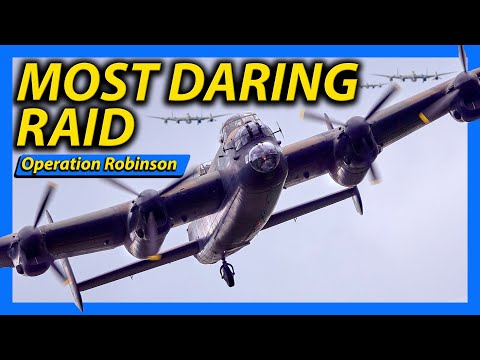
Air Chief Marshal Sir Arthur Harris, the new commander of Bomber Command, was under immense pressure. Since taking over in February 1942, he had launched spectacular thousand-bomber raids, but losses continued to mount and efficiency remained questionable. Harris needed a clear, undeniable success to boost morale and prove the worth of his command. The Schneider Works was the perfect target—a crucial cog in the German war machine, and its destruction would be a propaganda victory as much as a military one.
Harris turned to the Avro Lancaster, a relatively new heavy bomber with excellent range, a large bomb load, and speed. But there was a catch: most crews were trained for high-altitude, spaced-out formations. This mission required low-level flying in close formation, a skill few had mastered. Only Number 5 Group, led by Air Vice Marshal Alec Coryton, had completed conversion training. Harris called upon all nine of its squadrons.
Through mid-October, the crews trained relentlessly, flying low over the English countryside, getting a feel for the dangerous new tactic. Tensions ran high. Aircraft were kept fueled and armed, ready to go at a moment’s notice. But the target remained a mystery—except to Group Captain Leonard Slee, the mission leader.
On the morning of October 17, the weather finally broke. Operation Robinson was a go. At bases across eastern England, aircrews gathered for the final briefing. The plan: 88 Lancasters would bomb the iron mill, while six would target the nearby electrical transformer station at Montchanin. The bombers would fly a circuitous route over the Bay of Biscay to avoid concentrations of German fighters in northern France, then cross the coast south of Nantes and head inland at low level. The attack would be timed for dusk, allowing the Lancasters to escape under cover of darkness.
At 12:08 PM, Wing Commander Leonard Slee lifted off from RAF Syerston in his 49 Squadron Lancaster. One by one, the remaining 93 bombers followed. Among them was Wing Commander Guy Gibson, leading 106 Squadron—the same man who, seven months later, would command the legendary Dambusters raid.
The formation headed south over the English Channel. To distract German defenses, Whitley bombers flew ahead to attack U-boats, while fighters from 2 Group struck coastal targets. The tactic worked. The Lancasters encountered no enemy fighters—only a few bird strikes that damaged four aircraft and wounded two crewmen. One Lancaster from 207 Squadron developed engine trouble over the Bay of Biscay and turned back, but not before its gunners shot down two German seaplanes and damaged a third. Flight Engineer Sergeant Kenneth Chalmers was killed in the exchange, but the bomber limped home safely.
As the sun dipped toward the horizon, the main force reached the final waypoint near the town of Nevers. Slee flashed a green signal light, and the formation climbed to bombing altitude—between 2,500 and 7,500 feet. Dusk had fallen, and visibility was perfect. The lead aircraft opened its bomb bay doors. So far, there had been no sign of German defenses. The element of surprise was complete.
“Bombs burst on factory!” came the first report. “Bang on target!” But as the minutes passed, smoke obscured the aiming points, and later crews struggled to identify their targets. A tail gunner watched in horror as his aircraft’s bombs fell on nearby housing—the very thing they had tried so hard to avoid.
Just seven minutes after the first Lancaster arrived, the raid was over. The only resistance had been limited anti-aircraft and small arms fire. The six Lancasters tasked with hitting the transformer station—including Guy Gibson and Flight Lieutenant John Hopgood—successfully knocked it out, sending electric blue flashes into the sky. But one Lancaster, flown by Squadron Leader William Kerr of 61 Squadron, struck a building during its low-level run and crashed. All but one of its crew were killed; Sergeant Richard Turtle survived and was taken prisoner.
As darkness fell, the surviving 92 Lancasters turned for home. Most returned safely, though about half landed at bases in southern England due to fuel shortages. The crews were jubilant. Guy Gibson’s report called it “one of the greatest low-level daylight raids of the war.” But senior officers urged caution—they wanted photographic evidence before declaring success.
The next day, a photo-reconnaissance Spitfire piloted by Squadron Leader Tony Hill flew over Le Creusot. His camera failed. Bad weather grounded further flights for days. When Hill finally returned with clear images, the results were mixed: many bombs had fallen on the housing area, but the rolling mills, forges, machine shops, and locomotive sheds were severely damaged or destroyed. The transformer station was out of action for two years. The Schneider Works returned to limited operations after three weeks, but full production did not resume for eight months.
Operation Robinson was deemed a success. Harris had his victory, and the Lancaster had proven its worth. The low-level skills honed during the raid would be put to even greater use the following year, when many of these same crews—including Guy Gibson—were selected for the Dambusters raid. Leonard Slee was promoted to group captain and would lead another successful low-level Lancaster raid on the Zeppelin works at Friedrichshafen in June 1943.
But for now, the men of Bomber Command could celebrate. They had struck a vital blow against the enemy and silenced the critics—at least for a while. The war was far from over, and the skies over Europe would soon demand even greater sacrifices.
Yet even as the crews of Number 5 Group filled out their reports in the dispersal huts at Syerston, Waddington, and Coningsby, the men at High Wycombe were already turning their attention to what came next. Harris had learned something far more valuable than a single success. He had learned that his crews could do the impossible when given proper training and a clear objective.
“Send me the operational records from every squadron,” he reportedly told his staff. “I want to know which crews flew the lowest, which crews held formation best, and which crews brought their aircraft home without a scratch.” The Dambusters raid was still months away, but its seeds were being planted in the smoke-stained logbooks of Operation Robinson.
At 49 Squadron, Leonard Slee was a changed man. He had led ninety-four bombers over enemy territory and brought back all but one. The cost of that single loss—Squadron Leader Kerr and his crew, save for the lone survivor Sergeant Turtle—weighed heavily on him. Slee spent the following days personally writing letters to the families of the dead, refusing to delegate the grim task to his adjutants.
Meanwhile, in the operations room at Bomber Command headquarters, the intelligence officers were studying Tony Hill’s photographs with magnifying glasses and mounting excitement. The rolling mills were gutted. The locomotive sheds had collapsed into heaps of twisted steel. The transformer station at Montchanin was a smoking ruin that would take two years to restore. But the images also showed something else—row upon row of shattered houses, and in one frame, a bomb crater less than fifty yards from a schoolyard.
“The French will not thank us for this,” one officer murmured. “But the Germans will curse us for it.” It was a sentiment that would echo through the rest of the war.
Back in England, the men of Number 5 Group were granted a brief reprieve. Leave passes were issued. Pubs in Lincoln and Nottingham were filled with young airmen in blue uniforms, drinking to fallen friends and to the strange luck that had carried them through. Guy Gibson, never one to rest on his laurels, was already pestering his superiors for details of the next operation. He had tasted low-level daylight bombing and found it to his liking—a dangerous preference that would define the rest of his short life.
But the Germans were not idle. Within days of the raid, Luftwaffe reconnaissance aircraft were circling over Le Creusot, photographing the damage and reporting back to Berlin. The German High Command was furious. The Schneider Works had been considered safe from daylight attack—too far inland, too well defended by the sheer distance from English airfields. That assumption had been shattered in seven minutes.
Orders were dispatched to strengthen anti-aircraft defenses across central France. Fighter units were redeployed from the Eastern Front. And a message was sent to every Luftwaffe commander in the West: the RAF can strike anywhere, at any time, and we must be ready.
For Arthur Harris, this was the greatest compliment of all. The enemy was reacting to him. The initiative was finally his.
Yet the winter of 1942 would bring new challenges. The Battle of the Atlantic was reaching its crisis point, and Bomber Command’s resources were being pulled in a dozen directions at once. Harris wanted more Lancasters, more crews, more targets. But the men who had flown to Le Creusot and back knew that the real test was yet to come.
In a small office at RAF Scampton, a young intelligence officer named Frederick Winterbotham was already drafting a list of names. He was looking for pilots who could fly low, navigate by moonlight, and keep their nerve under fire. Operation Robinson had given him exactly what he needed—a shortlist of the best low-level crews in the entire RAF.
The names on that list would go on to achieve immortality over the dams of the Ruhr. But that is a story for another day.
And so the raid at Le Creusot passed into the record books—seven minutes of bombing that had done more to restore faith in Bomber Command than a year of night operations. But the men who flew it rarely spoke of it afterward. They simply went back to their airfields, their training, and their waiting.
In the dispersal huts, the empty chairs told their own story. Squadron Leader Kerr’s crew was gone, save for Sergeant Turtle, who would spend the rest of the war behind wire. Slee wrote his letters by hand, one by one, and never mentioned the weight of it in his official reports.
By early 1943, the shortlist from Operation Robinson had been refined to a handful of names. Gibson’s was at the top. When 617 Squadron was formed that spring, the low-level skills learned over the French countryside—the tight formations, the dusk timing, the nerve to fly at 150 feet—became the foundation of the Dambusters’ success.
“You learned to fly low over Le Creusot,” Gibson told his new crews. “Now you’ll learn to fly lower.”
Harris got his victory, and Bomber Command got its reprieve. But the real legacy of that autumn afternoon was written in the logbooks of the men who survived—and in the lives of the French families whose homes had been shattered alongside the Schneider Works.
War, after all, is never clean. Was Operation Robinson a triumph, a tragedy, or both?
Report this article
Select a reason for reporting:






