The desert night was shattered by the roar of helicopters. In the early hours of October 19, 2001, US Special Operations forces descended on a remote airstrip southwest of Kandahar, codenamed Objective Rhino. Their mission: secure a foothold deep inside Taliban territory and signal to the world that America was coming for those responsible for 9/11.
But this was just the beginning. The road to Kandahar would be paved with fierce resistance, unlikely alliances, and a dramatic showdown that would define the opening chapter of America’s longest war.
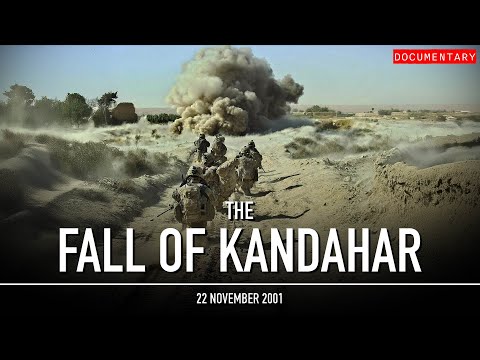
In the weeks before 9/11, Afghanistan was a forgotten land, ravaged by decades of conflict. The Soviet invasion of 1979 had left the country in ruins, and from the chaos emerged the Taliban—a hardline Islamist movement that seized control in 1996 and imposed a brutal regime. They harbored Osama bin Laden and his al-Qaeda network, the very terrorists who would soon orchestrate the deadliest attack on American soil.
When the Twin Towers fell, the world changed. President George W. Bush demanded that the Taliban hand over bin Laden. They refused. On October 7, 2001, US airstrikes began pounding Taliban targets across Afghanistan, marking the start of Operation Enduring Freedom.
The initial assault was swift and devastating. US bombers and Navy attack aircraft struck Taliban military facilities, communications hubs, and training camps. The city of Kandahar—the Taliban’s spiritual and political heart—was a prime target. “We will not relent until we have achieved our objectives,” Bush declared. But military planners knew that Kandahar would be the hardest nut to crack.
Unlike the north, where the Northern Alliance held strongholds, the south was a Taliban bastion. The US had few allies on the ground. Undeterred, two Special Forces teams began a daring journey toward Kandahar in early November, gathering support from anti-Taliban tribal leaders along the way.
One team linked up with Hamid Karzai, a tribal leader with a small but growing following. “We were just 35 men,” Karzai later recalled. “But we were determined.” Their mission: march on Kandahar and wrest it from Taliban control.
As they advanced, the Taliban struck back. At Tarin Kowt, hundreds of Taliban fighters descended on Karzai’s position. “We called in airstrikes,” a US soldier remembered. “The bombs fell like rain.” The Taliban retreated, but the fight was far from over.
On December 2, Karzai’s men and their US advisors moved toward a critical bridge at Sayd Alim Kalay. The Taliban defended it fiercely. “Gunfire erupted from every direction,” one witness said. “We couldn’t break through.” US warplanes pounded the enemy positions, but the Taliban held on.
Two days later, the allies launched an all-out assault. “We piled into trucks, weapons loaded,” an Afghan fighter recalled. “We knew this was our moment.” Airstrikes softened the ridge across the bridge, but Taliban machine guns and RPGs answered with fury. The battle raged for hours.
Then, a turning point: a stray US bomb landed on friendly forces, killing three Americans and wounding dozens. “It was the worst friendly fire incident we’d seen,” a commander later admitted. The setback shook the troops, but reinforcements arrived, and the push continued.
Meanwhile, another Special Forces team, approaching from the south, had linked up with Gul Agha Sherzai, a former governor of Kandahar. His convoy of 100 vehicles rolled toward the city, meeting little resistance until they reached a valley east of Highway 4. “The Taliban ambushed us,” Sherzai said. “But we fought back.” US airstrikes broke the enemy assault, and the Taliban fled.
By early December, the noose was tightening around Kandahar. The Taliban, sensing defeat, began to surrender. “They knew they were beaten,” Karzai said. On December 6, Taliban forces abandoned the city. Sherzai’s men and US troops moved in, securing the governor’s palace and the airport.
Kandahar had fallen. It was a decisive victory, but the war was far from over. The Taliban would regroup, and Kandahar would become a target again—twice more, in 2011 and 2021. The battle for Kandahar was just the first chapter in a long, bloody saga.
The victory at Kandahar sent shockwaves through the Taliban’s ranks. “We had taken their spiritual home,” a US intelligence officer later remarked. “They would never forget it.” But even as Karzai’s men celebrated in the governor’s palace, the Taliban’s leadership had already vanished into the rugged mountains and borderlands.
Mullah Omar, the Taliban’s reclusive leader, had slipped away. Bin Laden, too, was nowhere to be found. The US had won a battlefield victory, but its most wanted men had escaped. “We missed them by hours,” a Special Forces commander admitted.
In the weeks that followed, the US turned its attention to the Tora Bora cave complex in eastern Afghanistan. Intelligence suggested bin Laden was hiding there, sheltered by loyal fighters. The battle that followed became one of the war’s great frustrations.
Afghan militias led the assault, backed by US airstrikes. But the caves were a natural fortress, and the enemy fought from tunnels and ridges. “Every time we thought we had them cornered, they slipped away,” an Afghan commander recalled.
By mid-December, bin Laden had vanished. He would not be found for nearly a decade. The failure at Tora Bora haunted US officials for years. “We let him go,” one CIA officer later said. “That’s the truth of it.”
As 2001 drew to a close, Afghanistan’s future hung in the balance. Hamid Karzai was sworn in as head of an interim government in Kabul. The Taliban had been driven from power, but their fighters had melted back into the countryside.
US military planners began to focus on reconstruction and nation-building. “We thought we could rebuild Afghanistan into a stable democracy,” a State Department official reflected. “We were naive.”
The Taliban, meanwhile, regrouped across the border in Pakistan. Safe havens in the tribal areas allowed them to recruit, train, and plan. “They never left,” an Afghan intelligence officer warned. “They just waited.”
Within a year, the first signs of a Taliban insurgency began to appear. Ambushes, roadside bombs, and assassinations became routine. The US and its allies found themselves fighting a shadow war against an enemy that refused to stand and fight.
Kandahar, the city that had fallen so decisively in December 2001, would become the epicenter of that insurgency. The battle for the city was over. The war for Afghanistan was only beginning.
By 2003, the Taliban had regrouped into a shadowy network of fighters operating from the tribal belt along the Pakistan border. “They would cross at night, plant a bomb, and vanish before dawn,” an Afghan police chief recalled. “We could never catch them.” The insurgency was evolving into something the US military had not prepared for.
Kandahar became the front line of this new kind of war. Coalition bases dotted the province, but the Taliban controlled the villages and the roads after dark. “We owned the day,” a US Marine admitted. “They owned the night.”
America’s response was to pour more troops into the south. By 2009, the US had committed tens of thousands of soldiers to Afghanistan as part of a renewed counterinsurgency strategy. The goal was to protect the population and win hearts and minds. “We were building schools and clinics,” a civil affairs officer said. “But the Taliban were building fear.”
The surge brought temporary gains. In Kandahar, US and Afghan forces pushed into Taliban strongholds in the districts of Panjwai and Zhari. Firefights raged through grape fields and mud-brick compounds. “Every village was a fortress,” a platoon sergeant remembered. “Every wall could hide an IED.”
Casualties mounted. Roadside bombs became the Taliban’s weapon of choice, tearing through armored vehicles and killing soldiers and civilians alike. “You never got used to it,” a medic said. “The sound of an explosion meant someone’s son wasn’t coming home.”
Despite the bloodshed, the coalition made progress. By 2011, the surge had pushed the Taliban out of key districts. But the gains were fragile. Afghan forces, trained and equipped by the US, were expected to hold the line as American troops began to withdraw.
That same year, the Taliban struck back with a dramatic assault on Kandahar city itself. “They wanted to show they were still relevant,” an Afghan intelligence official said. “And they succeeded.”
The May 2011 attack was a coordinated assault on government buildings, police stations, and the governor’s office. Suicide bombers and gunmen fought for two days. “The city was on lockdown,” a resident recalled. “We could hear gunfire everywhere.”
The Taliban lost the battle, but the psychological impact was profound. “They proved they could hit the heart of Kandahar anytime they wanted,” an analyst noted. “That was a message to the Afghan people: we are not gone.”
As the US withdrawal accelerated, Afghan security forces took on more responsibility. But corruption, poor leadership, and low morale plagued the Afghan army and police. “We were asked to do too much with too little,” an Afghan commander said. “And we were abandoned.”
By 2021, the Taliban were on the march again. The withdrawal of US troops had left a vacuum, and the Taliban filled it with alarming speed. “The provinces fell like dominoes,” a US intelligence officer recalled. “Kandahar was the prize they wanted most.”
The final battle for Kandahar in 2021 was brutal. The Afghan National Army fought house to house, but they were outgunned and out of supplies. “We ran out of ammunition,” a soldier said. “We ran out of hope.”
On August 5, civilians were told to evacuate. Thousands fled, streaming toward refugee camps. “The roads were jammed with families,” an aid worker remembered. “They had nowhere to go.”
Ten days later, the Taliban broke through the last defenses. The Afghan government collapsed. “We watched the flag come down,” a police officer said. “And we knew it was over.”
The fall of Kandahar in August 2021 was not a sudden collapse—it was the end of a long unraveling. As US forces withdrew, the Afghan army crumbled, and the Taliban swept back into the city their leaders had fled two decades earlier. “We were back where we started,” a former Afghan interpreter said. “Only this time, no one was coming to help.”
Karzai, who had once marched into Kandahar as a liberator, watched from Kabul as the government he led disintegrated. Sherzai, the former governor, fled the country. “We built something fragile,” Karzai later reflected. “And it broke.”
The US had spent twenty years, trillions of dollars, and thousands of lives in Afghanistan. “We won every battle,” a retired general admitted. “And still lost the war.” The Taliban now rule from the same governor’s palace US troops once secured.
Today, Kandahar remains the Taliban’s spiritual capital. “The city is quiet,” a journalist reported in 2023. “But it is the quiet of fear.” Girls are barred from school. Opponents vanish. Hunger stalks the streets.
The battle for Kandahar was supposed to be a turning point—a victory that would remake Afghanistan. Instead, it became a cautionary tale. “We thought we could change the country,” a veteran said. “We couldn’t even hold the city.”
Twenty years after the first bombs fell, the Taliban raised their flag over Kandahar once more. The war was over. But the question that haunted so many—was it worth it?—remains unanswered. What do you think: did the battle for Kandahar achieve anything lasting, or was it all for nothing?
Report this article
Select a reason for reporting:






