Every Canadian knows the big names of World War II. The Americans stormed the beaches, the British held the line, the Soviets broke the Nazi war machine—but where does Canada fit in? We sent over a million men and women to fight in a war that wasn’t on our soil. We punched far above our weight. And yet, when historians talk about the deadliest armies of the Second World War, Canada rarely gets mentioned.
Today, we’re going to change that. We’re putting the Canadian Army head-to-head against the United States Army. Not to see who was bigger—we already know that answer—but to answer a harder question: which army was deadlier per soldier? If you took one Canadian infantryman and one American infantryman, gave them the same rifle, and sent them into the same battle, who would inflict more damage on the enemy? The answer might surprise you, and it might make you proud.
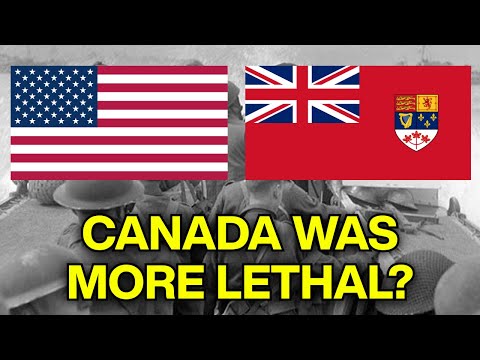
Before we compare anything, we need to define what we’re measuring. Lethality isn’t about bravery, it isn’t about sacrifice, and it isn’t about winning. Lethality is cold math. How many enemy soldiers did your army kill, wound, or capture, divided by how many soldiers you had doing the fighting? This gives us what military historians call a casualty exchange ratio. If your army inflicts two enemy casualties for every one of your own, your ratio is two to one. The higher the number, the more effective your force.
We’re also going to look at lethality per soldier deployed. This matters because the United States fielded over 11 million military personnel during the war. Canada fielded just over 1.1 million. If both armies inflicted the same total casualties, that would mean Canadian soldiers were 10 times deadlier per capita. So, let’s break down the numbers.
The United States Army was a juggernaut. By 1945, America had deployed over 11 million men and women in uniform across every theater of the war: Europe, North Africa, the Pacific, and beyond. American forces inflicted approximately 1.2 million German military casualties on the Western Front and in Italy. In the Pacific, they accounted for roughly 800,000 Japanese casualties. Add in operations in North Africa, the Philippines, and other theaters, and the total climbs to somewhere between 2.5 and 3 million enemy casualties.
Those are staggering numbers, but America also had enormous resources to match. The United States military’s greatest strength wasn’t individual marksmanship or tactical brilliance. It was overwhelming firepower and logistics. American forces rarely attacked without massive artillery preparation. They rarely advanced without air superiority. They rarely ran out of ammunition, fuel, or food.
At Normandy, American forces suffered around 29,000 killed in action during the campaign to secure the beachhead and break out into France. German forces in the same theater lost over 200,000 men killed, wounded, or captured. That’s a lethality ratio of about 7:1 when you account for the full campaign. But here’s the thing: much of that lethality came from bombers, artillery, and naval guns, not from the individual rifleman.
The average American infantryman was well-trained, but often green. Many had never seen combat until they hit the beaches. American tactical doctrine emphasized firepower over maneuver, which meant calling in artillery strikes rather than closing with the enemy. This approach saved American lives, but it also meant that American infantry soldier-for-soldier were not always the ones doing the killing.
When we calculate lethality per soldier deployed, the picture becomes clearer. America inflicted somewhere between 2.5 and 3 million enemy casualties. They had 11 million men and women in uniform. Do the math and you get roughly one enemy casualty for every four American soldiers. That’s respectable. But is it better than Canada?
Canada entered the war on September 10th, 1939, a full week after Britain and more than two years before the United States. By war’s end, over 1.1 million Canadians had served in uniform. Of those, approximately 730,000 served in the Canadian Army. Canadian forces fought in nearly every major theater: the disaster at Hong Kong, the catastrophic raid on Dieppe, the grueling Italian campaign, the invasion of Normandy, the liberation of the Netherlands, and the final push into Germany. And they made the enemy pay.
Let’s start with the Italian campaign. The Canadian First Infantry Division and the Fifth Armored Division fought their way up the Italian boot from Sicily to the Po Valley. They faced some of the toughest German defensive lines of the war: the Gustav Line, the Hitler Line, and the Gothic Line. At Ortona in December 1943, Canadian soldiers fought house-to-house against elite German paratroopers in what became known as Little Stalingrad. The battle lasted eight days. The Canadians took the town. German casualties were severe, with the First Parachute Division losing an estimated 1,300 men killed and wounded. Canada paid with 650 killed and more than 1,700 wounded. That’s a casualty exchange ratio of nearly 1.3 to 1 in brutal urban combat against the best soldiers Germany had.
Now, let’s talk about Normandy. On June 6th, 1944, the 3rd Canadian Infantry Division landed on Juno Beach. They faced the 716th Infantry Division and elements of the 21st Panzer Division. By the end of D-Day, Canadian forces had pushed further inland than almost any other Allied unit. Some elements advanced nearly 9 kilometers, among the deepest penetrations of the entire invasion. The cost was 1,074 Canadian casualties, including 359 killed. German losses on Juno Beach and the immediate surrounding area were estimated at over 1,200.
But the real Canadian killing began after the beaches. In the weeks following D-Day, Canadian forces faced repeated counterattacks from hardened SS Panzer divisions. At the Battle of Carpiquet Airfield on July 4th, 1944, the North Shore Regiment from New Brunswick and the Chaudière Regiment from Quebec attacked fortified German positions held by the 12th SS Panzer Division, the infamous Hitler Youth Division. The fighting was savage. The Canadians suffered over 370 casualties, but inflicted an estimated 500 on the fanatical SS defenders.
Then came the Falaise Pocket. In August 1944, Canadian and Polish forces were given the task of closing the gap and trapping the German 7th Army and 5th Panzer Army. The fighting around Hill 262, known as The Mace, saw some of the most intense combat of the entire Normandy campaign. Canadian and Polish forces held against repeated German breakout attempts, inflicting catastrophic losses. When the pocket finally closed, over 50,000 German soldiers had been captured and an estimated 10,000 killed. Total German equipment losses included 344 tanks and assault guns, 2,447 vehicles, and 252 artillery pieces. The Canadian 2nd Corps played a central role in this destruction.
Finally, there’s the liberation of the Netherlands. From September 1944 to May 1945, Canadian forces fought to clear the Scheldt Estuary, open the Port of Antwerp, and liberate the Dutch people. This campaign involved savage fighting through flooded terrain, fortified islands, and desperate German defenders. The Battle of the Scheldt alone cost Canada over 12,800 casualties, but German losses were even higher: over 40,000 killed, wounded, or captured.
When we add up Canada’s total record across all theaters, a picture emerges. In Italy, roughly 25,000 to 30,000 enemy casualties. In Northwest Europe, from D-Day through Victory in Europe Day, approximately 60,000 to 80,000. In Hong Kong, Dieppe, and other operations, roughly 5,000 to 10,000. That brings the total to approximately 90,000 to 120,000 enemy casualties.
Now, let’s calculate lethality per soldier. Canada inflicted somewhere between 90,000 and 120,000 enemy casualties. We had roughly 730,000 soldiers in the army. That works out to approximately one enemy casualty for every six or seven Canadian soldiers. Wait. That’s lower than the American number. But hold on, we need to adjust for something important.
Here’s the dirty secret of military statistics: most soldiers never fire a shot. Of the 11 million Americans in uniform, only about 2 million were actual combat troops—infantrymen, tankers, artillery crews, and combat engineers. The rest were support personnel: truck drivers, clerks, cooks, mechanics, and medics.
The same was true for Canada, but the ratio was different. Canada’s army was smaller and leaner. A higher percentage of Canadian soldiers were in combat roles. Estimates suggest that between 250,000 and 300,000 Canadians served in direct combat positions throughout the conflict.
If we recalculate using only combat troops, the picture changes dramatically. America had about 2 million men in actual fighting roles. Against their 2.5 to 3 million enemy casualties, that means each American combat soldier accounted for roughly one to one-and-a-half enemy casualties on average. Canada had between 250,000 and 300,000 men in combat positions. Against 90,000 to 120,000 enemy casualties, that means each Canadian combat soldier accounted for about one enemy casualty for every two to three Canadians in the fight. Still lower. So, what gives?
Here’s the key insight. Canada faced the Germans. American forces in the Pacific fought the Japanese, who by 1944 and 1945 were suffering from critical shortages of ammunition, fuel, and trained soldiers. Japanese units often fought to the death, inflating American casualty infliction numbers. Canadian forces, on the other hand, spent the vast majority of their war fighting the German Wehrmacht and Waffen SS, the most professional and lethal military force of the conflict.
When American forces faced the same Germans, their exchange ratios dropped. At the Battle of the Bulge, German forces caused over 80,000 American casualties while suffering around 75,000 of their own. That’s barely better than one to one. Canadian forces, facing the same quality of enemy, maintained ratios of 1.5 to 1 up to 3 to 1 throughout the Normandy campaign and the push into Germany.
So, who was deadlier per soldier? If we measure killing power against the toughest enemy, the Canadian army has a legitimate claim to being the more lethal force. Canadian infantry consistently achieved favorable casualty exchange ratios against first-rate German formations. They did it without the massive air and artillery support that American forces relied upon. They did it in some of the most brutal terrain of the war: the flooded polders of Holland, the fortified hills of Italy, the hedgerows and villages of Normandy.
The American military strength was industrial. They could afford to lose men and machines because they had more of both. They used firepower to save lives. The Canadian military strength was tactical. They couldn’t afford to trade casualties one for one. So they fought smarter, harder, and meaner.
German commanders noticed. After facing Canadian forces in Normandy, General Kurt Meyer of the 12th SS Panzer Division admitted that his elite troops had met their match. In his memoirs, Meyer described the relentless Canadian assaults and acknowledged that the Canadians fought with a ferocity his veterans had rarely encountered. Field Marshal von Rundstedt, commanding German forces in the west, reportedly warned his officers that Canadian units were among the most dangerous they would face.
Per soldier, man for man, rifle for rifle, Canada was deadlier. The United States won the war through overwhelming force, and there’s no shame in that. America’s industrial might and logistical genius were decisive. But Canada won its battles through skill, grit, and sheer lethality at the point of contact.
We didn’t have endless reserves. We didn’t have unlimited artillery shells. What we had was training, discipline, and a refusal to quit. That’s not nationalism. That’s history.
The next time someone asks what Canada contributed to World War II, tell them this: we sent a million soldiers overseas, we liberated nations, and per man, per rifle, per bayonet, we were among the most effective fighters of the entire war.
So now the question is yours to answer. Was the Canadian Army truly deadlier per soldier than the American Army—and which Canadian battle do you think deserves far more recognition than it gets?
Report this article
Select a reason for reporting:






