August 8, 1944. The fields near Gaumesnil, Normandy, looked peaceful—but they were about to become a graveyard for some of Nazi Germany’s most feared tanks. In a matter of minutes, four mighty Tigers would burn, and the legendary tank ace Michael Wittmann would meet his end. But who fired the fatal shot? The answer has been debated for decades.
By August 1944, the Allies had broken through German lines in Operation Totalize, and the remnants of the 101st SS Panzer Battalion were ordered to counterattack. Leading the charge was 30-year-old Michael Wittmann, a celebrated commander with 117 tank kills to his name. His target: Canadian and British armor massing on Hill 122.
Wittmann’s force of seven Tigers raced forward, but they were heading straight into a trap. Concealed behind a stone wall to the west were the tanks of the Sherbrooke Fusiliers, including two Fireflies—Shermans equipped with powerful 17-pounder guns that could penetrate a Tiger’s armor. To the northeast, the Northamptonshire Yeomanry lay in wait, with 21-year-old Trooper Joe Ekins at the gunsight of his Firefly.
“I could see at least three Tigers coming,” Ekins later recalled. “We waited until they were at 800 yards and our tank commander told me to target the rear one.”
As the Tigers advanced, German officer Hans Höflinger, watching from another tank, grew suspicious of a small wood to his right. “We couldn’t keep the wood under observation on account of our mission,” he said. Moments later, heavy fire erupted from the treeline.
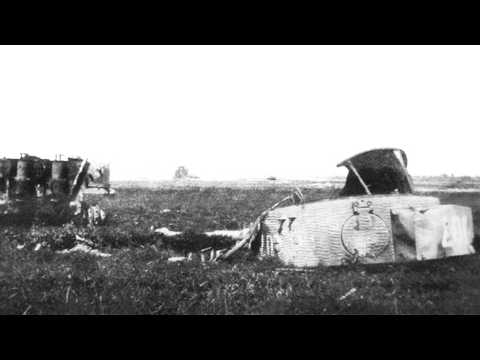
Ekins fired twice at the rearmost Tiger. It exploded. He shifted targets, knocked out a second, then a third—all in twelve minutes. Meanwhile, Höflinger’s own tank was hit and caught fire. He and his crew bailed out and dashed to the rear. “I stopped to look around and to my dismay discovered that five of our tanks had been knocked out,” he remembered. “The turret of Michael’s tank was displaced to the right and tilted down to the front somewhat.”
Another witness, Dr. Rob, saw Wittmann’s Tiger engulfed in flames. “I saw flames suddenly shoot from the tank and the turret fly off and fall to the ground,” he wrote. “The tank then burned out completely.”
Four Tigers were destroyed that day, including Wittmann’s number 007. But the question remains: who fired the fatal shot? Was it Joe Ekins, the young British trooper who claimed three kills? Or was it one of the Sherbrooke Fusiliers, whose Fireflies were positioned closer to Wittmann’s tank?
The debate continues, but one thing is certain: the death of Michael Wittmann marked the end of an era for Nazi Germany’s tank forces in Normandy.
To untangle the mystery, historians have turned to the battlefield itself. Aerial reconnaissance photographs taken the day after the battle, combined with accounts from both sides, allow us to reconstruct the positions with remarkable precision. Wittmann’s Tiger 007 was the leftmost of the four destroyed tanks, roughly 170 meters from the main road. The three Tigers that Ekins engaged were further to the right, closer to his concealed Firefly.
By measuring the ground, researchers found that those three Tigers sat at ranges of 790, 740, and 775 meters from Ekins—distances at which his 17-pounder could strike with lethal effect. Wittmann, however, was approximately 1,000 meters away and possibly obscured by the stone walls, drifting smoke, and the chaos of battle.
“I fired twice at the third tank at the rear and it blew up,” Ekins said. But the Northamptonshire Yeomanry’s war diary recorded the first Tiger brewed up at 12:46, while Höflinger insisted the fatal moment came at 12:55. That nine-minute gap matters. Dr. Rob recalled that Wittmann’s tank only erupted several minutes after the initial shots—time enough for a different gun to find its mark.
Enter the Sherbrooke Fusiliers. Commanded by the legendary Sydney Radley-Walters—the Allies’ highest-scoring tank ace—their tanks had punched firing holes through the stone wall and waited. “We opened fire at about 500 yards,” Radley-Walters recalled. “The lead tank, the one closest to the road, was knocked out.”
That range—500 yards, or roughly 450 meters—is telling. Wittmann’s tank sat only about 200 meters from the Canadian armor on its flank. A shot from that distance, striking the rear-left hull near the air inlet above the fuel tank, would produce exactly the kind of outward explosion a local farmer later described when he examined the wreck.
The farmer, Serge Vara, photographed the destroyed Tiger six months after the battle. He noted damage on the rear left of the hull—not a neat penetration hole, but a violent blast. He also found an RAF Typhoon rocket nearby and concluded an air attack had done the deed. Contemporary RAF records, however, offer no support for that claim, and the rocket may have been fired months later. The aerial theory, most historians agree, can be discounted.
What remains is a picture of two plausible killers. Ekins, the young gunner who never heard Wittmann’s name until the 1960s, and the Sherbrooke Fusiliers, whose Fireflies lay hidden behind a wall with a clear flank shot. The balance of evidence—the timing, the range, the direction of the blast damage—points toward the Canadians.
Yet certainty remains elusive. The fog of war, the burning wrecks, the screaming shells—all of it swallowed the truth that day. What is not in doubt is the outcome: in twelve minutes, four of Germany’s most feared tanks were reduced to smoking hulks, and one of the war’s most celebrated commanders was dead.
For the men in those Shermans and Fireflies, the fighting was not yet over. Even as Wittmann’s Tiger burned, the surviving German armor and infantry were still trying to press the attack. The Battle Group Waldmüller, bloodied but not broken, attempted to reorganize in the hollows and tree lines south of the allied positions. But the momentum had shifted decisively.
Radley-Walters kept his squadron disciplined. “We engaged them as they came,” he said. “We didn’t chase them. We waited for the next target.” The Sherbrooke Fusiliers claimed two more armored vehicles before the German retreat began in earnest.
To the northeast, Joe Ekins and his crew were already pulling back from their firing position. Their tank had taken a glancing hit on the turret lid, stunning the commander, and the crew was running on adrenaline and instinct. Ekins would later admit he had no idea whose tanks he had destroyed. “We just saw Tigers and fired,” he said. “That was our job.”
By early afternoon, the counterattack had collapsed. The Canadians and British resumed their advance toward Falaise, and the road south lay open. For the Germans, the loss of Wittmann was more than a tactical setback. It was a psychological blow from which the 101st SS Panzer Battalion would never fully recover.
Wittmann’s body and those of his crew were hastily buried by retreating German soldiers in a communal grave in the very field where they fell. The location was forgotten as the front lines swept past. For nearly four decades, the fate of Tiger 007 and its crew remained a mystery.
Then, in 1983, a search team led by French researcher Serge Varin returned to the field near Gaumesnil. Using wartime records and eyewitness accounts, they began to dig. They found the remains of five men. The identification was confirmed by two grim artifacts: the charred identity disc of Tiger 007’s driver, and a 6.35mm pistol that Wittmann habitually carried in his uniform pocket.
The crew was reburied with full military honors at La Cambe German Cemetery, where 21,000 fallen soldiers now rest. Wittmann’s grave, marked with a simple stone, became a pilgrimage site for veterans and historians alike.
But the debate over who fired the fatal shot never truly died. In the decades that followed, historians, enthusiasts, and the surviving veterans themselves argued over the evidence. The Canadians pointed to the range and the blast damage. The British pointed to Ekins’ confirmed kills and the timing in the war diary.
In 2012, shortly before his death, Joe Ekins was asked one final time if he believed he had killed Michael Wittmann. His answer was characteristically blunt. “To be honest, I don’t care,” he said. “All I know is that I fired five shots in the war and I knocked out three Tiger tanks. And that’s enough for me.”
Perhaps that is the only verdict history can offer. The fog of war swallowed the truth on August 8, 1944, and no amount of investigation can fully pierce it. What remains is the record of the battle itself: four Tigers destroyed, an advance halted, and a legend ended in the burning fields of Normandy.
The fields near Gaumesnil fell silent again, but the echoes of that day would linger for generations. The wreckage of Tiger 007 was picked over by souvenir hunters and scrap collectors, its story slowly buried beneath the Normandy soil. Yet the men who fought there never forgot.
Joe Ekins returned to England and lived a quiet life, rarely speaking of the war. He worked as a mechanic and raised a family, but the events of August 8, 1944, followed him. Historians and enthusiasts wrote letters, asking for his account. He gave it, always with the same modest tone. “I was just doing my job,” he insisted. “The real heroes are the ones who didn’t come back.”
Sydney Radley-Walters, meanwhile, became a legend in his own right. He remained in the army, rising to the rank of colonel, and was awarded the Distinguished Service Order. But he never claimed credit for Wittmann’s death. “We were all firing,” he said in a 1980 interview. “It could have been any one of us. The important thing is that we stopped them.”
As the years passed, the debate over who killed Wittmann became a cottage industry. Books were written, documentaries filmed, and conferences held. Each new piece of evidence was scrutinized, each eyewitness re-interviewed. But no smoking gun ever emerged.
In 2014, a team of researchers used advanced ballistic analysis and 3D modeling to re-examine the battlefield. They concluded that the angle of the fatal hit on Wittmann’s Tiger was most consistent with a shot from the Sherbrooke Fusiliers’ position. But they admitted the margin of error was too great to be definitive.
The mystery, it seemed, would endure. And perhaps that was fitting. For the men who fought that day, the truth was never about who fired the shot. It was about survival, duty, and the terrible cost of war.
Today, a small memorial stands near the site of the battle. It bears no names, only a simple inscription: “In memory of all who fell here, August 1944.” Visitors come from around the world, some to pay respects, others to chase the ghost of Michael Wittmann. But the fields themselves hold no answers.
Only the wind moves through the wheat now, whispering over ground that once shook with the roar of guns. The Tigers are gone, the Shermans rusted away. But the question remains, as stubborn as the men who fought here: Who fired the fatal shot that ended Wittmann’s reign? Was it Joe Ekins, the young gunner who claimed three kills? Or one of Radley-Walters’ Canadians, hidden behind a stone wall? The evidence points both ways, and history refuses to settle the score.
What do you think? Who really killed Michael Wittmann? Share your thoughts in the comments below.
Report this article
Select a reason for reporting:






