The Sopwith Camel was more than just an aircraft; it was a legend forged in the crucible of World War I. Its distinctive silhouette and roaring engine struck fear into the hearts of enemy pilots, while its unparalleled maneuverability and firepower made it a force to be reckoned with. But behind its fearsome reputation lay a dark secret: the Camel was a beast that demanded respect, and many who dared to tame it paid the ultimate price.
In the hands of a skilled pilot, the Camel was a deadly weapon, capable of outmaneuvering and outgunning any adversary. It was credited with shooting down more enemy planes than any other British fighter, a testament to its lethal efficiency. Yet, for the inexperienced, the Camel was a deathtrap. Its notorious difficulty to control led to countless crashes, claiming the lives of novice pilots before they ever reached the battlefield.
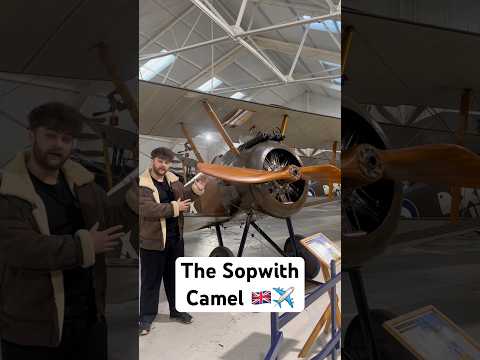
This is the story of the Sopwith Camel, a machine that epitomized the duality of war: brilliance and tragedy, victory and loss. As we delve into its history, we’ll explore the genius of its design, the bravery of the pilots who flew it, and the harrowing challenges they faced in the skies over Europe.
The Camel was born from the need for a fighter that could dominate the aerial arena. Its designers at the Sopwith Aviation Company crafted an aircraft that was both agile and powerful, with a rotary engine that gave it a unique torque effect, making it highly responsive to control inputs. This torque, however, was a double-edged sword. In the hands of a skilled pilot, it allowed for lightning-fast turns and evasive maneuvers that left enemies bewildered. But for a novice, it was a recipe for disaster, as the aircraft could spin out of control with little warning.
Despite its challenges, the Camel quickly became the backbone of the Royal Flying Corps and the Royal Naval Air Service. Its twin synchronized machine guns, mounted in front of the cockpit, provided devastating firepower, and its ability to carry bombs added versatility to its role. The Camel was not just a fighter; it was a multi-role aircraft that could adapt to various missions, from dogfights to ground attacks.
As the war raged on, the Camel proved its worth in numerous engagements, earning a reputation that spread far beyond the trenches. Its pilots, many of them young and inexperienced, were thrust into a deadly game of cat and mouse in the skies. The Camel demanded skill, courage, and a bit of luck, and those who mastered it became legends in their own right.
But the Camel’s story is not just one of triumph. It is also a tale of sacrifice and the steep learning curve of war. The aircraft’s unforgiving nature meant that training accidents were common, and many pilots met their end not in combat, but in the treacherous skies of their own airfields. The Camel was a harsh teacher, and its lessons were written in blood.
In the hands of aces like William Barker and Roy Brown, the Camel became an instrument of victory. Barker’s exploits in the Camel earned him the Victoria Cross, while Brown was credited with shooting down the Red Baron, Manfred von Richthofen, in one of the war’s most famous dogfights. These pilots, and many others like them, turned the Camel’s flaws into strengths, using its quirks to outsmart and outfight the enemy.
As we continue, we’ll uncover the stories of these brave aviators and the machine that carried them into history. The Sopwith Camel was not just an aircraft; it was a symbol of an era when the skies were the ultimate battleground, and the men who flew were the knights of the air.
To understand why the Camel earned such a fearsome reputation, one must first grasp the peculiar nature of its rotary engine. Unlike conventional engines, the entire cylinder block spun around a fixed crankshaft, creating a massive gyroscopic force. This force pushed the nose of the aircraft in the direction of the spin during a turn, making right turns alarmingly fast and left turns sluggish and heavy. Pilots had to learn to use this torque to their advantage, or it would kill them.
Veterans soon discovered that the Camel could whip into a right-hand turn with breathtaking speed, a maneuver that left enemy fighters scrambling to react. In a dogfight, that split-second advantage often meant the difference between life and death. But the same force that made the Camel lethal in combat also made it treacherous during takeoff and landing, where a moment’s hesitation could send the aircraft into a fatal spin.
The training fields of England became grim proving grounds. Young pilots, many with barely a dozen hours in the air, climbed into the Camel’s cockpit and discovered a machine that seemed to fight back. More than a few never left the ground, their aircraft cartwheeling across the grass before they had a chance to learn its secrets. Instructors spoke of the Camel in hushed, respectful tones, warning their students that it was a thoroughbred, not a plow horse.
Yet the survivors emerged as some of the finest aviators of the war. They learned to feel the torque in their bones, to anticipate the Camel’s moods as one might read the temper of a wild stallion. In their hands, the aircraft became an extension of their own reflexes, twisting and diving through the sky with an elegance that belied its brutal nature.
By 1917, the Camel had arrived at the front in earnest, and the Germans quickly learned to respect it. Its twin Vickers machine guns, synchronized to fire through the spinning propeller, delivered a devastating punch. Enemy pilots who once roamed the skies with impunity now found themselves facing a nimble adversary that could turn inside them and pour lead into their engines before they could react.
The Camel’s arrival coincided with some of the bloodiest months of the air war, and its impact was immediate. Squadrons equipped with the new fighter began to claw back the advantage that the Germans had enjoyed with their Albatros and Halberstadt scouts. The tide of aerial supremacy, which had seemed to favor the Central Powers, began to shift.
But victory came at a cost. The same qualities that made the Camel a superb fighter made it a demanding companion. Fatigue, a moment’s inattention, a sudden gust of wind—any of these could turn a routine patrol into a catastrophe. The pilots who flew it knew that the Camel demanded everything they had, and sometimes more.
It was into this crucible that a new generation of aviators was thrown, young men from every corner of the British Empire, eager to prove themselves in the skies. Among them were future aces whose names would become synonymous with the Camel’s legacy. Their stories, and the machine that carried them, would etch themselves into the annals of aviation history.
One such aviator was Arthur “Pip” Sinclair, a nineteen-year-old from the Yorkshire moors who had lied about his age to enlist. He arrived at the front with barely forty hours of flight time, most of it in docile trainers that handled like gentle ponies compared to the Camel. His first sight of the fighter, squat and aggressive on the aerodrome tarmac, sent a thrill of equal parts excitement and dread through his chest.
“She looks like she’s already angry,” he muttered to his mechanic, a grizzled corporal who had seen too many young pilots come and go.
“That she does, sir,” the corporal replied, wiping his hands on an oily rag. “And she’ll stay angry till the day she’s scrapped. Just remember—she turns right like a dream and left like a mule. Get greedy with the stick and she’ll put you in the ground.”
Sinclair nodded, swallowing hard. He had heard the stories, the whispered warnings passed between pilots in the mess. The Camel had claimed as many British lives as it had German, they said, and the grim arithmetic was hard to dispute.
His first patrol came on a grey October morning, the sky low and heavy with clouds. Sinclair’s flight leader, a laconic Canadian named Tremaine with three victories already painted on his fuselage, briefed them quickly. A German two-seater had been spotted crossing the lines, likely on a reconnaissance run. They were to intercept and destroy it before it could return with photographs of the British trenches.
Sinclair climbed into the cockpit, his hands trembling despite his efforts to steady them. The engine coughed, spat, and then roared to life, the entire airframe shuddering with barely contained violence. He taxied to the end of the field, heart hammering against his ribs, and waited for Tremaine’s signal.
The takeoff was a blur of noise and terror. The Camel bucked and twisted, fighting him every inch of the way, and for a heart-stopping moment Sinclair thought he had lost control entirely. Then the wheels left the ground, and he was airborne, climbing steeply into the grey murk.
Tremaine’s voice crackled over the speaking tube, calm and steady. “Stay close, keep your eyes open, and don’t do anything clever. The Camel will do the clever work for you—just don’t fight her.”
They flew in a tight V formation, engines droning, eyes scanning the horizon. The clouds pressed in around them, cold and damp, and Sinclair felt a chill that had nothing to do with the altitude. Every shadow, every shifting shape in the mist, could be an enemy—or a fatal miscalculation.
Then Tremaine’s voice came again, sharper this time. “Contact. Twelve o’clock low. Two-seater, heading east. Follow me down.”
Sinclair’s stomach lurched as the formation tipped into a dive, the Camel’s nose dropping with a sickening swiftness. The wind screamed past his cockpit, the engine howling, and the German aircraft grew larger with every passing second. He could see the observer in the rear cockpit turning, raising his machine gun, and then the air was filled with tracers.
What happened next would stay with Sinclair for the rest of his life. Tremaine’s Camel banked hard right, using the torque to whip around in a turn so tight it seemed to defy physics. The German pilot, caught off guard, tried to follow—and exposed his belly. Tremaine’s guns chattered, and the two-seater staggered, smoke pouring from its engine.
Sinclair, meanwhile, was fighting his own battle. The torque had pulled him off course, and he found himself hurtling toward the falling German aircraft, his hands frozen on the controls. Instinct took over where training had failed. He eased the stick, let the torque carry him through the turn, and squeezed the trigger.
The Vickers guns hammered, the recoil shaking the airframe, and then he was past, pulling up hard, the world spinning around him. When he regained his bearings, the German two-seater was gone, a plume of black smoke marking its final plunge toward the earth.
Tremaine’s voice came over the tube, dry and amused. “Not bad, Sinclair. Not bad at all. But next time, try not to nearly ram the poor bastard before you shoot him.”
Sinclair let out a breath he hadn’t realized he was holding, a wild laugh bubbling up from somewhere deep in his chest. He had survived. He had fought. And the Camel, for all its savagery, had carried him through.
Back at the aerodrome, Sinclair climbed out of the cockpit on shaking legs. The mechanic met him with a knowing grin. “She didn’t kill you, sir. That means she likes you.”
He flew dozens more patrols that winter, each one sharpening his instincts until the Camel’s savage torque felt less like an enemy and more like a partner. He learned to trust the machine’s violence, to let it carry him through turns that no other fighter could match.
By the war’s end, Sinclair had seven victories to his name—modest by the standards of legends, but hard-won. He never forgot that first dive, or the lesson Tremaine had drilled into him: the Camel was a beast, and only respect kept you alive.
What would you have done, frozen at the controls or trusted the torque?
Report this article
Select a reason for reporting:






