They emerged from the gates of hell, but the world was not waiting with open arms. For the hundreds of thousands of Jews who survived the Holocaust, liberation was not an end—it was the beginning of a new nightmare. Many returned to homes that no longer existed, to communities that had been erased, and to neighbors who had taken their property and now eyed them with hostility. The war was over, but the suffering had only changed shape.
In the displaced persons camps that dotted postwar Europe, survivors lived under armed guard, often in conditions barely better than the camps they had just left. The Harrison Report, commissioned by President Truman, revealed the shocking truth: Jewish survivors were being treated as prisoners, not as liberated people. “We appear to be in a camp similar to the ones we were in before,” one survivor wrote. “Only now, we are not the ones who are guilty.” The world had promised never again, but the gates of immigration remained largely shut.
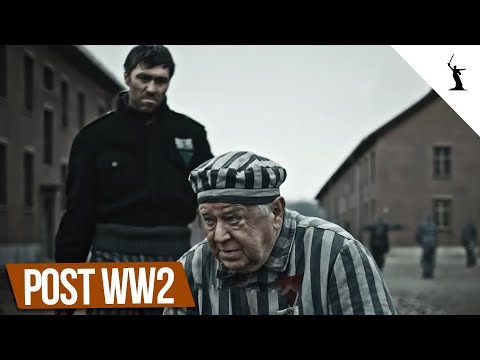
While the Allies had originally planned to repatriate displaced persons to their home countries, many Jews refused to return. They had seen too much. Their homes had been stolen, their families murdered, and their communities destroyed. More than 250,000 people lingered in camps for years after the war, waiting for a country that would take them in. The British Mandate of Palestine became the primary destination for many, but the United Kingdom, fearing Arab opposition, refused to allow Jewish refugees in.
Desperate, former Jewish partisans and the Hagana organized a massive smuggling operation called Bricha, which eventually transported 250,000 Jews—both displaced persons and those who had hidden during the war—to Palestine. It was a race against time, a silent rebellion against a world that seemed to have forgotten them.
In Poland, the few Jews who returned from the Soviet Union or from the camps in Germany were met with a resurgence of anti-Semitism. The Kielce pogrom of July 4, 1946, left 42 Jews dead and dozens more injured. The violence was motivated in part by the widespread Polish belief in “Judeo-communism,” which portrayed Jews as supporters of the Soviet regime. Hundreds of Jews were killed simply for trying to reclaim their property. “We survived the Germans,” one survivor recalled, “only to be killed by our neighbors.”
The exodus began. Jews fled Poland, Hungary, and other Eastern European countries, leaving behind the lands their families had inhabited for centuries. By 1952, when the displaced persons camps finally closed, over 80,000 Jewish survivors had found refuge in the United States, 136,000 in Israel, and another 10,000 in countries as far-flung as Mexico, Japan, and South Africa. But even in their new homes, they carried the scars of the past.
In Israel, the survivors faced a different kind of struggle. In 2016, it was reported that 45,000 Holocaust survivors were living below the poverty line, leading to heated protests against the Israeli government. The average cancer rate among survivors was almost 2.5 times the national average, while colon cancer rates were nine times higher—a direct consequence of starvation and extreme stress. The past refused to stay buried.
And yet, even as the survivors aged, a new generation began to ask questions. Descendants of survivors turned to Yad Vashem, searching for the fates of relatives whose names had been lost to history. The central database of Holocaust victims’ names, with over 3 million entries, became a lifeline—a way to reclaim the stories that the Nazis had tried to erase.
But the world’s memory was fading. A 2018 survey found that 66% of American millennials did not know what Auschwitz was, and 22% had never heard of the Holocaust. The survivors were dying, and with them, the living memory of the atrocities. The silence that had once protected them now threatened to bury the truth forever.
This is the story of what happened after the Holocaust—of the struggle to rebuild, the fight for justice, and the battle to remember. It is a story that is still unfolding, even today.
The reparations negotiations that began in 1951 were never just about money. When Israeli Foreign Minister Moshe Sharett submitted his claim for $1.5 billion, he was staking a moral demand: that Germany acknowledge the financial cost of rehabilitating half a million survivors. Chancellor Konrad Adenauer’s acceptance of the terms was a political gamble, one that sparked fierce debate in both countries.
In Israel, the reparations were denounced as blood money. Survivors marched in the streets, and opposition leader Menachem Begin called it a deal with the devil. Yet the funds flowed, and over fourteen years, $845 million in direct and indirect compensation was paid. In 1988, another $125 million followed.
But the reckoning was far from complete. In 1999, German industrial giants like Deutsche Bank, Siemens, and BMW faced lawsuits for their role in forced labor during the war. To end the litigation, Germany agreed to raise $5 billion for surviving Jewish forced laborers, each eligible for a one-time payment of between $2,500 and $7,500.
The French railway company SNCF was required in 2014 to allocate $60 million to American Jewish survivors for its role in transporting deportees to Germany—approximately $100,000 per survivor. And yet, the system was far from perfect: $57 million in reparations were fraudulently paid to thousands of people who were never eligible.
Beyond the money lay a deeper question: how does a civilization reckon with stolen art? From 1933 to 1945, Nazi Germany looted approximately 600,000 artworks worth $2.5 billion in 1945 dollars—the equivalent of $30 billion today. Jewish-owned collections were a prime target, and the consequences still haunt the art market.
Anyone collecting pre-1945 European art today must verify that a potential acquisition was not stolen from Holocaust victims. The most high-profile legal battles have reached the US Supreme Court, including cases involving the Republic of Austria. For many families, a painting hanging in a museum is not just art—it is the last tangible link to a murdered relative.
The restitution movement of the mid-1990s was fueled by what scholar Dan Diner called a collective European memory of the Holocaust. As property was restored, something else was unlocked: memory itself. The connection between property and remembrance proved crucial, with each restitution case unearthing new details about the Holocaust and deepening Europe’s understanding of its own dark past.
But memory is fragile, and it can be weaponized. Holocaust denial—the assertion that the genocide did not occur as described by scholars—remains a persistent poison. Deniers reject the core facts: that the Nazi government deliberately targeted Jews for extermination, that five to seven million Jews were systematically killed, and that gas chambers were used as tools of mass murder.
Many deniers prefer the term “revisionism,” but scholars insist on “denial” to distinguish them from legitimate historical revisionists. Most denial claims imply that the Holocaust is a hoax, a deliberate Jewish conspiracy to promote Jewish interests at the expense of others—making Holocaust denial, at its core, an anti-Semitic conspiracy theory.
The methods of deniers are criticized for relying on a predetermined conclusion that ignores overwhelming contrary evidence. Yet the damage is done: according to journalist Alan Posener, German films and TV series have failed to responsibly confront the country’s past, fueling a growing historical amnesia among young Germans.
A September 2017 study by the Körber Foundation found that 40% of 14-year-olds surveyed in Germany did not know what Auschwitz was. In the United States, a 2018 survey released on Holocaust Remembrance Day revealed that 66% of millennials could not identify Auschwitz, and 22% had never heard of the Holocaust at all. More than 95% of Americans interviewed were unaware that the Holocaust occurred in the Baltic states of Latvia, Lithuania, and Estonia.
Nearly half of adults and millennials could not name a single Nazi concentration camp or ghetto in German-occupied Europe. In stark contrast, a study in Israel showed that young participants on social media use the Holocaust as a discursive tool—not to remember, but to criticize and oppose Israel’s current surveillance agenda.
In 2005, the United Nations General Assembly designated January 27th as the International Day of Commemoration in memory of the victims of the Holocaust. January 27th, 1945—the day Auschwitz-Birkenau was liberated. The date had already been observed in several countries, and in the United States, an equivalent commemoration begins on the Sunday before the Hebrew date of 27th Nissan and continues for a week.
But commemoration is not the same as understanding. The survivors are aging, their numbers dwindling, and the world they leave behind is one where the truth is both more accessible and more contested than ever. The Holocaust and its aftermath left millions of refugees, shattered communities, and a cultural void that has never been fully filled.
Yiddish, once spoken by 11 to 13 million people on the eve of World War II, was practically eradicated from Europe. About 5 million Holocaust victims—85% of the total—were Yiddish speakers. The language and culture that had flourished for centuries in Eastern Europe were destroyed alongside the communities that sustained them.
And in the realm of faith, the Holocaust posed questions that no theology could fully answer. How can people still have any kind of faith after the Holocaust? Orthodox Jews have asserted that the fact of the Holocaust does not diminish belief in God—that a creation can never fully comprehend its creator, just as a child in an operating room cannot understand why surgeons are cutting open a living body.
Theodor Adorno famously remarked that to write poetry after Auschwitz is barbaric. And yet, survivors wrote. Elie Wiesel, Primo Levi, Viktor Frankl, Anne Frank—they wrote not despite the barbarism, but because of it. Art became a form of witness, a refusal to let silence win.
The Holocaust also left its mark on film, from Schindler’s List to The Pianist to Life is Beautiful. Each generation finds new ways to tell the story, even as the survivors who lived it grow fewer. The Schwab Foundation project, the Four Seasons documentary, Yad Vashem, and the US Holocaust Memorial Museum all race against time to record the testimonies before they are lost forever.
Even the stolen art tells a story. From 1933 to 1945, the Nazis looted approximately 600,000 artworks worth $30 billion in today’s dollars. Jewish-owned collections were prime targets, and the legal battles over restitution continue to this day. For many families, a recovered painting is not just property—it is a murdered relative’s voice, speaking across the decades.
In 2005, the United Nations designated January 27th as the International Day of Commemoration in memory of the victims of the Holocaust. January 27th, 1945—the day Auschwitz-Birkenau was liberated. The date is observed around the world, but commemoration is not the same as understanding.
A 2018 survey found that 66% of American millennials could not identify Auschwitz, and 22% had never heard of the Holocaust. More than 95% were unaware that the Holocaust occurred in the Baltic states. Nearly half could not name a single Nazi concentration camp or ghetto. The survivors are dying, and with them, the living memory of the atrocities.
This is the story of what happened after the Holocaust—of refugees turned away, of pogroms in Poland, of survivors living in poverty in Israel, of reparations and restitution and art stolen and reclaimed. It is a story of a world that promised never again, and then struggled to remember what it had promised.
Yiddish, once spoken by 11 to 13 million people, was practically eradicated from Europe. About 5 million Holocaust victims—85% of the total—were Yiddish speakers. The language and culture that had flourished for centuries were destroyed alongside the communities that sustained them.
And in the realm of faith, the questions remain unanswered. How can people still have any kind of faith after the Holocaust? Some say the fact of the Holocaust does not diminish belief in God—that a creation can never fully comprehend its creator. Others say the question itself is the only honest response.
The Holocaust and its aftermath left millions of refugees, shattered communities, and a cultural void that has never been fully filled. The survivors are aging, their numbers dwindling, and the world they leave behind is one where the truth is both more accessible and more contested than ever.
What will we do with the memory they leave behind—and what will we lose when the last survivor is gone?
Report this article
Select a reason for reporting:






