In the annals of military history, countless soldiers have displayed extraordinary bravery, but only one man holds a distinction that seems to defy the odds: William Manley, the only person ever awarded both the Victoria Cross and the German Iron Cross. How did a British surgeon come to earn the highest honors from two nations that would later become bitter enemies? This is the incredible true story of a man whose courage knew no borders.
Born in Dublin in 1831, William Manley seemed destined for a life of service. Following in his grandfather’s footsteps, he pursued medicine and joined the Army medical staff in 1854, just as the Crimean War erupted. Attached to the Royal Artillery, he was thrust into the brutal siege of Sevastopol, where he witnessed the horrors of war firsthand. But it was in a faraway land, amidst the thick forests of New Zealand, that Manley’s heroism would earn him the legendary Victoria Cross.
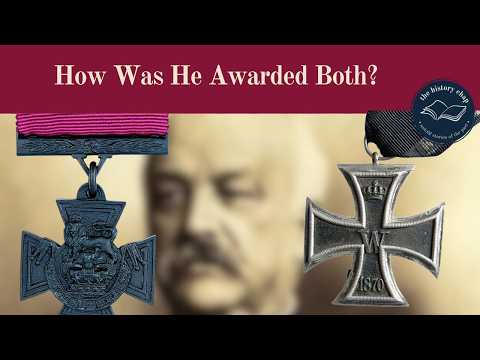
On April 29, 1864, at the Battle of Gate Pā, Manley found himself in the midst of a disastrous British assault. As soldiers fell under withering Māori fire, he ran into the chaos, tending to the wounded and carrying them to safety. He was the last officer to leave the fortifications, and his actions that day would be immortalized with the VC. But Manley’s story was far from over. Just six years later, he would volunteer for the British Ambulance Corps in the Franco-Prussian War, attached to the Prussian Army. His bravery under fire at four major engagements caught the eye of Crown Prince Frederick of Prussia, who recommended him for the Iron Cross.
Thus, William Manley became the only man to wear both medals—a testament to his unwavering dedication to saving lives, regardless of nationality. His legacy endures as a symbol of humanity in the midst of conflict.
Yet the full story of how those two medals came to rest side by side on the same chest is stranger and more human than the bare facts suggest. To understand it, we must return to the night before Gate Pā, to a dinner table where nine British officers gathered in high spirits.
They were confident men, professional soldiers of a professional army, and they had every reason to believe the morning would bring an easy victory. The Māori defenders numbered barely 230, while Cameron’s force boasted over 1,600 men and eleven Armstrong guns. The officers dined together, toasted one another, and retired to their tents expecting glory. Manley, the quiet surgeon among them, could not have known that within twenty-four hours he would be the only man at that table left standing.
When the assault came, it was not glory but slaughter. The 43rd and the naval Brigade charged into a storm of rifle fire from trenches so well concealed the British had not even seen them. Commander Edward Haye fell almost at once, mortally wounded, and it was Samuel Mitchell of HMS Harrier who dragged him clear before meeting Manley in the smoke.
Together the two men carried Haye back through the fusillade, and together they would later stand among the first men decorated with the Victoria Cross. But Haye died before help could reach him—one of thirty-one British soldiers killed that day, with eighty more wounded.
Manley did not stop. Again and again he went forward into the fire, hauling injured men from the killing ground, dressing wounds under the very muzzles of Māori muskets. When the storming party finally broke and fell back, William Manley was the last officer to leave the pā. The Māori, victorious but exhausted, slipped away under cover of darkness that night, and the war rolled on.
Manley would storm four more pā before his time in New Zealand was done, and on one occasion he leapt into the Whakatāne River to save a drowning artilleryman—an act that earned him the Royal Humane Society’s bronze medal. He finished the campaign as a Staff Surgeon, the kind of officer whose courage was measured not in enemies slain but in lives preserved.
Then came 1870, and with it the Franco-Prussian War—a conflict that would make the Iron Cross story possible.
When the Franco-Prussian War erupted in July 1870, William Manley was a married man of thirty-nine, settled into the comfortable rhythms of a peacetime army surgeon. He had nothing to prove and every reason to stay home. Instead, he volunteered.
The British Ambulance Corps had been raised on a wave of public sympathy, funded by £300,000 in donations, and its mandate was strict neutrality—tending the wounded of both armies, French and Prussian alike. Manley was given command of B Division, attached to the Prussian 22nd Division, and by late autumn he was marching through northern and eastern France with the advancing German armies.
He was at four major engagements in quick succession—Beaune-la-Rolande, Châteaudun, and the bloody fighting around Orléans among them—and in each one he did what he had always done. He went forward. He knelt in the mud and the shell-fire, and he worked.
It was at Orléans, in early December, that his reputation reached the ears of Crown Prince Frederick. The prince was a thoughtful, liberal-minded man, married to Queen Victoria’s eldest daughter, and he understood courage when he saw it. An Englishman, under no obligation to be there at all, risking his life for Prussian soldiers—it moved him. He recommended Manley for the Iron Cross, Second Class, and his father, King Wilhelm, approved it.
So it was that a British surgeon stood before the Crown Prince of Prussia and received the kingdom’s highest award for bravery, to be pinned beside the little bronze cross from New Zealand. No one else has ever held both.
When the French capitulated and Paris lay starving behind its walls, Manley did not gloat. He went into the city with supplies for the French hospitals, and the French Red Cross decorated him for it. Neutrality, for him, was never a diplomatic fiction. It was a promise.
The rest of his career reads like a roll-call of the Victorian Empire’s wars. He served in the Second Anglo-Afghan War and was present at the occupation of Kandahar. In 1882 he accompanied General Wolseley’s expedition to Egypt, and as Deputy Surgeon General he was principal medical officer to the Second Division at the Battle of Tel el-Kebir. Thirty years of service, and he retired in 1884 as an honorary Surgeon General, a Companion of the Order of the Bath, and a Knight of St John.
He settled at Cheltenham Spa, on the edge of the Cotswolds, in a house on Lansdown Crescent, and lived there quietly among his children. One son would become a lieutenant colonel in the British Army; another would die in 1901 while serving with the British expedition during the Boxer Rising in China—the same year, as it happened, that his father’s own long life came to its close.
William Manley died of diabetes in 1901, a month short of his ninetieth birthday, and was buried in a local cemetery. Just another forgotten soldier of Victorian Britain, as the saying goes.
But there is one detail worth pausing on. The Iron Cross he received was not the plain decoration most people imagine. It was the Second Class—and the recommendation that won it came from a German prince who would himself become emperor in 1888, only to die after ninety-nine days on the throne, succeeded by a headstrong son whose ambitions would one day set Britain and Germany on a collision course.
When the guns of August 1914 roared and Britain and Germany tore into one another across the mud of Flanders, the Iron Cross and the Victoria Cross had become emblems of two warring empires. Yet in a quiet house in Cheltenham, an old man had already passed beyond that reckoning. William Manley never lived to see the Great War—he died thirteen years before it began—and perhaps that was a mercy. He had worn both medals in an age when courage could still be counted a shared human currency, not a national one.
Today his grave lies in a local cemetery, modest and unassuming, and his name appears on no grand monument. But his story survives in the registers of the Victoria Cross and in the archives of the Prussian army, two records that have never again converged on a single man. He remains the only person in history to hold both decorations—a fact that grows stranger and more remarkable with every passing decade.
What made him unique was not that he fought for two nations, but that he refused to stop being a healer when the world demanded he become an enemy. At Gate Pā he carried wounded men from under Māori fire. At Orléans he knelt in Prussian mud to save German soldiers. In besieged Paris he brought supplies to the French. He belonged, in the end, to no army at all—only to the wounded.
So the next time someone tells you that bravery belongs to one flag or one cause, remember the Dublin surgeon who wore the cross of a queen and the cross of a kaiser on the same breast. History has never produced his equal, and it may never do so again.
What do you think—was Manley a hero of two nations, or of none? Let me know in the comments below.
Report this article
Select a reason for reporting:






