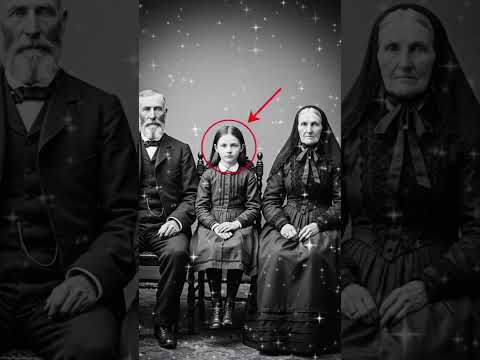
Dr. Emma Richardson had spent three months in the basement archive of the Boston Historical Society, cataloging Victorian photographs. The air was thick with the smell of old paper and dust, and most days blurred into an endless stream of stern faces and faded sepia tones. But on this particular afternoon, a mislabeled box marked “Agricultural Equipment 1880s” caught her eye. Inside, instead of farming tools, she found a collection of family portraits.
One photograph stood out immediately: a black-and-white image from 1871, showing a family of five posed stiffly in their Sunday best. The father, with a thick beard and weary eyes, stood behind his wife, who sat with a baby on her lap. Two older children, a boy and a girl, flanked them. It looked like a typical Victorian family portrait—until Emma noticed the girl’s eyes.
There was something unsettling about them. The girl, no older than ten, stared directly at the camera with an intensity that seemed to pierce through the decades. Her expression was not the usual solemnity of the era; it was a mixture of fear and defiance. Emma felt a chill run down her spine. She had seen thousands of photographs, but this one was different.
Curiosity piqued, Emma decided to examine the photograph more closely. She carefully removed it from its cardboard frame and placed it under a magnifying glass. The image was sharp, but the girl’s eyes seemed to hold a secret. “What are you trying to tell me?” Emma whispered, as if the girl could hear her.
She spent the next hour scanning the photograph into the society’s digital database, then zoomed in on the girl’s face. The high-resolution scan revealed details invisible to the naked eye. In the reflection of the girl’s eyes, there was something—a faint shape that looked like a window, and beyond it, a figure standing outside.
Emma’s heart raced. She had heard stories of hidden messages in old photographs, but she had never encountered one herself. She quickly checked the other faces in the portrait. The parents’ eyes were normal, reflecting only the photographer’s studio lights. But the girl’s eyes were different. They held a reflection that didn’t match the setting.
Determined to uncover the truth, Emma began researching the family. The photograph was dated 1871, and the clothing suggested they were well-to-do. She searched through census records and old newspapers, but found no immediate match. The family seemed to have vanished from history.
Then, she noticed a small inscription on the back of the photograph, barely legible: “Farewell, my darlings.” The words sent a shiver through her. Was this a final goodbye? And why did the girl’s eyes hold that mysterious reflection?
Emma knew she had stumbled upon something extraordinary. The photograph was not just a family portrait—it was a puzzle, a message from the past. And she was determined to solve it.
She started with the inscription. “Farewell, my darlings” was written in a hurried, slanting hand—not the careful copperplate of a professional photographer’s label. Someone had added it later, perhaps the father himself. Emma photographed the back of the card and compared the ink to other documents in the archive, but the handwriting matched nothing in the collection.
The next morning, she pulled the 1870 and 1871 Boston city directories from the shelf. If the family was well-to-do, the father’s name should appear. She worked backward from the studio stamp—Halloway & Sons, Tremont Street—and cross-referenced every family that had commissioned a portrait there in the spring of 1871. There were forty-three. By noon, she had narrowed the list to six.
The third name made her stop: Elias Whitmore, importer, 14 Chestnut Street. A wife, Margaret. Three children—Thomas, twelve; Clara, nine; and an infant, Henry. The ages fit the photograph exactly. But when Emma checked the 1872 directory, the Whitmores were gone. No forwarding address. No obituary in the Boston Daily Advertiser. It was as if the family had simply evaporated.
She called up the society’s collection of Tremont Street business records and found Halloway’s ledger for 1871. The entry for April 17 read: “Whitmore family, cabinet portrait, paid in full.” In the margin, in pencil, someone had added two words: “Rush order.”
Why would a family need a portrait rushed? Emma thought of the inscription again. Farewell, my darlings. A rush order, a farewell, and a reflection in a child’s eye that showed a figure standing outside the studio window.
She returned to the scan and enlarged the girl’s eyes until the pixels began to break apart. The figure was still there—a man in a long coat and a low-brimmed hat, positioned at the edge of the glass. He was not looking at the camera. He was looking at Clara.
Emma sat back in her chair, the glow of the monitor washing her face in pale light. A man in a long coat, watching Clara through the studio window. Not a passerby caught by accident—his posture was too deliberate, his gaze too fixed. She saved the enlarged image and printed it on the archive’s aging laser printer, then pinned it to the corkboard beside her desk.
The next step was obvious, though it made her stomach tighten: she needed to find out what happened to the Whitmores. She pulled the death registers for 1871 and 1872, scanning page after page of faded cursive. Nothing for Elias, Margaret, Thomas, Clara, or little Henry. No burial permits, no coroner’s reports. In a city that recorded everything, the Whitmores had left no trace at all.
She tried a different angle—the Chestnut Street address itself. Old property tax records showed the house at number 14 had changed hands in September 1871, sold by a solicitor acting on behalf of “the Whitmore estate.” The buyer was a shipping merchant named Cornelius Vane. Emma wrote the name down and underlined it twice.
By late afternoon she had pulled the Vane family papers from the manuscript collection. Cornelius Vane, it turned out, had been a partner in the same import trade as Elias Whitmore. The two men had shared warehouses on Long Wharf. And in a letter dated August 1871, Vane wrote to a business associate in Liverpool: “The Whitmore matter is settled. The house is mine, the debts are cleared, and the family has gone abroad. I trust we need not speak of it again.”
Gone abroad. Emma read the line three times. It was the kind of phrase that closed doors rather than opened them. She checked the passenger manifests for Boston Harbor in the autumn of 1871. There was no Whitmore listed on any vessel bound for Europe.
She turned back to the photograph, to the man at the window. If the family had fled, why would a stranger be watching them during their final portrait? Unless the portrait was not a farewell to a journey, but to something else entirely.
Emma reached for the phone and dialed the extension for Dr. Alan Pierce, the society’s curator of manuscripts. He answered on the second ring. “Alan, I need a favor. I need to know if anyone has ever researched a Cornelius Vane—and I need it by tomorrow.”
There was a pause on the line. Then, quietly: “Vane? Emma, why are you asking about that name?”
She looked at the photograph pinned above her desk, at Clara’s unblinking eyes. “Because I think a little girl has been trying to tell us something for a hundred and fifty years.”
The next morning, Alan Pierce was waiting at her desk before she’d even hung up her coat. He held a thin folder, its edges soft with age. “Cornelius Vane,” he said, sliding it across the table. “I’ve been avoiding this name for twenty years.”
Emma opened the folder. Inside was a single sheet of paper—a police blotter entry from September 1871, misfiled among shipping records. It listed a disturbance at 14 Chestnut Street: “Man seen loitering, reported by neighbor. No arrest made.” The description matched the figure in the photograph: long coat, low-brimmed hat.
“Vane wasn’t a partner,” Alan said quietly. “He was a predator. He bought up debts, then used them to take everything a family had. The Whitmores owed him money. He called it in all at once.”
Emma’s throat tightened. “And the family?”
Alan pointed to the bottom of the blotter. A second entry, three days later: “Whitmore residence found empty. No signs of violence. Case closed.” Someone had scrawled a note in the margin, barely legible: “Gone abroad—per Vane.”
Emma stared at the words. Gone abroad. The same phrase that had closed the door a hundred and fifty years ago. But Clara’s eyes had held the truth—a man watching from the window, waiting to collect. The farewell on the back of the photograph was not for a journey. It was for a life about to be erased.
She pulled the high-resolution scan up on her monitor one last time. The figure at the window was still there, still watching. But now Emma saw something she’d missed: Clara’s hand, resting on the arm of the chair, was not relaxed. Her fingers were curled into a small, deliberate shape. A signal.
Emma zoomed in until the pixels blurred. The girl’s fingers were forming letters—three of them, pressed against the velvet. R. U. N.
She sat back, her heart pounding. Clara had known. In the last moment before the shutter clicked, she had left a message for anyone who might look closely enough. A warning. A plea.
Emma reached for her notebook and wrote a single line: “Clara Whitmore, 1871. Not lost. Not forgotten. Just waiting to be seen.”
She pinned the note beside the photograph and turned off the monitor. The archive fell into silence, save for the hum of the old fluorescent lights. Somewhere in the dark, a little girl’s eyes still held their secret—and now, at last, someone had listened.
But the story doesn’t end here. If you could zoom into any old photograph in your family’s collection, what would you hope to find hiding in the eyes of the past?
Report this article
Select a reason for reporting:






