The first snowflakes of January 1942 fell on a landscape already soaked in blood. In the shattered outskirts of Rzhev, Soviet soldiers huddled in frozen trenches, their breath misting in the frigid air, knowing that the average lifespan of a rifleman here was measured not in months, not in weeks, but in hours—sometimes mere minutes. The German war machine had been stopped at the gates of Moscow, but now the Red Army was about to throw itself into a vortex of violence that would consume over 400,000 lives and become known as the ‘Rzhev Meatgrinder.’
This was not a battle for territory. It was a battle for survival, for the fate of the Soviet capital, and perhaps for the entire war. Stalin believed the Germans were on the ropes, their reserves depleted, and ordered a grand winter offensive to encircle and destroy Army Group Center. But the plans were ambitious, the intelligence flawed, and the enemy far from beaten. What followed was a series of brutal, grinding engagements that echoed the trench warfare of World War I, where men died in droves for a few hundred meters of frozen ground.
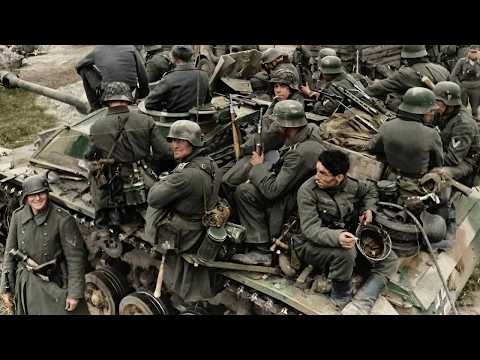
The initial Soviet advance seemed promising. On January 8, 1942, the Kalinin Front attacked, and two days later, Zhukov’s Western Front struck toward Vyazma, threatening to cut the vital Smolensk-Vyazma highway. Levitin’s radio broadcasts announced the liberation of town after town, and it seemed only a matter of time before Rzhev itself would be freed. But the Germans, recognizing the strategic importance of the city as a transportation hub, clung to it with desperate tenacity. Hitler himself intervened, replacing General Strauss with the ruthless Walter Model, who would become the architect of the defense.
Model was a master of improvisation. He shortened the front, freed up reserves, and established a network of fortified villages—the so-called ‘Königsberg Line’—where every house was turned into a bunker, every cellar a firing position. The Soviet advance began to stall, not because of enemy resistance alone, but because of a critical shortage of ammunition. The stockpiles accumulated for the Moscow counteroffensive were nearly exhausted. The Red Army had advanced 200 kilometers, but at a staggering cost.
Meanwhile, the Germans faced their own crisis. The encircled 23rd Corps near Olenino was desperately trying to break out, and Model launched a counterattack that caught the advancing Soviet 29th and 39th Armies off guard. In the forests near Monchalovo, the Germans tightened the noose around two Soviet armies. All attempts to break the encirclement from outside failed, and on February 17, a desperate airlift managed to evacuate only 5,000 soldiers from the pocket. The rest were left to their fate.
The Rzhev salient became a gaping wound on the map, jutting dangerously close to Moscow—only 150 kilometers away. For the Soviet High Command, this was an unacceptable threat. Stalin demanded its elimination, and the Red Army prepared for a new offensive, determined to avenge the losses of the winter. But the Germans were also planning. Field Marshal von Kluge, commander of Army Group Center, decided to eliminate the Soviet bulge west of Rzhev near the village of Kolkowsky, where the 39th Army and 11th Cavalry Corps held a vulnerable position.
The operation, codenamed ‘Seydlitz,’ began on July 2, 1942, with a massive artillery barrage and intensive air strikes. The Soviet troops in the Kholm-Zhirkovsky salient were caught in a trap, short on ammunition, food, and transport. General Konev, commanding the Kalinin Front, understood the danger but stubbornly refused to withdraw, unwilling to give up a single meter of liberated ground. Within three days, the encirclement was closed near the village of Pushkari. It was a devastating defeat.
The loss of the salient was a strategic blow. The Germans regained control of the shortest route from Smolensk to Vyazma, significantly improving the supply situation for the 9th Army. But the Red Army was not done. On July 30, 1942, the Kalinin Front launched a new offensive toward Rzhev, and within two days, Soviet troops were only 6 kilometers from the city. The plan was to liberate Rzhev in a matter of days. Instead, those few kilometers would take a month of bloody fighting to traverse.
On August 4, Zhukov’s Western Front joined the attack, achieving complete surprise near the village of Pogoreloye Gorodishche. The 20th Army, led by Lieutenant General Reiter, punched a 30-kilometer hole in the German defenses and established bridgeheads across the Vazuza and Gzhat rivers. But the advance could not be exploited. German artillery, especially heavy howitzers, dominated the battlefield. Then the weather intervened: torrential rains turned the ground into a quagmire, bogging down tanks and trucks alike.
Model, meanwhile, was playing a dangerous game. He ordered the construction of rear defensive positions—the so-called ‘Buffalo’ line—in direct defiance of Hitler’s orders. The Führer believed such preparations would encourage withdrawal, but Model persisted, even falsifying maps sent to Berlin. Every trench and minefield was carefully documented so that retreating units could quickly occupy them. When the Soviet offensives resumed, they would face a deadly maze of fortifications.
By September 1942, the fighting had devolved into a brutal street battle for Rzhev itself. Soviet assault groups finally entered the northern part of the city on September 21, and for weeks, control of individual houses and blocks changed hands multiple times. The Luftwaffe dominated the skies, pounding Soviet positions, while Model committed his elite ‘Grossdeutschland’ division to hold the city. In the end, the Germans retained control, but Rzhev was reduced to rubble, no longer usable as a supply base or railway hub.
As autumn turned to winter, the Soviet High Command prepared a new operation—codenamed ‘Mars’—to finally destroy the Rzhev salient. But the plan was overly complex, the forces were dispersed, and Soviet intelligence failed to detect the presence of three German panzer divisions near Smolensk. When ‘Mars’ began on November 25, 1942, it was a bloodbath. The 3rd Mechanized Corps, led by the legendary Mikhail Katukov, made initial gains but was soon cut off and surrounded.
The failure of ‘Mars’ was a bitter pill, but it had a silver lining. The German panzer divisions tied down at Rzhev were desperately needed at Stalingrad, where the tide was turning. The 9th Army was bled white, and by the time of Kursk, it was a shadow of its former self. The Rzhev salient had become a death trap for both sides.
Finally, on February 6, 1943, Hitler authorized the withdrawal from the salient, codenamed ‘Buffalo.’ The city of Rzhev was liberated on March 3, 1943, after 13 months of savage fighting that cost the Red Army over 430,000 casualties. German losses were estimated at 150,000 to 200,000. The battles around Rzhev had long been erased from history, but the victory at Stalingrad owed much to those who sacrificed themselves in the ‘Meatgrinder.’
German soldiers called Rzhev ‘the derailment point’ because of the shape of the salient on the map. In letters home, they wrote: ‘There is no land here, only mud, corpses, and steel.’ After the war, Rzhev was not mentioned in textbooks. Only in 1978 did the city receive the Order of the Patriotic War, First Class, without explanation. In 2020, a memorial was finally opened—a 25-meter statue of a soldier standing before a backdrop of cranes, with the names of 17,000 fallen soldiers inscribed at its base.
But the story of Rzhev is not just one of sacrifice and suffering. It is a story of how a nation, faced with annihilation, refused to break. The Rzhev Meatgrinder was a crucible that forged the eventual victory, but the cost was staggering. And as the snows of another winter began to fall, the survivors knew that the war was far from over—and that Rzhev would not be the last hell they would endure.
Yet the ‘Buffalo’ withdrawal was not a simple retreat—it was a masterclass in defensive maneuver warfare. As the 9th Army pulled back, Model’s engineers left behind a wasteland of booby-trapped buildings, fouled wells, and roads seeded with mines. Soviet pursuit units that rushed forward found themselves navigating a deadly corridor where every abandoned village was a potential killing ground. The Germans fell back in stages, fighting for every ridge line and river crossing, buying time for the main force to escape the closing trap.
For the Red Army soldiers who finally entered the ruins of Rzhev on March 3, 1943, the liberation felt less like triumph and more like walking through a graveyard. The city that had once been home to 56,000 people was now a moonscape of shattered brick and twisted steel; scarcely 150 civilians emerged from the cellars, hollow-eyed and starving. They spoke of mass graves behind the church, of executions in the town square, of a winter spent hiding in root cellars while the fighting raged above them. The soldiers handed out what bread they had, then moved on—the front was still moving west, and there was no time to mourn.
What the Soviet command did not immediately grasp was the strategic dividend that Rzhev had bought them. By tying down Model’s 9th Army and the elite ‘Grossdeutschland’ division for thirteen months, the Red Army had kept some of Germany’s best formations far from the oil fields of the Caucasus and the ruined streets of Stalingrad. When Paulus’s 6th Army surrendered in February 1943, the divisions that might have rescued it were already bled white in the frozen forests around Rzhev. The connection was invisible in the newspapers, but it was decisive on the map.
There was a darker truth, however, that the Soviet leadership preferred not to discuss. The Rzhev operations had been rushed, poorly coordinated, and wasteful on a scale that bordered on criminal. The ‘Mars’ offensive in particular had thrown away hundreds of tanks and tens of thousands of lives against defenses that aerial reconnaissance should have detected. Stalin blamed the front commanders; Konev was nearly demoted, and several army commanders were sacked. But the deeper failure lay in a system where reports were polished to please the Kremlin, where intelligence was filtered through fear, and where the cost of a single day’s delay was measured in regiments of dead conscripts.
Among the survivors, the memory of Rzhev would not fade. Veterans of the 30th Army spoke of ‘the valley of death’ near the Volga—a ravine so choked with frozen corpses that soldiers walked across it as if over a bridge. Others remembered the sound of the Katyusha rockets at night, the way the sky turned orange and the ground shook like an earthquake, and then the silence that followed, broken only by the moans of the wounded. Many never spoke of it at all. They came home, took off their uniforms, and went to work in factories and fields, carrying the meatgrinder inside them.
The Germans, too, remembered. Veterans of the 9th Army later described Rzhev as ‘a fortress of mud and ice’—a place where the enemy was not only the Red Army, but the cold, the disease, and the endless, grinding artillery. Letters sent home from the salient were often censored, but some survived: ‘We are holding on, but I do not know how much longer. The Russians come in waves. They do not seem to care if they die.’ Such words captured the essence of what both sides endured—a battle of attrition in which courage was measured not by victory, but by the ability to endure one more day.
As the spring thaw of 1943 turned the frozen ground to impassable mud, the front stabilized along a new line west of Rzhev. The salient was gone, but the war was far from decided. Both sides now turned their eyes south, toward the Kursk bulge, where the next and greatest armored clash was already being planned. The men who had survived Rzhev knew what was coming—another cauldron, another meatgrinder, another test of whether flesh and will could outlast steel and fire. They had learned the grim arithmetic of the Eastern Front: that victory was not won by the boldest charge, but by the side that could absorb the most punishment and still stand.
For the men who survived, the silence after Rzhev was the hardest part. They returned to villages where every family had lost someone, where the word ‘meatgrinder’ was spoken in whispers, as if saying it aloud might summon the guns again. Some became teachers, some became factory workers, and some simply disappeared into the vastness of the country, carrying wounds that no medal could heal.
The history books stayed silent for decades, but memory is stubborn. In 2020, when the memorial finally rose above the Volga—a lone soldier gazing toward the west—veterans in their nineties traveled from across Russia to touch the engraved names. One old man found his brother’s name and stood there for an hour, saying nothing.
Rzhev was never a victory parade. It was a debt paid in blood so that Stalingrad could be won, so that the road to Berlin could be opened. The ‘derailment point’ on the German maps became the turning point on the Soviet ones.
And still, the question lingers like winter fog over the ruined city: how many more Rzhevs were erased from memory, and how many names still wait to be carved in stone? Tell us what you think in the comments.
Report this article
Select a reason for reporting:






