James Mitchell had seen thousands of old photographs in his career as a genealogist. None of them had ever made his blood run cold. But on a humid April afternoon in the basement archive of the Greenwood County Historical Society, a single image stopped him dead.
The photograph, mounted on thick cardboard, showed a black family in their Sunday best: a carpenter named Samuel Johnson, his seamstress wife Clara, and their two young daughters. But it was the third child—a pale, light-haired boy of about seven—who made James freeze. In 1920 Mississippi, during the height of Jim Crow, a white child standing proudly in a black family’s portrait wasn’t just unusual. It was a death sentence.
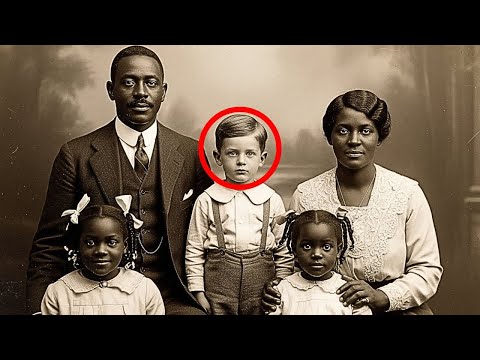
James turned the photo over. Faded pencil read: Samuel, Clara, Ruth, Dorothy, and Thomas. March 14th, 1920. His mind raced. The boy—Thomas—was unmistakably white. Yet there he stood, the carpenter’s hand resting protectively on his shoulder, no trace of awkwardness or forced arrangement. He belonged there.
James showed the photograph to the archivist, a sharp-eyed woman named Mrs. Patterson. Her face flickered with something—recognition, maybe memory. “That would be Samuel and Clara Johnson,” she said quietly. “Respected family. But the boy… I’ve heard stories. The kind people don’t talk about anymore.” She glanced at the clock. “If you want to understand that photograph, talk to Evelyn Price. She’s 93. Her mother knew the Johnsons.”
That night, in his hotel room, James began digging. The 1920 census listed Samuel and Clara Johnson with two daughters—Ruth and Dorothy—and no son. No Thomas. He searched birth records for any white boy born in Leflore County between 1912 and 1914. Nothing matched. Then he found it: a newspaper clipping from February 3rd, 1920.
“Tragic accident claims local couple. Mr. Robert Hayes, 34, and his wife Margaret, 29, perished in a house fire. They leave behind one son, age six.”
One son. Age six. Six weeks later, a white boy named Thomas appeared in a black family’s photograph. James’s assistant emailed back with grim news about the Greenwood County Children’s Home: overcrowded, abusive, children used as unpaid labor, suspicious disappearances. “No charges filed. Facility shut down 1923. Records incomplete.”
James stared at the five faces in the sepia print. Samuel’s steady gaze. Clara’s quiet strength. The two girls in their white dresses. And Thomas—the impossible child—sandwiched between them like he’d always been there.
What had they risked? Everything. And someone had gone to great lengths to hide it. The photograph was evidence of something extraordinary—and dangerous. Tomorrow, he would visit Evelyn Price. Tonight, the mystery had taken hold of him completely.
A truth hidden for a hundred years was waiting to be discovered.
Evelyn Price’s memory was a gift, and by the time James left Magnolia Gardens, he had the whole story: the fire, the orphanage, the middle-of-the-night rescue, the two years of hiding Thomas in plain sight, and the heartbreak of sending him north in June 1922. He had names, dates, and a thread to pull.
At Mount Zion Baptist Church, Pastor Marcus Williams and his secretary Patricia Lewis led James to a basement archive that shouldn’t have existed. A ledger from the 1920s, kept by the meticulous Reverend Walter Thompson, recorded the Johnson family’s “righteous undertaking” in ink. “Samuel and Clara Johnson with daughters Ruth and Dorothy and ward Thomas, age six. Family portrait commissioned. May God protect them.”
Patricia and the pastor exchanged a glance that James couldn’t quite read. “Follow me,” the pastor said quietly, and pulled out a smaller wooden box. Inside was a letter dated July 1922, written in a child’s careful hand. Dear Reverend Thompson, Mama Diane says I should write to say I arrived safe. I miss Mama Clara and Papa Samuel very much. Please tell them I love them. Thomas.
James felt tears on his cheeks. Pastor Williams’s eyes were wet too. “This stays in our archive,” he said firmly. “But you have my permission to tell this story.”
Back in Chicago, James traced Thomas Hayes through the census, a 1935 marriage license to Anna Schmidt, and a death record from 1987. Three children. Robert, Margaret, Elizabeth. Robert had a son—Thomas Hayes Jr., a high school history teacher in Chicago who posted about civil rights and had no idea his grandfather had been raised by a black family in Mississippi.
James sent a careful message. Two days later, Thomas Hayes Jr. replied: My grandfather rarely spoke about his childhood. I’d very much like to hear what you found.
They met at a cafe in downtown Chicago. James slid the 1920 photograph across the table. “This is your grandfather,” he said, pointing to the pale boy between the two girls. Thomas stared, his face shifting from confusion to shock. “That’s a black family. Samuel and Clara Johnson, with their daughters Ruth and Dorothy, and your grandfather Thomas Hayes.”
He told him everything—the fire, the orphanage, the rescue, the photograph taken as proof, the secret letters, the final separation. When he finished, Thomas’s hands were shaking. “They saved my grandfather,” he whispered. “Which means they saved all of us.”
James nodded. “I haven’t traced the Johnson descendants yet. Ruth and Dorothy both had children.”
Thomas set the photograph down carefully. “Then let’s find them. I want to thank them for what their ancestors did.”
It took James three weeks. Ruth Johnson had married William Crawford—the son of Albert Crawford, the photographer who had charged half price for the portrait. Their line led to Ruth Washington, a retired teacher in Memphis. Dorothy’s line led, astonishingly, back to Mount Zion Baptist Church itself: Patricia Lewis was her granddaughter, and Pastor Marcus Williams her great-grandson.
When James called the pastor, Williams didn’t sound surprised. “My grandmother Dorothy told my mother everything,” he said. “We’ve been waiting for someone to put the pieces together. Someone from outside, who could tell it properly.”
“Why didn’t you just tell me?” James asked.
“Because the story needed to be discovered, not handed over. You found the photograph. You found Evelyn. That gives it authenticity. If we just told you, it might have seemed like family legend.”
James understood. He arranged a call with Ruth Washington in Memphis. When he showed her the photograph over video, she put her hand over her mouth. “They saved a white child,” she whispered. “In Mississippi in 1920. Oh my lord.”
Then he told her about Thomas Hayes Jr. “He wants to meet you. He wants to thank your family.”
Ruth was silent for a long moment. “A hundred years later,” she finally said, “and the family’s coming back together. Of course I’m willing. This is everything my grandmother hoped for.”
Pastor Williams had one more suggestion. “We’ll bring everyone together. The descendants of Samuel and Clara, and the descendants of the boy they saved. Here. At Mount Zion. This is what my great-grandparents would have wanted.”
James hung up and sat in the quiet of his hotel room, the 1920 photograph propped against his laptop. Five faces stared back at him across a century. Four had made sense to him once. Now all five did. And in three months, their families would finally meet.
The sanctuary of Mount Zion Baptist Church filled slowly that warm Saturday in June. James stood near the front, watching the pews come alive with faces he had only known as names on census forms. Ruth Washington arrived from Memphis with her three children and two grandchildren, her eyes sweeping the room like she was searching for something she’d lost.
Pastor Marcus Williams moved among them, greeting each relative with an embrace. Seven descendants of Dorothy Johnson had come. Others had traveled from as far as California and New York. Nearly thirty Johnson family members in all. Across the aisle, twenty-three people carried the blood of the boy Samuel and Clara had saved.
Thomas Hayes Jr. entered last, flanked by his two sisters. He paused in the doorway, taking in the room, and James saw his jaw tighten. For a moment the history teacher looked like he might turn and walk back out.
Then Ruth Washington crossed the floor and took his hands in hers. She didn’t speak. Neither did he. They simply stood there, two strangers bound by a photograph taken a hundred years before.
No media had been invited. This was private, sacred. On a large screen beside the pulpit, the 1920 portrait glowed: Samuel, Clara, Ruth, Dorothy, and young Thomas.
Thomas Hayes Jr. spoke first, his voice unsteady. “I’m standing here today because of an act of extraordinary courage and love. My grandfather should have been sent to an orphanage where he likely would have died or been broken. Instead, two people risked everything to save him.”
He looked at the Johnson descendants gathered before him. “They weren’t rich. They weren’t powerful. They were a black family in Jim Crow Mississippi, which meant they lived every day under threat of violence. Taking in a white child could have gotten them killed. And they did it anyway.”
He paused, composing himself. “My grandfather lived to be seventy-three. He married, raised my father and aunt and uncle, saw grandchildren born. He worked as a carpenter, a trade he learned from Samuel Johnson. All of us exist because of what your ancestors did.”
He stepped down and approached Ruth Washington. “I don’t have words adequate to thank you. But we will never forget this. We will tell this story to our children and grandchildren.”
Ruth embraced him, both of them crying. Around the sanctuary, there wasn’t a dry eye.
Pastor Williams took the pulpit. “My great-grandparents were ordinary people who did an extraordinary thing. They saw a child in danger and responded with love despite the risk. This picture was taken as evidence, as proof that Thomas existed and was loved. Samuel knew it was dangerous to document what they’d done, but he insisted. He wanted there to be a record, even if it cost them. And now, a hundred years later, that photograph has brought our families together.”
Ruth Washington shared the stories her grandmother Ruth had passed down—young Thomas playing with her and Dorothy, learning carpentry from Samuel, helping Clara in the garden. “My grandmother said Thomas was shy at first, traumatized by losing his parents. But slowly he began to smile again. Clara would hold him and sing to him, and Samuel taught him to measure wood and use tools. They loved him like their own.”
She paused. “And when they had to send him away, my grandmother said her mother cried for weeks. Clara never stopped thinking about him, wondering if he was safe, if he was happy.”
Thomas Hayes Jr. stood again and pulled out a small box. “When my grandfather died, we found this in his attic. We never knew what it meant, but now we do.”
Inside was a carved wooden horse, worn smooth by time and handling. He turned it over so the room could see the tiny letters beneath the base. “SJ,” he said. “Samuel Johnson made this for my grandfather. He kept it his entire life. Seventy-three years.”
He handed the toy to Pastor Williams. “This belongs in your family’s history. It’s proof that he never forgot them—just as they never forgot him.”
The two families mingled for hours, sharing stories, embracing strangers connected by blood and by something stronger than blood. James moved among them, documenting with photos and notes, watching history correct itself in real time.
Afterward, outside the church, Thomas Hayes Jr. and Pastor Williams held a press conference. The story had leaked—too many people knew, and journalists from across the country had descended on Greenwood. Thomas faced the cameras.
“In 1920, my grandfather lost his parents in a fire. He was six years old, alone, and about to be sent to an abusive orphanage. A black family named Johnson took him in, hid him, protected him, and loved him at tremendous risk to themselves. Today, our families reunited to honor that act of courage.”
He held up the 1920 photograph. “This picture was taken as evidence. Samuel and Clara Johnson wanted the world to know that they had loved this boy, even if it cost them everything. A hundred years later, their wish has come true.”
James watched the cameras flash and felt the weight of the moment settle over him. The story was no longer his alone. It belonged to the world now—and to whatever came next.
The story went viral within days. Major newspapers ran it; television networks featured the two families standing together outside Mount Zion. The 1920 photograph was seen by millions. “This picture was taken as evidence,” Thomas Hayes Jr. told the cameras. “A hundred years later, their wish has come true.”
Critics asked why the world celebrated a Black family saving a white child. Pastor Williams answered firmly: “The Johnsons knew oppression intimately. That’s what makes their choice so powerful. Despite everything, they chose love.”
The families established a foundation in Samuel and Clara’s names, funding scholarships for foster children. The photograph was donated to the Smithsonian. The house at 412 Elm Street became a museum.
Five years later, Thomas’s daughter Sarah married Pastor Williams’s grandson at Mount Zion. They named their first child Clara.
James stood in the cemetery afterward, beneath the same stars that shone on Samuel and Clara in 1920. The mystery was solved. Love had outlived the hatred that tried to silence it.
But it makes you wonder—if two ordinary people could risk everything for a child in 1920 Mississippi, what quiet act of courage might you be called to make today?
Report this article
Select a reason for reporting:






