In the fall of 1873, a surveyor pressed his ear against a canyon wall and heard something that should not exist. The sound was not water, not wind, not the creak of settling rock. It was a low, regular vibration—like a millstone turning far underground. He wrote it down, closed his notebook, and walked back to camp. He never spoke of it again.
Weeks later, an elderly Paiute leader told a one-armed explorer that something inside those same walls was still breathing. The explorer was John Wesley Powell, the man who had already mapped the Colorado River and would soon run both American geology and ethnography. He recorded the old man’s words, filed them away, and published nothing. In the margin of a surveyor’s notebook, he wrote a single word: wait.
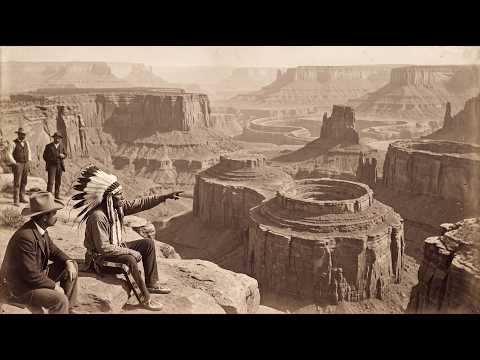
This is not a treasure hunter’s tale. It is a story about two records that were never meant to meet—and the strange arithmetic of what they describe.
The surveyor was Owen Marsh, a quiet man who measured depth, width, and grade. His notebook is a dry ledger of barometric readings and weather notes. But three entries from a single side canyon of Kanab Creek have been marked separately in the archive. The first describes a wall 40 feet high and 110 feet long, smooth, showing no bedding lines. Canyon walls are read layer by layer, like pages of a book. This section had no pages.
The second note sits 300 yards farther up. On the canyon floor, two parallel grooves emerge from under the gravel. They run 22 inches apart and hold that exact spacing for 140 feet. Marsh does not name them. He only notes that they do not follow the direction of the water. They cut across it. Water doesn’t flow sideways.
The third note is the shortest. Near the end of the side canyon, 18 feet above the floor, is an opening roughly the size of a doorway. The opening has been closed. The material that seals it looks as if it were poured—the same color as the surrounding rock, but not rock, with no joints and no mold marks. Marsh knew the mud-and-stone granaries of the ancestral Puebloans well; he sketched them in other canyons. This was not that.
When he pressed his ear against the fill, he heard the vibration. He measured it, recorded it, and walked away. He did not interpret it. He was a surveyor.
That same October, Powell sat beside a juniper fire with Chu-ar-um-peak, a Kaibab Paiute leader who had guided him across the plateau for years. The interpreter was Jacob Hamblin, who had known the region for two decades. The nights were already freezing. The old man wrapped himself in a rabbit-skin blanket and spoke of places the Paiute did not go. He gave a number: seven. He described where some were, refused to say where the others were. Inside those places, he said, were chambers. Their walls had not been cut by water. They were smooth to the touch, like oiled leather. Their entrances had once been open. They were no longer.
The prohibition was not vague fear. It was experience. Long ago, two groups had gone into those places. The ones who came back from the first group told what they had seen and never went down that canyon again. No one came back from the second group. After that, nobody went in. Even when they passed the mouths of those canyons, the Paiute changed their path.
But the chambers are not what makes Powell’s notes remarkable. It is what was said to be inside them. According to the account, when the Paiute first came into this country, some people had gone into those chambers. Inside, they saw objects about the height of a man, made of neither wood, nor stone, nor clay. They caught the light the way metal does, but they looked like no metal the Paiute had ever seen in trade. And they did not stay still. They moved back and forth along grooves in the floor. They made a rhythmic sound—like the breathing of something very large that had fallen asleep, a breath slowed almost to a stop. And when someone came close, they turned toward that person.
Hamblin could not translate the Paiute word for these things. Powell left a short explanation in the margin: the word describes both the movement of a tool and the movement of an intention—not animal, not wind, not water, not alive, but not lifeless either. In the end, Hamblin gave Powell a single English word to write down: machines. That is a translator running out of language.
Chu-ar-um-peak did not tell any of this the way a storyteller tells a story. He grew serious when asked about the locations, left some questions unanswered. And when he was asked who had made the chambers, he said only one thing: When the Paiute came into this land, they were already there. Already built, already sealed. Someone had been there first.
The canyon is real. The archive is real. Powell’s 1873 commission and Almon Harris Thompson’s survey are real. The unanswered question begins only after that point—because in the same file that holds Marsh’s notes, there is another record written weeks later. A record Marsh never read. And when the two are placed side by side, they read like a conversation neither man knew he was having.
Put the two records side by side and the matches begin to stack up in a way that is hard to wave away. Chu-ar-um-peak described chambers whose walls water had not cut, smooth to the touch. Marsh measured a smooth wall with no bedding lines. The old man described things moving along grooves in the floor. Marsh measured two parallel grooves that cut across the flow and held their spacing for 140 feet. Chu-ar-um-peak said the entrances had once been open and were no longer. Marsh sketched an opening closed with a fill that looked poured and was not rock.
Then comes the most unsettling match in the file. Of the seven places, Chu-ar-um-peak described only one in detail. The others had gone quiet, he said. This one was still breathing. His description: west of Kanab, at the end of a narrow canyon that bends to the south, a little above the floor. Marsh’s sealed entrance was west of Kanab, at the end of a narrow canyon that bends to the south, 18 feet above the floor. The same place.
And there is one more match, and this one is about time. According to Chu-ar-um-peak, the place did not make the same sound in every season. The breathing was strongest in the month the leaves turn yellow. In summer it nearly went silent, and in winter it could not be heard at all. The day Marsh pressed his ear to that wall was in the last week of September—the week the cottonwoods in the canyon turn yellow.
One man said it beside a fire. The other pressed his ear to a wall and wrote it down. Neither ever heard the other.
That this story cannot be proven is not a weakness in the story. It is the story. It isn’t necessary to dismiss anyone to say that this is not proof. There is a strong, honest explanation, and it deserves to be told at full strength.
Skeptics reasonably start with geology. The side canyons of Kanab Creek cut through thick beds of limestone. Limestone dissolves in water, and over time it fills with caves, fractures, and connected voids. Geologists in this region know breathing caves well—systems that pull air in or push it out as the outside pressure changes, and that can produce a low, rhythmic rushing sound. Stone that breathes: that is exactly what a man with his ear pressed to the rock might hear.
The fill that looks poured can be explained, too. When water loaded with calcium carbonate seeps from a cave mouth for years, it leaves behind a curtain of travertine and flowstone. It looks poured, it has no joints, and it can seal an entrance completely. Travertine of this kind is common across this canyon country. The grooves could be joints in the rock widened by erosion. The smooth wall could be a surface polished by centuries of flash floods.
And the testimony passed through two filters—first Hamblin’s limited Paiute, then Powell’s pen. The word machine came out of the mind of an American in 1873. What Chu-ar-um-peak actually meant may have been something else entirely.
Skeptics raise a second point, and it is a fair one. The Tavwoats account that Powell did publish already speaks of a closed road, a blocked pass, a sealed path, a place no one may enter again. These are images with deep roots in the oral tradition of this region. An interpreter and a scientist listening beside a fire may have given those images the solid shapes of their own world. Powell’s field notes are also disorganized, and some pages are known to have been copied out years later. Even the seasonal match has an explanation: in the fall, cold fronts crossing the plateau swing the air pressure fast, and a breathing cave is at its loudest in exactly those weeks.
And Powell not going back to that canyon requires no secret. There were congressional budgets, the arid lands report, and a hundred other priorities.
All of this is reasonable. None of it has been disproven. But none of it has been tested, either. No sample was taken from the fill. No airflow was measured. The grooves were never mapped again. No photograph. No second survey. No excavation. And no one, to this day, has proven that nothing is there.
One thing should also be said clearly. The Kaibab Paiute carry their own traditions today, in their own way. This file does not speak for them. It only reads what was written in a stranger’s notebook in 1873, through the mouth of an interpreter.
For the next twenty years, Powell ran the two most powerful scientific institutions in America. The Bureau of Ethnology funded hundreds of field studies. The Geological Survey mapped the canyon again and again. In 1880 and 1881, Clarence Dutton surveyed the canyon’s geology from end to end for a monograph published in 1882. None of them went back to that side canyon. Nobody did.
The commission report that went to Congress in 1874 lists, item by item, population counts, reservation proposals, acres of farmable land, and whether each spring ran all year. Nothing about chambers. In the archive file, Marsh’s notebook runs to 212 pages. The pages given to that side canyon: three. And in the margin of those three pages, in Powell’s handwriting, one word—wait.
Thompson’s map of the Kanab Basin, drawn at the end of that season, is in the same file. On that map, every one of the forty side canyons has a name or a number. Except one. The narrow canyon that opens to the west and then bends south is drawn on the map, but it has no name and no number. At its far end, there is only a small cross made in pencil.
And there is a gap in the record that is even harder to explain. The photographer John K. Hillers was in the area in 1873, exposing hundreds of glass plate negatives for Powell—Paiute camps, springs, canyon walls. Hillers’ list for that season includes plates taken in the Kanab side canyons. There is no plate of the smooth wall, the grooves, or the sealed entrance. Not one.
In 1908, Theodore Roosevelt declared the area a national monument. In 1919, Congress created Grand Canyon National Park. In 1984, much of the Kanab Creek watershed became federal wilderness—land where motor vehicles, permanent structures, and unpermitted digging are prohibited. So the wall a surveyor pressed his ear against in 1873 now stands on ground where a permit to dig is almost impossible to get.
One hundred and fifty years. Seven places. One notebook. Zero excavations.
So the file closes the way it opened: with a sound and a silence. Marsh’s three pages, Chu-ar-um-peak’s seven places, Powell’s one word—wait—still sitting in box 41, still unanswered. The wall is still in the canyon. The wilderness still forbids the shovel. And no one on record has pressed an ear to that stone again.
Maybe that is the ending: not a discovery, but a door left deliberately shut. Powell could have published. He could have sent Dutton. He chose to file it and wait—and he never wrote down what for. Perhaps he was waiting for the Paiute to decide. Perhaps he was waiting for science to catch up. Perhaps he simply understood that some doors are sealed for a reason, and that the reason was not his to open.
Chu-ar-um-peak said it plainly beside the fire: When the Paiute came into this land, they were already there. Already built, already sealed. Someone had been there first. That is the whole story in one sentence—someone was here before, and they closed the door behind them.
So the question was never really whether the machines exist. It is what we owe the sealed door. Do we dig, and prove ourselves right? Or do we wait, as Powell did, and leave the breathing stone to its sleep?
When Chu-ar-um-peak said they were already there—who do you believe he was remembering? Tell us in the comments.
Report this article
Select a reason for reporting:






