The intelligence report was one page long, and it traveled through the ready rooms of the Imperial Japanese Navy like a joke everyone wanted to tell. Somewhere over the Solomon Islands, in the humid airfields ringing Rabaul, veteran Zero pilots passed it hand to hand between missions. It described a new American carrier fighter, still unseen in combat, and the listed weight was staggering—nearly twice what a Mitsubishi Zero weighed with full fuel and ammunition.
Men who had flown from Pearl Harbor to the Philippines to Java, who had watched British Hurricanes and Dutch Buffalos fall out of the sky in their first afternoon against a Zero, read the number and laughed. “A fighter that heavy could not turn inside anything,” one veteran said. “It’s nothing more than a truck with wings, sent up to die.”
They folded the report away and went back to their coffee, certain that whatever the Americans built next would die in the water the same way everything before it had died. They were not wrong about the weight. They were wrong about everything else.
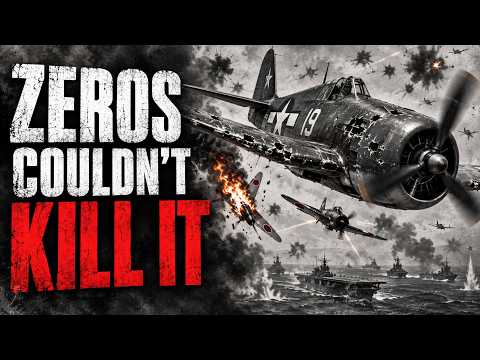
To understand why, you have to go back two years earlier and six thousand miles east, to a flat stretch of former potato fields on Long Island called Bethpage. There, in the summer of 1941, the engineers of Grumman Aircraft were staring at a problem that had nothing to do with elegance and everything to do with survival.
Leroy Grumman, the company’s founder, had flown for the Navy in the First World War. He understood, in a way boardroom executives rarely did, what it meant to bring an airplane home with holes in it—or not bring one home at all. His chief engineer, William Schwendler, had spent months absorbing every scrap of combat data the Navy could hand him. What they learned was not encouraging.
American pilots flying the stubby Wildcat against the Zero were dying at an alarming rate, and the reasons were mechanical, not personal. The Wildcat had no armor plate behind the pilot’s seat. Its fuel tanks were not sealed against gunfire, so a single hit could turn the aircraft into a torch. Its engine did not have the raw power to disengage from a fight once one turned against it.
The Zero, by contrast, was a masterpiece of a different philosophy. Light, agile, capable of outturning almost anything in the sky because Japanese designers had stripped away armor and self-sealing tanks in exchange for maneuverability. It was a blade. The Wildcat was neither a blade nor a shield. It was something caught in between, and pilots were paying for that indecision with their lives.
Grumman kept a running file of after-action reports on his own desk and read every one himself. The reports were written in the flat, restrained language the Navy preferred, but underneath sat the same story again and again. A wingman hit once low on the fuselage, gone in a sheet of flame before he could radio a position. A pilot who nursed a shredded Wildcat two hundred miles back to a carrier deck only because a single lucky round had missed his fuel line by inches.
Grumman did not consider these stories abstractions. He considered them a debt.
In the spring of 1942, Grumman engineers sat down with combat veterans, among them a young lieutenant commander named Edward O’Hare, who had already shot down five Japanese bombers in a single engagement. The engineers asked a blunt question: What killed your wingmen? The answers were not complicated. No armor, no sealed tanks, not enough horsepower to run when a fight turned bad.
So Grumman and Schwendler built the opposite of a Zero. At the heart of the new design sat a Pratt & Whitney engine producing roughly 2,000 horsepower—nearly double what the Zero’s engine could generate. Around the cockpit went more than 200 pounds of armor plate. The windscreen was thick enough to stop a rifle round. The fuel tanks, holding well over 200 gallons of high-octane fuel, were lined with a rubber compound that swelled shut the instant a bullet passed through it, sealing the leak before it could catch fire. And mounted in the wings were six Browning machine guns, each firing rounds heavy enough to tear a control surface apart with a single burst.
The new fighter would never outturn a Zero. It was never designed to. It was designed to outlive one.
On a June morning in 1942, the first prototype rolled out onto the grass at Bethpage. Test pilot Robert Hall climbed into the cockpit, ran the engine up, and lifted off over the same potato fields where Grumman had once dreamed of building nothing more ambitious than mail planes. It flew. It was heavy—exactly as heavy as the Japanese intelligence report would later claim—but it climbed and it held together and it came back down in one piece.
Within weeks, the engine was upgraded again, and the aircraft that emerged from that second round of changes was the one that would eventually cross the Pacific and meet the Zero in the air. The Navy called it the Hellcat.
That same month, on the other side of the world, an accident occurred that neither side yet understood was a turning point. During a raid on the Aleutian Islands, a young Japanese pilot named Tadayoshi Koga took a single rifle round through his aircraft while returning from a strike on an American base. The bullet severed a line feeding his engine, and Koga, following standard procedure, tried to put his crippled Zero down on a stretch of ground his commanders had marked as an emergency landing site.
What looked from the air like flat grassland was in fact a soft, waterlogged bog. The moment his wheels touched down, they caught and held, and the aircraft flipped violently onto its back at full landing speed. Koga died instantly. His wingmen circled twice, saw no fire and no movement, and flew home unable to confirm what had happened or to destroy the wreckage as procedure required.
For weeks, the wreck sat untouched on that lonely island, rain filling its inverted cockpit, the body of the young pilot still strapped inside, while both navies remained entirely ignorant of what was waiting there. It was not sabotage or espionage that finally delivered the Zero into American hands. It was simple bad luck for the side that had lost it and simple persistence for the side that eventually found it.
More than a month later, an American patrol aircraft spotted the overturned Zero sitting undisturbed on the island. A salvage crew recovered it largely intact, crated the wreckage, and shipped it to a naval air station in San Diego, where engineers rebuilt it piece by piece. By the autumn of 1942, American test pilots were flying a fully restored Japanese Zero in mock combat against their own fighters.
And for the first time, the United States Navy understood exactly what it was up against. The Zero’s ailerons stiffened dramatically at high speed, making it sluggish and difficult to maneuver in a fast dive. Its engine lost power rapidly at altitude. Its lightweight airframe—built without armor or sealed tanks for the sake of agility—could not survive being pushed to its structural limits the way a heavier aircraft could.
The information came too late to change the Hellcat’s basic design, since that design was already locked in and moving toward mass production. But it confirmed everything Grumman and Schwendler had gambled on. The Zero could be beaten, and the way to beat it was to refuse to fight it on its own terms.
Through the winter and into the following year, the Bethpage factory shifted into a rhythm that felt more like a heartbeat than a production line. A new Hellcat rolled off the assembly floor roughly every hour, assembled by workers who a year earlier had never touched an aircraft part in their lives. The first operational squadron received its aircraft in January of 1943. A second followed soon after. By late summer, ten Hellcat squadrons were flying from the decks of four fleet carriers spread across the Pacific—their pilots young, largely untested, and utterly unaware of how completely the balance of the air war was about to shift beneath them.
On the evening before their first mission, in a ready room thick with cigarette smoke and the smell of strong coffee, one squadron commander stood in front of a chart pinned to an easel and told his pilots what to expect. They were flying an aircraft the enemy had never seen in combat. The Japanese would misidentify it. They would underestimate it—exactly as the intelligence report circulating through Rabaul had underestimated it months before.
And in the morning, for the first time, that underestimation was going to be tested against real fire, real altitude, and real men who had spent two years believing nothing in the sky could stand against them. Outside on the flight deck, the new fighters sat under a darkening sky, engines silent, propellers still. To the deck crews walking among them with flashlights, checking gun ports and fuel caps one final time, they did not look like the future of naval aviation. They looked exactly like what the Japanese intelligence report had promised: broad-shouldered, thick-winged, heavier in the nose than any fighter the Navy had sent to war before.
None of the young men climbing into their cockpits the next morning could have said with certainty that the aircraft beneath them was about to change anything. They only knew that somewhere to the west, on a small speck of coral no one back home had ever heard of, they were about to find out.
Marcus Island was a triangle of coral and packed sand sitting far out in the central Pacific, close enough to Tokyo that Japanese planners had never seriously considered it a target. It held a weather station, a radio relay, and a garrison who believed, with good reason, that they were sitting in one of the safest corners of the empire.
In the last dark hour before dawn, the new fighters lifted off the deck of their carrier in measured intervals, one after another, vanishing into a black sky, climbing west toward an island that had no idea what was coming. The Japanese radar operator on Marcus caught the formation on his screen with barely minutes to spare. The fighters came in high, peeled off in pairs, and dropped toward the airfield with every gun firing.
Ground crews who had never heard the sound before described it later as heavier than anything American aircraft had produced—a deep, tearing note that did not sound like a fighter at all. By full daylight, the airfield was burning. The fuel stores were a column of black smoke rising thousands of feet into the morning air, and the aircraft caught on the ground had been reduced to twisted metal.
It was a small raid against an undefended target, barely a skirmish by the standards of what was coming, but it was the first time the new American fighter had fired its guns in anger, and it worked exactly as its designers had hoped. Pilots climbed down from their cockpits afterward—not exhilarated so much as quietly relieved, running their hands along wings that had come home without a scratch, checking gun ports that had jammed on no other American fighter quite so rarely.
Word traveled fast across the task force that evening. The heavy, awkward-looking fighter everyone had privately worried about had handled itself exactly the way its engineers had promised back on Long Island. But no one aboard those carriers mistook a raid on a lightly defended weather station for proof of anything. Marcus had been a hunt against sleeping prey, over almost before the defenders understood they were under attack.
The real question—the one that mattered—was what would happen when the new fighter met Zeros flown by men who were awake, alert, and had spent two years perfecting exactly the kind of fight they expected to have. The real test came weeks later over an island the Japanese had held since the earliest days of the war, and were determined never to lose again.
There, veteran Zero pilots rose to intercept an American strike far larger than anything they had faced before—carriers launching wave after wave of fighters and bombers under a low morning sun. The Japanese pilots did what they had always done, diving hard to use their superior turning ability, trying to slip in behind an American tail and force a quick, decisive kill before the enemy could react. It had worked against Wildcats for two years.
Against the new fighters, it did not work at all. Instead of turning to meet the dive, the American pilots climbed. Their engines, built with nearly twice the horsepower of a Zero’s, hauled them upward at a rate the lighter Japanese fighters simply could not match. Pilots who had trained their entire careers to win a turning fight found themselves chasing an enemy who refused to turn—who used altitude and raw engine power instead, diving down out of the sun to fire a single burst and then climbing away again before a Zero could ever bring its own guns to bear.
One Japanese pilot who survived that engagement remembered watching an American fighter execute a maneuver he did not think the heavy aircraft was capable of—standing nearly on its tail, rolling hard, and dropping directly onto the tail of his wingman. The burst that followed did not merely damage the Zero. It broke the aircraft apart in the air, the fuselage separating just behind the cockpit, the engine spinning away trailing fire while the wings tumbled separately toward the sea.
What haunted the Japanese pilots who returned from that fight was not simply that they had lost aircraft. It was that the aircraft they lost to did not behave the way a heavy fighter was supposed to behave—and that the aircraft they hit did not go down the way a Zero would have gone down.
A Zero struck in the wing root by heavy machine-gun fire would very often catch fire immediately. Struck twice in the fuselage, it would begin losing fuel from tanks that had never been sealed against gunfire. Three solid hits near the cockpit, and the pilot himself was usually dead.
The new American fighters came home instead with holes in their wings and fuselages large enough to put a fist through, and their pilots climbed out and walked to the mess hall for breakfast. It was not a contest between two blades anymore. It was a contest between a blade and a shield—and a shield, it turned out, could win.
In the end, the flying truck the Japanese had laughed at destroyed several thousand enemy aircraft while losing only a fraction of that number in return. Grumman built over ten thousand of them, and the men who flew them never forgot the debt their engineers had paid.
What do you think—was the Hellcat’s victory a triumph of engineering, or a warning about what happens when an enemy mistakes weight for weakness?
Report this article
Select a reason for reporting:






