He materialized from the monsoon mist—a lone figure with a Fairbairn-Sykes knife strapped to his chest and eyes the color of a stormy Tasman Sea. No fanfare, no paperwork trail, just a cryptic memo authorizing the transfer of one Australian SAS specialist to MACV-SOG’s Forward Operating Base 2 in Kontum. Captain Hayes squinted at the document, his gut screaming that this was no ordinary lend-lease. “A bloody phantom transfer,” muttered Sergeant Rodriguez. “What is this? A foreign exchange student program?” But Briggs wasn’t there to make friends. He was there to hunt.
The Americans, brash and loud, relied on overwhelming firepower and swaggering camaraderie. Briggs operated on the opposite principle: stealth, silence, and absolute absence. He moved through the camp like a shadow, disappearing only to reappear exactly where needed. He never smiled, never shared rations, and offered only monosyllabic responses. “If it needs saying, I’ll say it,” he told Lieutenant Davies when teased about his silence. The SOG men viewed his quiet intensity as arrogance—until Operation Nightingale changed everything.
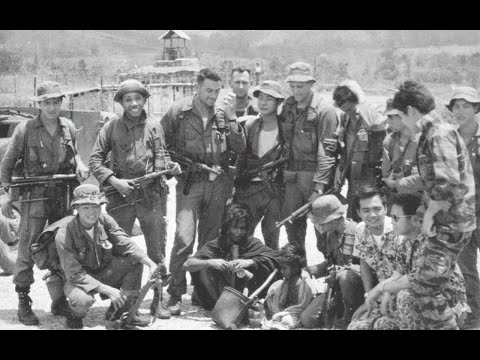
The mission was a straightforward reconnaissance insertion along the Laotian border, but Briggs moved at a snail’s pace that infuriated the pace-oriented veterans. “We need to move, mate,” Rodriguez hissed. Briggs’ voice came as a dry whisper: “We’re already where they want us to be.” Moments later, the jungle erupted. AK-47 fire, mortar shells, and the click-hiss of three hidden Claymore mines arming nearby. They had walked directly into a kill zone designed to wipe them out instantly.
Panic set in. Captain Hayes shouted orders, but the trap was too tight. Then Briggs moved. He didn’t fire a single shot. He dropped his rifle and darted toward the Claymores, crawling under the deadly wire with his webbing belt. The SOG men watched in disbelief as he secured the tripwires to a tree root, disarming the pressure plates without triggering the explosives. “Follow my six,” he snapped—his first genuine command—and led them into a waterlogged mangrove swamp that no map marked as viable. After 45 brutal minutes, they emerged alive. Rodriguez, covered in leeches, stared at Briggs. “How did you know that swamp was there?” Briggs merely wiped mud from his knife. “The water runs that way. Where there is water, there is always a way through.”
Captain Hayes realized Briggs hadn’t just saved them—he had orchestrated their escape with impossible calm and intimate knowledge of the terrain. “He’s not a soldier,” Hayes whispered. “That Aussie is a two-legged weapon designed only for existence. He doesn’t fight, he survives, and we were just collateral in his survival plan.”
The near-death experience shifted everything. Resentment dissolved into deep, unsettling respect. Briggs never held a formal class; his training was subtle, constant, delivered through silent demonstration. He taught them to read the jungle like a book—the dew point on leaves at dawn, the angle of the sun through the canopy, the subtle shift in air temperature. His most profound lesson centered on breath. “You breathe too deep,” he’d state plainly. “You pull the air, you move the moisture, the sound travels, you are announcing yourselves.” He demonstrated how to breathe so shallowly, mostly through the nose while lying prone, that he could remain perfectly still for hours, melding with the moss and mud. He called it breathing like the dead.
The turning point came when they stumbled upon fresh tracks near a suspected VC resupply cache. Hayes prepared a flanking maneuver, but Briggs stopped him with a single hand gesture. He stripped down to his trousers, boots, and vest, taking only his fighting knife and a small spool of comms wire. He slipped into the bush alone. Two hours later, he reappeared just as silently, placing two items on the ground: a detailed VC hand-drawn map of local supply trails and a small brass bell used to alert camp guards. “They use the bell near the stream,” Briggs explained. “I removed it. Now they think their ears are playing tricks.” He hadn’t fired a shot, hadn’t raised an alarm, and had successfully penetrated a functioning enemy camp. The team, humbled and awestruck, knew they were no longer dealing with a temporary liaison. They were students of a master.
Upon return to FOB 2, Captain Hayes bypassed standard reports and went straight to the highest echelon of MACV-SOG command. “Sir, regarding the Australian asset, Briggs, my formal recommendation is that we initiate steps for a permanent retention.” There was a pregnant pause. “Permanent, Captain? He’s on temporary loan. We’re talking international exchange protocol here.” “Protocol is killing men, sir,” Hayes countered. “Since Briggs arrived, RT Florida’s mission effectiveness has jumped 50% and our risk exposure has plummeted. He is, simply put, the difference between mission success and a body bag retrieval operation.”
The response from the Australian Liaison Offices was strangely ambiguous—no immediate rejection, only non-committal radio messages: Acknowledged. Briggs’ status remains under review pending evaluation of operational impact. Continue current assignment. The silence hinted at a secret understanding. Perhaps the SASR knew exactly what Briggs was capable of and viewed his assignment with SOG as a high-stakes real-world deployment where he could hone his craft far from administrative scrutiny. In the camp, the issue was an open secret. Hayes ensured Briggs always had the best gear and quietest quarters. Briggs himself remained utterly detached, never asking about his papers or return date. To him, the mission was continuous. His loyalties were not to a flag or a memo, but to the mission and the men who relied on his silent expertise.
The true crucible came during extraction from a mission deep inside Laos. Specialist Mac McIntyre went down hard, twisting his ankle badly. The team was forced to leave him behind briefly, intending to circle back. But a massive buildup of anti-aircraft weapons meant no air support could enter the zone. Captain Hayes faced an impossible dilemma: risk the entire team or accept the loss of one man. “I’ll go,” Briggs said, his voice flat, final. Hayes looked at him, startled. “Briggs, that’s a deep penetration. You’ll be alone against heavy pursuit. You go in, you might not come out.” “If you send the team, you lose the team,” Briggs stated, bundling a medical kit and two canteens into his vest. He took no assault rifle, opting instead for his silenced CAR-15, his fighting knife, and a length of comms wire. He disappeared into the twilight.
The next 36 hours were agony for RT Florida. They could hear distant enemy patrols sweeping the sector, but there was no sign of Briggs. Meanwhile, Briggs wove through the jungle like smoke, avoiding every well-worn trail, using his dead man’s breathing to hide during daylight. He found McIntyre huddled beneath a root system, delirious from fever. The return journey was the true test. Using his comms wire as a garrote and his knife as a surgeon’s tool, he executed a series of silent, close-quarter eliminations on two separate two-man patrol teams. He did not fire a single shot. After 36 hours and 15 minutes, a gaunt, exhausted Briggs walked into the extraction point, McIntyre slung over his back. “Three eliminated,” he reported. “The others are searching the opposite sector. We can lift now.” He placed two items on the ground: brass knuckles and his unblemished Fairbairn-Sykes knife. He had proven that invisibility was the most effective weapon of all.
The successful extraction marked the final turning point. Briggs was no longer a temporary asset—he was the unit’s talisman, their unspoken guarantor of survival. Captain Hayes began revising RT Florida’s operational doctrine, moving from aggressive direct action toward stealth-first philosophy. The characteristic heavy, fast-paced American stride vanished, replaced by Briggs’ low-impact, toe-to-heel shuffle. Radio chatter was cut to the barest minimum. Even personal gear changed—lighter, silent loads, secondary Fairbairn-Sykes knives. Sergeant Rodriguez, once the loudest skeptic, became Briggs’ most fervent disciple, studying wildlife movements and practicing the dead man’s breathing. Briggs never sought credit, never gave a formal lecture. His training continued through quiet correction—a pointing finger to a snapped twig, a soft cough to indicate a misplaced step. The legend grew. Other teams whispered of Hayes’ unit, unnervingly quiet and lethally efficient. They earned a new moniker: the shadow team.
But the inevitable arrived during monsoon season. A low-priority encrypted message slipped into Hayes’ file: Subject: Termination of Secondment, Corporal Briggs, C. His tour had officially expired. He was to be rotated back to Australia. Hayes stared at the paper, a knot tightening in his stomach. He brought the issue before his men. The reaction was outright fury. “They can’t take the Aussie,” insisted Mac McIntyre, the man whose life Briggs had saved. “If we run the upcoming insertion without him, we’re blind.” Sergeant Rodriguez voiced the collective sentiment: “Captain, if they pull him now, it’s not just a personnel change, it’s a death warrant for the next team that hits the border.”
In an act of audacious defiance, Hayes instructed his lieutenant to draft a collective non-official letter of protest. Every man signed it, listing every major success and every life saved because of Briggs’ silent proficiency. Hayes then pulled Briggs aside. “Briggs, the paperwork came through. You’re being recalled to Australia. They want you back within the week.” Briggs showed no reaction. He simply nodded and began sharpening his knife. “Understood, Captain.” Hayes was surprised. “Don’t you have anything to say? A complaint?” Briggs looked up, his cold eyes connecting. “My orders are clear. If I’m to be elsewhere, then I will be elsewhere. The mission ends when the assignment ends.” “No,” Hayes said, leaning closer, his voice low and intense. “The mission ends when we decide it ends.” He paused, lowering his voice to a whisper. “If the Australians don’t dispatch someone specific to collect you, we will facilitate your disappearance. I will falsify your discharge papers, assign you a new name, something simple like Smith, and hide you in the fire base until the war is over. You will be declared MIA and you can live out the rest of this war as RT Florida’s own shadow. No one here will talk. We need you to survive.” The intensity of the offer was immense. Briggs merely continued sharpening his steel, the soft shing of the whetstone the only sound. He didn’t agree, but crucially, he didn’t refuse. He was waiting for the final move.
The final act was executed with the same methodical silence that defined his tenure. No Australian SAS personnel arrived to escort their operative home; headquarters had simply scheduled him for a standard transfer flight out of Da Nang, leaving the logistics to American base command. Hayes felt a surge of defiant hope. He had the falsified papers ready, the quiet corner of the bunker prepped, the entire team sworn to secrecy. Briggs could become Smith tonight.
But Briggs made his own choice without consultation. He knew Hayes was willing to commit career suicide to keep him, knew the desperate need of the men who had become his strange, loud American family. Yet he understood that accepting the clandestine offer would tether Hayes to a crippling secret and stain the unit with unnecessary risk. His purpose was to reduce risk, not create it.
On a rainy Tuesday night, when the monsoon hammered the corrugated iron roof and drowned out all other sound, Callum Briggs simply packed his meager kit. He left the expensive American equipment behind—the newer radio, the heavy assault pack—and took only his original worn webbing, his rifle, and his polished fighting knife. He didn’t seek out Hayes. He didn’t shake hands with Rodriguez or McIntyre. There were no farewells, no speeches, no promises to write. He merely walked out the main gate, informing the sleepy guard he was catching a lift to the logistics depot. He left the way he had arrived—a ghost walking between the raindrops.
By morning, when his bunk was discovered empty and his paperwork found neatly stacked on Hayes’ desk, the men of RT Florida understood. He hadn’t accepted the fate of a deserter or a ghost. He had chosen the path of the professional soldier, departing silently to protect the men who had protected him.
A week later, sitting alone in the heavy silence of the command bunker, Captain Hayes found himself staring at the freshly painted wooden wall. Briggs had left a mark—not a signature, but a final indelible piece of instruction, a stark reminder of his philosophy scratched with the tip of a bullet into the green paint: “When you don’t hear footsteps, that’s Briggs.”
The phrase became the unit’s unofficial motto, recited to every new replacement who arrived at the perpetually quiet RT Florida hooch. Briggs was gone, but his methods lived on—the gold standard for survival. Years later, long after the unit was disbanded and the war had ended, veterans of MACV-SOG would trade stories, lowering their voices when they spoke of the legendary Australian. He was the anomaly, the phantom man they had borrowed, the greatest asset they had ever deployed—and the one man they had desperately, collectively decided they never wanted to pay back. But the ghost of the Australian SAS, true to his creed, paid the debt himself with his silence, ensuring their legend and his own would endure.
What do you think—did Briggs make the right call by vanishing, or should he have stayed as the shadow team’s guardian?
Report this article
Select a reason for reporting:






