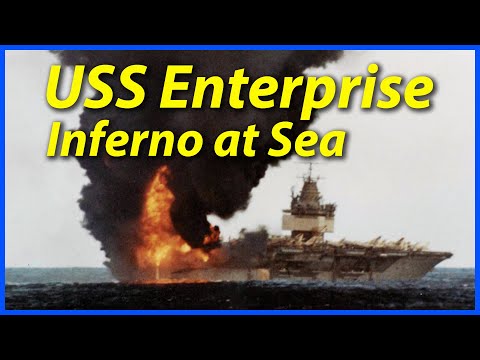
January 14, 1969. Just off the coast of Oahu, Hawaii. The crew of the USS Enterprise, the world’s first nuclear-powered aircraft carrier, was preparing for yet another day of flight operations. But what should have been a routine exercise quickly spiraled into one of the most devastating fires in naval history.
Explosions rocked the massive carrier, killing 28 sailors, injuring over 300 more, and destroying 15 aircraft. It was a disaster that could have been far worse—but lessons learned from past fires and the heroic efforts of the crew helped prevent total catastrophe.
USS Enterprise was no ordinary aircraft carrier. Launched in 1960 and commissioned in 1961, it was a technological marvel that revolutionized naval warfare. Designed under Project SCB 160, Enterprise was originally intended to lead a new class of six nuclear carriers, but due to high costs, the rest of the class was cancelled, making Enterprise a one-of-a-kind vessel.
Measuring 1,123 feet, it was the longest naval vessel ever built, with a displacement of 93,284 long tons. It ranked as the third-largest carrier class after the Nimitz and Gerald R. Ford classes. Unlike any other carrier, Enterprise was powered by eight A2W nuclear reactors, replacing conventional boilers and giving it unparalleled endurance at sea. It was capable of speeds exceeding 33 knots and was home to a crew of around 4,600 service members.
Initially, Enterprise was launched without its planned RIM-2 Terrier missile launchers due to cost constraints. However, later modifications equipped it with Sea Sparrow missile systems for air defense, three Mark 15 Phalanx CIWS gun mounts, and two 21-cell Rolling Airframe Missile launchers. It also carried the SCANFAR phased array radar system, although it proved unreliable and was later removed. It was eventually replaced with the more advanced Aegis Combat System featuring the SPY-1 radar, which provided superior target tracking and engagement capabilities.
Enterprise saw action almost immediately in October 1962 during the Cuban Missile Crisis. It was dispatched as part of a naval force enforcing the US blockade of Cuba. As tensions escalated between the United States and the Soviet Union over the installation of nuclear missiles on the island, Enterprise played a critical role in maritime operations, ensuring that Soviet ships carrying military cargo were intercepted and turned back. Alongside other carriers and surface combatants, Enterprise provided an imposing presence that helped deter escalation into full-scale conflict.
During the Vietnam War, it became the first nuclear-powered carrier to see combat. In December 1965, Enterprise joined Task Force 77 in the Gulf of Tonkin and began launching combat sorties over North and South Vietnam. On December 2, 1965, it set a historic milestone as the first nuclear-powered carrier to engage in combat operations, delivering 167 tons of ordnance on enemy positions. Its aircraft flew thousands of sorties, delivering precision strikes on key infrastructure and reinforcing the US naval presence in the region. By the end of its deployment, Enterprise had firmly established itself as a major asset in the Vietnam War, demonstrating the strategic advantages of nuclear-powered aircraft carriers in sustained combat operations.
But in 1969, just before another deployment to Vietnam, disaster struck. On the morning of January 14, 1969, USS Enterprise was conducting final battle drills and an Operational Readiness Inspection (ORI) before heading back to Vietnam. Additional personnel were aboard to observe the ORI. At 8:18 that morning, as the carrier turned into the wind to begin flight operations, disaster struck.
A Zuni rocket loaded on an F-4 Phantom II overheated due to the exhaust from an MD-3A Huffer, a tractor-mounted aircraft starter. The rocket detonated, setting off a deadly chain reaction. The explosion tore through the Phantom, rupturing its fuel tanks and igniting a mass of fireball that quickly engulfed the surrounding area. The initial blast sent shockwaves across the deck, knocking sailors off their feet and triggering a series of secondary explosions.
Within moments, three additional Zuni rockets exploded in succession, tearing apart the aircraft they were mounted on and ripping holes into the flight deck. Shrapnel and debris were thrown across the ship as flames erupted, fueled by the highly flammable JP-5 jet fuel that was now cascading down through the gaps in the deck into the hangar and lower levels.
The chaos intensified as a 500-pound bomb, now overheated and unstable, detonated with devastating force, sending fiery wreckage hurtling through the air. This triggered a chain reaction with multiple other ordnance stores igniting in rapid succession. Fireballs erupted as bombs cooked off in the intense heat, each explosion compounding the destruction. The raging inferno spread across the deck and down into the ship’s compartments, endangering both flight operations and the integrity of the vessel itself.
Over the course of the disaster, a total of 18 explosions tore through Enterprise, reducing 15 aircraft—including multiple F-4 Phantom IIs, A-7 Corsair IIs, RA-5C Vigilantes, and an E-2 Hawkeye—to smoldering wreckage and turning the flight deck into a charred battlefield.
Despite the chaos, the crew fought back with relentless determination. Commanding officer Captain Kent Lee, realizing the importance of keeping smoke away from firefighting efforts, ordered the ship to continue turning into the wind. This crucial maneuver helped prevent the billowing smoke from further obstructing the deck and allowed the crew to better assess the damage and tackle the growing inferno.
Firefighters aboard Enterprise raced against time, battling the flames with everything at their disposal. High-pressure hoses doused the fires with seawater while damage control teams deployed firefighting foam in an attempt to smother the burning jet fuel. Explosions continued to rock the ship as ordnance and fuel ignited, forcing the crew to adapt their strategy on the fly. Despite the overwhelming heat and chaos, sailors worked tirelessly to suppress the spreading blaze.
As the inferno raged, the destroyer USS Rogers and the cruiser USS Bainbridge arrived to assist, positioning themselves alongside Enterprise to provide additional firefighting support from just feet away. Crews on Rogers used their own high-powered hoses to spray water onto the carrier’s deck, while Bainbridge coordinated rescue efforts and medical assistance for the wounded. Their combined efforts proved critical in controlling the fire.
Finally, after four grueling hours of intense firefighting, the flames were brought under control. The ship, though battered and scorched, had survived. It was a testament to the bravery, skill, and discipline of the crew who refused to give up in the face of catastrophe.
The battle against the fire was over, but the challenges for Enterprise were far from finished. The carrier, though severely damaged, remained afloat and was escorted to Pearl Harbor by USS Bainbridge and USS Rogers later that same day. Enterprise underwent an initial damage assessment revealing extensive destruction to the flight deck and below.
Over the next 51 days, repairs were carried out at Pearl Harbor Naval Shipyard, focusing on restoring critical flight operations capability before the ship could continue its scheduled deployment. Once deemed seaworthy, Enterprise resumed operations and proceeded to the Western Pacific, fulfilling its commitment to support the Vietnam War. Despite the tragedy, the ship’s rapid recovery underscored the resilience of the crew and the strategic importance of nuclear-powered aircraft carriers in sustained military operations.
The toll, however, was devastating: 28 sailors lost their lives, 314 were injured, and the ship sustained $126 million in damages—equivalent to over a billion today. A JAG manual investigation confirmed that the huffer’s exhaust overheated the Zuni rocket, triggering the initial explosion. An airman had noticed the issue but was ignored due to the high noise levels on deck.
However, Enterprise was better prepared than past carriers: 96% of the crew and 86% of the air wing had attended firefighting training—an enormous improvement over the USS Forrestal fire of 1967, where poor training had led to greater devastation.
Key recommendations from the investigation included redesigning the air start units to vent exhaust upwards, increasing crew education on ordnance cook-off temperatures, improving communication between flight deck and damage control teams, installing redundant firefighting systems, and cross-training dentists as anesthetists to allow for more emergency surgeries. These lessons helped shape future firefighting and safety procedures aboard all US Navy carriers.
In just four hours, the USS Enterprise fire claimed 28 lives, injured hundreds, and left lasting scars on the ship and its crew. But the bravery of the sailors and the lessons learned from the disaster led to major improvements in naval aviation safety.
Enterprise went on to serve for another 43 years, participating in operations across the globe. In 1975, during Operation Frequent Wind—the fall of Saigon—its aircraft played a crucial role in evacuating American personnel and South Vietnamese refugees. The ship’s helicopters and fixed-wing aircraft flew round-the-clock missions, plucking desperate evacuees from rooftops and landing zones as the North Vietnamese Army closed in on the capital.
In 1988, Enterprise took part in Operation Praying Mantis, launching air strikes against Iranian naval assets in retaliation for the mining of the USS Samuel B. Roberts. The carrier’s aircraft sank an Iranian frigate and crippled another in a day of fierce surface and air combat that remains one of the largest US naval engagements since World War II.
During the 1990s, Enterprise enforced no-fly zones over Iraq as part of Operation Southern Watch and later launched air strikes during Operation Desert Fox in 1998. In the aftermath of the September 11 attacks, Enterprise was one of the first carriers to respond, conducting air strikes against Taliban and al-Qaeda positions in Afghanistan as part of Operation Enduring Freedom.
But the story of the 1969 fire is not merely one of destruction. It is a story of how a crew, forged by training and tempered by tragedy, saved their ship against impossible odds. The lessons forged in that inferno—the redesigned exhaust vents, the improved communication protocols, the cross-trained medics—would echo through every carrier deck that followed.
In its final years, the carrier continued its role in global security operations before being decommissioned in 2017. USS Enterprise remains one of the most iconic warships in naval history—a testament to the resilience of the men and women who served aboard her, and a reminder that even in the darkest moments, courage and sacrifice can light the way forward.
Yet for all its technological marvel and storied career, the ship’s true legacy lies not in its reactors or radar, but in the 28 sailors who perished on that January morning—and in the hundreds who fought through the flames to ensure the Enterprise would sail again.
Their names are etched into the ship’s memorial, a quiet corner of the hangar bay where the roar of jets fades to a hush. Every January 14th, the crew would gather there—not just to mourn, but to remember what their predecessors had taught them.
In 2012, the Navy named the third Ford-class carrier Enterprise—CVN-80—carrying the torch forward. When her keel was laid, steel from the 1969 fire’s salvaged hull was melted into the new ship’s nameplate. The old ship’s scars became the new ship’s bones.
That is the quiet arithmetic of disaster: 28 lives lost, 314 wounded, and a hundred small fixes that have kept thousands of sailors safe in the decades since. The fire took four hours. The lessons have lasted lifetimes.
So the next time you see a carrier cutting through the sea, remember the men who turned into the wind and fought the flames. What would you have done on that deck, with the fire at your back and the ship depending on you? Tell us in the comments below.
Report this article
Select a reason for reporting:






