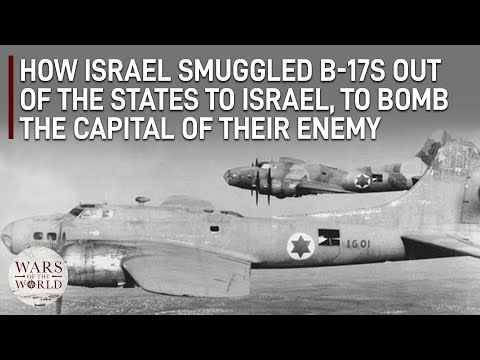
In the sweltering Miami summer of 1948, four Boeing B-17 Flying Fortresses sat on a tarmac, their engines humming with secrets. To the U.S. authorities, they were civilian freighters on a routine cargo run to Puerto Rico. But inside the cockpit of one bomber, co-pilot David Goldberg gripped the controls, unaware that his “simple” ferry job would soon become a suicide mission over the skies of Cairo.
Just weeks earlier, on May 14, 1948, David Ben-Gurion had declared the birth of the State of Israel. Within hours, Egyptian Spitfires were raining bombs on Jewish settlements. The fledgling nation had no real air force—just a handful of scrap planes and a few brave volunteers. Desperate for heavy bombers, Israeli agents turned to the surplus markets of America. Their plan: smuggle four B-17s out of the U.S. under the guise of commercial flights, then use them to strike the heart of the enemy.
But the mission was cursed from the start. In San Juan, the hired colonel meant to fly the lead bomber got so drunk he couldn’t stand. Goldberg had to fly the 20-hour leg to the Azores alone, battling fatigue and a navigator who nearly fell out of a hole in the floor. As they approached the Azores, the colonel—now sober—announced he would ditch the plane rather than attempt a risky instrument approach. “I grabbed a fire extinguisher and told him I’d crush his skull if he didn’t get out of the seat,” Goldberg later recalled. They landed safely, but the FBI was already closing in.
Three bombers made it to Czechoslovakia, where they were secretly rearmed with German bomb racks and crude guns. The fourth was impounded by Portuguese authorities. The crews, mostly international volunteers, knew the stakes: Egypt was bombing Israeli cities, and the B-17s were Israel’s only hope for retaliation. Their commander, Ray Kurtz—a Brooklyn-born veteran with a cool head and a sharp wit—devised a daring plan: use the delivery flight itself to bomb Cairo.
On July 15, 1948, the three Flying Fortresses took off from Czechoslovakia, their bellies full of bombs. Two headed for the Egyptian airfield at Al-Arish, while Kurtz flew alone toward the Abdeen Palace, the residence of King Farouk. At 25,000 feet, Kurtz’s crew began passing out from a faulty oxygen system. “We staggered over the target at 9:40 PM,” Kurtz remembered. “The city was well lit up—they must have expected someone to land because the runway lights were on.” The bombs missed the palace but hit a movie theater, sending panic through Cairo. The psychological blow was devastating.
Israel now had long-range bombers—or so the world believed. The three B-17s, forever known as the Hammers, would go on to fly dozens of missions, their serial numbers constantly changed to fool enemy intelligence. But the story of how they got there—the drunken colonel, the fire extinguisher, the FBI investigation—remains one of the most audacious heists in aviation history. And it was only the beginning.
For the men who had engineered the whole affair, the consequences were only just beginning to unfold. Charlie Winters, Al Schwimmer, and Hank Greenspun had pulled off the impossible—but the U.S. government was not about to let them walk away clean. Within months, a federal grand jury in Miami indicted all three for violating the Neutrality Act, accusing them of conspiring to export warplanes to a foreign nation engaged in armed conflict.
The trial was a spectacle. Prosecutors painted the trio as profiteers and lawbreakers, while defense attorneys argued that they had acted on moral imperative—that the arms embargo was a death sentence for Holocaust survivors fighting for their lives. “I did what I thought was right,” Greenspun told the court. “If that makes me a criminal, then I’ll wear that label with pride.” The jury deliberated for less than a day before returning guilty verdicts on all counts.
Schwimmer and Greenspun were each fined ten thousand dollars—a staggering sum at the time. But the judge reserved special contempt for Winters, whom he viewed as the ringleader. “You have shown a callous disregard for the laws of your country,” the judge declared. “I sentence you to eighteen months in federal prison.” Winters, a man who had risked everything to help a nation he had never visited, was led away in handcuffs while his co-defendants looked on in disbelief.
The prison term broke Winters financially and physically, but not his spirit. Upon his release, he returned to Miami and quietly resumed his freight business, rarely speaking of the operation that had made him a footnote in history. Greenspun, meanwhile, went on to become a newspaper publisher in Las Vegas, using his platform to champion civil rights and, eventually, to campaign for a presidential pardon. Schwimmer, the quiet engineer, faded into the background—but not for long.
Schwimmer’s quiet retirement lasted only a few years. In 1951, David Ben-Gurion personally asked him to return to Israel and build an aviation industry from nothing. He founded Israel Aircraft Industries, the state-owned aerospace giant that would one day produce the Kfir fighter and the Arrow missile defense system. The man who had smuggled bombers out of Miami now had his name on the door of a factory that employed thousands.
Greenspun’s pardon came first. In 1961, President John F. Kennedy—prompted by Greenspun’s Las Vegas newspaper empire and a quiet word from Israeli diplomats—signed a full pardon. “I’ve been called a gunrunner, a smuggler, and a traitor,” Greenspun said at a press conference. “But the only title I ever wanted was ‘American who did the right thing.'” He kept a framed copy of the pardon in his office until his death in 1989.
Schwimmer waited much longer. He continued to lead Israel Aircraft Industries through the 1950s and 1960s, transforming it into a cornerstone of Israeli defense. But the U.S. conviction still barred him from entering America—a painful irony for a man who had served his country as a flight engineer during World War II. He applied for a pardon three times. Each application was denied.
Then, in 1999, a young White House staffer named Daniel Kurtzer—later to become U.S. ambassador to Israel—dug up the old file. He was stunned by what he found. “This man helped found the Israeli air force,” Kurtzer recalled telling his superiors. “He’s a hero in Israel. And we’re still punishing him for a fifty-year-old smuggling charge?” President Bill Clinton signed the pardon in December 2000, six months before leaving office.
Schwimmer was too frail to travel to Washington. He received the news by telephone at his home in Tel Aviv. His daughter later said he wept for the first time since the war.
Charlie Winters never lived to see his own pardon. He died in 1984, a forgotten man in a small Miami apartment, his health ruined by prison and his finances destroyed by legal fees. But his family refused to let the story die. His daughter, Joan, spent two decades writing letters to presidents, senators, and journalists. She tracked down Steven Spielberg after watching Schindler’s List and wrote him a letter explaining her father’s sacrifice.
Spielberg was moved. In 2007, he wrote directly to President George W. Bush. “There are probably many unsung heroes of America and of Israel,” the letter read, “but Charlie Winters is surely one of them. While a pardon cannot make Charlie Winters whole, and regrettably he did not live to see it, it would be a fitting tribute to his memory and a great blessing to his family if this pardon is granted.”
Bush signed the posthumous pardon in January 2008, one of the final acts of his presidency. Joan Winters received the document in a small ceremony in Miami. She placed it in a frame alongside a photograph of her father standing beside a B-17, his face young and unlined, unaware of the storm that was coming.
Today, half of Charlie Winters’s ashes are buried in a Christian cemetery near the Jewish cemetery of the Knights Templar in Jerusalem. The other half were scattered by his family at the summit of Mount Tabor, overlooking the Jezreel Valley—the same valley where, thousands of years earlier, another small army had faced impossible odds and somehow prevailed.
Ray Kurtz never spoke publicly about the Cairo raid until decades later, when a young Israeli historian tracked him down in a Brooklyn nursing home. “You want to know what I remember most?” he said, his voice barely a whisper. “Not the bombs. Not the palace. The silence on the radio when we turned for home. We didn’t know if we’d even have a country to land in.” He paused, then smiled. “But we did.”
The Hammers themselves met quieter ends. After the 1956 Sinai campaign, the three surviving B-17s were retired to a dusty corner of Tel Nof airbase, their engines cannibalized for spare parts, their fuselages slowly bleached by the desert sun. One was eventually scrapped. Another was sold to a museum in the 1970s, only to be destroyed in a hangar fire. The third—the aircraft Kurtz had flown to Cairo—vanished from official records entirely, its fate still debated by aviation historians today.
But the squadron lived on. Number 69 Squadron, the Hammers, transitioned from Flying Fortresses to jet bombers to the F-15I Ra’am—the “Thunder”—one of the most advanced strike aircraft in the world. Every pilot who joins the unit receives a briefing on its history. They learn about the drunken colonel and the fire extinguisher. They learn about the oxygen system that nearly killed its own crew. And they learn about three American civilians who broke the law of their own country to give a newborn nation its first real teeth.
In 2018, on the seventieth anniversary of the Cairo raid, the Israeli Air Force held a small ceremony at Tel Nof. A single F-15I roared overhead, its afterburners carving a white scar across the sky. On the ground, a plaque was unveiled. It listed the names of the volunteers, the smugglers, and the bomb chuckers—the unlikely coalition of idealists and opportunists who had willed the Israeli air force into existence.
Joan Winters attended the ceremony. She was in her seventies now, her hair silver, her father’s framed pardon tucked carefully in her carry-on luggage. An Israeli general approached her afterward and asked if she would like to sit in the cockpit of the F-15I. She climbed the ladder slowly, her hands trembling, and lowered herself into the seat her father had once occupied in a very different kind of bomber.
“He would have loved this,” she said, her voice cracking. “He never wanted credit. He just wanted to help. And look what it became.”
The general nodded. “Your father didn’t just help us buy airplanes,” he said. “He helped us believe we could survive.”
That belief—fragile, stubborn, impossible—had carried the Hammers from a Miami tarmac to the skies over Cairo, from a Czechoslovakian hangar to the heart of a nation’s defense. It had survived prison sentences and presidential pardons, FBI investigations and international embargoes. And it had outlived every single person who had dared to dream it into existence.
Today, if you stand at the summit of Mount Tabor where Charlie Winters’s ashes were scattered, you can see the Jezreel Valley stretching out below—green and golden, dotted with kibbutzim and highways. On a clear day, you can watch Israeli fighter jets trace lazy circles in the sky, their engines a distant rumble like thunder.
They are the descendants of three battered B-17s that nobody wanted, flown by men who had no business being heroes. And they are still called the Hammers.
What other forgotten stories of unlikely courage are waiting to be told?
Report this article
Select a reason for reporting:






