James Rivera had handled thousands of historical photographs in his five years as a curator at the National Museum of African American History and Culture. But on a humid September morning in 2024, a box from a Richmond estate sale made him stop cold. Inside, wrapped in tissue paper, was a studio portrait from 1889: two young men, one white, one black, dressed in identical suits, hands resting on each other in a gesture of unmistakable friendship. For Virginia, 24 years after the Civil War, the image was extraordinary. Then James looked closer.
The white man’s fingers weren’t resting—they were gripping, knuckles white. The black man’s smile didn’t reach his eyes, and his free hand was clenched into a fist. In the background, partially hidden, hung a heavy chain. On the back, a faded inscription read: “Thomas and Marcus. Last photograph before the departure. May God forgive us for what we have done. September 14th, 1889.”
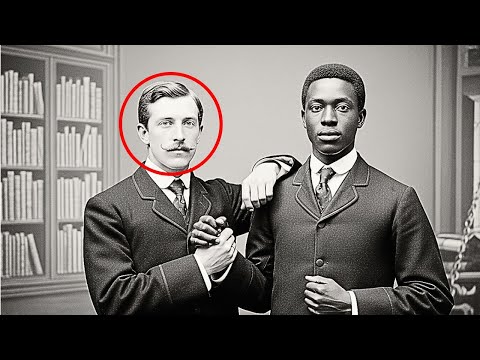
James’s pulse quickened. “May God forgive us”—not for something they were about to do, but for something already done. He photographed the image from every angle and called his colleague Dr. Patricia Okoye, a historian at Howard University. Within hours, they had a name: Thomas Whitmore, son of a prominent planter, and Marcus Freeman, a freedman who had remained on the family’s plantation. The 1880 census listed Marcus as a servant, no surname. By 1889, he was still there—bound by fraudulent labor contracts that kept him in debt peonage, a system of legalized slavery under another name.
Four days before the photograph was taken, Thomas had filed a counterclaim against his father, accusing him of illegal peonage and submitting copied ledgers as evidence. The photograph was a deliberate act of defiance—visual proof that Thomas stood with Marcus as an equal. But on October 2nd, 1889, Thomas was dead. The cause: “accidental shooting.” The informant: his father. No trial, no scandal, no mention of the pending case.
James and Patricia dug deeper. They found Marcus’s congressional testimony from 1902, in which he described how Thomas had obtained a court order freeing him, how William Whitmore had shot his own son, and how Marcus had fled north with the documents, carrying Thomas’s last gift. “He gave up his inheritance, his family, and ultimately his life because he couldn’t accept that I was still enslaved,” Marcus had said. The photograph, it turned out, was not just a portrait—it was evidence, a testament hidden in plain sight for over a century.
But the story was far from over. The donation had come from Dorothy Hayes, Marcus’s granddaughter. Her estate still held boxes of personal papers—letters, legal documents, a diary—that might contain the original affidavit Thomas had written before his death. James booked a flight to Richmond. He had a feeling the next box would change everything.
Jennifer Park’s office occupied the ground floor of a renovated Victorian on East Grace Street, three blocks from where Anderson & Sons Photography had once advertised “fine portraiture for distinguished families.” She led James past a reception desk to a climate-controlled storage room where five archival boxes sat on a steel table. Each bore a label in neat marker: HAYES, DOROTHY — PERSONAL PAPERS.
“These weren’t included in the donation,” Jennifer said. “They seemed too private. Family letters, business records, some legal documents. We were hoping a relative would surface.” She hesitated. “No one has.”
James pulled on nitrile gloves and opened the first box. Inside were bundles of letters tied with faded ribbon, the paper brittle as autumn leaves. He untied one and recognized the handwriting from Marcus Freeman’s congressional testimony—clear, deliberate, the script of a man who had taught himself to write and never took the skill for granted.
The first letter was dated June 12, 1929, addressed to his son Thomas Freeman. “My son, you bear the name of the bravest man I ever knew. Thomas Whitmore was more than a friend to me. He was my brother in all but blood, and he gave his life so that I could be free.” James read slowly, photographing each page. Marcus described growing up at Oakwood, Elizabeth Whitmore teaching both boys to read in secret, Thomas returning from the University of Virginia to discover his childhood companion still trapped in debt bondage.
He moved to the second box: ledgers from Marcus’s Philadelphia carpentry business, meticulous records of every contract and payment. “He kept flawless books,” James murmured. Patricia, on speakerphone from Washington, said quietly, “Of course he did. Fraudulent records had once been used to enslave him. Honest records were his proof of freedom.”
The third box was wrapped in oilcloth. James’s hands trembled as he peeled it back. Inside lay a court order dated October 2, 1889—the day Thomas died—signed by Judge Robert Chambers of the Richmond Circuit Court. It declared Marcus Freeman’s labor contracts fraudulent, ordered his immediate release, and awarded him $500 in back wages. Beneath it was Thomas Whitmore’s affidavit, fifteen pages of precise, furious handwriting.
“I submit this evidence not as a son betraying his father, but as a citizen upholding the law, and as a friend honoring the humanity of Marcus Freeman, who has suffered years of illegal bondage at my family’s hands. If there is shame in this testimony, it belongs to those who maintain such systems, not to those who expose them. I am prepared to accept any consequences that come from speaking this truth.”
James set the page down. His eyes stung. Thomas had known. He had filed these papers knowing his father might kill him—and he had done it anyway. Beside the affidavit was a second print of the photograph, with a note in Thomas’s hand: “To Marcus, this photograph was taken so that no one can deny our friendship or question my sincerity in advocating for your freedom. We stand as equals here as we should stand under the law. If something happens to me, use this evidence to prove the truth. Your friend always, Thomas Whitmore. September 14th, 1889.”
The fourth box held newspaper clippings Marcus had saved across four decades—articles on peonage, labor rights, the slow grind of justice. Buried among them was a brittle Richmond obituary from November 1912: “William Whitmore, Prominent Planter, Dies at 78.” No mention of Thomas. No mention of peonage. Marcus had kept his enslaver’s obituary, a silent witness to the lie that had outlived the man.
The fifth box contained Marcus’s Bible, a pocket watch, and a small leather diary. James opened it carefully. The first entry, January 15, 1890: “I am free. Thomas died to make it so, and I will not waste the gift he gave me. Today, I begin my life as a truly free man.”
Later entries traced a life rebuilt from nothing—work found, a business started, Sarah met, children born. And on September 14, 1895: “Six years ago today, Thomas and I had our photograph made. I look at it sometimes and remember his courage. He knew what his father might do, and he moved forward anyway. I try to live my life in a way that honors his sacrifice.”
James closed the diary. In the silence of the storage room, he could almost hear Marcus’s voice—the careful cadence of a man who had carried his friend’s memory for forty-five years, passing the story to his children with the instruction to remember. He looked at Jennifer Park. “These documents need to be preserved,” he said. “And I need to find Marcus Freeman’s descendants. They deserve to know what their ancestor carried north.”
Jennifer nodded slowly. “There’s one more thing,” she said, reaching into the bottom of the fifth box. “This was wrapped separately. I didn’t know what to make of it.” She handed him a sealed envelope, yellowed with age, addressed in Marcus’s handwriting to “The Family of Thomas Whitmore, Oakwood Plantation, Henrico County, Virginia.” The postmark read Philadelphia, 1935—the year Marcus died.
James turned the envelope over. It had never been opened. The seal was intact, the paper stiff with eighty-nine years of waiting. “Marcus wrote this the year he died,” he said, his voice barely above a whisper. “And no one ever delivered it.”
Jennifer leaned closer. “The Whitmore family sold Oakwood in the 1920s. By 1935, there may have been no one left at that address to receive it.” She paused. “Or someone received it and sent it back. Either way, it ended up with Dorothy.”
James photographed the envelope, then carefully slit the seal with an archival blade. Inside was a single sheet of paper, folded twice, covered in Marcus’s steady hand. The letter was addressed to “Any living child of Thomas Whitmore.”
“I do not know if you exist,” Marcus had written. “I do not know if you were ever told the truth about your father, or if his name was spoken in your house with shame or with silence. But I am an old man now, and I have carried this debt long enough.”
James read on. Marcus described the photograph, the court order, the night of October 2nd, 1889. He wrote of Thomas’s courage without flinching and of William Whitmore’s crime without softening it. And then, near the end, the letter changed.
“I have prospered in Philadelphia. I own my shop and my home. My children are educated. None of this would have been possible without your father. I have tried, all these years, to find a way to repay a debt that cannot be repaid. Enclosed with this letter is something that belongs to your family, not mine. I have kept it safe for forty-six years, but it is not mine to keep. It is yours. I only ask that you remember what he did, and why.”
James looked up. “He says something is enclosed.” He checked the envelope again, running his fingers along the inside. Nothing. The enclosure was gone—or had never been placed inside.
Patricia’s voice crackled through the speakerphone. “James, what would a formerly enslaved man consider valuable enough to return to the family of the man who freed him?”
He stared at the letter. “Something of Thomas’s. Something William Whitmore kept after the murder.” His mind raced through the probate inventory he had found years—no, weeks—earlier. “The 1912 probate listed an outstanding settlement, the Freeman matter, five hundred dollars. But it also listed personal effects. I need to see that inventory again.”
Jennifer was already pulling up the Henrico County records on her laptop. The probate file had been digitized. She scrolled through the inventory: furniture, livestock, farm equipment, debts owed and owing. And then, near the bottom, a line James had overlooked the first time.
“One gold pocket watch, engraved, bequeathed to Thomas W. Whitmore, deceased, retained in estate.”
James’s breath caught. “William kept his murdered son’s watch. And Marcus had it.” He turned back to the fifth box, where Marcus’s own pocket watch lay wrapped in cloth. He lifted it gently, turning it over in his gloved fingers. The case was silver, worn smooth. But on the back, faint beneath decades of handling, an engraving surfaced under the light.
T.W.W. — From Mother, 1885.
Thomas William Whitmore. Elizabeth Whitmore’s gift to her son. Marcus had carried it north in 1889, kept it for forty-six years, and tried to return it to a family that had never answered.
James called Robert Whitmore, William’s great-great-grandson, and told him about the watch. Robert’s voice cracked. “My grandmother mentioned a watch that was lost after Thomas died. She said William never spoke of it. Now I know why.” They arranged to meet at the museum.
Robert held the watch for a long moment, then looked at the photograph. “Thomas and Marcus were brothers in every way that matters. My family owes them both.” He agreed to donate the watch to the exhibition, where it now sits beside the photograph—two artifacts of courage and sacrifice.
James stood in the gallery on opening day, watching visitors lean close to the image. The chain, the clenched fist, the inscription—all of it finally understood. Marcus’s letter had found its way home at last.
What story will you uncover in the photographs your family has kept hidden?
Report this article
Select a reason for reporting:






