Guadalcanal, August 21, 1942. The night was a black wall of jungle and rain. On a narrow sandbar at Alligator Creek, 800 Japanese soldiers were about to die in a slaughter so complete that Tokyo would refuse to believe it. The weapon that killed most of them was not a machine gun. It was a 37-mm anti-tank gun—a 912-pound cannon already obsolete against the tanks it was built to fight—firing canister rounds: tin cases that disintegrated at the muzzle and sprayed 122 steel balls across the width of that sandbar every two and a half seconds.
The gun crews fought at 250 yards, infantry range, in the open. One crew lost eight of its ten men to a single Japanese machine gun mounted on an abandoned tractor across the creek. They kept loading.
The doctrine that sent Japanese infantry charging into American guns had a name: seishin, spiritual willpower. The Imperial Japanese Army believed the bayonet was the decisive weapon of infantry combat, that a man willing to die could break any defensive line through sheer moral force. For years, they were right. In 1930s China, massed bayonet charges shattered nationalist divisions armed with bolt-action rifles and no coordinated automatic weapons. The doctrine worked because the firepower on the other side could not produce enough volume to stop it.
Guadalcanal changed the math. From August to October 1942, the 1st Marine Division held a thin perimeter around Henderson Field—the first major Allied ground offensive in the Pacific. Japanese counterattacks came at night across the terrain the island offered: sandbars, jungle defiles, ridge spines, narrow approaches packed with charging men.
The Marines had water-cooled Brownings, BARs, pre-registered artillery. But even these had limits. A single .30-caliber machine gun overheats. Its water jacket gets shot through. BARs run dry. A charging Japanese company of 200 men on a sandbar 25 feet wide at 03:30 demands a density of fire that no single infantry weapon can deliver.
Six weeks after the Tenaru, Edson’s Ridge proved the point. Major General Kiyotake Kawaguchi’s 3,000 men hit Colonel Merritt “Red Mike” Edson’s 840 raiders and paramarines on a 1,000-yard jungle ridge. Edson’s men fought with rifles, BARs, Brownings, 60-mm mortars, and danger-close 105-mm howitzers from 3rd Battalion, 11th Marines, dropping shells within 200 yards of the ridge spine. The Marines won, but the 1st Parachute Battalion was functionally destroyed. 89 men walked off that ridge. The line nearly broke. No canister guns were present.
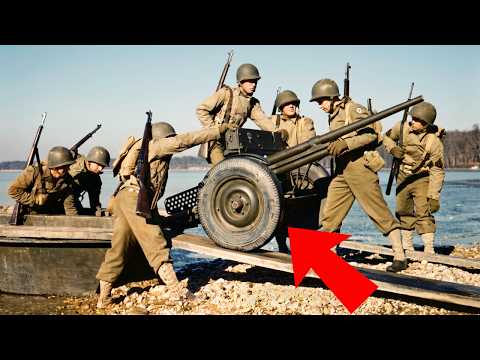
The weapon that could have changed the arithmetic was already on the island, sitting on the beach, pointed out to sea, waiting for Japanese tanks that never came. A 37-mm anti-tank gun—and the round that made it lethal against infantry was a tin can full of steel balls.
The M3 37-mm gun was a near copy of the German Rheinmetall Pak 36, standardized in December 1938, and built at Watervliet Arsenal in New York and Rock Island Arsenal in Illinois. 18,702 guns between 1940 and 1943. As an anti-tank weapon, it was already dying. At Kasserine Pass in February 1943, crews watched their armor-piercing rounds bounce off German medium tanks like marbles off a dinner plate. But in the Pacific, where Japanese armor stayed light, the gun found a second life for a reason nobody at Watervliet had prioritized.
912 pounds, light enough for four men to drag into a gun pit, light enough to tow behind a Jeep, light enough to manhandle through chest-deep surf at Tarawa. That portability put it in the assault wave, and in the assault wave, it met infantry.
The round that mattered was the M2 canister. The ordnance manual described the case as ordinary roofing tin. Inside, 122 hardened steel balls, each roughly 3/8 of an inch in diameter, set in a resinous matrix. Total cartridge weight, 3 and 1/2 pounds. The tin disintegrated at the muzzle. What came out was a shotgun blast from a cannon bore, a spreading cone of steel moving at 2,500 feet per second covering the width of a sandbar at 250 yards. A trigger pull every 2 and 1/2 seconds, each one delivering the equivalent firepower of dozens of riflemen compressed into a fraction of a second.
But only 9% of the roughly 78 million 37-mm rounds produced were canister. Gun captains hoarded them. You fired canister when massed infantry crossed the kill zone and not one second before.
PFC Frank Pomroy, H Company, 2nd Battalion, 1st Marines, had trained on the 37-mm at New River, North Carolina. On Guadalcanal, he served as loader on the gun closest to the water’s edge at Alligator Creek. One of the two 37-mm crews at that position would lose eight of its ten men to a single Japanese machine gun before the night was over. That story is coming. But first, the night of August 21, 1942.
Colonel Clifton B. Cates, commanding the 1st Marines, attached 100 men of Battery B, 1st Special Weapons Battalion, with two 37-mm guns to Lieutenant Colonel Edwin Pollock’s 2nd Battalion, 1st Marines, dug in at the mouth of what the Marines called Alligator Creek. Coastwatcher Sergeant Major Jacob Vouza, captured by Japanese scouts, tortured, bayoneted repeatedly, and left for dead, crawled back through the Marine lines to deliver the warning. They were coming.
0130. A green flare split the dark. Roughly 100 men of Colonel Kiyonao Ichiki’s second company charged the sandbar. Machine guns and canister broke them at the waterline. 0230. A second wave, 150 to 200 men of the first and third companies, same approach, same result. But a Japanese machine gun team got across, mounted a Nambu on an abandoned amphibious tractor on the far bank, and poured fire into one of the 37-mm positions. The gun kept firing.
Then Corporal Jim Oliphant’s crew did the thing that wrote the doctrine for every Marine landing that followed. They repositioned their 37-mm gun to fire canister straight down the length of the sandbar. One gun enfiladed. A corridor of sand 25 feet wide packed with charging men, and a cannon loaded with tin cans full of steel balls firing down its entire length every 2 and 1/2 seconds. The barrel glowed red in the dark.
Simultaneously, Corporal George Parker’s 37-mm opened on Ichiki’s upstream flanking attempt with canister. On the line beside the guns, Private Albert Schmidt, Corporal Leroy Diamond, and PFC Johnny Rivers of the 11th machine gun squad, H Company, 2nd Battalion, 1st Marines, manned a single water-cooled .30-caliber Browning. They were credited with over 200 Japanese killed. Rivers was killed. Diamond was wounded. Schmidt was blinded by a Japanese grenade and kept firing under Diamond’s verbal direction. All three received the Navy Cross. But they were a machine gun crew, and the machine gun and the canister guns worked in concert, the Browning sweeping the width while the 37 sealed the corridor.
By dawn, the sandbar was carpeted with dead. Marines described being shoulder-high with Japanese bodies in front of one gun position. By 1700, it was over. Roughly 800 of Ichiki’s 917 men were dead. 85% destruction. Marine losses: 34 killed, 75 wounded. Ichiki burned his regimental colors. General Alexander Vandegrift wrote afterward, “I have never heard or read of this kind of fighting. These people refused to surrender.”
Six weeks later, the historically real canister on the ridge finally happened. Not at Edson’s Ridge in September, despite what 100 websites claim, but at the Battle for Henderson Field in late October. Captain Regan Fuller, commanding three 37-mm guns and two .50-cal machine guns on the Marine left flank, supporting Lieutenant Colonel Chesty Puller’s 1st Battalion, 7th Marines, watched Japanese troops massing for a charge at the jungle edge. His guns fired one round of canister each. The massed troops disappeared.
A year later at Tarawa, 2nd Lieutenant Roy Elrod’s 37-mm platoon of 2nd Battalion, 8th Marines, manhandled their guns through chest-deep water and reef fire onto Betio. A column of almost 200 Japanese appeared running across the island. Marines shouted to the gunners, “Rapid fire canister.” Staff Sergeant Ramsey received the Silver Star. The geometry was always the same. A narrow approach, massed bodies, a spreading cone of 122 steel balls every 2 and 1/2 seconds.
The canister round did not solve every problem on the battlefield. It solved one. And on that problem, nothing else came close.
Lieutenant Colonel Hiroshi Matsumoto at 17th Army Headquarters called the first reports of Ichiki’s annihilation false. He refused to believe it. The doctrinal lesson Tokyo drew was not that frontal assault against canister and interlocking machine guns was suicidal. The lesson was that Ichiki had not brought enough men. Within three weeks, Kawaguchi’s 6,000 were hurled at Edson’s Ridge. In October, Hyakutake’s full division struck Henderson Field. The largest banzai charge of the war came at Saipan on July 7, 1944. General Yoshitsugu Saito’s 4,300 men. The Imperial Japanese Army never adapted to canister and machine gun kill zones at the institutional level. The later shift to cave warfare at Peleliu, Iwo Jima, and Okinawa was forced by lost forces and lost geography, not by a recognition that the bayonet charge was obsolete.
The cost of firing a cannon at infantry range was paid in full at the Tenaru. That gun closest to the water, Pomroy’s position, took direct fire from the Nambu mounted on the abandoned amphibious tractor across the creek. Eight of the ten men on that gun were killed or wounded. The survivors kept loading. The canister’s effective range of 250 yards meant the crew absorbed everything the riflemen beside them took and more because the gun was a priority target. The high explosive round carried 39 grams of TNT, less than a modern grenade launcher. Canister or nothing. And only 9% of production was canister. You rationed it like morphine.
The persistent claim that canister was used at Edson’s Ridge in September 1942 is unsupported by any primary source. The 37-mm batteries were dug in on the Lunga beach line. The real canister on the ridge was Fuller’s October action, and the conflation has been copy-pasted across the internet ever since.
Grapeshot in the age of sail, canister at Gettysburg, 122 steel balls in a tin can on Guadalcanal. The idea never died. It evolved. In 1957, Picatinny Arsenal contracted Whirlpool Corporation to develop the beehive round. 8,000 steel flechettes in a 105-mm shell, first fired in combat in Vietnam in 1966. The 21st-century descendant arrived in Iraq in 2003: the M1028 120-mm canister round. 1,098 tungsten balls lethal to 600 meters. Same concept. Same geometry. Turn a cannon into a shotgun.
No surviving 37-mm gun has been positively identified as one of the two that sat on that sandbar. The guns are gone. The sandbar is still there. What Corporal Jim Oliphant’s crew did with the tin can full of steel balls at 0310 on August 21, 1942, wrote the doctrine that armed every Marine landing for the rest of the war. Robert Leckie, H Company, 2nd Battalion, 1st Marines, who lay on that line and later wrote it all down in Helmet for My Pillow, put it plainly: “Our regiment had killed something like 900 of them.” The canister round was never a sophisticated weapon. It was a brutal answer to a brutal problem. And it worked because the geometry of a sandbar and a shotgun has not changed in 400 years.
The men who survived that night walked away from the sandbar and into legend. Some, like Frank Pomroy, carried the smell of burnt tin and powder for the rest of their lives. Others never spoke of it at all.
The 37-mm gun was towed away, its barrel still warm, its canister racks empty. It would fight again on other beaches, against other charges, in the same brutal geometry.
What remains today is a quiet stretch of water and sand on a distant island. No plaque marks the spot where Oliphant’s gun sealed the corridor. The jungle has reclaimed the gun pits.
But the lesson endures: when men mistake willpower for firepower, the math is merciless. And the tin can full of steel balls always does the arithmetic.
Was Ichiki’s charge pure fanaticism, or did his doctrine leave him any other choice?
Report this article
Select a reason for reporting:






