When you hear the name Adolf Hitler, what comes to mind? Tanks, swastikas, and the deafening roar of a madman’s speeches? That’s the image we’ve been fed—a monolithic force of evil, almost supernatural in its destructiveness. But strip away the propaganda and the iconic imagery, and you’re left with something far more unsettling: a deeply weird, contradictory, and pathologically strange individual. A man who was terrified of germs yet emitted odors that made his own staff gag. A leader who preached purity while pumping his body full of experimental drugs. A recluse who craved the spotlight but couldn’t form a single healthy relationship. This is not the portrait of a genius or a demon—it’s the portrait of a profoundly maladjusted human being.
And the strangeness didn’t start with the war. It was there from the very beginning, in the cramped rooms of his childhood, in the trenches of World War I, and in the lonely years he spent chasing a dream he never achieved. What follows is the story of a man whose personal quirks and obsessions didn’t just shape his own life—they helped steer the course of history. But be warned: this is not a tale of redemption. It’s a journey into the bizarre, petty, and deeply human flaws of one of history’s greatest monsters.
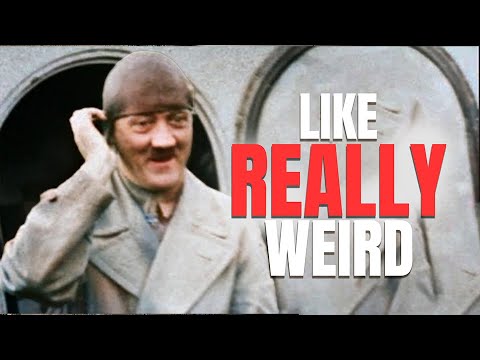
Adolf Hitler was born in 1889 in a small Austrian town, the son of a domineering father and a doting mother. His father, Alois, was a customs official with a temper and a taste for authority. Hitler later admitted he feared him. His mother, Clara, was the opposite—affectionate, protective, and utterly indulgent. This tug-of-war between oppression and smothering love shaped a boy who couldn’t connect with others. He preferred isolation, fantasy, and control. Sound familiar? It’s the blueprint for a dictator.
By the time World War I broke out, Hitler was a young man with no friends, no prospects, and a head full of grandiose dreams. He served as a messenger on the Western Front, but while his comrades drank, smoked, and sought comfort in brothels, Hitler kept to himself. He spent his downtime drawing, reading political pamphlets, and avoiding human contact. He didn’t make a single lasting friendship during the war. This wasn’t moral superiority—it was social ineptitude. And it only deepened his sense of exclusion.
But perhaps the most puzzling aspect of Hitler’s personal life is his sexuality—or rather, the glaring absence of it. Unlike Stalin, who had children and affairs, or Mao, who indulged his appetites, Hitler remains an enigma. Rumors swirled—strange preferences, abusive tendencies—but concrete evidence is scarce. Some historians suggest he was asexual; others point to his germaphobia and obsession with control as barriers to intimacy. Even Mussolini found him odd. During a visit to Rome in the 1930s, Hitler requested a woman be sent to his room. Mussolini, ever the womanizer, smirked—finally, proof that the German leader was human after all. But the woman was only asked to iron his shirt for the next day’s speech. The meeting ended without a hint of intimacy. Mussolini was baffled.
And yet, Hitler had a strange effect on women. During his imprisonment after the failed 1923 coup, he received piles of love letters and homemade sweets from admirers. He didn’t reciprocate—but he did eat the cakes. He actually gained weight in prison, a rarity among inmates. This indulgence in sugar clashed with his public image of austerity. But it was a small crack in the façade, a hint of the contradictions bubbling beneath the surface.
When Hitler did form an emotional attachment, it ended in tragedy. His half-niece, Geli Raubal, moved into his Munich apartment in the late 1920s. He was forty; she was a teenager. He controlled every aspect of her life—what she wore, who she saw, when she went out. The surveillance was suffocating. In 1931, Geli shot herself in the chest. Hitler covered up the scandal, but those close to him said he never recovered. Every woman who got close to him was destroyed. Years later, Eva Braun would meet the same fate, taking cyanide just hours before Hitler’s own suicide.
But the weirdness didn’t stop at his personal life. Hitler’s political rise was equally bizarre. He didn’t enter politics young—he was a state informant sent to spy on the German Workers’ Party. Instead of denouncing them, he joined. The man sent to contain extremism became its catalyst. And he wasn’t a natural orator. His early speeches were rambling and incoherent. The hypnotic tribune we know from the newsreels was a carefully constructed act. He rehearsed for hours—gestures, pauses, facial expressions—even practicing in front of a mirror. Nothing was spontaneous. Everything was staged.
His worldview was a mishmash of pseudoscience, Germanic mythology, and pagan nonsense. He believed he was guided by an ancestral spirit from a prehistoric Aryan past. Himmler was obsessed with Nordic artifacts; Hess was into astrology. Hitler surrounded himself with mystics and quacks. And yet, these two men—so different in temperament—remained allies for years, dragging Europe into the abyss.
As the war progressed, Hitler’s habits grew stranger. He was obsessed with health and purity, yet his body was a chemical dump. His doctors pumped him full of stimulants, sedatives, hormones, and animal extracts. He trembled, had mood swings, and lost touch with reality. He hated mornings—so much so that on D-Day, no one dared wake him when the Allies landed in Normandy. The news was delayed for hours because Hitler needed his sleep. By the time he woke, the Allies had secured their foothold. The delay cost lives.
The pattern of indulgence and denial followed him everywhere. He lectured his inner circle about the virtues of vegetarianism and the dangers of tobacco, yet secretly devoured liver dumplings and sausages when he felt he’d earned a reward. His public austerity was a costume he shed the moment the cameras were gone. This wasn’t hypocrisy in the ordinary sense—it was something more compulsive, a need to maintain two separate selves that never acknowledged each other.
His digestive troubles became legendary among his staff. The flatulence was so severe that dinner guests learned to keep their distance, and the odor lingered in rooms long after he left. Secretaries and ministers later described these meals as endurance tests, endured only because disagreeing with the Führer was unthinkable. He dominated every conversation, delivering hours-long monologues on architecture, history, and war while his listeners fought the urge to gag.
Yet for all his physical repulsiveness, Hitler craved audiences. The lonely soldier of World War I, ignored by his comrades, had transformed into a man who could not tolerate silence or solitude. He talked at people rather than with them. Guests were props, mirrors reflecting his own brilliance back at him. Anyone who dared interrupt was never invited again.
His affection for animals was equally selective. He doted on his German Shepherd, Blondie, feeding her by hand and allowing her freedoms no human ever enjoyed. He seemed more at ease with the dog than with any person in his life. This tenderness coexisted with a total absence of empathy for millions—a contradiction that defies easy explanation. Perhaps animals never challenged him, never disagreed, never required the vulnerability that human relationships demanded.
Before politics consumed him, Hitler had dreamed of being an artist. He spent years in Vienna, painting urban landscapes and buildings—technically competent but emotionally hollow. He avoided depicting people, and when he did, they appeared rigid and lifeless. The Vienna Academy rejected him, a humiliation he never forgave. Had he applied to a less prestigious school, he might have been accepted. But Hitler did not tolerate reduced ambitions. Decades later, critics remained unimpressed, describing his work as devoid of imagination.
He never abandoned his artistic self-image. He considered himself a man of superior aesthetic sensitivity, especially in architecture. This conviction would later shape the grandiose plans for Berlin and Nuremberg—monuments designed to outlast empires, built on a foundation of personal resentment.
In the final years, his world shrank to a concrete bunker. Surrounded by maps, pills, and exhausted listeners, he repeated the same theories and grievances. The crowds were gone. The stages were gone. What remained was a trembling, paranoid man talking to himself in the dark. The mechanisms that had amplified his flaws on a historical scale had collapsed, leaving only the strange, small individual beneath.
But the bunker years reveal something even more unsettling than paranoia—an almost childlike dependence on routine. Hitler ate the same meals at the same hours, insisted on the same seating arrangements, and flew into rages when a servant misplaced a spoon. Order was no longer a preference; it was a psychological crutch. In a world collapsing above his head, the placement of cutlery became a matter of cosmic importance.
His relationship with food grew increasingly bizarre. He lectured visiting officials on the moral superiority of his diet while secretly hoarding chocolate and pastries. Aides reported finding crumpled wrappers hidden in his desk drawers. The man who preached sacrifice could not resist a cream cake. It was a small, almost pathetic detail—but it fit the pattern perfectly. Every public virtue had a private vice.
Sleep offered no escape. Hitler suffered from chronic insomnia, pacing his quarters at odd hours and demanding company from exhausted secretaries. He would ramble about past betrayals, imagined conspiracies, and the ingratitude of the German people. No one was allowed to leave until he dismissed them. These sessions could stretch until dawn, leaving his staff hollow-eyed and resentful.
Perhaps the strangest detail of all concerned his hands. Witnesses described them as remarkably soft, almost feminine—he was obsessive about washing them, scrubbing until the skin cracked. Yet he refused to wear gloves in public, believing they made him look weak. He would rather suffer chapped, bleeding hands than appear vulnerable. The contradiction was pure Hitler: vanity and fear locked in perpetual combat.
His voice, too, betrayed him in private. The thunderous orator of the rallies spoke in a soft, almost hesitant tone when the crowds were gone. He mumbled, trailed off mid-sentence, and sometimes stared blankly at the wall for minutes at a time. The performance required an audience; without one, the machinery simply stopped.
And yet, even as everything crumbled, he clung to the rituals of power. He insisted on daily situation reports, demanded salutes from officers, and spoke of counteroffensives that existed only in his imagination. The gap between fantasy and reality had grown so wide that aides began nodding along, agreeing with whatever he said, just to end the meetings faster.
By April 1945, the bunker had become a theater of the absurd. A wedding ceremony was staged for Eva Braun. Champagne was served. Maps were studied with desperate intensity. Outside, the Red Army was three hundred meters away. Inside, Hitler discussed architectural plans for a city that would never be built.
The wedding was brief, the champagne flat, the maps meaningless. Hitler dictated a final testament, blaming everyone but himself, then retired with Eva to his private quarters. The next afternoon, a single gunshot echoed through the bunker. Eva had already taken cyanide. He had shot himself in the temple, his body slumped beside hers on the sofa.
Staff carried the corpses up to the garden, doused them in petrol, and lit the pyre. There was no grand finale, no dramatic last stand—just flames, smoke, and the smell of burning flesh in a cratered courtyard. The man who had demanded absolute loyalty was cremated by subordinates eager to flee.
When the news reached the world, it seemed almost anticlimactic. The monster who had orchestrated the murder of millions died not in glory but in a cramped underground room, a trembling, drug-addled shell of a man. The myth collapsed, leaving only the strange, petty, obsessive individual behind.
So here is the question that lingers: if such a deeply flawed, odd, and maladjusted person could reshape the world in his image, what does that say about the systems that enabled him—and about us?
Report this article
Select a reason for reporting:






