In March 1942, a café owner in Queensland looked up to see a Black American soldier standing in her doorway, hat in hand, waiting for a sign that would tell him to leave. There was no sign. She walked over, looked him in the eye, and said four words that no white person in America had ever said to him in his life. Then the military police arrived and told her to stop. And that is when this woman, who had never once set out to challenge anything larger than a dirty oven, told the United States Army to get out of her shop.
What happened next would be repeated in cafés and pubs and family homes across Queensland in the months that followed. Shopkeepers and publicans and barmaids, people with no political agenda and no grand plan, decided one by one that they were not going to treat human beings as something less. The Americans had not expected this. They had looked at Australia and assumed it would be easy. They were wrong.
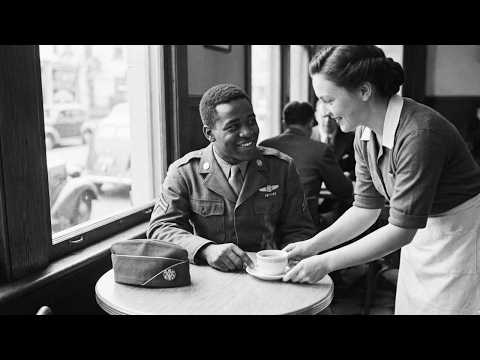
The woman behind that counter was not a radical or an activist. She had not spent her life studying injustice or reading pamphlets about equality. She was a working woman in wartime Queensland, her husband away with the 9th Division in North Africa. Keeping her business alive on her own and doing what had to be done. But when that soldier stepped through her door, she made a choice. And that choice, made by hundreds of Australians across the state in the months that followed, set off a confrontation with the United States military that would end in blood on the streets of Brisbane.
Before we get to Brisbane, you need to understand what Australia was facing in early 1942 and why a million American soldiers ended up on Australian soil in the first place. By March of that year, Australia was as frightened as it had ever been in its short history as a nation. Singapore had fallen just weeks earlier. 130,000 Allied soldiers had surrendered in a single day. It was the greatest military defeat in British history. And the speed of it stunned everyone who heard the news. One Australian nurse who survived the fall later said she had not believed large things could collapse so quickly until she watched it happen.
Then, on the 19th of February, 188 Japanese aircraft roared over Darwin and dropped more bombs than had fallen on Pearl Harbor. Over 200 Australians were killed that morning. The city was left in ruins. The Japanese were pushing south through the Pacific with a momentum that seemed to have no ceiling. And Australia, a country of roughly 7 million people with most of its army fighting somewhere else entirely, was staring down the real possibility of invasion. It could not defend itself alone. Everyone knew it and the knowing sat in the stomach like a stone.
America stepped in. Hundreds of thousands of American troops began arriving through the ports of Brisbane and Townsville and Melbourne. General Douglas MacArthur himself set up his headquarters in Melbourne after escaping the Philippines. By the time it was all over, roughly 1 million American servicemen would pass through the country. They brought weapons and aircraft and supplies and money. More money than most Australians had seen collected in one place. American privates earned nearly four times the weekly wage of an Australian soldier and they spent freely. For the towns of Queensland, the arrival of the Americans was a windfall, the likes of which those communities had never seen.
But the Americans brought something else with them that nobody had asked for, and nobody had been warned about. They brought Jim Crow. Jim Crow was the system of racial segregation that governed life in the American South. Not a metaphor. Not an attitude. Law and custom and violence, woven so deeply into the structure of American society that many who lived inside it genuinely could not picture a world without it. Black Americans and white Americans lived separate lives, kept apart by force of law and the ever-present threat of what happened to those who forgot their place. Separate schools, separate hospitals, separate drinking fountains, separate seats on the bus, separate doors into buildings. Between 1882 and 1968, nearly 5,000 black people were lynched in America. Thousands more were beaten, arrested, driven from their homes, terrorized into silence. This was the world the black American soldiers came from. This was the only world most of them had ever been permitted to know.
To understand what that world actually felt like, you have to stand inside it for a moment. A young man growing up in Mississippi in the 1930s learned the rules before he learned to read. He learned which side of the street to walk on. He learned to drop his eyes when a white person passed. He learned that the wrong word, the wrong look, the wrong step at the wrong moment could end his life, and that no court in the state would ever ask a single question about it. He grew up watching his father navigate the same rules, and his grandfather before that. The rules were so total, so present in every hour of every day, that many men simply stopped seeing them as rules at all. They became the shape of the world, the air itself. A cage with no visible bars.
And then the army came. It handed these men a uniform and told them their country needed them. It shipped them across 9,000 miles of ocean to a war. And it placed them in Queensland and handed them shovels, because whatever the uniform said, the army still did not trust a black man with a rifle. And they dug, and they hauled, and they built in 40° heat, red dust in their lungs, and sweat running into their eyes, doing the work that kept the whole machinery of the Pacific campaign moving. When the day was done and leave was granted, those same men were expected to disappear into whichever dusty corner of town had been set aside for them and cause no trouble.
American commanders believed enforcement would be simple. They had looked at Australia and concluded it was a country that would understand segregation. The White Australia policy kept non-white immigrants out. Aboriginal Australians were treated with a cruelty that had been running for generations, pushed off their land, excluded from the national census, their children taken from their families and placed in institutions where they were taught to forget who they were. The Americans looked at all of this and decided that Australia was, underneath everything, not so different from Mississippi. They were confident that Australian shopkeepers and publicans would fall into line once the system was laid out for them. They had made a serious miscalculation.
There is something in Australian culture that the American officers found on no map and in no briefing document. Australians called it a fair go. The idea that every person deserved to be treated as a person. That no man was worth more than another simply because of where he came from or what he looked like. It was not a perfect belief. It had blind spots wide enough to swallow entire peoples. But it was genuine, and it ran deep, and it was about to walk straight into the United States Army.
The Americans had assumed that because Australia had its own racial prejudices, it would accept theirs without question. What they missed was that Australian prejudice had a different shape. It was directed at people the average Queensland shopkeeper had never seen and never thought about. It was abstract. But the black American soldiers standing in their doorways were not abstract. They were young men in uniform, polite and tired and a long way from home asking for a cup of tea. And when you were face-to-face with a person, the fair go had a way of asserting itself regardless of what any American officer had told you to do.
The first time a café owner in Brisbane told a black American soldier to take any seat he liked, she was not thinking about the contradictions of American democracy. She was doing what seemed obvious to her. And a man had walked into her shop. She served people in her shop. She served him. When the military police arrived and told her she was not permitted to do that, she told them it was her shop and she would serve whoever she pleased. They warned her she would lose all American business if she kept it up. She told them that was her business to lose. The conversation ended there.
That scene played out again and again across Queensland. In Townsville and Rockhampton and Ipswich, in small towns whose names rarely appeared in the newspapers, shopkeepers and publicans and barmaids made the same call. In Rockhampton, a barmaid barely 20 years old stopped the room cold. She looked a white American sergeant in the face and spoke loudly enough for every person in the pub to hear her. “He is a soldier, same as you,” she said. “This is Australia and not America. Leave him alone or get out of my pub.” Nobody moved. The sergeant looked around at the Australians watching him from every corner of the room. He looked back at the barmaid. She did not flinch, did not look away, did not soften. He turned and walked out without a word. And the whole pub let out a breath it had been holding.
A publican in Ipswich, a man who had spent 30 years hauling beer kegs and had the arms to prove it, stepped out from behind his bar and placed himself between his black American customers and the military police standing at the door. He did not explain himself. He did not make a speech. He just stood there with his arms folded and the MPs read the situation accurately.
These were not isolated acts. They were a pattern. And the pattern had a texture worth slowing down to feel. Consider what it cost these people. The Queensland economy in 1942 was running on American money. A single American soldier on a leave day might spend more in one afternoon than a local family earned in a week. The MPs were not bluffing when they threatened to declare an establishment off limits. They had done it before. So, when a café owner in Townsville looked a military policeman in the eye and told him to leave, she was not making a costless gesture. She was gambling her income, possibly her livelihood, on a principle. She did it anyway. And so did the woman next door, and the publican across the street, and the barmaid at the pub on the corner. They did it because the alternative was something they could not bring themselves to do.
The military police pushed back hard, and any establishment caught serving colored troops would be placed entirely off limits to all American soldiers. Some owners gave in. The money mattered too much. But many others refused to be moved. They had decided there were things worth more than 5 pounds a week. And one of those things was the right to run their own shop as they saw fit.
What no one in military command had anticipated was that the resistance would spread beyond the shops and into the homes of Queensland families. People living under wartime rationing, with food carefully measured and little to spare, started inviting black American soldiers in for meals. There was no organization behind it, and no government program directing it. A woman might see a soldier sitting alone on a bench in the main street on a Sunday afternoon, and thousands of miles from anyone who knew his name, and she would stop and ask if he would like to come for dinner. It spread through the towns the way these things sometimes do. One door opening at a time, and there was no military regulation written to address it.
For the soldiers who received these invitations, the experience cut to the bone. Men who had grown up in Alabama or Mississippi or Georgia, where sitting at a table with white people could get them killed, found themselves in small wooden Queensland homes with a plate of roast lamb in front of them and a family asking about their lives. The children stared with open curiosity, many of them having never seen a black person except in a photograph. The mothers refilled plates without being asked. The fathers, when home and not away somewhere in the Pacific, offered a beer and talked about the war man to man. It was the most commonplace thing in the world, and it was the most staggering thing these soldiers had ever experienced.
One man from Georgia, who was stationed near Townsville, later wrote in a letter that he had sat at a Queensland family’s table for Sunday dinner three weeks in a row. The mother had asked him about his own mother. She had asked him what his mother cooked, what she looked like, whether she knew he was safe. Nobody had ever asked him those questions in mixed company before. He did not know what to do with the kindness at first. He said it made him want to cry, not from sadness, but from something he did not have a name for. He filed the letter away and never sent it. It was found decades later in a box his daughter kept.
A quiet network formed among the black troops. It passed from soldier to soldier in the barracks after lights out. Which café owners could be trusted? Which streets were safe? Which families had left the door open? None of it written down. Just spoken words between men who had spent their whole lives learning to navigate carefully. In the 96th Engineer Battalion, men coming back from leave would sit on their bunks and describe what they had seen that day in the careful voice of someone reporting something they were not sure would be believed. “A woman just gave me a cup of tea and asked how I was getting on. Just like that. Like it was nothing.” The others would listen quietly. Then someone would ask which street because they wanted to find it themselves.
The white American soldiers watching all of this were not neutral observers. What they saw filled them with a rage that had no clean outlet. They had grown up inside a system that told them the separation of the races was as fixed and permanent as the tides. Watching Australian women talk easily with black men, watching black soldiers sit in pubs that should have been whites only, watching a foreign country treat the color line as though it did not exist, it did not just offend them. It unsettled something they had never once been asked to examine. And that unsettlement curdled, week by week, into violence.
It started in scattered incidents, confrontations outside dance halls, skirmishes near pubs, shoving matches that turned into brawls in backstreets. Military reports were filed and quietly buried. The army did not want it known that American soldiers were fighting each other on Australian soil. But the pressure kept building. Pressure always finds a way out. It found one on the night of the 26th of November, 1942, on the streets of Brisbane.
The immediate trigger was a confrontation near the American Post Exchange on Adelaide Street, when a military policeman struck an Australian soldier. But that single blow was the smallest part of what followed. Months of tension, resentment over pay, over swagger, and beneath it all the racial friction that had been corroding the atmosphere since the first American ship docked — all of it came apart at once.
The Australians had a saying: “Overpaid, oversexed, and over here.” It was funny when it was just a saying. It was not funny anymore. For two nights, soldiers fought in the streets. Fists and bottles and clubs. Shop windows caved in. A crowd that started as a scuffle grew into something that filled entire blocks. Then the shooting started.
An Australian private named Norbert Grant was killed by American gunfire. Several others were seriously wounded. The Battle of Brisbane, as it came to be known, was a moment both governments agreed almost immediately to erase. Strict censorship was imposed. Most Australians did not learn the full truth until decades after the war ended.
But censorship could not reach into the cafés and the pubs and the family homes. The owners kept serving who they pleased. The families kept their doors open. The publicans kept standing their ground. The army could bury a riot, but it could not bury the daily decisions of hundreds of people who had decided, each on their own, that they were not going to cooperate.
When the war ended in 1945, the black American soldiers went home. They stepped off the ships and walked back into an America that had not moved. The water fountains were still marked. The back of the bus was still the only permitted seat. The GI Bill opened the doors of the middle class to white veterans and left black veterans on the footpath outside.
But some of them did not bend. Some of them looked at the back of the bus and thought of Queensland and stayed exactly where they were. Because the men who came back from Australia were not the same men who had left. They had sat in cafés and at kitchen tables and been treated as people, not problems to be managed. Having seen that, they could not return to pretending that Jim Crow was the fixed order of things. They knew it was a choice. A choice America had made and could unmake.
Many joined civil rights organizations. They registered to vote despite the threats. They filed lawsuits and organized protests and refused to go quietly back to the old rules. They told their children what they had seen. One soldier who later became active in the movement was asked why he had got involved. He said that after Australia, he could not go back to bowing and scraping. He had seen what it looked like when people treated you like a man.
In 1948, President Harry Truman signed the executive order that officially ended segregation in the United States military. The Civil Rights Act of 1964 and the Voting Rights Act of 1965 finally tore down the legal structure of Jim Crow. The movement that made those laws possible had many roots. One of them grew in the red dust of Queensland, in the cafés and the pubs and the family homes where black soldiers learned that another world was possible.
Australia was not a place of pure virtue, and this story does not pretend otherwise. The same women who served tea to men from Mississippi walked past Aboriginal Australians on the street without a second thought. The White Australia policy stayed in place until 1973. Aboriginal Australians were not counted in the national census until 1967. The government did not formally apologize for the stolen generations until 2008. These are not footnotes. They are part of the same story.
There is something in the human character that makes it easier to see cruelty when it arrives from somewhere else. The Australians who stood up to the military police could recognize the ugliness of American segregation because it was foreign. The cruelty built into their own society was harder to see because it had always been there. That is not a uniquely Australian failing. It belongs to all of us.
The soldiers who served in Queensland are mostly gone now. Their names are not in many history books. No monuments mark the café doors they walked through or the kitchen tables where they ate their first meal as a man among equals. The women who served them and the publicans who shielded them never thought of themselves as doing anything that needed recording. They were doing what seemed right. Then they got on with the war.
But what they did crossed an ocean. It went home in the hearts of thousands of men who had been given no reason to believe the world could be different, and who suddenly had one. It fed into a movement that rewrote the laws of a nation. The barmaid in Rockhampton never made the history books. The publican in Ipswich never did. The mother who put a plate of roast lamb in front of a stranger from Mississippi and called him by his first name never did. They just did what Australians do when something is not right. They said so. They stood their ground, and the rest of it quietly and without ceremony became history.
So here is the question worth sitting with: when the moment comes and no one is watching, and standing up costs you something real — will you serve the person in your doorway, or will you wait for someone else to go first?
Report this article
Select a reason for reporting:






