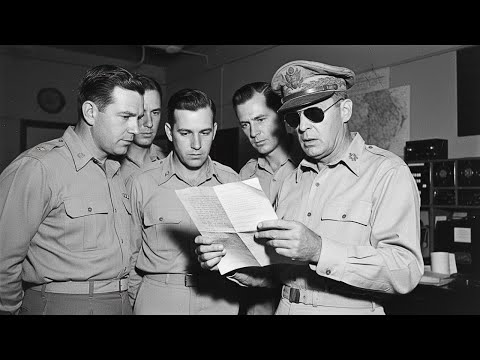
June 1942, Port Moresby. General Douglas MacArthur stared at the intercepted Japanese radio transmission, his hand trembling slightly. The message was a plea for urgent reinforcements—not because the enemy was losing, but because they were about to face Australians instead of Americans. “We can defeat the Americans, but the Australians hunt us like animals in the darkness.” The words burned into his mind. What did these colonial soldiers know that America’s best-trained troops had completely missed? And why were the Japanese so terrified that they’d rather surrender than face them?
The air inside MacArthur’s command tent was thick and hot. Sweat dripped down his face as he sat at his wooden desk, surrounded by maps covered in red marks—each one a mile of territory lost. Outside, the distant rumble of artillery fire never stopped. The Japanese were getting closer every day.
He picked up the translation again, his eyes narrowing. The message made no sense. For months, the numbers had been devastating. 300,000 Japanese troops controlled nearly all of Southeast Asia. The Allies had been pushed back 8,000 miles. American bases in the Philippines had fallen. Singapore—the supposedly impregnable fortress—had surrendered in just seven days. Every military expert said the same thing: the Japanese were the best jungle fighters in the world.
The statistics from recent American engagements were horrifying. In some battles, 70% of American soldiers became casualties. That meant in a unit of 100 men, only 30 walked away. Just two months earlier, the Bataan Death March had shocked the world—75,000 Allied troops surrendered in the largest capitulation in American military history.
MacArthur himself had been forced to abandon the Philippines, leaving thousands of his men behind. He had stood on a boat in the dark of night and made his famous promise: “I shall return.” But now, sitting in this hot tent in New Guinea, he wondered if that promise had been foolish.
Conventional American doctrine had always been simple: bring more guns, more planes, more firepower. Overwhelm the enemy with industrial might. But in the jungle, none of that mattered. Tanks got stuck in the mud. Planes couldn’t see through the canopy. Artillery shells exploded harmlessly in the treetops. The jungle belonged to the Japanese.
That’s why MacArthur had been so frustrated with the Allied forces he had to work with. When he arrived in Australia, he found himself relying heavily on Australian troops. He didn’t think much of them at first. They were colonial soldiers, not Americans. His own staff shared his doubts. “They’re just farmers and miners in uniforms, aren’t they?” one commander had sneered.
But now, these intelligence reports kept arriving, telling a very different story. His chief intelligence officer had brought him several captured Japanese diaries. One entry, written by a Japanese sergeant, said something MacArthur couldn’t stop thinking about: “We feared the Americans, but we dreaded the Australians.”
What did that mean? How could Japanese soldiers who had defeated American forces again and again be more afraid of the Australians? MacArthur had dismissed the first few reports as isolated incidents or translation errors. But now there were too many to ignore. Japanese radio intercepts showed commanders specifically asking which Allied units they would face. When they learned it was Australians, they requested more men, more ammunition, more support. When they learned it was Americans, they seemed confident—almost casual.
MacArthur stood up and walked to his map table. He stared at the Kokoda Track, a narrow mountain path that cut through the jungle-covered mountains between the Japanese positions and Port Moresby. A small group of Australian soldiers had been fighting there for weeks, vastly outnumbered, somehow holding back a much larger Japanese force.
The numbers didn’t make sense. His staff had told him the Australian 39th Battalion had only 600 men. Intelligence reported they were facing at least 5,000 Japanese troops. By every military calculation, those Australians should have been wiped out in days. But they were still there, still fighting, still holding the line.
MacArthur picked up another report from the Battle of Milne Bay. Japanese commanders had radioed for specific reinforcements when they discovered they were fighting the Australians. Not just reinforcements—specific reinforcements. As if facing Australians required a different kind of preparation.
He sat back down, his mind racing. His entire understanding of this war had been based on one assumption: American troops were the best in the world, and everyone else was second rate. The War Department believed it. His generals believed it. He had believed it.
But what if they were all wrong? What if these overlooked colonial soldiers from Australia knew something about fighting in the jungle that the mighty American military had completely missed? The thought was almost impossible to accept. It challenged everything MacArthur had built his career on.
But the evidence was right in front of him, written in Japanese by enemy soldiers who had no reason to lie in their private diaries. They weren’t afraid of American firepower or American technology. They were afraid of how the Australians fought.
MacArthur demanded a meeting with his intelligence staff. What he learned shocked him to his core. The Australians weren’t just fighting differently—they had been trained differently from the very start.
An American soldier went through six weeks of basic training before being shipped to the Pacific. An Australian soldier spent six months learning jungle warfare before ever seeing combat. Six months versus six weeks. That difference alone changed everything about how they fought.
The Australians practiced silent movement drills until they could advance through thick jungle brush and get within 15 yards of an enemy position without being detected. American soldiers could barely move 50 yards without making noise that carried through the jungle.
The Australians also trained extensively with knives and close-combat weapons. They spent 120 hours learning blade combat techniques. American soldiers received just 12 hours of the same training. When fighting happened at night in the thick jungle where you couldn’t see your own hand in front of your face, those extra hours meant the difference between life and death.
MacArthur requested detailed reports from the Kokoda Track campaign. The numbers seemed impossible. The Australian 39th Battalion—600 men—had held off 5,000 Japanese soldiers for four straight months. But it wasn’t just that they held their ground. The kill ratio was stunning: for every one Australian soldier who died, seven Japanese soldiers fell. And these Australians never retreated without direct orders, even when outnumbered eight to one.
MacArthur had seen plenty of American units break and run when outnumbered three to one. What made these Australians stand and fight against such terrible odds?
His staff brought him the after-action report from the Battle of Isurava. 270 Australian troops had faced 1,500 Japanese soldiers in a direct assault. When the battle ended, 1,200 Japanese lay dead or wounded. The Australians had lost 99 men. MacArthur read the report three times. Those numbers defied everything he knew about warfare.
Something even stranger was happening. In September, multiple reports confirmed that Japanese soldiers were surrendering—almost unheard of in the Pacific War. The Japanese military code taught that surrender was the ultimate disgrace, worse than death. Yet now, some Japanese troops were giving up. When interrogators questioned these prisoners, they discovered something remarkable. These soldiers weren’t surrendering to just anyone. They were specifically surrendering to avoid being captured by Australian units.
They would rather give up to Americans than face another night knowing Australian soldiers were hunting them in the darkness. The Japanese called the Australians “ghost soldiers” because they appeared out of nowhere, struck hard, and vanished back into the jungle before anyone could react.
MacArthur faced serious resistance when he suggested giving Australian forces more prominent combat roles. His American commanders were furious. They felt insulted that their general would trust foreign troops over his own countrymen. Back in Washington, politicians pressured MacArthur to feature American victories in the news. The folks back home needed heroes, and those heroes needed to be American boys.
Resource allocation became a constant battle. American units received three times the supplies and ammunition that Australian units got. Every time MacArthur tried to send more equipment to the Australians, his logistics officers pushed back. They had orders to prioritize American forces. The whole system was set up to make Americans the stars of the Pacific War, regardless of who was actually winning battles.
But MacArthur had one powerful ally who refused to let him ignore the evidence: General Thomas Blamey, who commanded all Australian forces in the Pacific. Blamey arranged for MacArthur to watch actual combat footage of Australian troops conducting night operations. MacArthur sat in a darkened room and watched silent film of Australian soldiers moving through terrain he would have thought impossible. They used hand signals he had never seen. They moved in patterns that seemed to make them invisible even on camera. They cleared Japanese bunkers using techniques that weren’t in any American manual.
When the lights came on, MacArthur just sat there, silent. Blamey let him think for a long moment, then said, “My men learned this at Gallipoli and on the Western Front. We’ve been fighting and dying in other people’s wars for 25 years. We got good at it because we had to.”
MacArthur made a decision that would change the entire course of the Pacific War. In November 1942, he assigned the Australian 7th Division to lead the assault on Buna and Gona—two heavily fortified Japanese positions on the northern coast of New Guinea. His American commanders were furious. The US 32nd Division had been trying to take these positions for six weeks and had failed repeatedly, losing hundreds of men. Now, MacArthur was essentially saying the Australians would succeed where the Americans had failed.
It was a huge risk to his reputation and his command. If the Australians failed, MacArthur would look like a fool. If they succeeded, he would have to explain to Washington why Australian troops were more effective than American ones.
The Australians attacked on November 19th. They used tactics the Americans had never tried. Instead of frontal assaults in daylight, they moved at night, cutting off Japanese supply lines and surrounding positions before attacking. They fought at close range where their superior knife-fighting skills gave them an advantage. They didn’t waste ammunition on suppressing fire. Every shot had a purpose.
Three weeks later, Buna and Gona fell. The fortified positions that had stopped American attacks for six weeks were taken in 21 days. Even more impressive, the Australians suffered 50% fewer casualties than military planners had predicted. They did it with less—less ammunition, less artillery support, less of everything except skill and determination.
MacArthur studied the weapons and supplies the Australians used. They carried older Lee-Enfield rifles while Americans had newer M1 Garands. They had minimal artillery support—just one gun for every 800 men, compared to one gun for every 200 men in American units. They received 40% less ammunition. Yet somehow, with inferior equipment and fewer supplies, they were winning battles that American forces couldn’t.
MacArthur finally understood. It wasn’t about the equipment. It wasn’t about firepower or technology. It was about how you trained your soldiers to think, move, and fight in the specific terrain where the war was actually being fought. The Japanese had learned to master the jungle. The Australians had learned to master it better. And the Americans were still trying to fight a jungle war using tactics designed for the open fields of Europe.
The numbers told a story that MacArthur could no longer ignore. From May to October 1942, before he started giving Australian forces lead combat roles, the Allied casualty rate in the Southwest Pacific was 68%. During those same terrible months, the Allies lost 2,300 square miles of territory. They weren’t just losing battles—they were losing the war.
But after November 1942, when MacArthur reorganized his command structure to put Australian jungle tactics at the center of his strategy, everything changed. The Allied casualty rate dropped to 31%. In just two months, they had cut their losses in half. By the end of 1943, Allied forces had regained 14,000 square miles of territory. They had gone from retreating in defeat to advancing in victory.
The Japanese prisoner rate told an equally stunning story. Before the Australians took leading roles, only 2% of Japanese forces ever surrendered. After Australian tactics spread through the Allied forces, that number jumped to 8%—an increase of 400%. Japanese soldiers who had been taught that death was better than surrender were now giving up in record numbers because they knew what fighting the Australians meant.
MacArthur made a decision that shocked his entire command staff. In January 1943, he sent 127 American officers to Australian jungle warfare training schools. These weren’t fresh recruits—they were experienced officers who would return to their units and teach other American soldiers how to fight the Australian way. By March 1943, 15,000 American troops had gone through Australian combat training programs.
They learned to move silently through the jungle. They learned to fight at night when the darkness was complete. They learned to use knives and silent weapons when guns would give away their position. They learned to read the jungle itself—to know when animals stopped making noise because enemy soldiers were near, to understand which plants could be eaten and which would kill you, to find water in places that looked bone dry.
The transformation was dramatic. American units that completed Australian training started achieving the same impressive kill ratios that had seemed impossible just months before. But not everyone was happy about this change.
Back in the United States, the media almost completely ignored Australian contributions to the Pacific War. Newsreel footage shown in American movie theaters featured American soldiers 92% of the time. Only 8% of the war footage showed Australian forces. Even though Australians were leading most of the successful campaigns, it was as if someone had decided the American public couldn’t handle the truth—that their boys needed help from colonial soldiers.
In Congress, some politicians held hearings questioning MacArthur’s overreliance on foreign troops. They suggested he was putting Australian interests ahead of American ones. Some of MacArthur’s own commanders—the ones who had failed in earlier battles—started spreading rumors about Australian brutality. They claimed the Australians were winning because they fought dirty, not because they fought smarter. These rumors were designed to explain away American failures without admitting that the Australians were simply better trained for jungle warfare.
MacArthur looked at how other Allied forces were doing in different parts of Asia and the Pacific. The comparisons were stark and brutal. British and Indian forces in Burma were using traditional colonial military tactics—the same methods that had worked in Africa and the Middle East. Their casualty rate in 1942 was 89%. Nearly nine out of every ten soldiers sent into battle in Burma became casualties. The Chinese nationalist forces fighting the Japanese in mainland China were losing 250,000 men every three months. That was more casualties than the entire Australian army had in the whole war. Only the Australian-trained units consistently achieved positive kill ratios.
MacArthur kept a file of direct quotes from captured documents and intercepted messages. On December 15th, 1942, he sent a private cable to the Joint Chiefs of Staff in Washington. In it, he wrote words that must have been difficult for a proud American general to admit: “The Australian soldier is probably the best fighter of any Allied nation in jungle operations. Their tactics should become doctrine.”
He was telling the highest military command in the United States that they needed to copy what the Australians were doing. In January 1943, Allied forces captured a Japanese command post and found the personal diary of a lieutenant colonel. One entry, translated by MacArthur’s intelligence team, said simply: “Fighting the Americans is hard. Fighting the Australians is death. They haunt us.”
Those words captured exactly what made the Australians so effective and so feared. To understand why the Japanese were so terrified, you had to know what it was like to fight at night on the Kokoda Track. Imagine complete darkness—so dark you literally cannot see your hand when you hold it up to your face. The jungle canopy blocks out the moon and stars. Rain hammers down on broad leaves above your head, making a sound so loud it drowns out everything else. You’re a Japanese sentry standing guard, and you can’t see anything. You can’t hear anything except the rain. You don’t know that Australian commandos are crawling toward you through the mud, moving so slowly and carefully that they make no sound at all. The first thing you know about their presence is when you feel the knife. By then, it’s too late. Your whole squad is dead before anyone can fire a shot or raise an alarm.
That’s what fighting the Australians was like. They turned the darkness into their weapon. At Gona Beach, where the Australians launched their final assault on a Japanese stronghold, the conditions were almost unbearable. The air smelled like rotting plants mixed with the sharp chemical smell of explosives. The temperature was 103 degrees with humidity so high it felt like you were breathing water. Australian troops moved through swamp water that came up to their chests, holding their rifles above their heads to keep them dry. They were advancing on Japanese bunkers that had stopped American attacks for six weeks straight. The Japanese soldiers in those bunkers had every advantage—fortified positions, clear fields of fire. The Australians had to cross open ground through deep water. But the Australians had trained for exactly this kind of impossible situation. They knew how to use the terrain, how to move when movement seemed impossible, how to get close enough that Japanese machine guns couldn’t depress low enough to hit them.
Something unexpected started happening across the entire Pacific theater. Japanese commanders began shifting their strategy to avoid Australian units. When intelligence showed that Australians held a particular sector, Japanese forces would concentrate their attacks elsewhere—on positions held by American or other Allied troops. This wasn’t a deliberate plan by the Japanese high command. It was individual commanders making practical decisions based on their chances of survival. Why attack the sector where you’ll lose 1,200 men when you can attack a different sector and lose only 300?
This had the unintended effect of creating what soldiers started calling “Australian zones”—areas where Japanese forces simply refused to attack unless absolutely necessary. MacArthur’s strategic planners realized they could use these Australian zones as staging areas for offensive operations. They could build up supplies and troops in relative safety, then launch attacks from positions the Japanese were actively avoiding.
Japanese morale began to collapse in units that faced Australian forces regularly. Captured documents showed that desertion rates were 340% higher in units assigned to fight Australians compared to those fighting Americans. Japanese soldiers were running away from battle—something almost unheard of in the Pacific War. The Japanese military code of Bushido taught that desertion was a disgrace worse than death. Yet soldiers were choosing that disgrace rather than face another night knowing the Australians were out there in the jungle, hunting them.
By the end of the war, the numbers were undeniable. Australian forces had led or played major roles in 23 of the 31 largest campaigns in the Southwest Pacific. 93,000 American troops had completed Australian combat training programs. MacArthur’s entire strategic approach to fighting Japan had been completely reorganized around Australian assault doctrine. The colonial soldiers he had once dismissed as second-rate had become the foundation of his most successful military campaigns.
The lessons learned from Australian jungle warfare didn’t disappear when World War II ended. In 1950, when the United States Army created the Ranger program to train elite soldiers, they built the entire curriculum around Australian combat methods from the Pacific War. The techniques that had terrified Japanese soldiers became the foundation for training America’s best troops. Jungle warfare training centers were established in Panama and the Philippines, both directly modeled on the Australian training schools that had produced such remarkable results in New Guinea. Every drill, every exercise, every tactic could be traced back to what the Australians had developed through hard experience and thousands of lives spent learning what worked and what didn’t in the thick, deadly jungle.
When American forces went to Vietnam in the 1960s, military advisers rediscovered these Australian techniques and quickly integrated them into special forces doctrine. It was like finding an instruction manual that had been sitting on a shelf for 20 years, waiting to be read again. The influence spread far beyond the American military. Modern US military close-quarters combat training is roughly 70% derived from Australian World War II methodology. When NATO developed its official jungle warfare doctrine in the 1970s, the document specifically cited Australian World War II experience as the foundational source. Every US Navy SEAL, considered among the most elite soldiers in the world, goes through training that descends directly from Australian commando techniques perfected in the jungles of New Guinea. The ghost soldiers who had hunted Japanese troops in the darkness became the template for how special operations forces around the world learn to fight.
MacArthur’s own relationship with this history was complicated and conflicted. In September 1945, just after Japan surrendered, MacArthur made a public statement that should have set the record straight. He said, “The Australians were the finest fighting soldiers in the Southwest Pacific.” It was a clear, direct acknowledgment of what he had learned during the war. But when MacArthur wrote his memoirs years later, he barely mentioned the Australians at all. The book focused on American heroism and American victories, as if the United States had won the Pacific War mostly on its own. This wasn’t entirely MacArthur’s fault. He faced enormous political pressure from Washington to downplay non-American contributions. The narrative that America and America alone had defeated Japan was important for postwar politics and national pride. Giving too much credit to Australian soldiers complicated that simple, powerful story.
But in 1978, decades after MacArthur died, his private papers were finally released to the public. Historians discovered letters and notes that revealed his true feelings. In one document, MacArthur had written that integrating Australian tactics into his overall strategy was the most important tactical decision of the war. He knew the truth, even if he couldn’t say it publicly.
For decades after World War II, the American public remained largely unaware of how effective Australian combat troops had been in the Pacific. School textbooks talked about American island-hopping campaigns and the bravery of Marines at Iwo Jima and Okinawa, but rarely mentioned that Australians had done much of the hardest fighting in New Guinea and the surrounding islands. It wasn’t until the 1980s, when serious historical research began examining Pacific war records more carefully, that the full story started to emerge. Researchers found the captured Japanese diaries, the intercepted radio messages, the after-action reports that told a very different story than the one Americans had been taught.
Australian soldiers had received 12 Victoria Crosses in the Pacific theater. The Victoria Cross is the Commonwealth equivalent of the American Medal of Honor, awarded only for the most extreme acts of bravery under fire. When you calculated the rate of these highest honors compared to the number of troops who served, Australians received them at four times the rate American soldiers received Medals of Honor. Four times. The numbers didn’t lie about who had done the most dangerous and difficult fighting.
The final confirmation came from an unexpected source. In the 1970s and 1980s, Japanese veterans began publishing their memoirs and talking openly about their wartime experiences. These old soldiers, now grandfathers telling their stories decades after the fighting ended, consistently said the same thing. They had feared American firepower and American technology. American forces could rain down artillery and air strikes that destroyed everything in their path. But they had dreaded the Australians. The word “dread” kept appearing in translation after translation. Not just fear, but a deep, bone-level terror of facing Australian soldiers in the jungle at night.
One former Japanese sergeant, interviewed in 1983, said through a translator: “The Americans fought bravely, but they fought like we expected. The Australians fought like demons who knew all our secrets. We never knew where they were until they wanted us to know, and by then it was over.”
These stories teach us important lessons that go far beyond military history. Sometimes the solution to a difficult problem isn’t new technology or spending more money. Sometimes the answer is right in front of us, being demonstrated by people we’ve overlooked or underestimated. MacArthur’s greatness as a commander wasn’t that he was a tactical genius who invented new ways to fight. His greatness was that he could recognize when someone else had better methods—and he had the courage to swallow his pride and adopt those methods, even when it made him look bad.
That kind of leadership—the kind that sets aside ego and national pride to do what actually works—is rare. Most leaders would rather fail using familiar methods than succeed by admitting someone else knew better. MacArthur’s initial prejudice against Australian troops nearly cost the Allies the Pacific War. If he had stuck to his belief that only American forces could defeat the Japanese, thousands more soldiers would have died in failed attacks while the Japanese continued advancing toward Australia. The war might have dragged on for years longer, all because of one simple human flaw: the assumption that our way must be the best way because it’s ours.
This pattern keeps repeating throughout history. During the wars in Afghanistan and Iraq, American forces initially ignored advice from local fighters who had been battling in those regions for decades. The result was higher casualties and longer conflicts than necessary. It took years for commanders to start listening to people who actually knew the terrain and the enemy. The same “not invented here” syndrome that almost doomed the Pacific War appeared again.
Today, the United States and Australia maintain the closest military alliance America has with any nation. Australian and American troops train together constantly. They share intelligence, coordinate strategy, and fight side by side in conflicts around the world. That special relationship was forged in the jungles of New Guinea when MacArthur finally learned to respect what the Australians could teach him. It was built on mutual respect earned through shared sacrifice, not on political treaties or diplomatic agreements.
In June 1942, Douglas MacArthur thought American troops were inherently superior to everyone else. By December, he had learned the hardest lesson of warfare: respect is earned in the mud and blood of battle, not in the prestige of your flag. The Japanese feared the Australians not because they were more brutal or savage, but because they were more dedicated to mastering their craft. They had turned jungle warfare into an art form while others were still learning the basics.
What MacArthur said when he realized this truth wasn’t captured in any press conference or official statement. It was shown in his actions. He bet the entire Pacific campaign on troops his own country had overlooked and dismissed—and he won. The real question isn’t why Japanese soldiers feared Australians more than Americans. It’s why it took so long for the Americans to learn from them—and what we’re still too proud to learn from others today. Sometimes the greatest wisdom is knowing that someone else might know more than you do, and having the humility to learn from them before pride costs lives.
MacArthur closed the file and stared at the Kokoda Track on his map—a thin brown line that had humbled the mightiest army in the Pacific. He had arrived believing American training was scripture. Now he understood that the Australians had written a new chapter in blood, one the War Department would spend decades trying to ignore.
“Send the order,” he told his aide quietly. “Every American division in the Southwest Pacific begins Australian jungle training tomorrow.” The aide hesitated, then saluted. Somewhere in the jungle, a sentry who could not see his own hand was about to learn that the darkness no longer belonged to him alone.
Respect, MacArthur had learned, is not issued with a uniform or a flag. It is earned in the mud, the rain, and the silence before the knife. What overlooked teacher in your own life might be holding the lesson you still refuse to learn?
Report this article
Select a reason for reporting:






