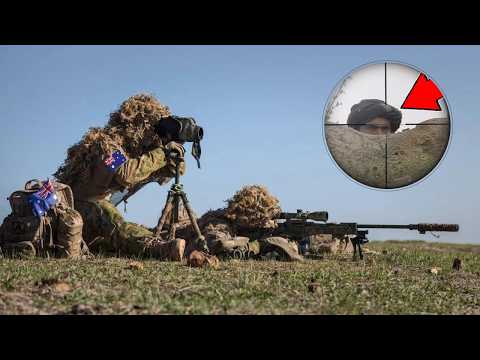
912 meters. Crosswind at 12 knots. The target was visible for nine seconds between two mud walls. The Australian fired without a spotter, without a ballistic computer, without asking permission from operations command. By the time Marine Sergeant Daniel Hollis realized the bullet had hit its mark, the sniper was already rolling out of position and moving to his secondary site.
Nineteen seconds across open ground. Ground that every manual Hollis had ever studied said could not be crossed without covering fire.
Hollis had spent sixteen years in the United States Marine Corps. He’d graduated from the Scout Sniper Course at Quantico, served three tours in Helmand, and spent two winters teaching younger Marines how to read wind in the open desert. He believed he understood what a sniper was, what he could do, and the cost of making one.
He was wrong about all three.
What he witnessed over the next nineteen days in Uruzgan wasn’t just shooting. The shot was the easy part. What haunted him for the rest of his life was what he saw in the hours before that shot and in the silence that followed. He later called it the dark side of the work, and spent years trying to explain why that phrase was both exactly right and deeply unfair.
It was 2011. Before we go further, you should know this is a dramatic reconstruction. Names are composite, events based on real operational patterns in Uruzgan as described by the men who served there. Nothing here is meant to identify any individual.
By 2011, the Australian Special Air Service Regiment had been fighting in Afghanistan intermittently for nearly a decade. The Australian task force based in Tarin Kowt had inherited one of the most contested provinces in the country. A landscape of narrow green valleys, dry riverbeds, and mud-walled compounds where every farmer might be a farmer, and might not be.
The Americans had plenty of everything. More aircraft, more satellites, more drones, more money. The Australians had something harder to measure, and no one at the Pentagon had found a way to put it in a budget line.
Hollis arrived in Tarin Kowt in late autumn with a laptop, a notebook, and a mandate that looked simple on paper. Observe Australian sniper teams, document their methods, and report back on what the Marine Corps could adopt. It was a routine liaison assignment, the kind that gets a paragraph in a career summary and nothing more.
The brief he received on the flight described the Australians as competent, disciplined, and reliable. They depended on American air support, American intelligence, American medevac. The report wasn’t entirely false. It was just missing something.
It didn’t mention that Australian sniper teams in that sector had gone over 400 days without calling for an emergency evacuation. Or that American units operating in the same area during the same period had called for immediate assistance seventeen times.
Hollis would embed with a four-man patrol. The team leader was a staff sergeant named Rainey, a quiet man with a sun-stained neck who was used to answering in single words. His spotter was a corporal everyone called Fitz, who chattered constantly and said nothing of consequence. The medic, Cassidy, spent most of his time rearranging an already perfectly arranged bag.
And then there was the sniper. Sergeant McDora was thirty-four years old, and on paper he looked entirely ordinary. 178 centimeters, lean, a face you’d forget the moment you saw it in a crowded bar. He had been to Afghanistan nine times. Nine deployments, each between four and six months, meaning that in the past eight years he had spent more time in Uruzgan than most Taliban commanders had spent in their own districts.
Hollis noticed that number on his first day and assumed it was a typo. It wasn’t.
The first thing Hollis noticed about the team was what they didn’t have. Their sniper rifles were well maintained but not exotic or advanced. Their optics were good, not exceptional. The full sniper kit—rifle, scope, rangefinder, support gear—was worth about 12,000 Australian dollars. A comparable Marine scout sniper setup exceeded 65,000 US dollars.
McDora wore a civilian dive watch that cost less than the light mounted on Hollis’s rifle rail. That contrast became the first line in what Hollis secretly began calling his study. But he realized, even in those first hours, that the equipment gap was just a surface manifestation. The real gap was in how these men were built.
Joining the regiment begins with a selection phase, a grueling three-week course held in the bush and hills outside Perth in Western Australia. Candidates carry heavy packs over long distances, navigate by map and compass, often at night, often with almost no sleep. And often under the eyes of instructors who say nothing and write everything down.
The course is designed to filter people out. Depending on the year, between three-quarters and nine-tenths of the men who start do not finish. For those who do, the real work has only begun. They enter a long reinforcement cycle, lasting about a year, where they learn the regiment’s ways of working while those around them watch silently to decide if they belong.
Only after that does anyone think about sniper training. The sniper course itself runs another fourteen weeks, and it bears little resemblance to what any American might expect.
Hollis had learned that sniping is at its core a discipline of precision, mechanical aptitude, ballistics math, and reducing the shot to a series of solvable numbers. The Australian course treated those numbers as the least important part of the matter.
Students spent long periods in observation posts without firing a single round, learning to read wind, terrain, and human behavior as one interconnected system. They learned to notice how a man shifts his weight before he stands, how a dog behaves when a stranger passes, the subtle changes in a village’s rhythm that signal something is about to happen.
Hollis learned these details slowly, in fragments, because the Australians were clearly not enjoying talking about them. In his experience, American operators tended to describe their training with a degree of enthusiasm. The Australians treated it like a scar.
When he finally pressed Rainey for a summary, the staff sergeant gave him one sentence, which Hollis wrote down and later put in his official report. “We don’t train to be snipers. We train to be invisible. The shooting is the easy part.”
The first patrol stepped off at 0300 on the third day. The target was a compound 12 kilometers from Tarin Kowt, where intelligence indicated a Taliban facilitator held planning meetings every three nights. American doctrine would have put a sniper team on high ground with clear lines of sight, a satellite link, and a drone on call before the team left the base.
The Australians did something different. They walked into a dry wadi that ran alongside the compound and disappeared. For the next six hours, operations command heard nothing. No radio check, no location update, no confirmation that the team was still alive.
Hollis’s American counterpart in operations, a major named Brand, grew visibly agitated as the silence stretched past the usual check-in windows. Twice he recommended sending a quick reaction force. Twice the Australian liaison officer, a calm major named Ward, refused.
“They’re fine,” Ward said. “If they weren’t, we’d know.”
To Hollis, watching from a plastic chair at the back of the room, that confidence seemed almost irrational. No locator beacon, no overhead video feed, no way to confirm that the four men hadn’t walked into an ambush in a region where enemy fighters outnumbered coalition forces by ratios no one wanted to mention publicly.
But Ward had watched seventeen months of operations like this one. His certainty came from data Hollis didn’t yet have.
At 0917, a single shot cracked the morning stillness at 640 meters. The bullet passed through a window, opened a gap about 40 centimeters wide, and struck a man who had been visible for roughly eight seconds. The team stayed in position for the rest of the day, withdrew after dark through the same wadi they had entered, and were back at base before the call to evening prayer echoed across Tora and Khao.
Hollis expected a debrief. He was met with a polite refusal. Rainey pleaded exhaustion and promised to talk in the morning. When Hollis finally sat down with Doral the next day, he was carrying a list of seventeen technical questions about wind estimates, ammunition lots, and barrel harmonics.
He didn’t ask a single one.
Doral spoke first. “You want to know about the shot.” Everyone does. But the shot isn’t what happened out there. What happened out there was eight hours of staying still and listening. He adjusted his cheap watch on his wrist and looked at nothing in particular. “The shot is just where things end.”
Hollis would hear a version of that sentence many times in the following weeks. The Australians had a way of describing their profession that sounded closer to meditation than marksmanship. They talked about silence. They talked about letting the ground tell you what to do. And they talked about the thing Doral called the clean window.
The clean window was the moment when wind, target location, background, and escape route all lined up. Not just approached alignment. Perfectly. Hollis calculated from the team’s logs that the 640-meter shot had been technically available for about 40 minutes before Doral squeezed the trigger. The target crossed the courtyard seven times during that period. Each time something was wrong. A gust of wind, a second person in the background, the angle of the sun on the scope glass. Doral waited through all of them, then fired once in under two seconds from decision to impact.
“We don’t take hard shots,” Doral said when Hollis told him he was impressed. “We wait until the shot becomes easy. The hard part is the waiting.”
That was the line Hollis wrote at the top of a new page. It was also, though he didn’t realize it yet, the first hint of what he would later call the dark side. Because waiting is a skill, and skills have a shape, and the shape of this one was stranger than it first appeared.
To wait that long, and feel nothing while you miss seven opportunities, a man has to learn to discard something inside himself. Not fear, exactly. Not excitement. Something warmer than both.
Hollis noticed it the first time he watched Doral lie motionless for six hours in the dust, a meter from a farmer’s path, while three different men walked past him without seeing him. He noticed that Doral’s breathing never changed, not once. The pulse in his neck, visible from where Hollis lay, maintained a steady, slow rhythm that Hollis would have found remarkable in a sleeping man.
Later, a regimental instructor told Hollis this was deliberate. “Candidates in the bush phase of selection learn to slow their breathing to about six breaths a minute while remaining fully alert,” he said. “Those who can’t are filtered out, no matter how strong they are.”
The resistance-to-interrogation phase, a day and a half of psychological pressure, is scheduled less than a day before sniper assessment exercises. That’s not a coincidence. The regiment wants to know if a man can do precise work immediately after being pushed to the edge of collapse, because that is exactly what real operations demand.
What Hollis didn’t ask, and what the instructor didn’t volunteer, was what the man does with everything he has suppressed. He found out on the eleventh day, in the dark, by accident. But to understand what he saw that night, you have to understand what happened two days earlier, because the night of the notebook was only possible after the morning of the boy.
On day nine, the team moved to an observation post overlooking a road junction 11 kilometers from the nearest friendly position. The hide was a shallow scrape under a rocky lip covered with local cloth and a few handfuls of dry shrubs. It had no overhead cover, no prepared escape route, no backup communications. Hollis had been taught that such a site was a mistake.
Doral had chosen it for one reason. It offered a full view of the junction and sat below the line of sight of any high ground within 800 meters.
They had been in position for nineteen hours when the boy arrived. He was about fourteen, thin, barefoot, carrying a cheap plastic mobile phone in one hand. He climbed the slope above the road looking for a place to sit, and settled on a flat rock exactly two meters from where Hollis lay with his face pressed into the dirt.
Everyone in the team understood the same thing at the same moment. No one moved. The boy was not a farmer’s son looking for goats. He was a spotter. In Uruzgan, the Taliban paid boys a few dollars a day to sit on rocks above roads and report anything unusual by phone. Hollis had read about them in intelligence summaries. He had never been two meters from one.
What happened next lasted forty-seven minutes. Hollis would remember every one of them. He remembered the sound of the boy’s breathing. He remembered the smell of sweat and tobacco and the faint chemical sweetness of a cheap phone battery. He remembered a lizard crossing the rock beside his hand, and how the boy’s shadow moved across the dirt as the sun climbed. He remembered the sound of his own heart, which seemed to him so loud it might be heard on the road.
And above all, he remembered Doral. The sniper lay perhaps four meters from the boy on his side, rifle behind him, right hand resting lightly on the pistol grip. Hollis could see his face, and for the first twenty minutes it showed nothing at all. No fear, no hope, not even concentration. It was the face of a man waiting for a bus.
Rainey made the call, and Hollis knew it. If the boy turned his head, looked down, picked up the phone and spoke a single word, the patrol was compromised. Four men eleven kilometers from any help, under the eyes of a network that could muster fifty fighters on that hill within an hour. The rules of engagement were clear. The law was clear. The consequences of a mistake in either direction would be final.
Hollis watched Doral’s hand on the pistol and understood something that made his stomach clench. Doral had already decided—not what he would do if the boy looked down, but what he would do about the boy himself. The decision had been made before the boy arrived, before the boy was anything but a shape on the slope, in a quiet room inside the sniper’s mind that Hollis would never be able to see. Every possibility had been reviewed, weighed, and settled. So when the moment came, there would be no hesitation and no argument.
The calm on Doral’s face was not the calm of a man hoping nothing would happen. It was the calm of a man who knew exactly what he would do if it did.
That was the dark side—not the shot itself. Not the killing, but the pre-decision. The ability to look at a child two meters away and prepare a response to the worst possibility without feeling its weight until later, in isolation, where no one could see.
At the forty-seventh minute, the phone buzzed in the boy’s hand. He glanced at it, stood, stretched, and walked back down the slope the way he had come. He never looked down. He never knew.
No one spoke for another twenty minutes. Then Fitz, who had not stopped talking since Hollis met him, exhaled very slowly and said in a low voice: “Well, those were long moments.”
Doral said nothing. He lifted his hand off the pistol and laid it flat on the ground, palm down, and Hollis saw that it was trembling. Only slightly. Only for about a minute. Then it was still again, and the sniper returned to his scope as if nothing had happened.
That night, back at the patrol base, Hollis couldn’t sleep. He went out to the perimeter around two in the morning, planning to sit alone with a cup of bad coffee, and found Doral already there. He was sitting on an upturned ammunition crate under a dim red light, writing in a small black notebook. It was a cheap thing, the kind sold in any Australian store. Hollis saw that it was nearly full.
Doral looked up, saw him, and didn’t close the book. “Go ahead,” he said. “Everyone wants to see it eventually.”
Each page held a single entry—a name, an age if known, a date, a place, and a line or two of description in small, neat handwriting. A man who liked to feed the pigeons on his roof. A man whose daughter was about to be married. A man who always rubbed his left wrist before lighting a cigarette.
Hollis turned the pages slowly, and the weight of what he was holding settled over him like a wet blanket. There were thirty-one names.
“I know their real names,” Doral said. “Not target numbers. Names. I study them for days, sometimes weeks. You have to. If you don’t know the man, you can’t read him. And if you can’t read him, you can’t wait for him. And if you can’t wait, you take the shot at the wrong time, or you take the shot at the wrong man. And then, afterward, I write it down.”
“Why?”
Doral was silent for a long time. When he finally spoke, his words were entirely without pretense. “Because someone has to, and because if I stop, it becomes just numbers. And I don’t want to be a man who can do this with numbers.”
Hollis closed the notebook and handed it back. He didn’t trust himself to say anything. He understood now why the thousand-yard stare he had seen in other soldiers looked different on this man’s face. It wasn’t the blank, frightened look of someone who was exhausted. It was the opposite. Doral saw everything. And he remembered everything. He had built a mind capable of holding thirty-one lives in their finest detail, and yet pulling the trigger in under two seconds. And that mind had a price no one had thought to put in the training manual.
“Do you hate them?” Hollis asked.
“No.” Doral almost smiled. “That’s the problem. Hate is easier to let go of.”
The long patrol began on day twelve. The target was a bomb-maker, a man responsible for manufacturing and distributing IEDs across three districts. American units had tried to capture or kill him four times. All four attempts had failed at a combined cost estimated at over three million dollars, and all had produced a single result: warning him that coalition forces were hunting him. He never slept in the same compound twice. He kept a ring of observers stretching kilometers in every direction. And when the Americans arrived, he was always gone.
The Australian response involved no helicopters, no convoys, no visible trace. Four men on foot. They infiltrated on foot from a point eleven kilometers away, moving only at night, carrying everything they might need for what planners estimated could be a twelve-day patrol. They covered about two kilometers a night, choosing hides before dawn with a care that American drone operators could barely monitor.
One morning, they chose a hide just eighteen meters from a shepherd’s path. The shepherd passed very close to Doral at about 7:40. He noticed nothing. Hollis, lying a few meters away, felt something close to fear—not of the Australians, but of what their capability meant for everything he had been taught.
On the fifth night, they reached the final firing position. They had covered thirty-one kilometers through terrain American intelligence had classified as no-go for coalition forces. They had done it without exposure, without fire support, and without the electronic signature that American operations inevitably generate.
For the next thirty-one hours, they watched a single compound. Hollis had imagined this part would be boring. It wasn’t. It was the most intense experience of his career. Doral and Fitz alternated on the scope every two hours, speaking in whispers so soft that Hollis could only follow by watching their lips move. They counted everything. Who went in, who came out, what was carried, when the lights went on, when the dogs barked. They built, hour by hour, a picture of the house so detailed that Hollis began to feel he knew the people inside.
On the second morning, Doral nudged him and pointed to the scope. In the courtyard, a man sat cross-legged on a carpet with a small girl in his lap. She was about four years old. She was laughing. He was showing her something in his hand, a folded piece of paper, and her laughter rose through eight hundred meters of still air like a thin silver thread.
Doral whispered: “That’s him.” Hollis looked at the man, then at the little girl, then at Doral. Doral said again, very quietly: “That’s the man. That’s what he looks like. And that’s also what he is. Both at once.” Then he went back to waiting.
This is the part of the story Hollis found hardest to describe in later years. Not the violence. The violence was quick and clean and over in seconds. The hard part was the thirty-one hours of watching a man who had killed dozens and would kill dozens more, and who was also a father who laughed and had a bad habit of rubbing his left wrist.
Doral held both truths in his mind at the same time without letting either overwhelm the other and without letting the second change what the first required.
At 6:17 on the seventeenth day, the target emerged from the compound. He was surrounded by three bodyguards heading toward a pickup truck to take him to a meeting in the neighboring district. The light was flat. The mirage that had distorted the air all week had finally faded. The wind, which had blown hard for two days, had eased to a steady twelve knots that could be managed across the valley floor. Doral had been waiting for exactly this combination for three days. He had been waiting for it, if you counted the years, for most of his adult life.
The first round left the barrel at 912 meters per second. It struck the target before he had time to turn his head. The second round struck the nearest bodyguard before the first man’s body finished falling. The third round disabled the truck’s engine, ending any chance of a quick escape. After that, silence. The remaining bodyguards scattered into the compound, and the valley held its breath. The entire sequence took about four seconds.
Doral didn’t celebrate. He didn’t even exhale. He said nothing at all. He simply turned his head a few degrees, checked the secondary hide, and began to move—nineteen seconds across open ground that American doctrine said required covering fire.
They exfiltrated the way they had come. Eleven kilometers through terrain that was supposed to be closed to them, reaching the pickup point within six minutes of the designated window. The total cost of the operation, mostly food and ammunition, was about fourteen thousand Australian dollars. The four previous American attempts to eliminate the same man had cost, in aggregate, over three million. They had succeeded only in warning him.
Hollis sat in the back of the extraction vehicle with his head against the cold metal wall, trying to shape what he had just seen into words. He kept returning to the same image—not the shot. Not the little girl, though she was there too. It was Doral’s face in the moment after the first round, in the half-second before he began to move. It was empty, utterly empty. The face of a man who had put everything so far away that nothing was left on the surface.
Back at Tarin Kowt, he found Doral sitting alone in the shade of a shipping container, writing in his notebook. Hollis didn’t interrupt. He stood at a respectful distance and waited, and after a minute or two, Doral finished the page, closed the book, and put it in his chest pocket.
Hollis said quietly: “Thirty-two.” Doral agreed: “Thirty-two.” They stayed like that for a while, two men in the heat saying nothing.
Hollis said finally: “I’m going to ask you the same question everyone asks eventually. Is it worth it?”
Doral took a long time to answer. And when he did, his voice carried no self-pity, no drama, no pride. “Someone has to do it, and I’ve learned to be very good at it. That’s the problem. When you’re good at something, they ask you to keep doing it.” He looked at his hands. “I would tell my younger self to pay attention to what happens inside. Because by the time you notice, part of it is already gone.”
That was the sentence Hollis carried home. He wrote his report on the flight back to the United States. It ran forty-seven pages. He described the Australians’ concealment and movement techniques, the speed of their patrols, their style of hiding, and their habit of keeping information within small groups rather than feeding it into shared systems anyone with the right clearance could read. He described how sniper teams used long deployments to build terrain knowledge no rotation model could match.
The report was read by nearly two hundred offices in the special operations community. Parts of it were adopted. The Marine Scout Sniper program later incorporated new elements of Australian-style concealment and movement. Pre-deployment training for some units was amended to emphasize long-term familiarity with a single area. These were real changes, and they mattered.
But the deeper lesson was harder to change. The American system was built around rotation. Twelve months, maybe fifteen, then home. Fresh eyes, broad career paths, no concentration of expertise that might become a power center of its own. Those were legitimate goals, born of a legitimate fear of an unaccountable military. They were also structural obstacles to the kind of mastery Hollis had seen in Uruzgan.
Buried in the middle of his report, on page thirty-one, was a short paragraph no one acted on. It was about cost. Not the dollar cost, but the human one. Hollis noted that the Australian model produced superior tactical results, and that it did so partly by keeping the same men in the same country for years. That same exposure was producing men who carried the weight of what they had done in a way that rotating Americans mostly did not. The familiarity that made the Australians effective was the same thing that made them vulnerable. He recommended that any future adoption of their methods be paired with serious, long-term support for the individuals who carried them out. That recommendation was noted. It was not implemented.
He retired in 2016 after a final posting as an instructor at Quantico, where he taught a generation of young Marines how to stay perfectly still. He never used the word “dark” in the classroom. But he told them often that the point of the course was not the shot itself. The shot was the easy part. The point was knowing what you were prepared to carry afterward.
He stayed in touch with a few of the Australians. Some moved into civilian work. Others retired to quiet properties in Western Australia and Queensland, on farms where the loudest sound was a tractor. A few stayed in the regiment to train the next group of men who would walk the same valleys.
Doral retired in 2015 after his eleventh deployment. He settled in a small town on the Queensland coast, where he spent most of his time fishing and avoiding conversation about his service, according to mutual friends. When a journalist once asked him what he wanted people to understand about his work, he gave a very short answer that barely counted as one. “We got very good at something extremely difficult. That’s all most people need to know.”
Hollis traveled to see him in his sixtieth year. He had no real reason to go. He told himself he went to say thank you, and that was partly true. They sat on a veranda overlooking an empty gray beach and talked about fishing, fuel prices, and the weather. Neither mentioned Uruzgan until the day was almost over and the sunlight had turned the color of old copper. Then Doral went inside and came back with the notebook. It was thinner than Hollis remembered. Years of handling had rounded its corners. Doral didn’t hand it to him. He opened it to the last page bearing a name and held it so Hollis could see.
There were forty-one entries. And beneath the last one, in the same small, precise handwriting, was an extra line. It wasn’t a name from the target file. It wasn’t a date or a place. It was a short note written years earlier, and Hollis had to read it twice to be sure he understood. It described a tall American with a quiet manner and a habit of writing everything down. A man who had lain motionless for forty-seven minutes on day nine, hidden above a road junction, and had never asked the question everyone asks first.
Doral had been watching him too. Of course he had. That was his job. He watched everyone. He couldn’t stop anymore, and Hollis realized, sitting on that veranda with the sea darkening behind them, that this was the truth of Uruzgan. Not a monster. Not a hero. A man trained so thoroughly in observation that he could no longer stop seeing, a man who kept every face and name and small gesture in a mind that never forgot anything.
Doral said: “You never asked me the one thing.” “What’s that?” “Whether I would do it again.” Hollis waited. Doral said: “I would. That’s the part that scares me. I would.”
The sun slid into the water. The two men sat in silence, and a small breeze off the sea turned the pages of the notebook until Doral closed it.
Hollis flew home the next morning. On the plane, he began writing short reflections for a military journal, trying to explain what he had learned during those nineteen days and the years that followed. It reached twelve pages. He never published it. He decided some things don’t bear publishing.
But one question stayed with him, the same question this story leaves in your mind. When a nation sends its best men to do its hardest work, and they become exactly what that work requires, who pays for the part of them that never comes back?
What do you think—can a person be trained to be invisible without losing something they can never recover?
Report this article
Select a reason for reporting:






