The ramp dropped, and the sea swallowed them whole.
It was 6:30 a.m. on June 6, 1944, and the men of Easy Company, 16th Infantry Regiment, had expected to storm Omaha Beach. Instead, they plunged into neck-deep water, their hearts pounding as German machine guns tore the surf to foam. Within minutes, hundreds would be dead or dying. But these 32 men—led by 29-year-old Lieutenant John Spalding—had a mission that could turn the tide: breach the Atlantic Wall and unlock the beach.
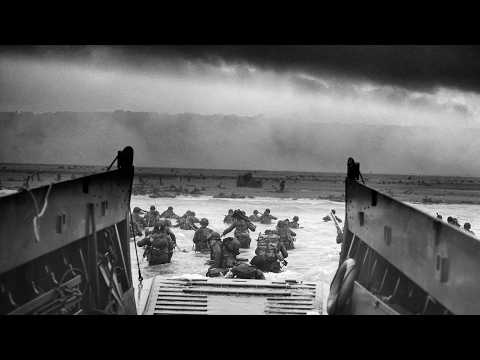
Omaha was a killing ground unlike any other. A crescent of golden sand, backed by 100-foot bluffs bristling with pillboxes, mortars, and 80 machine guns. The Germans had turned the five natural draws—the only exits from the beach—into death traps. The Allies knew they had to take them. The Germans knew they had to hold them.
For Spalding’s men, the target was the E-1 draw, a valley that led off the beach and into the heart of the defenses. Their job: land on Easy Red sector, fight through the murderous fire, and silence the guns overlooking the draw. It was a suicide mission on paper.
Spalding’s second-in-command was Technical Sergeant Philip Streczyk, a Polish-American veteran of North Africa and Sicily. Streczyk had already earned three Silver Stars and a reputation as a soldier who could scare the hell out of green recruits—and then save their lives. “He was sharp-minded and sharp-tongued,” one comrade recalled. “But when it came to a fight, no one doubted Streczyk.”
Alongside them were Sergeant Clarence Colson, a cool-headed Texan, and 20-year-old Vincent DiGito from Brooklyn, lugging a flamethrower that had nearly drowned him in the surf. These were ordinary men—clerks, farmers, factory workers—thrust into an extraordinary moment.
As their Higgins boat approached the shore, the sea around them erupted. Mortar shells geysered water. Machine-gun bullets pinged off the steel ramp. “We were terrified, seasick, and soaked,” Spalding later wrote. “But we had a job to do.”
When the ramp dropped 200 yards from shore, they found themselves in deep water, not on the beach. They had hit a sandbar. Men struggled under the weight of their packs, some drowning before they ever fired a shot. Spalding grabbed a ladder from a medic and pulled himself toward the shore, bullets snapping past his head.
By some miracle, they landed in a relatively weak spot between two German strongpoints. But the rest of their company had drifted into the teeth of WN-62, one of the deadliest positions on Omaha. “The destruction was horrific,” Spalding recalled. “We could hear the screams.”
Sheltering at the base of the bluffs, the 32 men took stock. They were alone, waterlogged, and outgunned. But they had a choice: wait for reinforcements that might never come, or push forward and silence the guns themselves.
Spalding looked at Streczyk. The veteran nodded. “Let’s go.”
With a Bangalore torpedo, Sergeant Colson breached the barbed wire. Then, with Streczyk leading, they began to climb the bluffs—yard by yard, mine by mine, into the storm of fire.
The slope was a minefield in every sense. Streczyk moved like a man who had done this a hundred times before, his eyes scanning the earth for tripwires and telltale depressions. “Watch the damn mines!” Sergeant Bisco hissed, but the warning was swallowed by the crack of rifle fire from above.
Halfway up, a machine gun opened up from a nest just below the crest. The men flattened themselves against the dirt. “I couldn’t take my eye off that gun,” Spalding said. “It was infested with mines, and we had an angel on each shoulder.”
Sergeant Blades fired his bazooka and missed. A bullet tore through his left arm. Private Curley was hit next, then Sergeant Phelps took two rounds in the legs. The section was bleeding out, pinned down, and running out of time.
Spalding made the call. “We rush it!” he shouted. Fifteen yards from the gun, the lone German operator threw up his hands and screamed “Kamerad!” Spalding ordered his men to hold fire—they needed prisoners. Streczyk, fluent in Polish, had a few choice words for the captured gunner before they pushed on.
With the wounded left in the care of Private Bowen, the medic, the rest of the section continued upward. Sergeant Colson took the lead, firing from the hip with a BAR. He reached the crest first and found a trench running along the top, a pillbox at its far end spraying bullets down on the men below.
Colson didn’t hesitate. He worked his way down the back of the trench, unseen. “I got the BAR set up, opened the door, and started spraying,” he recalled. A white flag appeared. A dozen Germans stumbled out, hands raised. The pillbox fell silent.
Word spread along the bluff: a gap had been opened. Captain Joe Dawson’s G Company, landing twenty minutes behind Spalding, linked up with them at the top. A hurried conference, and the plan was set—Dawson would turn left toward Colleville, Spalding would push right toward WN-64.
The fighting was far from over. Hedgerow to hedgerow, rifles and grenades, more men would fall. But the impossible had been done. Omaha Beach was open.
For the men of Spalding’s section, the cost had been brutal. Two sergeants—Ray Mundo and Bisco—lay dead. Eight more were wounded, their blood staining the sands of Easy Red. Yet seven would receive the Distinguished Service Cross, including Spalding, Streczyk, Colson, and the medic Bowen.
Others would earn a marble headstone in the years to come, falling in the hedgerows of Normandy or the forests of Germany. The war was not done with them yet.
But for now, the bluff was taken, and the E-1 draw was one step closer to being unlocked.
As Spalding’s men pushed right toward WN-64, they could hear the crackle of small-arms fire from the direction of Colleville. Dawson’s G Company was meeting stiff resistance, but the Germans were now fighting on two fronts, their carefully interlocked defenses beginning to crumble.
“We knew we had to keep moving,” Colson later said. “If we stopped, they’d regroup. We couldn’t let that happen.”
Down on the beach, the follow-on waves were still struggling ashore. The water was littered with wrecked landing craft, and the shingle was crowded with men pinned down by fire from the bluffs. But word was spreading—a gap had been found. Men began to move, crawling up the bluffs through the path Spalding’s section had carved.
By mid-morning, the trickle had become a stream. Engineers cleared obstacles, infantrymen pushed inland, and the beach, though still deadly, was no longer a death trap. “It was like a dam breaking,” one survivor remembered. “Once the first few got through, the rest followed.”
Spalding and his men, meanwhile, were fighting their way toward WN-64. The strongpoint was a maze of trenches and pillboxes, and the Germans inside fought with desperate courage. Grenades flew, rifles cracked, and men fell on both sides.
It was during this assault that Private Vincent DiGito, the young Brooklynite with the flamethrower, finally got his chance. Having retrieved his pack from the beach, he crept up to a pillbox that had been holding up the advance. A burst of flame, a scream, and the gun fell silent.
“He was just a kid,” Spalding said later, “but he did his job that day.”
By noon, WN-64 had fallen. The E-1 draw was open, and men and vehicles were beginning to move inland. The battle for Omaha was far from over—the fighting would rage for hours more, and the beach would remain under fire until nightfall—but the critical breakthrough had been achieved.
For Spalding, Streczyk, Colson, and the others, there was no time to rest. They pushed on, into the hedgerows and villages beyond, where the enemy waited. The war would take them to places they could never have imagined, and for some, it would never truly end.
The years after the war were not kind to all of them. Spalding went home to Kentucky, served in the state legislature, remarried, and raised three more children—a life that looked from the outside like the American dream. But the war had left its mark in ways no one could see.
Streczyk returned to New Jersey, married, and had four children. He had survived 440 days of combat, from North Africa to the Hürtgen Forest. But the horrors he had witnessed never left him. Racked by PTSD and physical pain from his wounds, Philip Streczyk took his own life in June 1958.
He became, perhaps, the last casualty of that bloody morning on Omaha Beach—a man who had done more than almost anyone to unlock the beach, and who paid a price that no medal could ever repay.
Today, the bluffs above Easy Red are quiet. The concrete blocks of the Roman ruins still stand where Spalding’s men sheltered. The pillboxes are silent, their guns long gone. But if you walk that ground, you can still feel the weight of what happened there.
Thirty-two men went up that bluff. Two never came down. Seven earned the Distinguished Service Cross. And all of them—the living and the dead—helped open the door to Fortress Europe.
Their courage was not unique that day. All along Omaha, small groups of soldiers found gaps, breached the wire, and climbed the bluffs. But each one mattered. Each one saved lives.
So here is the question for you: When you walk the sands of Omaha Beach today, what will you remember—the peace of the present, or the sacrifice of the past?
Report this article
Select a reason for reporting:






