June 1943, Guidonia airfield, Rome. The aluminum skin of the captured P-38G Lightning gleamed under the Mediterranean sun, its twin booms casting long shadows across the tarmac. Engineer Filippo Zapata circled the aircraft slowly, his heart pounding. This was no ordinary prize—it was a complete, flyable American fighter, delivered by a navigational error into Italian hands three days earlier. As he ran his fingers along the cold metal, Zapata felt a chill that had nothing to do with the morning breeze. He was about to uncover a truth that would shatter everything he believed about his country’s aviation prowess.
Zapata was the Regia Aeronautica’s senior propulsion engineer, a man who had spent fifteen years evaluating engines for Fiat, Alfa Romeo, and Isotta Fraschini. He had examined captured Spitfires and Soviet Yaks. He thought he understood the state of aviation engineering in 1943. He was wrong.
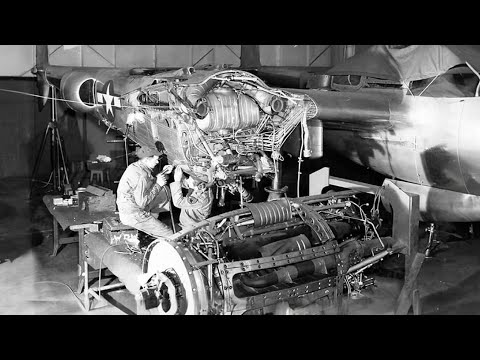
His team approached the Lightning with toolboxes and measuring instruments. The Americans had sent this machine across an ocean to fight—thousands of miles from home. That alone suggested an industrial capacity Italy could barely comprehend. But it was what lay beneath those engine cowlings that would reveal a truth so devastating it would haunt Italian engineers for the rest of the war.
They weren’t just behind. They were impossibly, irretrievably outmatched.
The P-38 was everything Italian engineering was not. Where Italian fighters were elegant, lightweight designs squeezing maximum performance from minimal resources, the Lightning was an American brute—massive, complex, powered by engine technology Italian factories couldn’t begin to replicate. Twin Allison V-1710 engines, turbocharged, counter-rotating propellers. On paper, it seemed wasteful. Two engines where one should suffice. Typical American excess.
But Zapata was a scientist. Scientists don’t trust reputation. They trust measurements.
His team spent the first hour documenting external dimensions. The wingspan stretched 52 feet—reasonable for a fighter. But the weight, when they calculated loaded weight from structural analysis and fuel capacity, was staggering. Nearly 18,000 pounds fully loaded—almost twice the weight of Italy’s frontline fighters, the Macchi C.202 and Fiat G.55.
“How does something this heavy even fly?” his assistant Giorgio Mancini muttered.
“That’s what we’re about to find out,” Zapata replied, though he already suspected the answer would be unsettling.
The real examination began when they opened the engine cowlings. The left engine came first. As the panels swung away and the Allison V-1710 was revealed, the team fell silent. It wasn’t the size, though the 12-cylinder liquid-cooled V configuration was enormous by Italian standards. It wasn’t even the obvious quality of the machining, though every component gleamed with precision Italian factories—struggling with material shortages and Allied bombing—could no longer match.
It was the turbocharger system.
Zapata had read intelligence reports about American turbochargers. The concept wasn’t new—using exhaust gases to spin a turbine that compressed intake air, allowing engines to maintain sea-level power at high altitude. German engineers had experimented with it. Italian engineers had drawn up proposals. But nobody—not the Germans, not the British, certainly not the Italians—had successfully integrated a turbocharger into a production fighter aircraft.
The Americans had done it twice, one for each engine, and they were building hundreds of these aircraft every month.
The turbocharger assembly sat behind and below each engine, connected by a complex network of exhaust ducting snaking through the tail boom structure. The turbine wheel, when Zapata carefully examined it, was a masterpiece of metallurgy—a precision-forged component designed to spin at over 21,000 revolutions per minute while exposed to exhaust gases exceeding 700 degrees Celsius.
“What alloy is this?” Mancini asked, running his fingers over the turbine blades.
Zapata shook his head slowly. “Nickel-chrome, perhaps. Or something proprietary. Whatever it is, we don’t have it. And even if we could acquire the material, we lack the precision casting capability to manufacture it.”
The implications were devastating. Each P-38 engine with its turbocharger system could produce approximately 1,125 horsepower in war emergency power—over 2,850 horsepower combined. For comparison, the Daimler-Benz DB 605 powering Italy’s most advanced fighter, the Macchi C.205V, produced 1,475 horsepower. One P-38 had nearly twice the power of Italy’s best single-engine fighter.
But the numbers got worse. Zapata began calculating engineering requirements. The Allison displaced 1,710 cubic inches—28 liters. The precision required to machine 12 cylinders, 12 pistons, connecting rods, a crankshaft capable of sustaining 3,000 RPM under combat loads, the supercharger, the turbocharger, the intercooler, the oil cooling system, the radiator, the reduction gearing… He pulled out his notebook and started listing components.
His assistant watched, then asked the question they were both thinking. “Could we build this?”
Zapata continued writing for several minutes before answering. “Build one? Perhaps. With six months, unlimited resources, our best machinists, and perfect conditions. Build it reliably? No. Build hundreds? Impossible.”
The cooling system alone was a revelation of American engineering sophistication. The Allison used liquid cooling with remote radiators mounted in the wing leading edges—a position that minimized drag while maximizing cooling efficiency. The radiators themselves were precision-manufactured cores with hundreds of tiny tubes, each brazed with exact tolerances. Italian radiator technology lagged years behind. Their radiators were heavier, less efficient, prone to combat damage. The American design integrated armor protection, redundant coolant passages, and a glycol mixture operating at higher temperatures than Italian systems could handle.
“They’ve solved problems we didn’t know existed,” Mancini observed.
“They’ve solved problems we knew existed but couldn’t afford to address,” Zapata corrected.
The counter-rotating propellers represented another layer of complexity. The left engine rotated clockwise, the right counterclockwise, eliminating the torque effect plaguing single-engine fighters. This required mirror-image reduction gearing, different propeller governors, careful synchronization. Zapata examined the reduction gearing—a precise assembly converting the engine’s 3,000 RPM to approximately 1,400 RPM at the propeller shaft. The gears were hardened steel, precision-cut with tolerances measured in thousandths of an inch.
“We couldn’t make these gears,” his metallurgy specialist, Domenico Russo, said flatly. “Not with our current steel quality, not with our heat treatment capabilities. These gears need to transmit 1,500 horsepower without failing. Ours would strip under half that load.”
As the examination continued, a pattern emerged more disturbing than any single component. Every system on the P-38 was designed with redundancy, maintainability, and operational flexibility in mind. The electrical system used a 24-volt architecture with redundant generators—one per engine. If one failed, the other could power all essential systems. Italian fighters used 12-volt systems with a single generator. The hydraulic system included redundant pumps and multiple circuit breakers. Italian fighters often used mechanical systems or single-point hydraulics vulnerable to combat damage.
But it was the ammunition capacity that truly shocked them. Each P-38 carried a 20mm Hispano cannon with 150 rounds and four Browning M2 .50-caliber machine guns with 500 rounds each—all concentrated in the nose. Total firepower: one cannon and 2,000 rounds of heavy machine gun ammunition. The Macchi C.205V carried two 12.7mm machine guns with 400 rounds each and a 20mm cannon with 200 rounds. The P-38 had three times the ammunition capacity and significantly more hitting power.
“They built a flying battleship,” Mancini said, examining the ammunition feed mechanisms. “Look at these feed systems. They’re designed to function under high-G maneuvers without jamming. These electric boost motors ensure positive feeding even when the pilot is pulling six G’s in a tight turn.”
Zapata was taking notes furiously, but he’d stopped writing technical specifications. Instead, he was calculating production requirements. Each P-38 required approximately 50,000 individual parts. The engines alone contained over 6,000 components each. The electrical system included eight miles of wiring. The hydraulic system required precision-machined valves and seals Italian suppliers couldn’t reliably produce. The aluminum airframe required alloys Italy was struggling to obtain due to material shortages and Allied blockades.
He looked up at the Lightning sitting on the tarmac, and for the first time in his career, Filippo Zapata felt genuine despair. This wasn’t just an enemy aircraft. It was evidence of an industrial revolution that had left Italy behind.
That evening, Zapata sat in his office at Guidonia and began writing his report. The technical specifications filled twelve pages—measurements, component analyses, materials assessments, performance calculations. But it was the final section, marked Strategic Assessment, that Zapata knew would be controversial. He wrote:
“The Lockheed P-38 Lightning represents a level of aeronautical engineering sophistication that exceeds Italian manufacturing capabilities by a margin of approximately five to seven years at our current rate of development. More significantly, the aircraft demonstrates American industrial capacity operating at a scale we cannot match.”
He detailed the findings: the Allison’s turbocharged power, the metallurgical mysteries, the precision gearing, the systems integration. He concluded:
“American manufacturing appears capable of producing these complex aircraft in large numbers while maintaining quality standards. Intelligence suggests production rates exceeding 200 aircraft monthly from multiple factories. For comparison, Italian fighter production across all types averages 150 aircraft monthly—and this rate is declining due to material shortages and Allied bombing.”
His recommendation was blunt: “The P-38 cannot be countered through technological parity. Italian fighters lack the engine power, altitude performance, and firepower to engage effectively. Tactical doctrine should emphasize avoiding engagement with P-38s when possible.”
And his strategic assessment was even bleaker: “If this aircraft represents typical American production capability, Italy faces an enemy with overwhelming industrial superiority. The war cannot be won through attrition against an opponent capable of producing weapons of this sophistication at scale.”
Zapata read his report three times before signing it. He knew what would happen. The technical sections would be accepted. The strategic assessment would be dismissed as defeatist. But he was an engineer, bound by evidence and mathematics. And the evidence was undeniable.
The next morning, Colonel Angelo Tondi, the Regia Aeronautica’s chief test pilot, arrived at Guidonia to fly the captured Lightning. Tondi was a veteran with thousands of hours in dozens of aircraft types. He’d flown every Italian fighter, captured Spitfires, even a Messerschmitt Bf 109. He listened to Zapata’s technical briefing with professional courtesy, but his expression suggested he believed the engineer was overstating things. Americans built heavy aircraft. Everyone knew that. Quantity over quality, brute force over elegance.
Tondi climbed into the P-38’s cockpit with the confidence of a man who had mastered every aircraft he’d ever flown. Zapata watched from the control tower as the Lightning’s engines started—first the left, then the right. The Allison V-1710s settled into a smooth, synchronized rumble that vibrated the tower windows. Tondi taxied to the runway, his movements cautious as he familiarized himself with the tricycle landing gear and nose-wheel steering. The takeoff roll seemed impossibly long to observers used to Italian fighters that leaped off the ground in seconds. But when the Lightning finally rotated, it climbed at an angle that made Zapata’s breath catch.
Fifteen minutes later, Tondi landed, taxied back to the hardstand, and shut down the engines. He sat in the cockpit for several minutes before climbing down. When he finally reached the ground, his expression had changed. He walked directly to Zapata.
“Everything in your report is correct,” Tondi said quietly. “And you understated some things. At altitude, this aircraft is untouchable.”
He paused, looking back at the Lightning. “At 25,000 feet, it was still accelerating. The climb rate exceeds anything I’ve experienced. The control harmony is excellent—heavy, but precise. The visibility is outstanding. The firepower…” He shook his head. “I fired a test burst. It was like unleashing thunder. The cannon and four machine guns all firing from the nose with no convergence issues. Point the aircraft at the target and pull the trigger. Everything in front dies.”
Zapata nodded slowly. “Can we counter it?”
Tondi was silent for a long moment. “Not with anything we have. Not with anything we’re developing. The Macchi C.205V is excellent at medium altitude. The Fiat G.55 has good firepower. But neither can match this American fighter in the regime where modern air combat occurs—high altitude, high-speed, sustained operations.”
“And you say they’re producing these at scale?”
“Intelligence estimates 500 per month by late 1943.”
Tondi laughed, but there was no humor in it. “500 of these per month. We produce what? 50 Macchis and 30 Fiats on a good month. And they’re producing B-17s and B-24s by the thousands. P-47s, P-51s, ships, tanks, everything.” He looked back at the Lightning. “We’re fighting a nation that can afford to put two 1,400-horsepower turbocharged engines in a single fighter and build hundreds of them. What does that tell you about this war?”
Zapata had no answer. The question was rhetorical anyway.
Over the following weeks, Italian engineers conducted exhaustive tests on the captured P-38. They flew it against Italian fighters at various altitudes and speeds. They measured its performance in climbs, dives, and turns. They compared its systems against equivalent Italian and German aircraft. Every test confirmed the same devastating conclusion: the Lightning was superior in almost every measurable way.
At altitudes above 20,000 feet, where bomber interceptions occurred, nothing in the Italian inventory could catch it. The turbochargers maintained full power where Italian engines gasped for air. Even the German Bf 109G with its DB 605 engine lost significant performance above 25,000 feet. The P-38 hit its stride there. Its speed advantage allowed it to choose when to engage and when to escape. Italian fighters attempting to intercept could be easily evaded by American pilots who simply pushed their throttles forward and outran pursuit.
The armament concentration in the nose proved devastatingly effective in mock combat. Italian fighters with wing-mounted guns suffered from convergence issues—the guns were typically harmonized to converge at 300 meters but were less effective at other ranges. The P-38’s nose-mounted weapons had no such limitation. Point and shoot.
But what truly disturbed Italian engineers was what they found when they began disassembling components for detailed analysis. The build quality was extraordinary. Welds were perfect. Machining was precise. Materials were high-grade throughout. There were no shortcuts, no compromises, no evidence of resource constraints.
An Italian engineer examining the engine wrote in his notes: “Every component appears overbuilt to a safety margin we cannot afford. Where Italian design maximizes performance from minimal materials, American design achieves performance through superior materials and manufacturing. We build to the edge of what’s possible. They build with margins that assume some components will fail and the aircraft will still fly.”
This philosophy extended throughout the aircraft. The structural members were heavier than strictly necessary, providing durability and damage tolerance. The electrical system included more circuit breakers and redundancy than Italian designers would ever specify. The hydraulic lines included armor protection that added weight but dramatically improved survivability. It was engineering from a nation with unlimited resources.
And it worked. The P-38’s legendary toughness was no accident. It was designed in from the beginning.
Zapata’s report climbed the chain of command. The technical sections were distributed to Italian aircraft manufacturers with instructions to identify relevant technologies for future implementation. The strategic assessment reached the desk of Marshal della Aeronautica Rino Corso Fougier, chief of the Italian Air Force. Fougier read it carefully, then filed it away. There was nothing to be done. Italy lacked the industrial capacity to replicate American technology. German support was focused on their own programs. The best Italian engineers could do was optimize existing designs and hope that pilot skill and tactical creativity could overcome material disadvantage.
It wouldn’t be enough. Everyone knew it. But nobody could say it publicly.
On August 11th, 1943, Tondi flew the captured Lightning in combat. Intelligence reported a formation of American B-24 Liberators returning from bombing Terni. Tondi took off from Guidonia, climbed to altitude, and positioned himself to attack. Using the Lightning’s familiar silhouette to close undetected, he opened fire on a straggling bomber. The concentrated firepower of the cannon and four machine guns tore into the Liberator. Tondi claimed the kill—possibly a B-24 named Bonnie Sue or The Lady Evelyn, depending on conflicting records.
It was a small victory. A captured American fighter, flown by Italy’s best test pilot, had destroyed one American bomber. For propaganda purposes, it was useful. For strategic purposes, it was meaningless.
The Lightning was grounded shortly thereafter—without spare parts, without maintenance manuals, without the logistics support that kept American P-38s flying. The captured aircraft became a hangar queen. Tondi never flew it again. The war moved on. Italy surrendered in September 1943. The Lightning at Guidonia fell into German hands, then was eventually destroyed to prevent recapture.
Zapata’s report survived in archives—a technical document marking the moment when Italian engineers confronted the full measure of American industrial might and found themselves unable to respond. After the war, when production figures were declassified, Zapata’s estimates proved conservative. The United States produced 10,037 P-38 Lightnings of all variants. Each one required two Allison V-1710 engines—20,074 engines just for the Lightning program. The Allison V-1710 was also used in P-40s, P-39s, and P-63s. Total production exceeded 70,000 engines. Italy’s entire wartime production of aircraft engines across all types and manufacturers was approximately 13,000 units. America had produced five times that many of a single advanced engine type.
The disparity extended to every category. America produced over 300,000 aircraft during the war. Italy produced approximately 11,000. American aluminum production in 1943 alone exceeded Italy’s total wartime output. American factory workers—many of them women who had never worked in manufacturing before—assembled complex aircraft with precision that Italian craftsmen struggled to match.
Years later, in the 1960s, an Italian aviation historian interviewed Filippo Zapata about his examination of the captured P-38. The engineer, retired and reflective, spoke carefully about that June day in 1943.
“I knew we would lose the war when I opened those engine cowlings,” Zapata said. “Not because of any single component, but because of what the entire aircraft represented. The Americans had built a fighter that required 50,000 parts, including two of the most complex engines in existence, and they were producing them in quantities we couldn’t match with our simplest designs. When I calculated the man-hours, the materials, the precision machining, the quality control required, it was clear we were fighting an industrial giant that had barely begun to mobilize. The P-38 wasn’t their best fighter. It was just one of several advanced types they were producing simultaneously. While we struggled to build a hundred fighters per month, they were building thousands—all of them as good or better than our best designs.”
“Did you ever fly in a P-38?” the historian asked.
Zapata smiled. “No. Tondi offered, but I declined. I’m an engineer, not a pilot. But I didn’t need to fly it. The numbers told me everything. Power-to-weight ratio, wing loading, thrust available versus thrust required. The mathematics of flight performance are unforgiving. The P-38 had superior power, superior altitude performance, superior firepower, superior range, and superior systems. It was better—and there were thousands of them.”
The captured P-38G at Guidonia never saw extensive combat service. It flew a handful of test flights, participated in one combat mission, then sat in a hangar as a technological curiosity—evidence of a war already lost, analyzed by engineers who understood the implications but were powerless to change them.
The story of the captured Lightning is ultimately a story about industrial capacity and the mathematics of modern warfare. Italy entered World War II with excellent aircraft designers, skilled pilots, and a proud aviation tradition. But they lacked the industrial infrastructure to compete with American mass production. They lacked the resources to develop advanced technologies like practical turbochargers. They lacked the materials to build with American safety margins. And they lacked the time to close a gap that widened with each passing month.
Filippo Zapata’s report documented this reality in precise engineering terms. Two Allison V-1710 engines producing 2,850 combined horsepower. Turbochargers maintaining sea-level performance at 25,000 feet. Counter-rotating propellers eliminating torque effects. Concentrated nose armament with 2,000 rounds of ammunition. Systems integration and redundancy that prioritized operational effectiveness over weight savings. And behind it all, an industrial machine capable of producing these complex aircraft at rates that made Italian production seem insignificant.
The captured P-38 sat on that Guidonia tarmac for only a few months. But for the Italian engineers who examined it, who measured its components and calculated its implications, that aircraft represented a turning point. The moment when mathematical reality overwhelmed tactical optimism, and they understood that this war would be decided not by courage or skill, but by factories, resources, and industrial capacity. America had all three in abundance. Italy had none.
The Lightning was proof. And no amount of Italian engineering genius could change that fact.
Zapata closed his notebook and walked away from the hangar, the weight of those numbers pressing on his shoulders. He had done his duty—measured, calculated, reported. But the truth he carried was a burden no engineer should bear alone.
Years later, long after the war, he would say that the P-38 taught him something beyond engineering: wars are not won by the bravest pilots or the most elegant designs, but by the nation that can build the most, the fastest, the best. Italy had courage. America had factories.
And in the end, the factories decided everything.
What would you have done, standing on that tarmac in 1943, staring at the proof of your country’s defeat?
Report this article
Select a reason for reporting:






