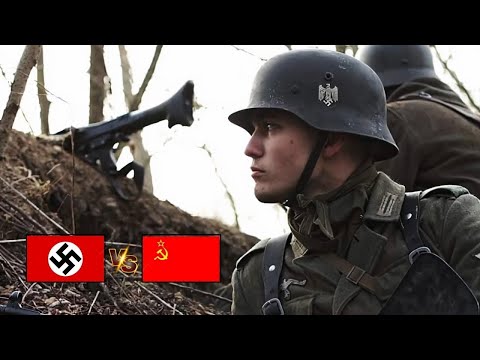
The year 1945 began with the German Army in full retreat, Soviet victories mounting as the Red Army pushed the invaders back toward the heart of the Third Reich. By late March, the Vistula Army Group—the last major German force on the Eastern Front—was a patchwork of inexperienced training units, some soldiers so young their rations included sweets instead of tobacco. They were ordered to hold their positions at all costs, terrified of retreating, which almost certainly meant immediate execution. Many buried themselves in foxholes or bunkers, hoping the Soviets would give them a chance to surrender rather than burn them alive with flamethrowers or tear them apart with grenades. But Stalin’s orders were clear: no mercy for the fascists who had besieged Stalingrad and Leningrad. And facing these young, untested Germans were the troops of Marshal Georgy Zhukov, the mastermind behind the Soviet victory at Kursk, commanding an unstoppable army that would not stop until it reached Berlin.
By early April, the atmosphere among the Vistula Army Group was a mix of terror and despair as the Russians prepared to advance on the Oder River. Along the fronts of the Oder and Neisse, troops awaited the largest concentration of firepower ever assembled by the Red Army: 2.5 million men, 41,600 artillery pieces, and 6,250 tanks. On April 9, Königsberg fell, allowing Marshal Rokossovsky’s 2nd Belorussian Front to move to the eastern bank of the Oder. In just two weeks, the Soviets carried out the fastest troop redeployment of the war. Both sides knew this was the final showdown. The Germans fought to keep the Reich alive; the Russians, remembering Stalingrad and Leningrad, harbored a special hatred for all Nazi soldiers. Surrender or capture meant certain death.
While the Soviets had Zhukov, the Vistula Army Group was led by Gotthard Heinrici, a veteran of World War I who had faced Zhukov before at Kursk. Heinrici was known for refusing Hitler’s scorched-earth orders, and now he faced his toughest challenge. The Germans feared their own soldiers would desert or surrender at the first opportunity. Orders were issued to separate men from the same region, and some commanders confiscated white handkerchiefs to prevent them from being used as signals of surrender. Soldiers caught attempting to desert were forced to dig trenches in no man’s land. Many longed to slip away into the forests, hoping to avoid punishment for their families.
On the Seelow Heights, an apparent calm hung just before the storm. German soldiers cleaned their weapons, wrote letters home, and tried to rest. But the Soviets were in a hurry. The race for Berlin had begun, and they didn’t want to miss the chance to be the glorious nation that finally defeated the Nazis. The plan was to launch the offensive on April 16 and take Berlin by April 22—Lenin’s birthday. The problem was that the main bridgehead captured by Zhukov’s 1st Belorussian Front was right below the best defensive position in the region: the Seelow Heights. Zhukov would later admit he had underestimated the strength of this position.
The tasks facing the Soviet general staffs were enormous. Russian gauge railroads had been quickly laid across Poland, and temporary bridges built over the Vistula to transport millions of tons of supplies. The Germans were about to face the perfect storm. The Battle of the Seelow Heights—the final charge to Berlin—was about to begin.
The Red Army tried to conceal the enormous attack, but that was nearly impossible given the scale of forces mobilized. In addition to 2.5 million men, there were four air armies. The main Soviet generals held meetings to meticulously prepare. It was decided that Zhukov’s 1st Belorussian Front and Konev’s 1st Ukrainian Front would attack on April 16, while Rokossovsky’s 2nd Belorussian Front would cross the lower Oder on April 14. A combat reconnaissance from the Küstrin bridgehead on April 14 was a great success: Chuikov’s 8th Guards Army pushed back the 20th Panzer Grenadier Division by 2 to 5 kilometers. Hitler was furious and ordered all members of the division to be stripped of their decorations until they earned them back in combat.
That night, the 1st Guards Tank Army began moving its brigades across the Oder under cover of darkness. Throughout the night, there was a constant flow of tanks, artillery, trucks, and columns of soldiers. Soviet loudspeakers blasted music and propaganda to cover the sound of tank engines, but the Germans knew what was happening and were terrified. On April 15, Red Army soldiers carefully observed German positions to ensure no last-minute reinforcements arrived. Large chunks of ice floated down the Oder, and pine forests on the eastern bank camouflaged thousands of armored vehicles and artillery pieces.
Soviet commanders were nervous about the possibility of the Americans and British reaching Berlin first. Such a scenario would be a humiliation. Berlin belonged to the Soviet Union by right of conquest and by right of suffering. Each army commander had been warned that Stalin was eagerly waiting for good news. Only Zhukov, Konev, and a few close collaborators knew that the entire strategy was designed to encircle the city first and deter the Western Allies from entering.
An officer of the Grossdeutschland Guards Regiment tasked with leading an improvised battalion observed that many of his young subordinates showed little willingness to fight for National Socialism. Some even longed to be injured to be evacuated. The fear of immediate execution kept them in their positions. The discouragement became evident when a Soviet loudspeaker began broadcasting messages, and numerous soldiers responded by shouting questions to the Soviets, showing unusual interest in living conditions behind enemy lines. They wanted to know if they would be sent to Siberia and how civilians were treated in Soviet-occupied Germany. These doubts reflected growing skepticism about the cause they were defending.
German officers employed multiple strategies to convince their men to continue fighting. Some resorted to propaganda, informing them of Franklin D. Roosevelt’s death on April 14, assuring them it meant the end of American armored attacks. They also tried to persuade them that relations between the Western Allies and the Soviet Union had deteriorated so much that the British and Americans would soon ally with Germany to stop the Red Army. Members of the 30th January SS Division approached reservists near Goblin with speeches linking Roosevelt’s death to a supposed miracle that had saved Frederick the Great. But their words failed to inspire the soldiers.
Despite the collapse of morale, some German fighters still clung to the idea of a major counteroffensive on April 20—Hitler’s birthday. Rumors circulated about miracle weapons that would change the war. Some officers, consumed by anger, resorted to extreme tactics to inflame fighting spirit, reminding veterans of the horrors they had experienced on the Eastern Front. In a letter to his wife, a senior lieutenant expressed the deep hatred that had taken root: “You can’t imagine the level of fury that hangs in the air here. I swear we will settle the score. Those heartless ones who have violated women and children are going to face something they’ve never experienced. We have made a solemn vow: each one of us will kill at least 10 Bolsheviks. May God give us the strength to carry it out.” The fear of the Soviet advance was used to stoke the soldiers’ desire for revenge, making hatred the last resort to maintain morale in a war practically lost.
From his forward position at the Reitwein outpost, General Vasily Chuikov, commander of the 8th Guards Army, had a privileged view of the Oder and the Seelow escarpment. But he did not like the presence of Marshal Zhukov, who had decided to join him to witness the initial bombardment and first assault. Irritated, Chuikov sent his staff officer, Captain Merekov, to guide the Marshal and his entourage to the position. The relationship between the two commanders was marked by rivalry. Chuikov believed his army had not received the recognition it deserved for its role in Stalingrad, while Zhukov took all the glory. Recent comments by Zhukov about the delay in taking Poznań had irritated Chuikov, who had in turn criticized the slow offensive toward Berlin in February. The tension became evident when Zhukov’s convoy arrived with headlights on, exposing their position from a great distance.
Meanwhile, in the trenches of the Oder, Soviet soldiers prepared for the imminent offensive. Hot soup and vodka were served while campaign phones rang incessantly and messengers ran back and forth. In Chuikov’s bunker, Zhukov’s entourage tried to kill time by drinking tea served by a soldier named Margo. The wait seemed endless. General Kazakov had deployed 8,983 pieces of artillery with a density of 270 guns per kilometer, plus heavy howitzers and Katyusha rocket launchers with a reserve of 7 million shells. The 1st Belorussian Front began the bombardment with more than 1.2 million shots on the first day. The overwhelming firepower led Zhukov to underestimate the difficulty of the offensive, not foreseeing the resistance the Germans would still offer in their last bastion before Berlin.
Zhukov usually personally inspected the front line before launching a major offensive, but on this occasion he primarily relied on reconnaissance images, largely influenced by the urgency of the situation. Under cover of night on April 15, most advanced German units had been withdrawn to a second defensive line just before the expected Russian bombardment. In this line, troops entrenched deeply. Dozens of MG42 machine gun nests were buried in newly built fortifications to slow the attacking infantry. The MG42 was considered the best machine gun of World War II; as long as the gunners could keep them functioning, they could hold off an attacking force many times their size. A few well-placed, well-hidden, and well-supplied MG42s were enough to delay an entire enemy regiment for hours.
Along with the machine gun positions, there was a varied arsenal of anti-tank guns: the 5 cm PaK 38, 7.5 cm PaK 40, 8.8 cm PaK 43, and the deadly 8.8 cm Flak anti-aircraft guns used against ground targets. These weapons formed the backbone of the defense against the overwhelming number of Soviet armored vehicles. Despite dwindling ammunition, in this second line the soldiers waited for the Russians. Across the entire front, scattered between the Third and Ninth Armies, they had fewer than 700 tanks and self-propelled guns. The heaviest division, the 25th Panzer, had only 79 such vehicles; the smallest unit had just two. Artillery was not in better shape: only 744 pieces available. Ammunition and fuel supplies were critical; in some units, reserves had almost completely disappeared. Facing the main Soviet attack was the 56th Panzer Corps under General Karl Weidling, known as “Smasher” Carl. Weidling had been given the nearly impossible task of preventing the main front from being broken.
The final battle before Berlin began at dawn on April 16, 1945, just 50 km east of the German capital. Over the swollen Oder River, red flares erupted in the night sky, signaling the start of a massive artillery bombardment. For almost an hour, a storm of fire and smoke shook the German front. The thunder of thousands of guns, mortars, and Katyusha rocket launchers turned the night into a hell of fire and explosions. Witnesses said never before in the war had such a bombardment been seen. The artillery units under General Kazakov operated tirelessly. The entire area was illuminated by the glow of thousands of shots. A battery commander from the 3rd Shock Army described the impact: “A deafening roar made everything around us shake. I felt like my eardrums were about to burst. The noise was so overwhelming that the soldiers had to remember to keep their mouths open to prevent the pressure from bursting their eardrums.”
At the explosion of the first artillery barrage, some German recruits woke up startled, convinced it was another “morning concert”—the term they used for Soviet harassment fire at dawn. But veterans of the Eastern Front immediately understood this was the beginning of the great offensive. Non-commissioned officers shouted desperate orders: “Alarm! To the positions immediately!” Survivors would always remember the anguish pressing on their chest and the dryness in their mouths. They murmured to themselves: “This time we’re finished.” The few soldiers who survived the artillery described the bombardment with words like “hell” or “earthquake.” Many were left completely deaf. In a matter of seconds, my 10 comrades died, recalled Gerd Wagner from the 27th Parachute Regiment. When he regained consciousness, he was wounded in the smoldering crater of a shell; he barely managed to crawl to the second line. Most were not so lucky. Trenches were crushed, burying both the living and the dead. Even decades later, the remains of the fallen continued to emerge from the earth.
Those in the rear felt the ground tremble beneath their feet and hurried to grab binoculars or use periscopes. From inside his Tiger tank, the commander of the 50th Heavy Panzer Battalion scanned the horizon through the periscope and was horrified: the entire sky to the east was burning. Another witness spoke of farms and villages consumed by fire, clouds of smoke spreading as far as the eye could see. At headquarters, a military chaplain, paralyzed by terror at the apocalyptic scene, could find no words more appropriate than a cry of despair: “My God, those bastards are here!”
In the midst of mud, smoke, and gloom, the Soviet assault began. Thousands of Zhukov’s soldiers were thrown to the front, stumbling as they advanced under fire. The artillery continued its destructive work, punishing enemy positions just ahead and clearing the way. However, when the Red Army broke through the Seelow Heights at dawn on April 16, the Germans were already prepared. From the top of the ridge, batteries of Flak guns hurriedly moved from the Western Front unleashed a hail of fire on the Soviet troops. For hours, shells and intense artillery fire swept through the waves of attackers, slowing their advance and sowing chaos. The battle intensified, and German resistance proved much stronger than anticipated. By stopping the first Soviet attack, Heinrici’s forces achieved something few generals could have accomplished under the same conditions. They had far fewer men and supplies, but the Red Army, instead of resorting to sophisticated strategies, opted for brute force.
Even so, the Russians needed to cross the Oder River to reach the Seelow Heights. This was not easy, as only the Küstrin bridge remained standing. Most troops had to cross by boat. The First Polish Army had to cross under enemy fire; their vanguard battalions used amphibious vehicles and American boats operated by young female soldiers, but most crossed in regular boats. Casualties during the crossing were high. Many assault boats had leaks, and some sank, causing heavy losses. When a battalion from the 12th Guards Rifle Division tried to cross, only eight men reached the western bank. Once on the other side, the Red Army reorganized and waited. When colored flares lit up the cloudy sky, the Soviet riflemen rose to advance. Zhukov, known for his brutality, sent infantry through minefields that had to be cleared before his tank armies could advance. For him, it was preferable to lose a few riflemen than a single tank.
The young German recruits were paralyzed by panic from the bombing and searchlights. Only veterans prepared to fire, but identifying targets in the thick river fog was impossible. “This time we’re finished,” they murmured, as the roar of Soviet tank engines grew closer.
By noon, Zhukov was losing patience. He ordered the tank armies forward prematurely, and chaos ensued—thousands of armored vehicles piled up at the bridgehead. The Tigers of SS Panzer Battalion 502 inflicted heavy losses on Katukov’s vanguard.
That night, Stalin’s fury crackled over the radio: “Are you completely sure that tomorrow you will be able to take the Seelow line?” Zhukov, struggling to maintain composure, promised victory. The race for Berlin was on.
On April 19, the German 9th Army collapsed. The road to Berlin lay open. What would you have done, trapped between Hitler’s execution squads and the relentless Red Army?
Report this article
Select a reason for reporting:






