On the morning of July 31, 1944, Colonel Chaser’s voice crackled over the radio: “We are on the shores of the Ria Gulf.” The message reached the headquarters of the 1st Baltic Front like a thunderbolt. Soviet troops had finally broken through to the Baltic Sea, cutting off the entire German Army Group North from the rest of the Wehrmacht. In Moscow, Stalin received the news with a rare smile. He ordered a bottle of Baltic seawater to be collected and sent to him—a symbolic trophy to be placed on his desk as material evidence of Soviet triumph.
But this was more than a military victory. It was a propaganda masterstroke. According to some accounts, Stalin later sent similar bottles to Churchill and Roosevelt, a subtle reminder of the USSR’s sacrifices and successes. The breakthrough at Tukums, a small Latvian town, had enormous political and strategic significance. Yet the story of that bottle was far from over.
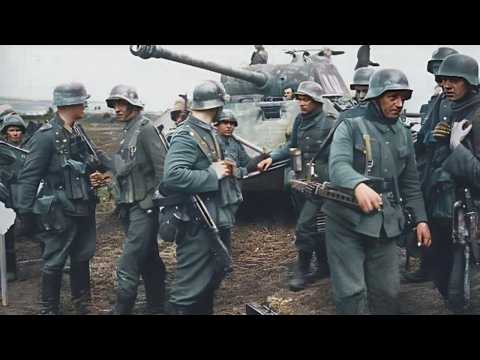
The Germans, humiliated by the encirclement, refused to accept defeat. They gathered infantry and tank divisions, and the heavy cruiser Prinz Eugen steamed into the Ria Gulf. On August 20, Wehrmacht tanks, supported by naval fire, smashed through Soviet lines and reached the trapped Army Group North. The next day, Tukums fell back into German hands. A narrow corridor along the coast opened, and the enemy slipped out of the encirclement.
Stalin’s reaction was icy and sardonic. When he received the report of Tukums’ loss, he picked up the bottle of seawater from his desk. “Return it to Comrade Bagramyan,” he said. “Let him pour it back into the Baltic Sea.” No one in the room laughed. They all understood the bitter truth: the fight for the Baltic was only beginning.
In the fall of 1944, the Courland Peninsula became the last corner of the Soviet Union still held by the Red Army—or rather, the last part of the USSR that the Red Army had yet to liberate. Its strange existence was the result of a chain of unusual circumstances and decisions made at the highest levels of the Third Reich.
In July 1944, at a meeting with Hitler, the commanders of Army Groups Center and North unanimously demanded an urgent withdrawal from the Baltic states. Even Guderian called the position “criminal stupidity.” But Hitler, as often happened, sided with the navy. Admiral Dönitz, commander of the German Navy, intervened with a new argument: the Baltic states were essential for training submarine crews. The North Sea was controlled by the Allies; their planes reached the western Baltic. Only the eastern Baltic remained safe for year-round training. 80% of U-boat crews were trained there, including on old sailing ships that simulated Allied convoys.
Dönitz actively fought any doubt in German victory. His orders were blunt: “Everyone who doubts the victory will be shot as a traitor.” Such posters hung in the submariners’ barracks. After the failed assassination attempt on Hitler, the Führer trusted his generals even less. And after hearing Dönitz categorically insist that Army Group North remain in the Baltic, Hitler agreed. The submarine fleet was one of his last hopes to wage offensive war and break the enemy’s momentum. It was impossible to let Soviet troops reach the southern Baltic coast, establish naval bases there, and strike German shipping and training grounds.
This decision—to leave Army Group North in the Baltic and on the Moonsund Islands—set the stage for the Kurland Cauldron. Dönitz’s staff even developed Plan Neptune, which called for mining the entire coast in case of a Red Army breakthrough. But there were not enough resources to carry it out.
Meanwhile, the Red Army’s advance forced the Germans to abandon Estonia in haste. On September 27, pursuing the retreating enemy, Soviet troops landed on the Moonsund Islands. At the same time, Finland’s exit from the war opened the Baltic Fleet’s passage from the Gulf of Finland to the open sea. Soviet torpedo boats immediately began hunting German transports. The first success came on September 30 near the island of Hiuma.
In early October 1944, the Stavka decided to change the direction of the main blow. The offensive began on October 5, and on the sixth day of fighting, the advanced units of the 5th Guards Tank Army broke through to the Baltic Sea near the town of Palanga. Army Group North was pushed back to the Courland Peninsula and found itself encircled.
The calculation was grim: with 520,000 men in Army Group North, using all available transport, evacuating personnel, weapons, and equipment would take five months. German admirals proposed evacuating at least the elite formations—for example, the III SS Panzer Corps. But Schörner insisted: Courland would become a second Verdun.
For the German command, it was obvious that the Red Army would not sit idle and watch an evacuation. With every transported soldier, it would become harder to hold the front, and transports full of people would be attacked by Soviet submarines and aviation. On the other hand, everyone knew the troops surrounded in Courland were doomed and the war was lost. But the commander of Army Group North, Ferdinand Schörner, convinced his subordinates of the need to defend the Courland Pocket. He could not reveal Dönitz’s words from the meeting. Instead, he ordered soldiers to read fake reports about new wonder weapons and a turning point in the war.
Meanwhile, immediately after the capture of Riga, the Stavka tasked Bagramyan and Yeremenko with going on the offensive and eliminating the Courland group. The 1st Shock Army, advancing along the coast of the Ria Gulf, was the most successful during this period. On October 18, Soviet troops crossed the Lielupe River and captured the village of Ķemeri. But the next day, their offensive was stopped near Tukums.
Here the Germans used a tactic of nomadic guns—88 mm anti-aircraft guns, Flak 18/36, which changed positions after two or three shots to avoid return fire. In other sectors, Soviet armies met fierce resistance and could not advance. Soon the Germans counterattacked with several tank divisions, and by the end of October 21, the Soviet offensive had completely stopped.
Less than a week later, on October 27, the second major offensive of two Baltic fronts began. The plan was to cut off the 16th and 18th German armies and destroy them piecemeal. The Soviet command understood perfectly that the supply of the German group in Courland depended entirely on the ports. The offensive was supported by powerful air strikes. Soviet night bombers, the Po-2, dropped not only bombs but also leaflets. The Germans nicknamed them “sewing machines” for the characteristic sound of their engines.
On the other side of the front, Schörner planned an offensive toward Memel—now the Lithuanian city of Klaipėda—to link up with the main forces in East Prussia. To carry it out, tank divisions from the 16th and 18th Armies were gathered into one fist. As often happened in war, two offensive plans—Soviet and German—collided head-on.
The blow of the 1st Baltic Front was met by advancing German tank divisions. The commander of the 1st Baltic Front, Ivan Bagramyan, decided to commit part of the 5th Guards Tank Army, which included new heavy tanks—the IS-2. The Germans had already encountered the new Soviet tank and respected its powerful gun. Its 122 mm cannon could confidently destroy any German armored vehicle, including Tigers.
A peculiar tactical trick was invented against the IS-2. German tanks hid on reverse slopes and set ambushes. Tiger crews sometimes set off smoke bombs next to knocked-out tanks so the IS-2 would count them as destroyed and move on. Often the Soviet heavy tank was hit before it could spot the enemy. The IS-2 posed a real threat, so the Germans knocked it out first.
As a result, the expected breakthrough by the tank army was not achieved. But at the same time, the German plan to unite with the troops in East Prussia was torn apart. Meanwhile, on the next sector, toward the city of Saldus, the 2nd Baltic Front of General Yeremenko advanced. The enemy showed stubborn resistance. The Soviets advanced only a few kilometers. Soviet aircraft tried to disrupt German supply with massive strikes on Liepāja, but soon the raids ceased due to worsening weather. The Germans used captured Soviet ZIS-5 trucks for transport—they were harder to distinguish from the air.
In early November 1944, the rasputitsa set in, and after a week of fighting, the offensive of the two Soviet fronts ground to a halt. At a meeting in the Kremlin on November 7, 1944, Zhukov criticized Marshal Vasilevsky, who was responsible for coordinating the Baltic fronts during the Courland offensive. He considered it a mistake to launch two attacks in different directions. According to Zhukov, a single powerful blow could have brought success. In the dispute between Zhukov and Vasilevsky, Stalin sided with the plan of two blows, considering that in difficult terrain with limited roads, several attacks could bring the desired effect.
Later, it turned out that the Germans had intercepted Soviet plans through a defector. A map of the 130th Latvian Corps, marked with the direction of the main attack, was found on a dead officer. In Army Group North, unlike the Soviet side, unity of command was preserved throughout the battles for the Baltic states. Using a developed road network, the Germans quickly transferred troops and, if necessary, withdrew them from the threat of encirclement.
Formations of Army Group North, with great combat experience gained during the battles near Leningrad, moved to the Courland Peninsula. In addition, they defended on a narrow front—one division held no more than 9 km. It was much easier to build defenses among the forests, rivers, and lakes of the Baltics than on open plains. Another advantage was the large number of mobile formations. In Courland, five tank divisions were concentrated on a fairly narrow front of 220 km. One of them, the 12th SS Panzer Division “Hitler Youth,” was transferred from Warsaw but could not break through. Tank divisions became a mobile reserve in defense, capable of quickly moving to threatened sectors, occupying terrain, and launching counterattacks on their own.
In November 1944, Soviet troops began preparing for a new offensive. The main obstacle was the weather. The Soviet command waited for suitable conditions for artillery and aviation. The new operation pursued two tasks: first, to strike at the main supply port—Liepāja—and second, to install control over the road that ran almost parallel to the front line. For deception, the Red Army simulated preparations for a blow toward Ventspils.
On December 21, the third Soviet offensive began in the Saldus area. At first, Bagramyan’s units met with success. German artillery was suppressed at the breakthrough site. Soviet infantry moved forward quickly. But at the same time, the troops of the 2nd Baltic Front immediately met fierce enemy fire. Soon the secret of the unexpected stubborn resistance was revealed. A dead German officer was found with a map passed by the defector, precisely indicating the boundaries of the 130th Latvian Corps’ offensive. The Wehrmacht command, using the still-functioning railway, pulled reserves to the breakthrough sector. By December 31, after several attempts to shake the enemy’s defense, the Soviet offensive was stopped.
By the end of the year, Hitler’s interest in Courland had almost faded. Under the blows of the Soviet troops and their allies, German defenses were cracking on all fronts. The situation in Army Group North worried him least. The same loss of interest was observed on the Soviet side. Troops from the two Baltic fronts began to be transferred to other strategic directions.
In January 1945, with the start of the Vistula-Oder Operation, Courland became a donor for the Germans. It was not possible to withdraw the entire army group, but individual divisions were still transferred by sea to Germany. One of the first was the III SS Panzer Corps, which later defended Berlin. Its evacuation was carried out under the code name “Blue Ice.” Soldiers were given double rations and fake letters from home to boost morale. Simultaneously with the German troops, the command staff of the Courland group—Ferdinand Schörner—was also withdrawn, becoming commander of Army Group Center. From January 25, Army Group North was renamed Army Group Courland.
Similar changes occurred on the other side of the front. The commander of the 1st Baltic Front, Army General Bagramyan, was sent to East Prussia with his headquarters. Instead of General Yeremenko, Marshal Govorov took command of the 2nd Baltic Front. This front was left alone against the Courland group.
The weakening of the German group due to the export of infantry and tank units by sea forced the Soviet command to make another attempt to crush the enemy. On February 16, 1945, the fourth major Soviet offensive began. It developed more successfully than in the fall. Soviet units managed to break through German defenses near the town of Vaiņode, but a rapid breakthrough of the front was not achieved. The pace was lost. The enemy pulled up reserves and restored the stability of the front. The Germans even used captured Soviet T-34 tanks, repainted gray, for counterattacks. This caused panic among the Red Army.
On March 17, the Soviet command made the last attempt to eliminate the surrounded Courland group. The main blow was delivered in the area of the city of Saldus. In some sectors, Soviet troops managed to advance deep into the German defense. But soon the headquarters had to stop the offensive. Two Soviet rifle divisions were themselves surrounded without support from the main forces. Only on March 28, after the most difficult fighting, did the surrounded units manage to break through to their own lines. Soon the fighting in this direction finally ceased.
In those same days, the Red Army entered Danzig. In these conditions, preserving the Baltic Sea as a training area for submariners lost all meaning. The actions of German troops in Courland finally turned into self-defense—a camp of armed prisoners of war, as the Red Army called it.
On May 8, 1945, when the signing of surrender in Karlshorst had already begun, Soviet radio stations openly transmitted a radiogram with orders to all German ships and vessels to proceed to the ports of Memel and Kolberg. The Soviet command did not particularly count on unquestioning submission, so the ports of Courland were blocked by Baltic Fleet boats. The boats carried posters on board: “Capitulation or death.” Many crews surrendered without a fight.
On the morning of May 9, Soviet troops took Liepāja without a fight. The mass surrender of Wehrmacht units began. In total, from May 9 to 13, 42 generals, more than 8,000 officers, and 181,000 ordinary soldiers surrendered in Courland, including about 14,000 Latvian volunteers. Among the prisoners was SS Brigadeführer Bruno Streckenbach, one of the organizers of the Holocaust, who hid under the name of an ordinary soldier.
The Soviet troops captured a great deal of equipment and weapons. But the heavy battles in Courland were hardly remembered. Like the Rzhev meat grinder, from October 1944 to May 1945, 90,000 Soviet soldiers laid down their lives. About 300,000 were wounded. Red Army units could not defeat the besieged enemy troops. The number of German troops, their combat experience, and refined defense tactics prevented this. It was impossible to block the supply routes by sea due to the lack of submarines and aircraft in the Baltic Fleet.
At the same time, as a result of the active offensive actions of the two Baltic fronts, the Germans lost the opportunity to withdraw large reserves from Courland and plug holes in their collapsing front. Experienced and well-armed German units could have strengthened the enemy’s defense and prevented the Red Army from taking Berlin before the Allies. As Schörner later admitted, “Every day Courland cost the Russians thousands of lives, but bought us time for the defense of Germany.”
The war ended, but the bottle of Baltic seawater never returned to the sea. It remained a quiet relic in some Moscow archive, a silent witness to a forgotten front. The soldiers who fought in Courland—Soviet and German alike—scattered to their homes or graves, their sacrifices buried under decades of silence.
Only in recent years have historians begun to count the true cost of the Courland Pocket. A hundred thousand lives for a strip of forest and marsh, a campaign that bought Hitler weeks and cost Stalin an army. The bottle, if it still exists, holds water from a sea that has since washed away the blood of two empires.
What do you think—was Courland a necessary sacrifice or a forgotten tragedy of the war?
Report this article
Select a reason for reporting:






