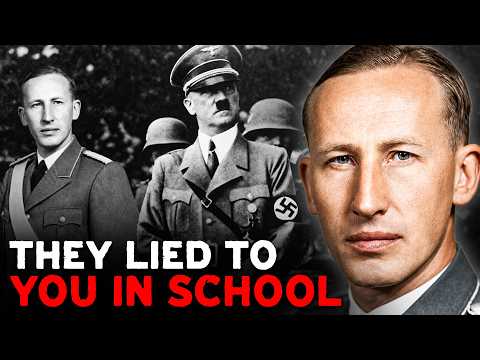
You can name them without trying. Göring drowning in his medals, Goebbels screaming into a microphone, a whole row of faces history can summon in an instant. Every one of them was a personality built to be impossible to replace, a brand of evil with its own face stamped on it. But one man at the very top did the exact reverse. He didn’t want to be seen at all. He spent his career building something engineered to keep running perfectly well without him. And Hitler reportedly called him the man with the iron heart. His name was Reinhard Heydrich, and he was the opposite of every other Nazi leader. Here is the part that should unsettle you. Being their opposite did not make him the better one. It made him worse and far harder to stop. The proof is what happened after he died. The others’ power died with them. Heydrich’s machine kept murdering people for years.
You can picture them without trying. Hermann Göring drowning in medals, a uniform redesigned to flatter a body that kept expanding. Joseph Goebbels leaning into a microphone, his whole face contorted with the performance. Hitler himself, the voice, the salute, the cult built around a single man. The Third Reich ran on personalities, leaders who made themselves into brands, each one a face you could instantly summon, and a name you could never confuse with anyone else’s. That was the point. Power in Nazi Germany was theatrical, and the men at the top wanted to be seen. They wanted crowds, cameras, monuments, and a personal stamp on everything they touched. Strip away the man and the role collapsed because the role was the man. They had made themselves the indispensable center of their own little empires.
Now picture Heydrich. And here’s the strange part. Most people can’t. There’s no signature pose, no famous gesture, no booming voice echoing out of newsreels. He’s the one face in the leadership you struggle to call up, and that was not an accident. While the others were busy becoming irreplaceable, Reinhard Heydrich was quietly doing the opposite. He was building a machine designed to keep running long after he was gone. And that single difference is what makes him the most disturbing figure of them all.
He didn’t chase the crowd. He chased the files. While Göring collected paintings and Goebbels collected applause, Heydrich collected information, names, addresses, associations, the careful index of an entire population’s secrets. As head of the Reich Security Main Office, he sat over the Gestapo, the intelligence service, and the criminal police all at once. He was, in effect, the most powerful policeman in occupied Europe, and his weapon wasn’t a speech. It was a card catalog.
But here is what those files were actually for, and why none of this can be mistaken for cold administrative talent admired in a vacuum. The surveillance system Heydrich built became the deportation lists. The card index that tracked who lived where became the instrument that decided who would be loaded onto trains. Under his authority and command structure, the Einsatzgruppen, the mobile killing units, followed the German army into the occupied East and shot hundreds of thousands of people into pits by late 1941. Town after town, an open-air slaughter conducted with paperwork and timetables. Then, in January 1942, he chaired the Wannsee Conference, the meeting at a quiet villa outside Berlin where senior officials sat down to coordinate the murder of every Jew in Europe. He prepared it the way an executive prepares a quarterly review. Statistics, country-by-country numbers, logistics. The protocol that survives is one of the most chilling documents in history, precisely because it reads like a business meeting.
So, when the rest of this story calls him efficient, disciplined, organized, hold this in your mind. Every one of those words is describing the engineering of genocide, not a personality quirk.
Before we go any further, if you want the version of this history that takes apart the cartoon villain story instead of just repeating it, subscribe. Because where this goes only gets more disturbing.
To understand the inversion, look at the man standing directly above Heydrich in the public eye. Hermann Göring was the regime’s number two, and he was everything Heydrich was not. He was a showman to the bone, a long-time morphine user, the founder of a private art collection of roughly 1,375 paintings, much of it looted from Jewish families who were robbed, deported, and murdered. He designed his own uniforms and reportedly changed them several times a day. And through all of it, he stayed genuinely popular. To a lot of ordinary Germans, Göring was the likable one, the larger-than-life figure they almost felt fond of.
But here is the detail that defines the whole inversion. In July 1941, it was Göring who signed the order commissioning Heydrich to prepare what the regime called the final solution of the Jewish question across German-controlled Europe. Sit with that. The most visible man in the Reich, the brand, the performer. He put his name on a piece of paper and handed the actual machinery of mass murder to the quiet technocrat below him. That’s the difference in one image.
Göring’s power was performance, and performance needs an audience, applause, a spotlight pointed at you. Heydrich’s power was infrastructure, and infrastructure doesn’t need an audience. It doesn’t need to be liked or seen or remembered. It just needs to keep working, which is exactly what it was built to do.
Set the two men side by side and the contrast almost looks staged. On one side, Carinhall, the sprawling estate stuffed with stolen masterpieces, the costume changes, the medals invented partly to be admired. On the other, a plain office and a wall of filing cabinets. One man wanted history to remember his face. The other arranged things so that history would barely register he had been there at all. And yet, it was the man with the filing cabinets who turned out to be the deadlier of the two, because everything Göring accumulated could be confiscated and everything Heydrich built could outlast him.
Goebbels lived for the microphone, and that tells you everything about how the regime thought power worked. The rallies, the films, the carefully staged crowds, the endless cult of the visible leader. The entire machine was engineered around being seen. Be loud enough, be everywhere, and the population falls in line. The Nazi elite wanted the spotlight aimed squarely at themselves. Heydrich built the precise inverse. His power worked because it was invisible. Wiretaps, informants, neighbors quietly reporting neighbors, a file on practically everyone who mattered and plenty who didn’t.
Imagine living inside that system. Never quite sure which colleague, which friend, which relative might pass along an overheard complaint. A careless sentence at dinner could end with a knock on the door. That fear did most of the work for him, because a population that polices itself doesn’t need a man on a stage to keep it in line. The others wanted you looking at them. He wanted to be the one looking at you, and never the other way around. A man who controls the spotlight can be toppled by losing the crowd. A man who controls the files can’t be toppled the same way, because no one even knows where to aim.
And the truly unsettling thing is how normal the surface looked. This was a concert-level violinist, a serious competition fencer, a former naval officer who came from a cultured, musical family. By several accounts, he had once looked down on the Nazis as little more than street thugs before he joined the party in 1931. Hitler reportedly called him the man with the iron heart. But none of that polish was a contradiction to the killing. The discipline, the focus, the high-functioning talent, those weren’t the opposite of what he did. They were the instrument he did it with. That’s a complication of the monster image, not an excuse for it.
Of every leader in the entire Reich, the Allies and the Czechoslovak resistance singled out exactly one man for a dedicated assassination operation. Not Hitler, not Göring, him. Think about what that choice reveals. The people actually fighting the regime, the government in exile, the British Special Operations Executive, the resistance on the ground, understood something the cheering public did not. The showmen were replaceable noise. Kill the man who gives speeches, and another man gives the speeches. But Heydrich was the engine. He was the one turning ideology into a working system, and a system, once it has a builder like that, becomes terrifyingly hard to switch off.
So, they made their decision. Two trained operatives, Jozef Gabčík and Jan Kubiš, were parachuted into occupied Czechoslovakia with a single mission, code-named Operation Anthropoid. Find the man almost no one could picture, and stop the machine by killing the one person they believed it still depended on.
On the morning of 27th May 1942, Heydrich did what he always did. Rode through Prague in an open-topped car, confident, exposed, certain that he had already broken the will of the people around him. At a hairpin turn where the car had to slow, Gabčík stepped into the road and aimed his submachine gun. He pulled the trigger, and the gun jammed. For one frozen second, the entire operation hung on nothing.
Then, Kubiš threw a modified grenade at the car. The blast drove fragments of metal and upholstery deep into Heydrich’s body. He didn’t die at the scene. He even staggered out and tried to chase his attackers before collapsing. He was rushed to a hospital, and at first, the doctors thought he might pull through. But infection set in from the debris driven into his wounds, and on June 4th, 1942, he died of sepsis.
But the most important consequence wasn’t his death. It was what came after.
The reprisals fell on a small village called Lidice, which the Nazis chose to make an example of. Around 170 men and boys were shot. The women, more than 200 of them, were sent to the Ravensbrück concentration camp, where many never came home. The children were taken away, and most of them were gassed at Chełmno. Only a handful were chosen for so-called Germanization. And in the end, only 17 of those children ever returned. The village itself was burned, dynamited, and bulldozed flat. Erased from the map by deliberate design. Across the wider crackdown, thousands more were arrested and executed.
That is the machine working exactly as it was built to work. Terror wasn’t an emotional outburst here. It was administrative policy, carried out with the same cold thoroughness Heydrich had spent years engineering into the system. The two men who killed him paid for it as well. After weeks in hiding, Gabčík, Kubiš, and a handful of fellow fighters were betrayed and cornered in the crypt of a church in Prague. Hundreds of SS troops surrounded them. The Nazis threw grenades down into the crypt, then tried to flood it by pumping in water. The men fought until their ammunition ran out, and rather than be taken alive, they turned their last rounds on themselves. They had always known the mission was very likely a death sentence, and that the reprisals would be monstrous. They did it anyway, because they believed the engine had to be stopped.
Comes the proof the very first lines promised you. Every other leader made himself indispensable through personality. And when they fell, their power fell with them. Heydrich made himself dispensable on purpose by building an apparatus of murder that could operate without a hand on the controls. And the payoff is the worst part of the entire story.
After he died, the killing did not slow down. It accelerated. The SS named its deadliest extermination phase after him. Operation Reinhard. Through the killing centers at Bełżec, Sobibór, and Treblinka, it murdered roughly 1.7 million people. And the overwhelming bulk of that slaughter happened in the months following his death, not before it.
In a stretch of roughly a hundred days in the second half of 1942, after Heydrich was already in the ground, something like 1.47 million people were killed, one of the highest kill rates of the entire Holocaust. The man was dead. And the machine he had assembled kept running at full speed, faster than ever.
Picture the timeline as a rising line on a chart. You might expect it to dip when the architect is removed. That’s how it works when power lives inside a single person. Take the speech maker away and the speeches stop. But this line doesn’t dip. It climbs, and it climbs hardest in the period after he’s gone. Because the thing he built was never about him being present. It was about the design surviving him.
He had done the one thing none of the others managed. He had made himself genuinely unnecessary to his own atrocity. That is the line that should never leave you. The others’ power died with them. His kept killing without him.
Here is the point the title was secretly about all along. We are comforted by villains who look like villains. The screaming, the corruption, the vanity, the obvious madness. All of it lets us feel safely unlike them. We tell ourselves we would have seen it coming because surely evil announces itself. Heydrich is the refutation of that comfort.
The traits that made him the opposite of the others, competence, discipline, organization, the complete absence of theater, are ordinary qualities we are trained from childhood to admire. We praise the efficient. We promote the organized. We trust the calm professional who delivers results without making a scene. And that is precisely why he is the most frightening figure the regime produced.
The danger was never his madness, because there wasn’t any. The danger was his normalcy weaponized and made repeatable. The screaming fanatic is a warning anyone can read. The quiet, capable man who treats genocide as a logistics problem gives you nothing to recoil from until it’s already done.
The others built monuments to themselves, and when the regime crumbled, they crumbled with it. Heydrich did the reverse. He built a machine and disappeared into it, and the machine outlived him by years and by more than a million lives. That’s the inversion, clean and cold. Being the opposite of every other Nazi leader did not make him the better one. It made him worse and far harder to stop.
The perpetrator who should frighten us most was never the loudest man in the room. He was the one you can’t quite picture. The one who made sure he would never have to be there at all.
So here is the question worth sitting with: in the systems you trust today, are you watching the faces, or are you reading the files? Tell us in the comments.
Report this article
Select a reason for reporting:






