Jeremy Camp never expected his life to become a movie. But when you fall in love, face unimaginable loss, and write songs that touch millions, Hollywood comes calling. The film I Still Believe chronicles his whirlwind romance with Melissa Henning, a love story that captured hearts—but the big-screen version isn’t the whole truth.
In the movie, Camp (played by KJ Apa) meets Melissa (Britt Robertson) at college, and their connection is instant. But as their relationship deepens, a love triangle emerges involving Camp’s mentor, musician Jean-Luc Lajoie. It’s a dramatic twist that keeps audiences on the edge of their seats. But here’s the thing: the real story was different.
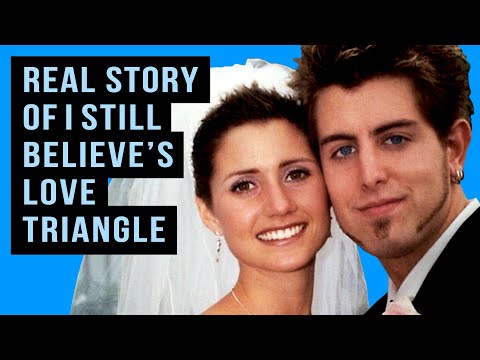
In reality, Jeremy Camp’s mentor was indeed Jean-Luc Lajoie, the frontman of the Christian rock band The Kry. But their meeting didn’t happen backstage at a concert, with Camp nervously approaching his idol. Instead, Lajoie sought out Camp after hearing about his talent, hoping to recruit him for the Harvest Crusades. And the love triangle? It didn’t involve Lajoie at all.
Camp revealed in an interview that the real third party was a Bible study leader, a friend who had feelings for Melissa. “Jean-Luc wasn’t in love with Melissa,” Camp clarified. But filmmakers condensed the character to avoid adding another face to the screen. Camp even checked with the real Lajoie, who gave his blessing: “Of course it’s okay.”
But the changes don’t stop there. The movie shows Jeremy and Melissa getting married on a beach—a romantic, sun-kissed ceremony. In truth, they exchanged vows in a church on October 21, 2001. And there’s a detail the film leaves out: Jeremy and Melissa sang together at their wedding, with Jeremy playing guitar. It was a moment of pure joy, a memory etched in time.
Another key figure in the movie is Jeremy’s father, Tom Camp, portrayed by Gary Sinise. In real life, Tom was a pastor in Lafayette, Indiana, and he was the one who married Jeremy and Melissa. The film doesn’t make this entirely clear, but it’s a poignant detail that adds depth to their story.
As the movie unfolds, we see Jeremy’s rise as a musician, his unwavering faith, and his heartbreaking loss. But the true story is even more compelling. Jeremy Camp’s memoir offers a deeper look into his journey—one that goes beyond the silver screen.
So, as you watch I Still Believe, remember: the real love story is messier, more beautiful, and ultimately more inspiring than any Hollywood adaptation could capture. And the truth behind the love triangle? It’s just one of many revelations waiting to be uncovered.
To understand why the filmmakers made these choices, you have to look at the timeline of Jeremy Camp’s actual life. He met Melissa Henning at Calvary Chapel Bible College in Murrieta, California, in the fall of 1999. He was nineteen. She was twenty-one. Their connection was immediate and intense—the kind of thing that makes you believe in something bigger than yourself.
But here’s where the movie takes creative license again. In the film, the couple’s breakup before Melissa’s diagnosis is portrayed as a painful but necessary step in their journey. In reality, the split was just as complicated, but the details played out differently. Camp has spoken about how he and Melissa briefly separated before her cancer diagnosis, a period he describes as one of the most confusing times of his life.
What the movie doesn’t fully capture is the intensity of Melissa’s faith during her illness. According to Camp’s memoir, she didn’t just endure her cancer—she embraced it as a calling. She saw her suffering as a platform to inspire others, even when her body was failing. Friends and family recall her refusing to let the disease define her, instead choosing to speak about hope at every opportunity.
The real Melissa was diagnosed with ovarian cancer in 2000, just months after she and Jeremy began dating seriously. She was only twenty-one years old. The prognosis was grim from the start, but she and Jeremy decided to marry anyway—not out of pity, but out of a fierce, stubborn love that refused to be extinguished by a diagnosis.
The song that became the emotional centerpiece of the film, I Still Believe, was written by Jeremy during one of Melissa’s hospital stays. He sat by her bed with his guitar, watching her sleep, and the melody came to him almost fully formed. He played it for her the next morning, and she wept. She told him it was the most beautiful thing she’d ever heard.
What happened next is where the movie and reality diverge most sharply. In the film, Melissa’s death is portrayed as a quiet, peaceful passing surrounded by loved ones. In truth, her final days were agonizing—the cancer had spread aggressively, and the pain was unrelenting. Jeremy has said that he held her hand until the very end, whispering the lyrics of his own song back to her as she slipped away.
Melissa Henning died on February 5, 2001. She was twenty-two years old. Jeremy was twenty-three. They had been married for less than four months.
The aftermath of Melissa’s death is something the film handles with a gentle, almost reverent touch. But Jeremy Camp’s real grief was raw, ugly, and relentless. He has described the months following her funeral as a fog of anger and confusion—he screamed at God in his car, pounded his fists on the dashboard, and questioned everything he’d ever believed. The movie hints at this darkness, but it softens the edges.
What the film also glosses over is how quickly Jeremy’s life moved forward. Within a year of Melissa’s death, he met Adrienne Liesching, a fellow musician who would become his second wife. They married in 2003. Some fans of the movie were shocked by this timeline, but Camp has always been candid about it: he wasn’t replacing Melissa. He was surviving.
In his memoir, Camp writes about a specific moment that changed everything. He was driving through the California hills, still numb with grief, when a song came on the radio—a worship chorus he’d heard a hundred times. He pulled over and broke down, not out of sadness, but out of a sudden, inexplicable peace. He describes it as Melissa’s voice in his memory, telling him to keep going.
That moment became the bridge to his debut album, Stay, released in 2002. The title track wasn’t about Melissa at all—it was about God’s faithfulness. But the album’s breakout hit, I Still Believe, carried her fingerprints all over it. Radio stations played it relentlessly, and soon Jeremy was performing it in arenas, watching thousands of strangers sing the words he’d written by his dying wife’s bedside.
He has said that singing it never got easier. Every performance was a small act of grief and gratitude braided together. He would close his eyes and see her face—not the pale, exhausted face of her final days, but the bright-eyed girl who’d sat across from him in the Bible college cafeteria, laughing at his terrible jokes.
The film ends on a note of hope, with Jeremy standing on a stage, bathed in light. But the real Jeremy Camp kept living, kept writing, kept loving. He and Adrienne went on to have three children. He became a pastor himself, echoing his father’s calling. And he never stopped telling Melissa’s story.
What the movie I Still Believe gets right—despite the altered love triangle, the beach wedding that never happened, the softened edges of grief—is the core of who Melissa Henning was. She was not a tragic figure. She was a young woman who chose joy in the face of death, who told her husband to keep singing long after she was gone.
And Jeremy Camp did exactly that. He’s still singing. The song outlived the girl, and in a way, so did the love.
But perhaps the most striking difference between the film and the truth is what happened after the credits rolled. The movie ends with Jeremy on stage, the lights blazing, the crowd singing back his words. In reality, that moment was just the beginning of a much longer, messier journey. He didn’t become a star overnight—he spent years touring small churches, sleeping in vans, and wrestling with a faith that had been shattered and rebuilt.
One detail the filmmakers left out entirely: Jeremy kept Melissa’s Bible. He still has it. Her handwritten notes fill the margins—prayers, questions, tiny declarations of trust. He has said that reading them feels like hearing her voice. Some pages are stained with tears, though he can’t remember if they’re hers or his.
The love triangle, the beach wedding, the condensed characters—these are the compromises of storytelling. But the heart of the film remains true. Melissa Henning really did tell Jeremy to keep singing. She really did face death with a stubborn, radiant hope. And Jeremy really did hold her hand until the end.
What the movie can’t capture is the sound of her laugh, the way she tilted her head when she was thinking, the specific weight of her hand in his. Those things belong only to him—and to the songs he still writes when the memories get too loud.
So when you watch I Still Believe, enjoy the romance and the music. But remember the real Melissa. Remember the real Jeremy. Remember that behind every Hollywood ending is a human being who kept living, kept grieving, kept believing.
And isn’t that the story worth telling?
What do you think—should filmmakers stick closer to the truth, or is creative license part of the magic? Let us know in the comments below.
Report this article
Select a reason for reporting:






