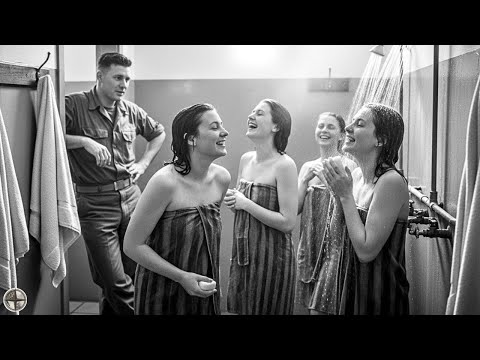
March 17th, 1945. Camp Kilmer, New Jersey. A gray morning gone silver where steam rose off the tarmac like low fog. The yard smelled of diesel and wet canvas. Iron gates creaked and clanged as they opened for a returning convoy. A column of olive drab two-and-a-half-ton trucks rolled in. Their dust streaked with Atlantic salt from a port unloading.
Sergeant James H. Miller, a stocky military police NCO with a scar on his left cheek, watched the trucks shift and breathe, eyes sharp under a tilted cap. You stand at the chain link and try to make sense of the line of faces stepping down from the trucks. They are pale and small against the winter coats and steel helmets of the men who lift their travel packs. But they are not children. They are German women of varying ages, bundled in mismatched skirts and threadbare overcoats, wrists cuffed with cloth bands, their hair pinned under scarves.
One carries a battered suitcase with a polka dot handkerchief tied to the handle. Another clutches a child’s wooden toy bitten by time. A third walks with a limp wrapped in a blanket that smells faintly of the sea and old smoke. Their shoes are narrow and worn. Their hands tremble.
Corporal Ellis, a pale, lanky MP with a clipboard, calls off names in clipped tones. Hannalor Bower, Anna Vice, Gertrude Kramer. Names fall into the yard like small stones. A translator, Private First Class Robert Klene, a German American from Cleveland, moves among them, telling them in halting German where to go. His voice is calm, professional, but the women’s eyes dart to him like birds to a window.
They are processed under a canvas awning. Identity checks, photographs, numbers stenciled onto their sleeves with a dip pen and India ink. Ink smells sharp in the winter air. A nurse brushes a thermometer over foreheads. Someone hands out woolen socks with a practiced efficiency. Sergeant Miller notes the small, almost invisible jewelry, a thin chain, a cameo tucked inside a shirt, relics of lives unaccounted for by war logistics.
The women shuffle past the inspection table, their breath clouding, murmuring in German. They whisper to each other in fragments, “Wasser, Tücher, Seife”—water, towels, soap. The questions pass like a current. Lieutenant Margaret Carter, liaison attached to the camp, steps forward with a clipboard. She tells them in a soft voice that they will be assigned bunks, that baths will be taken in shifts, that the showers are hot. Warm showers, she repeats as if the words might be talismans.
A ripple moves through the group, curiosity braided with apprehension. A woman named Hannah, 50 if she is a day, steps backward, eyes fixed on a squad of men carrying stacks of brand new white towels. Her mouth shapes a sound that could be a laugh or a sob.
They are led across the yard toward the latrine block, a low wooden building where steam already breathes from vents, a concrete belly humming with boilers and pipes. Inside the air is thick with the scent of antiseptic and soap, a sharp citrus edge that scrubs at the memory of burned bread and cold smoke. The showers hang like brass trumpets in a row. Eight nozzles soldered to chrome pipes, enamel basins lined in white. Each stall has a curtain, a luxury the women have not seen in months or years.
A Red Cross volunteer, Miss Evelyn Hart, shows them how to undress, how to fold, how to queue. She moves with an ease born from repetition. A towel here, a bar of soap there, a wrapped comb placed into a waiting hand. The soap is pale and stamped with a familiar American brand name, small discs that smell of lemon and floating cleanliness. One woman tentatively lifts a bar, fingers grazing the crisp paper, and inhales. The aroma is a shock, immediate and intimate, lemon and lather and something like sunlight.
Her eyes widen, the whisper moves like a small flame. “Wie können sie das bezahlen?” But solemn. How can they pay for this? The question is less about money than about wonder. Sergeant Miller stands at the shower door and watches. He has seen men unshaven after patrols. Soldiers who would sink into a tub like boys finding a pond. He knows the value of hot water to a tired body. He watches Hannalor step behind the curtain, the steam bloom around her like a veil. She closes her eyes and for a moment the war is a distant drum.
The soap slides over her hands and fingers. Bubbles rise and pop like tiny white flags. A towel is pressed into her palms, fresh, thick, edges hemmed, and she holds it to her face as if testing a stranger’s kindness. Outside, the camp’s routine carries on. Rifles laid in racks, mess kits clanged in preparation, a radio crackling with a weather report. Inside the washroom, time stretches into a different geometry. Scent becomes memory. Warmth becomes a ledger where old hunger is balanced against new availability.
The women move like people discovering an island in a map they thought erased. They exchange looks that contain something like disbelief and arithmetic confusion in bombing and blockade and hunger. How could this abundance be real? As they step out of the stalls, hair damp and skin pink by heat, towels tucked like flags around their waists, their whispered question repeats in small, stunned choruses. How can they live like this, even during war? It hangs in the steam.
Outside the latrine, Lieutenant Carter hands each woman a slip of soap wrapped in white paper and a small booklet with camp rules. The paper crinkles like something precious. Private First Class Miguel Alvarez, smudged with ash from the engine rooms, hands raw from loading crates, offers a smile that is both soldierly and human. He does not have an answer to the arithmetic of comfort. He only knows the work: boilers stoked, water rationed and monitored, supply lines that hum beneath the surface of this place.
And so the first small comforts—heat, hot water, the friction of clean cloth against skin—begin to rearrange the world for these women, one wet towel at a time. They have crossed oceans and a border of language. Here, behind the canvas awning and the barbed wire, something as ordinary as soap becomes a revelation.
Weeks later, on the morning the camp learned the war in Europe was over, Sergeant Miller stood at the gate as the women gathered in the yard. No one cheered. They simply stood in the pale sun, holding their towels and their letters, and looked at one another as if seeing each other for the first time. Hannalor walked to the fence and pressed her palm flat against the wire. Miller did the same on his side.
“We go home now?” she asked in halting English. He nodded, not trusting his voice. She smiled—the first real smile he had seen from her—and said softly, “We will tell them about the soap.”
He watched her walk back toward the barracks, clean hair catching the light, and thought that someday the world would remember this war in maps and monuments. But he would remember it in lemon and steam, in white towels flapping on a line, in the quiet dignity of a bar of soap.
What small kindness will you remember from a time the world forgot to be gentle?
Report this article
Select a reason for reporting:






