July 1968, Fu Thai Province, South Vietnam. Nineteen-year-old Nuan Thai Den crouched in the darkness beside a jungle trail she had used safely for six months. She was leading a supply column—twelve porters carrying ammunition and rice from Cambodia to Viet Cong units deeper in the province. The trail was familiar. Her scouts had checked it three hours earlier. No signs of enemy, no broken vegetation, no bootprints, no smell of cigarettes or insect repellent that marked American positions. Just jungle. Safe jungle.
She gave the signal. The column started moving. Her point man, Tran, was twenty meters ahead—experienced, careful, a survivor of two years. If there was danger, Tran would sense it. Den was watching Tran’s silhouette against the pre-dawn darkness when he simply vanished. No sound, no shot, no cry—just there one moment, gone the next, like someone had erased him from existence.
Before her mind could process what happened, the jungle erupted. Automatic weapons fire from three directions simultaneously—positions she had walked past without seeing. Muzzle flashes from vegetation that had looked empty. Her column disintegrated. Porters dropped loads and ran. Return fire was wild and panicked into the darkness. Then, as suddenly as it started, the firing stopped. Total silence.
Den lay frozen in elephant grass, breathing through her mouth, trying not to make any sound that would draw fire. She could hear wounded crying, hear porters crashing through jungle in retreat. But no enemy sounds—no voices, no movement. Whoever had ambushed them had vanished as completely as they had appeared.
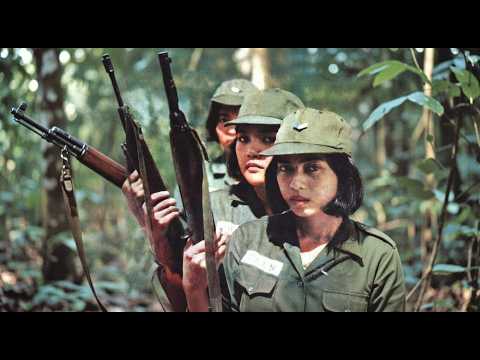
When dawn came two hours later, Den crawled back to the trail. Five dead, seven wounded scattered in the jungle, supplies abandoned. And the most terrifying part: no trace of who had attacked them. No spent brass casings, no blood trails, no footprints leading away from firing positions. Just empty jungle that had swallowed the attackers whole.
Later that day, back at base camp, her commander asked one question. “Did you see them?” Den shook her head. “Were they American?” “No,” Den whispered. “Americans we hear coming. We hear helicopters, radios, equipment. These? Nothing. We heard nothing until Tran died.”
Her commander’s face went pale. “Ma rung,” he said quietly. “The jungle phantoms. The Australian SAS.”
For the rest of her time in the war—for the rest of her life—Nuan Thai Den would remember that morning. Not because of the friends who died; she had seen friends die before. But because of the fear. The knowledge that five men had been watching her column for hours, studying their movements, positioning themselves perfectly. And she had never known they were there until they decided to kill.
Forty-seven years later, sitting in a Hanoi apartment being interviewed for a documentary, Den spoke words that shocked military historians. “We were not afraid of the American GIs, Australian infantry, or even B-52 bombing. We hated the Australian SAS because they made our comrades disappear.”
This is the story of why she feared them. Why women who had survived the most intense bombing in history, who had fought American Marines and South Vietnamese Rangers in close combat, who had proven their courage in countless firefights, spoke of the Australian SAS with something approaching terror even decades after the war ended. This is the Vietnamese perspective on the most feared unit in Vietnam—the story official histories never told because it came from the other side.
Don’t click away, because you’re about to discover why 138,000 women who served in Viet Cong forces learned to fear an enemy they almost never saw, rarely survived encountering, and couldn’t defend against no matter how experienced they became. This is their story.
To understand why the Australian SAS generated such fear among female Viet Cong fighters, you need to understand who these women were, what they had already survived, and what made them combatants whose testimony deserves to be heard. Between 1965 and 1973, approximately 138,000 women served in North Vietnamese Army and Viet Cong forces. This number is documented in post-war Vietnamese government records and represents women in formal military roles, not including civilian support. Some volunteered; most were drafted. The Democratic Republic of Vietnam implemented female conscription in 1965 when manpower shortages became critical. Women aged 17 to 24 were called up for military service just like men. They couldn’t refuse. They couldn’t buy their way out. They served or faced imprisonment.
Nuan Thai Den was drafted in January 1967 at age 19. She wasn’t a communist ideologue. She was a village girl from Dat Do district whose family had been killed six months earlier in an American artillery strike that missed its intended target by 400 meters. She had nowhere to go, no family to return to, and anger that needed somewhere to direct itself. Her training lasted six weeks at a camp in Cambodia: basic weapons handling with AK-47 rifles and RPG launchers, political education about American imperialism and Vietnamese liberation, jungle movement techniques and camouflage, basic medical care for treating bullet wounds and shrapnel injuries, map reading and navigation using landmarks instead of compasses. Then she was assigned to Transportation Group 470, moving supplies from Cambodia into Phuoc Tuy Province through trails that deliberately skirted Australian task force areas of operation.
“Six weeks of training, then they gave us rifles and sent us into the jungle,” Den recalled decades later. “They told us to move at night, avoid contact with enemy, and deliver supplies to the fighting units. They didn’t tell us that most girls in transportation groups didn’t survive their first year.”
The mortality rate was devastating. Transportation groups faced constant danger from air strikes, artillery, patrol encounters, and ambushes. But female fighters also faced additional threats: capture meant likely torture and rape by South Vietnamese forces; pregnancy in the jungle was essentially a death sentence; and menstruation in combat conditions created hygiene and health crises that male soldiers never experienced. Despite these challenges, the women served. They carried supplies through terrain that men struggled with. They worked as intelligence operatives in cities where men were more suspicious. They operated anti-aircraft guns defending the Ho Chi Minh Trail against American bombing. They fought as combat soldiers when units were decimated and needed replacements.
Le Thi Mai served with an anti-aircraft unit in 1968. Her unit defended a section of the Ho Chi Minh Trail that American aircraft bombed daily. “We shot down three American planes in four months,” Mai said in a 2010 oral history interview. “We also lost 23 girls killed, 14 wounded. Every day the planes came. Every day we fired at them. Every day girls died.” She described the experience with stark clarity. “American bombing was terrible but predictable. Same time every day. Same flight paths. We learned when to hide, when to fire, when to run. We survived by learning the pattern.”
Tran Thi Hue worked as an intelligence operative in Saigon from 1966 to 1968. Posing as a seamstress, she gathered information on American and South Vietnamese military movements and reported it to Viet Cong handlers. “The danger was constant but manageable,” Hue explained. “I knew which questions to ask, which not to ask. I knew how to blend in. I knew when South Vietnamese police were conducting sweeps. It was dangerous, but I controlled some of the risk.”
Phan Thi Kim fought in a combat unit during the 1968 Tet Offensive. Her unit attacked South Vietnamese positions in Can Tho. “We just kept shooting,” Kim said in a 1995 interview. “If we didn’t shoot, they would have shot us. We lost half our unit in three days, but we knew what we were facing. We could see the enemy. We could shoot back. It was terrifying, but it made sense.”
These women weren’t naive civilians. They were combat veterans who had learned to survive in conditions that killed the unprepared quickly. They had adapted to the patterns of warfare in Vietnam. They had learned which enemies operated which ways, and how to counter or avoid them. And then they encountered the Australian SAS and learned that everything they had adapted to didn’t apply.
American forces operated with doctrines that Viet Cong fighters learned to exploit. The US military in Vietnam relied on overwhelming firepower, air mobility, and search-and-destroy operations designed to find enemy forces and destroy them with superior weaponry. When American patrols made contact with Viet Cong units, the tactical response was standardized: establish a base of fire, call for artillery support, request helicopter gunships and medevac, and overwhelm the enemy with coordinated fires.
This doctrine was effective against conventional forces but problematic against guerrillas who understood the pattern. Viet Cong fighters learned the American rhythm. Engage briefly to inflict casualties. Break contact when you hear helicopters approaching. Withdraw into tunnels or jungle before the heavy weapons arrive. By the time American firepower transformed the contact area into a moonscape, the VC had disappeared.
Former Viet Cong commanders interviewed after the war described this tactic openly. Engage American patrols at close range for two or three minutes. Inflict casualties with AK-47s and RPGs, then withdraw immediately when helicopter sounds indicated gunships were coming. The Americans would destroy the area with artillery and air strikes, often killing civilians who hadn’t evacuated, but rarely killing the fighters who had initiated the contact.
“We learned Americans were predictable,” explained a former VC platoon leader in a 1985 interview. “They wanted to use their helicopters and radios and artillery. So we’d shoot at them to make them call all that in, then we’d be gone before it arrived. They killed a lot of jungle. They didn’t kill many of us.”
The predictability extended to movement patterns. American patrols used trails and roads because moving through dense jungle was exhausting and slow. They used helicopters for insertion and extraction, creating signature sounds that could be heard for kilometers. They communicated constantly by radio and voices that carried through the jungle. They smoked cigarettes. They wore insect repellent that smelled distinctly chemical.
“You could smell Americans from fifty meters,” Den said. “Cigarettes, bug spray, something sweet they put in their coffee. You could hear them from two hundred meters. Equipment rattling, boots on trails, voices. We always knew when Americans were close.”
This created a tactical environment where Viet Cong units could usually avoid contact with American forces unless they chose to engage. Scouts would detect American movements early. Units would withdraw into prepared positions or disperse into villages. When they did fight, it was at times and places of their choosing, not the Americans’.
Australian infantry operated differently. The First Australian Task Force in Phuoc Tuy Province employed tactics adapted from British counterinsurgency experience in Malaya. They moved more slowly through jungle, patrolled more carefully, used tracker teams with indigenous soldiers who could follow trails for kilometers. They didn’t rely as heavily on immediate fire support, instead emphasizing patrol skills and fieldcraft.
“Australians were harder to avoid than Americans,” admitted a former VC squad leader. “They moved quietly. They used Vietnamese scouts who could track us. They patrolled longer without resupply. We had to be more careful in areas where Australian battalions operated.” But Australian infantry still moved in platoon and company strength. Their movements could be detected by scouts and reported through intelligence networks. Vietnamese civilians in villages would report Australian patrol movements to Viet Cong intelligence officers. The locations of Australian bases were known. Their patrol patterns could be studied and predicted.
“Australian soldiers were good,” Den acknowledged, “better than Americans in jungle. But we could still hear them, still see them coming, still know when they were in an area. We just had to be more careful.”
The Australian SAS was something completely different—something that broke every pattern Viet Cong fighters had learned to recognize and exploit. The Australian Special Air Service Regiment had a mission completely different from American or Australian infantry operations. While line infantry conducted search-and-destroy sweeps and area-denial operations, the SAS conducted long-range reconnaissance patrols with a specific purpose: gather intelligence on enemy movements, positions, and logistics while remaining completely undetected.
SAS patrols operated in five-man teams—patrol commander, medic, signaler, two scouts. Five men total, because that was the perfect number: large enough to have tactical capability, small enough to move silently and be difficult to detect. They inserted by helicopter into remote areas, then disappeared for ten to twenty-one days at a time. They carried everything they needed—weapons, ammunition, food, water, radios, medical supplies. Nothing resupplied during the patrol. Once inserted, they moved deeper into enemy-controlled territory and established observation posts overlooking trails, base camps, or supply routes. Then they watched.
Days, sometimes weeks, gathering intelligence on enemy activities. From the Viet Cong perspective, this operational method was incomprehensible and terrifying because it violated every assumption they had developed about how enemy forces operated.
“We knew where American bases were,” explained Tran Van Duc, a former VC intelligence officer. “We knew where Australian bases were. We had scouts watching them. But the ma rung—we didn’t know where they were. Didn’t know when they inserted. Didn’t know where they were watching from. Didn’t know when they’d been observing us.”
The SAS achieved this invisibility through training and tactical discipline that took years to develop. Every SAS soldier had undergone six months of selection that tested not physical strength but mental endurance and judgment under extreme stress. They had completed jungle warfare training in Malaysia and Borneo. Many had combat experience from the Malayan Emergency and Indonesian Confrontation, giving them years of operating in jungle against guerrilla enemies before they ever reached Vietnam.
Their movement techniques were completely different from conventional forces. Where American patrols might cover three or four kilometers in a day, SAS patrols covered less than one kilometer, sometimes as little as five hundred meters. They moved slowly, stopping every few hundred meters to listen and observe for twenty or thirty minutes before moving again. They avoided trails completely, moving through dense jungle that conventional forces considered impassable. They wrapped every piece of metal equipment in tape to prevent noise. They mixed mud into their uniforms to kill any shine. They didn’t smoke, didn’t cook, didn’t speak above whispers for weeks. They established observation posts not on high ground where military doctrine suggested, but in concealed positions using natural vegetation and terrain features—positions so well camouflaged that you could walk within meters without seeing them.
“I learned about them from soldiers who survived encountering them,” Den said. “We’d send a supply column down a trail we’d used for months. Suddenly, everyone would be dead except one or two who ran. When we asked what happened, they’d say, ‘We don’t know. We didn’t see them. We didn’t hear them. People just started falling and then shooting was everywhere.’”
The psychological impact of encountering an enemy you couldn’t detect before they attacked was profound. Most combat has a rhythm. You see enemy positions, you take cover, you return fire, you fight and either win, lose, or withdraw. That rhythm gives soldiers some sense of control and agency. The SAS removed that completely.
Viet Cong fighters would be moving through areas they controlled, on trails they had used safely for months. And suddenly people would be dying. No warning, no chance to take cover. Just instant violence from positions they had walked past without seeing, followed by silence when the SAS withdrew as invisibly as they had attacked.
Between 1966 and 1971, the Australian SAS conducted nearly twelve hundred patrols in Phuoc Tuy Province and surrounding areas. According to official Australian records, these patrols resulted in over six hundred enemy killed confirmed, with hundreds more probable. SAS casualties during this period: one killed in action, one died of wounds, three accidental deaths, one missing in action. This produced a kill ratio unprecedented in the entire war.
But statistics don’t capture the fear that Viet Cong fighters—particularly female fighters—expressed about the SAS decades after the war ended. The fear came from specific tactical realities that made the SAS uniquely dangerous.
First was the complete inability to detect them before they attacked. Every Viet Cong unit had scouts who moved ahead of columns, checking for enemy ambushes. These scouts knew what to look for: broken vegetation, footprints, disturbed soil, equipment marks on trees. American and Australian infantry left these signs. SAS patrols didn’t.
“Our scouts were experienced,” said Le Van Tam, a former transportation group commander. “They could spot American ambush positions from a hundred meters. They could find where Australian patrols had stopped to rest. But they never saw ma rung until the shooting started.”
This wasn’t exaggeration. SAS training emphasized leaving no trace. They moved through jungle without breaking vegetation or disturbing the ground. They established ambush positions in ways that didn’t require clearing fields of fire, using natural gaps in vegetation. When they withdrew after contact, they left no brass casings, no blood trails, no clear indication of which direction they had gone.
Second was the time factor. SAS patrols often observed enemy movements for days before acting. They would insert into an area, establish an observation post, and watch a trail junction or supply route for a week. They would learn patterns: which times of day were busiest, which trails were used most frequently, where security was lax. Then they would use that knowledge to strike at the perfect moment.
“They knew our routines better than we did,” Den recalled. “We’d move supplies at night thinking we were safe. But they’d been watching for days, knew exactly when we’d come, had already positioned themselves perfectly. We’d walk right into ambushes that had been prepared for us specifically.”
Third was the precision and speed of their attacks. SAS ambushes typically lasted sixty to ninety seconds. Initiated with claymore mines and automatic weapons fire from concealed positions. Maximum violence for minimum time, then immediate withdrawal while Viet Cong forces were still in shock and disarray.
“The shooting would start and end so fast you didn’t have time to react,” explained Pham Thanh Lan, who survived an SAS ambush in 1969. “People falling, explosions, bullets everywhere, then silence. It was over before you could even point your weapon. When you looked around, friends were dead or dying, and whoever killed them was already gone.”
Fourth, and perhaps most psychologically devastating, was the certainty that if you encountered the SAS, some of your unit was already dead before you knew they were there. SAS doctrine was to initiate ambushes when enemy forces were most vulnerable and commit to the attack completely before breaking contact. This meant the first indication that SAS were present was people dying. No warning shots, no probing fire—just instant casualties.
“With Americans, you’d hear helicopters or shooting. Then the battle would start,” said former VC fighter Nguyen Van Duc. “With ma rung, the battle would be over before you knew it started. You’d hear shooting and people dying, then nothing. No helicopters coming, no artillery, just dead friends and whoever killed them already gone like ghosts.”
Captured Viet Cong documents from 1967 and 1968 provide remarkable insight into how enemy forces perceived different Allied units and developed specific tactics to counter them. These documents, captured by Australian and American forces during operations and later analyzed by military intelligence, reveal that Viet Cong leadership understood they were facing different types of enemies requiring different responses.
For American forces, the documents detailed extensive tactical guidance: how to engage American patrols (hit them at close range, inflict casualties quickly, break contact before gunships arrive), how to avoid American sweeps (disperse into villages, hide in tunnels, wait for operations to end), how to counter American fire bases (mortar them at night, then withdraw before counter-battery fire arrives). The documents assumed American forces could be fought successfully using proven techniques.
For Australian infantry, guidance was more cautious. Australian patrols were harder to ambush because they moved more carefully. Their tracker teams made evasion more difficult. Contact should be avoided unless necessary. If forced to fight, expect competent return fire and organized response. Use greater standoff distances than with Americans. But the guidance still assumed Australian infantry could be detected, tracked, and avoided or fought when necessary.
For the Australian SAS, the guidance was completely different. A captured document from 1968, translated by Australian intelligence officers, contained instructions that revealed the psychological impact the SAS had on enemy forces. The document warned Viet Cong units operating in Phuoc Tuy Province: Special enemy forces operate in small groups with silent movement and invisible positions. If encountered, assume you are already under observation. Assume your strength and positions are known. Assume ambush has been prepared. If possible, avoid all contact and withdraw to alternate positions. If contact occurs, expect heavy casualties and immediate withdrawal of enemy forces. Do not pursue. Prepare defensive positions and request reinforcement.
The document didn’t provide tactical guidance for defeating SAS patrols. It provided guidance for surviving encounters and avoiding them entirely. This acknowledgment that Viet Cong forces had no effective counter to SAS tactics revealed how completely the SAS had achieved tactical dominance.
“We had ways to fight Americans,” said Tran Duc, the former intelligence officer. “We had ways to fight Australian infantry. But ma rung—our orders were: if you think they’re in your area, change your plans. Use different trails. Move at different times. Assume they’re watching even if you can’t see them.”
This assumption of constant observation created a psychological burden that affected operations across entire regions. Every trail became suspect. Every jungle clearing could conceal watchers. Every supply movement risked walking into an ambush that had been prepared days in advance. The SAS didn’t need to patrol constantly or engage frequently. Their reputation and the uncertainty they created did the work. Enemy units operated under perpetual stress, never knowing if five silent professionals were observing them at that exact moment, learning their patterns, preparing an ambush.
For female Viet Cong fighters, this psychological warfare was particularly devastating because they were operating in an already discriminatory environment where their competence was constantly questioned by male commanders, and where mistakes could result in assault or execution, not just combat casualties. The pressure to perform perfectly while under constant observation by an invisible enemy created stress that male fighters didn’t fully experience.
Nuan Thai Den’s experience after the ambush that killed five members of her supply column in July 1968 illustrates the psychological impact of SAS operations on female fighters. After the ambush, Den was interrogated by her commander about what happened. Not debriefed—interrogated.
“He wanted to know if I’d been careless,” Den recalled. “If I’d made mistakes, if I’d failed to follow procedures. He was looking for someone to blame because five people were dead and supplies were lost.”
Den explained that she had followed all procedures. Scouts had checked the trail. The route had been used safely for months. Security was maintained. There were no signs of enemy presence. Her commander didn’t believe her.
“He said we must have been loud or lazy or made mistakes that alerted the enemy. He said American or Australian patrols couldn’t set up an ambush without leaving signs that scouts would detect. He accused me of lying to cover my incompetence.”
It was only after other supply columns reported similar ambushes—with no prior warning and no trace of enemy afterwards—that commanders acknowledged they were facing an enemy different from Americans or Australian infantry. By then, the psychological damage was done.
“Every time I led a column after that, I was terrified,” Den said. “Not just of being killed—of being blamed if we were ambushed. Of being accused of incompetence if we encountered ma rung and survived, but others died. The fear of the invisible enemy mixed with fear of my own commanders blaming me for things I couldn’t control.”
Other female fighters described similar experiences. Le Thi Mai, the anti-aircraft gunner, said that when her unit was attacked by Australian infantry during a sweep operation, her commanders praised her for fighting back effectively. But when another unit was hit by what was suspected to be an SAS ambush, the female squad leader who survived was demoted for failing to maintain proper security—despite no evidence she had done anything wrong.
“If a man commanded a unit that was ambushed by ma rung, it was bad luck or clever enemy tactics,” Mai explained. “If a woman commanded that unit, it was incompetence. We were held to different standards and blamed for things no one could have prevented.”
This gender discrimination added an additional layer of stress to an already terrifying tactical situation. Female fighters had to be perfect in ways male fighters didn’t, because they were constantly proving they belonged in combat roles. Encountering an enemy that made perfection irrelevant—that could kill you despite flawless execution of procedures—created a special kind of fear.
Phan Thi Lan survived an SAS ambush in 1969 while leading a reconnaissance patrol.
“We were checking a trail for our battalion to use,” Lan recalled. “I had five soldiers with me. We moved slowly, carefully, checking everything. Then three of my soldiers were dead before I heard the first shot. The other two ran. I lay in elephant grass for two hours, not moving, terrified that if I moved, they’d kill me too.”
When she finally crawled back to their lines, her commander asked why she survived when her soldiers died. As if she had abandoned them. As if she were a coward. The implication was clear: a male leader might have fought back. A female leader survived by hiding. The fact that fighting back against an SAS ambush was suicide didn’t matter. The gender assumptions did.
“After that, I was never given command again,” Lan said. “Not because I did anything wrong. Because I’d encountered ma rung and survived, and that made me suspect—made them question if I was really a soldier or just a girl who got lucky.”
The SAS probably never knew the secondary impact their operations had. They were conducting reconnaissance patrols and ambushes according to their training and doctrine. They didn’t know that their tactical effectiveness was creating internal conflicts in enemy units, where female fighters were being blamed for failing to counter tactics that male fighters also couldn’t counter.
The women who fought for the Viet Cong were not easily frightened. They had survived B-52 strikes that turned jungle into moonscape. Multiple survivors described Arc Light bombing raids where the earth shook for minutes, trees were ripped from the ground, and anyone caught in the impact zone simply disappeared.
“The bombing was terror,” said Le Van Minh, who survived three Arc Light strikes. “The ground would shake like an earthquake. The noise was so loud you couldn’t think. Trees falling, explosions everywhere, dirt raining from the sky. If you weren’t in a bunker, you died. Even in bunkers, sometimes you died when they collapsed. But Arc Light strikes were impersonal. You took shelter when you heard the bombers. You survived if your bunker held. You died if it didn’t. There was no skill involved. No tactical decisions to make. Just luck.”
Artillery was similar—terrifying but predictable. American firebases would fire harassment and interdiction missions at night, random artillery dropped on suspected enemy positions.
“You learned to dig deep holes and sleep in them,” explained Den. “Artillery would explode above ground, shrapnel flying everywhere, but if you were deep enough, you’d survive. We lost people to artillery, but not as many as Americans probably thought.”
Combat against American Marines and South Vietnamese Rangers was brutal but comprehensible. You could see the enemy. You could shoot back. You had agency in the fight.
“In Tet Offensive, we fought South Vietnamese forces in close combat,” said Phan Thi Kim. “House to house, room to room. It was terrifying. But it made sense. They shot at us. We shot at them. We won or lost based on who fought better. I could accept dying that way.”
The Australian SAS represented something different—an enemy that removed all agency from the fight.
“With Americans, I had choices,” Den explained. “I could avoid areas where they operated. I could watch for helicopters. I could prepare defensive positions. With ma rung—no choices. I didn’t know where they were. Didn’t know when I might encounter them. Didn’t know how to defend against them. I was helpless in ways I never felt against Americans, even with all their firepower.”
This helplessness—the loss of control and agency—was more psychologically devastating than the physical danger. Former VC fighters described the progression of fear as they gained experience. New fighters feared everything. After a few months, they learned to manage fear of bombing and artillery through preparation and camouflage. After a year, they learned to manage fear of American patrols through scout networks and tactical awareness. But fear of the SAS never diminished with experience. If anything, it increased.
“The more experience you gained, the more you understood how good they were,” said Nguyen Van Duc. “New soldiers didn’t really understand the danger because they didn’t understand what was normal versus what ma rung could do. Experienced soldiers had seen enough to know that ma rung were operating on a completely different level than anything else we faced.”
Tran Thi Hue, the intelligence operative, described the fear in stark terms. American bombing might kill you. Australian infantry might find and fight you. But ma rung were hunting you personally. They would watch you for days, learn your habits, wait for the perfect moment. It wasn’t combat—it was being prey.
This distinction between combat, where both sides fight, and predation, where one side hunts and the other is prey, captures why the psychological impact was so profound. The SAS had achieved a level of tactical dominance where Viet Cong forces—including experienced fighters who had survived years of war—felt hunted rather than engaged in mutual combat.
The testimony of female Viet Cong fighters about the Australian SAS reveals patterns that official military histories miss. First, the testimony is remarkably consistent across different women interviewed in different years by different researchers. They use similar language: disappear, ghosts, invisible, hunting. They describe similar tactical realities: no warning before ambushes, no trace afterward, no effective counter-tactics. This consistency across independent sources suggests the accounts are honest reflections of experience rather than coordinated propaganda.
Second, the women’s testimony often includes details that wouldn’t appear in propaganda: admissions of fear, descriptions of internal conflicts with male commanders, acknowledgments of tactical inferiority. Propaganda typically emphasizes heroism, resistance, and ultimate victory. These accounts emphasize terror, helplessness, and respect for enemy capabilities.
Third, the testimony reveals psychological impacts that lasted decades after the war ended. Nuan Thai Den’s 2015 interview was conducted fifty years after she joined the Viet Cong and forty years after the war ended. She was a grandmother living in a reunified Vietnam, where discussing the war was politically sensitive. Yet when asked about her wartime experiences, the fear in her voice when discussing the SAS was immediate and visceral.
“I still have nightmares,” Den admitted in the interview. “Not about the bombing, not about the firefights—about walking on a trail and feeling like someone is watching me, but not knowing where they are. I wake up terrified that I’m being observed and don’t know it. Fifty years later, and ma rung still haunt me.”
This long-term psychological impact suggests the experience of encountering the SAS created trauma different from other combat experiences. The uncertainty, the helplessness, the realization that skilled, patient enemies could observe and kill you without you ever knowing they were there—created fear that persisted long after other wartime fears had faded.
Post-war studies of PTSD in Vietnamese veterans have found that certain types of combat exposure created more lasting psychological damage than others. Captivity and torture created severe PTSD. Witnessing civilian casualties created moral injury. But encountering invisible enemies who killed comrades without warning created a specific type of hypervigilance and paranoia that persisted for decades. Female Viet Cong fighters who encountered or survived SAS operations showed these symptoms at higher rates than fighters who faced equivalent danger from artillery or conventional combat. The reason appears to be that conventional combat, however dangerous, allowed fighters to feel they had some control through their skill and decisions. SAS operations removed that sense of control completely.
The fourth pattern in female fighter testimony is respect for SAS tactical skill, even when discussing how devastating it was to face them.
“They were the best,” said Le Thi Mai simply. “Better than anyone else we fought. If I’d known soldiers like that existed, I might not have joined the war. But I respect their skill, even though I feared them.”
This respect from enemy combatants is perhaps the most credible testament to SAS effectiveness. These women had nothing to gain politically or personally from praising Australian special forces. They were describing an enemy that had terrified them and killed their friends. Yet they consistently described the SAS as operating on a different level than other Allied forces, with skills and tactics they couldn’t counter even after years of experience.
Former American military historians who have interviewed Vietnamese veterans note that VC and NVA soldiers describe American forces with a mix of resentment for the overwhelming firepower, frustration at not being able to fight on equal terms, and sometimes contempt for relying on technology over skill. They describe Australian infantry with respect for professionalism but confidence they could fight them successfully. They describe the SAS with fear and respect that acknowledges complete tactical inferiority.
The statistical record of SAS operations in Vietnam supports the female fighters’ testimony about their effectiveness. Between 1966 and 1971, the Australian SAS conducted 1,023 patrols documented in official records. These patrols operated in Phuoc Tuy Province primarily, but also conducted missions in surrounding provinces and across the border in Cambodia. The kill ratio achieved during these operations was six hundred enemy confirmed killed to one SAS soldier killed in action—Sergeant Bill Mott, killed by friendly artillery in 1969. One died of wounds—Signalman Eric Robinson, wounded in contact and died during evacuation. Three accidental deaths and one missing—Lieutenant Peter Schuman, missing in action 1970. This produces a ratio of approximately one hundred to one in direct combat, unprecedented for sustained small-unit operations.
More significant than the ratio is the pattern. SAS patrols made contact on their terms, at times of their choosing, against enemies who usually didn’t know they were under observation until the shooting started. Captured Viet Cong after-action reports, obtained from documents captured during operations, describe SAS contacts from the enemy perspective. The pattern is consistent: VC units moving along trails or occupying positions were engaged suddenly by heavy fire from concealed positions, suffered significant casualties in sixty to ninety seconds, then the attacking force withdrew before VC reinforcements could arrive or effective return fire could be organized.
Intelligence analysis of these reports found that VC forces almost never successfully counter-ambushed SAS patrols, rarely wounded SAS soldiers during contacts (most SAS casualties came from mines or accidents, not firefights), and never successfully pursued SAS patrols after contact because the Australians withdrew without leaving clear trails to follow.
The psychological impact was documented in captured enemy orders and guidance documents. Multiple documents from 1967–1969 instructed VC units operating in Phuoc Tuy to avoid contact with special enemy reconnaissance forces if possible, to assume they were under observation in areas where SAS were thought to operate, and to change routes and schedules frequently to avoid establishing patterns that could be exploited. This is noteworthy because captured VC documents from the same period contain confident tactical guidance for engaging American and Australian infantry units. The enemy believed they could fight other Allied forces successfully but acknowledged they couldn’t effectively counter SAS tactics.
From the Vietnamese civilian perspective, the SAS also generated fear distinct from other forces. Post-war interviews with civilians who lived in Phuoc Tuy Province during the war reveal that villagers knew when American or Australian infantry units were operating nearby. They would see helicopter insertions, hear patrols moving through jungle, encounter soldiers in villages. But civilians consistently report they never knew when SAS patrols were operating in their areas.
“Sometimes after the war, we’d hear that ma rung had been operating near our village for weeks,” explained a former village chief. “We never knew. Never saw them, never heard them. They were living in the jungle near us, and we had no idea.”
This invisibility to civilians, combined with their effectiveness against VC forces, meant that Vietnamese non-combatants couldn’t provide intelligence to VC units about SAS locations or movements—in areas where VC relied heavily on civilian intelligence networks to track Allied forces. The SAS operated in an intelligence vacuum where even friendly civilians couldn’t provide warning of their presence.
The long-term impact of facing the Australian SAS shaped how female Vietnamese veterans processed their wartime experiences decades later. In a 2010 oral history project interviewing female veterans, researchers found that women who had fought in areas where SAS operated described their war experiences differently than women who had fought in other regions.
Women who fought in northern areas against American bombing campaigns described the war in terms of survival and endurance—surviving the bombs, enduring the hardship, maintaining morale despite losses. Women who fought in urban areas described the war in terms of risk and espionage—gathering intelligence while maintaining cover, taking calculated risks in hostile environments. Women who fought in the Central Highlands described the war in terms of combat and tactics—attacking American positions, defending against sweeps, tactical victories and defeats.
But women who fought in Phuoc Tuy Province, where the Australian task force and particularly the SAS operated, described the war differently. They described it in terms of fear and helplessness. Being watched without knowing it. Friends disappearing without explanation. An enemy they couldn’t see, couldn’t fight, couldn’t escape.
“I never felt like a soldier in Phuoc Tuy,” said one female veteran who requested anonymity. “I felt like an animal being hunted. Ma rung took away everything that made me feel like I was fighting. I was just trying to survive each day, not knowing if they were watching me at that moment.”
This testimony, preserved in oral histories and documentaries, represents a perspective that official military histories rarely capture: the experience of being hunted by an enemy whose tactical superiority was so complete that it transformed combat from a contest into a predation. The women who served in Viet Cong forces in Phuoc Tuy Province didn’t fear the Australian SAS because they were weak or cowardly. They feared them because they understood, with the clarity of survivors, exactly how dangerous they were.
Den’s final words in the 2015 documentary captured what fifty years of reflection had taught her about the enemy that haunted her dreams.
“The Americans wanted to kill us. The Australians wanted to find us. But ma rung—they wanted to know us. They studied us like we were animals in the jungle. They learned our habits, our weaknesses, our fears. And then they used everything they learned to destroy us. That is why we feared them. Not because they were cruel. Because they were perfect. And we could never be perfect enough to survive them.”
Have you ever considered how the fear of an unseen, patient enemy shapes the way soldiers remember war—and what does that tell us about the true nature of combat trauma?
Report this article
Select a reason for reporting:






