You’ve seen them luminous on the silver screen, their smiles perfect, their charm effortless. But behind the cameras, in the shadowy corridors of studio power, a different story unfolded. These were not just bad moods. They were eruptions—furniture-throwing, career-destroying, sometimes violent explosions that everyone in the industry knew about and nobody dared talk about publicly.
Take Frank Sinatra. His own daughter called him a Jekyll and Hyde. His valet described a man who could be overwhelmingly generous one moment and violently destructive the next. In 1967, after losing a gambling dispute at the Sands Hotel, Sinatra tore up the switchboard, drove a golf cart through a plate glass window, and lost two front teeth. That was just one incident in a four-decade reign of terror.
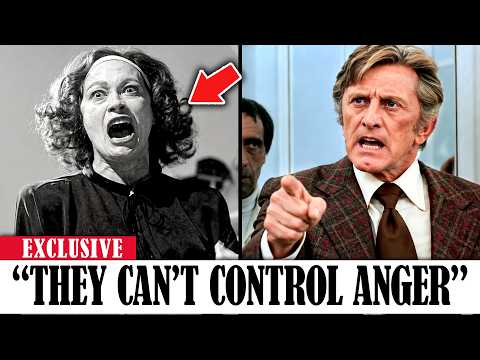
Or Harry Cohn, who ran Columbia Pictures with an iron fist and a buzzer system to eavesdrop on employees. He followed actresses home, kept files on their personal lives, and physically ejected people from his office. When he died, over a thousand people attended his funeral—most, reportedly, just to confirm the news.
And then there was Louis B. Mayer, the most powerful man in Hollywood for nearly 30 years. He screamed, cried, and fainted—sometimes all in the same meeting. Orson Welles called his emotional displays “absolutely fake,” but the temper behind them was very real. He slapped actors, threatened careers, and systematically destroyed John Gilbert’s career after a single punch.
These are the stories of 15 Golden Age stars with the worst tempers in Hollywood history. Some were brilliant but brutal. Some were charming but cruel. And one was genuinely evil. The industry kept their secrets for decades, but the people who worked alongside them never forgot.
What made these stars so volatile? Was it the pressure of fame, the unchecked power of the studio system, or something darker? The answers lie in the untold stories of the people who lived through it—the assistants, the co-stars, the directors who bore the brunt of these legendary rages.
As we delve into these accounts, you’ll hear from those who witnessed the outbursts firsthand. You’ll learn how the studios covered up the destruction, paid off hotels, and silenced victims. And you’ll discover why some of the most beloved figures in entertainment history were, behind closed doors, capable of terrifying cruelty.
But first, let’s start with number 13—a man who hated almost everything and wasn’t quiet about it. W.C. Fields was notorious for fighting with directors, carrying a loaded revolver, and chasing people off set with a prop cane. His misanthropy was legendary, but was it an act or the real man? The answer might surprise you.
W.C. Fields wasn’t just difficult—he was a one-man war against the world. He hated children, dogs, Christmas, and other actors with equal passion. On the set of My Little Chickadee in 1940, he and Mae West clashed so fiercely that they refused to speak to each other off camera. West later called working with him the most unpleasant experience of her career.
Fields carried a flask everywhere and grew more combative as the day wore on. He once chased a director off the set with a prop cane. And in his dressing room, he kept a loaded revolver—supposedly to shoot at trespassers. No one was ever sure if that was a joke or a genuine threat.
His distrust of banks was so extreme that he opened hundreds of accounts under fake names across the country. Many were never recovered after his death. He was brilliant on screen, but according to those who knew him, the curmudgeon wasn’t performing. That was just who he was.
Bette Davis didn’t just have a temper—she had a permanent state of controlled fury. She feuded with nearly every major actress of her era, most famously Joan Crawford. On set, she overruled directors she considered incompetent, which was most of them. She once told a director in front of the entire crew that she would be directing herself for the rest of the production—and then did exactly that.
When she worked with Crawford on Whatever Happened to Baby Jane? in 1962, the two waged a cold war that kept the production on edge. Davis allegedly kicked Crawford during a scene hard enough to leave a bruise. Crawford retaliated by putting weights in her pockets during a scene where Davis had to drag her across a room.
Davis won two Academy Awards and earned ten nominations. Nobody questioned her ability, but the people who worked alongside her remember the sets as battlefields—and Davis as a commander who didn’t take prisoners.
Humphrey Bogart was one of the greatest actors in Hollywood history. He was also a dedicated bar fighter who seemed to enjoy provoking people until someone threw a punch. He drank heavily and was known for picking arguments with strangers in restaurants and nightclubs. He once started a fight at the Stork Club with a penguin who, according to witnesses, hadn’t done anything to provoke him.
His wife, Lauren Bacall, frequently had to pull him out of situations before they escalated. What made Bogart different was that he seemed to enjoy the chaos. He didn’t lose his temper—he went looking for trouble, found it, and then complained about the consequences afterward. His publicist spent years cleaning up incidents that would have ended a lesser star’s career.
Bogart sometimes showed up to set with visible bruises from the night before and offered no explanation. The strange thing was that his temper existed alongside genuine warmth. People who knew him well said he could be the most loyal, generous friend in Hollywood. But after a few scotches, the switch flipped—and the man who just bought dinner for the entire table was suddenly looking for someone to argue with.
John Wayne’s on-screen image was all about quiet toughness. Off-screen, the toughness wasn’t always quiet. Wayne got into real fistfights. He once punched out a stuntman who he felt wasn’t performing well enough. He had screaming matches with directors, including John Ford, who would scream right back.
During the filming of The Alamo in 1960, which Wayne directed and starred in, he became so abusive to the crew that several members walked off the production. His temper also showed up in his politics. During the McCarthy era, Wayne aggressively supported the blacklist and publicly shamed actors he considered un-American. He feuded with Kirk Douglas over the politics of Spartacus and made comments about other actors’ patriotism that damaged relationships for years.
Wayne’s temper didn’t ruin his career, but it made him a complicated figure behind the curtain. His co-stars remembered the outbursts as clearly as they remembered the performances.
Kirk Douglas was built like a prizefighter and had a temper to match. On set, he was known for explosive confrontations with directors, producers, and co-stars who didn’t meet his standards. During the production of 20,000 Leagues Under the Sea in 1954, Douglas clashed repeatedly with director Richard Fleischer and co-star James Mason. Douglas wanted more control over his scenes and wasn’t shy about demanding it at volume.
He also had a reputation for being physically intimidating during arguments. Douglas was a former wrestler who used his size and intensity to dominate confrontations. His son Michael later described his father’s temper as something the entire family learned to navigate carefully.
On the set of Spartacus in 1960, Douglas clashed with the original director Anthony Mann so aggressively that Mann was fired and replaced by Stanley Kubrick. Douglas then clashed with Kubrick. The film was a masterpiece, but the production was a war zone.
Douglas channeled his aggression into his performances, which is part of what made him so compelling to watch. The jaw-clenching intensity of Spartacus and Paths of Glory came from somewhere real—but the line between the intensity on screen and the intensity in the trailer afterward was often impossible to find.
Spencer Tracy is remembered as the finest actor of his generation, a two-time Oscar winner with a gift for understatement. What the public didn’t see was the other Spencer Tracy—the one who appeared after the third or fourth drink. Tracy was a binge drinker who went on benders that lasted days, sometimes weeks. When he was drinking, he became hostile, destructive, and sometimes violent.
He trashed hotel rooms. He picked fights. He disappeared for days at a time, forcing productions to shut down until he resurfaced. MGM’s Howard Strickling cleaned up Tracy’s messes the way he cleaned up everyone else’s. Hotels were paid off. Police reports vanished. Co-stars were told to keep quiet.
One bender in the early 1940s ended with Tracy barricaded in a hotel room for three days while MGM sent people to talk him out. Another resulted in a trashed bungalow at the Beverly Hills Hotel that the studio quietly paid to repair. The pattern repeated itself for years.
Katharine Hepburn spent 26 years managing Tracy’s drinking and the temper that came with it. She once compared loving him to keeping a dangerous animal in the house. When Tracy was sober, he was the consummate professional—the actor everyone wanted to work with. When he was drinking, he became someone his closest friends barely recognized. The public only ever saw one version. The people who loved him lived with both.
Errol Flynn was charming when he was sober and terrifying when he wasn’t—which was increasingly often as the years went on. He threw furniture in hotel rooms across three continents and brawled in Hollywood, London, and Havana. On the set of The Sun Also Rises in 1957, he showed up so drunk and belligerent that director Henry King considered shutting down production entirely.
Flynn also had a habit of provoking people bigger and meaner than he was. He once fought a nightclub bouncer who outweighed him by sixty pounds and came out of it with a broken rib and a black eye—then told the story afterward like it was the highlight of his week. By the time he died at fifty, there wasn’t much left to destroy.
John Ford directed some of the greatest films in American history and won four Academy Awards. He was also one of the cruelest men ever to sit in a director’s chair. He made John Wayne, a grown man who’d worked with him for decades, cry on set more than once.
During Mister Roberts in 1955, Ford punched Henry Fonda in the jaw during an argument about how a scene should be played. Ford had to be replaced after suffering a health crisis during the same production—multiple people said the crisis was exacerbated by his own rage. His defenders argue his methods got results. His critics point out that four Oscars don’t justify punching your leading man in the face.
Otto Preminger was called Otto the Terrible, and that was one of the nicer nicknames. His most infamous target was Jean Seberg, a nineteen-year-old he plucked from obscurity for Saint Joan in 1957. Preminger berated her daily, reducing her to tears. During the climactic burning-at-the-stake scene, a gas canister misfired and Seberg was actually burned, leaving permanent scars.
Preminger told the press it was the kind of accident a director like him dreamed of. David Niven and Deborah Kerr confronted him directly and threatened to walk. He dialed it back—temporarily. Seberg later said, “He used me like a Kleenex and then threw me away.”
Joan Crawford’s volatility was legendary long before Mommie Dearest. She demanded absolute silence on set and would stop production cold over a noise. After marrying Pepsi chairman Alfred Steele, she ran board meetings with the same iron fist. When the board tried to sideline her after his death, she arrived with binders of research and outlasted executives twice her age.
Whether every detail in Christina Crawford’s memoir is accurate has been debated for decades, but nobody who knew Joan personally ever described her as calm. The woman who clawed her way from poverty to the top of Hollywood didn’t get there by being pleasant—and she didn’t change once she arrived.
These were the legends. Brilliant, magnetic, and capable of leaving wreckage in their wake. The studios polished the image, buried the incidents, and sold the dream. But the people who lived through the eruptions never forgot.
So here’s the question: if you had to work alongside one of these stars—knowing exactly what they were like behind closed doors—which one would you risk it for, and which would you refuse to be in the same room with? Tell us in the comments.
Report this article
Select a reason for reporting:






