The morning of July 13, 1912, began like any other in the sleepy seaside town of Herne Bay. But by noon, a young doctor would be summoned to a rented house on High Street, where he would find a bride dead in a zinc bathtub, her head submerged, and her husband standing by with a story already prepared.
That husband called himself Henry Williams. His real name was George Joseph Smith, and he was a man with a talent for making women disappear.
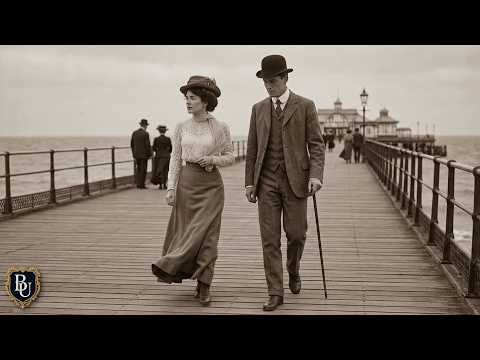
Bessie Mundy was thirty-three years old when she met the man who would kill her. She was unmarried, inexperienced, and possessed of a modest inheritance of £2,500—a sum held in a family trust that paid her only a small allowance. Her family considered her naive and sheltered. They were right.
In 1910, in the coastal town of Weymouth, she encountered a man who introduced himself as a picture restorer and art dealer. His name, he said, was Henry Williams. It was a lie. The man was George Smith, already married, a career con artist who preyed on women with independent incomes. He married them, took what he could, and vanished.
Within weeks of their wedding, he had seized her available cash and fled, leaving behind a letter accusing her of giving him a venereal disease—a calculated move to justify his desertion and discourage pursuit. The trust fund remained intact, beyond his reach. But Bessie was left alone, a married woman without a husband.
Eighteen months passed. Then, in March 1912, chance brought them together again on the beach at Weston-super-Mare. Bessie forgave him. They returned to each other, and soon they moved to Kent, to Herne Bay, where they rented a house at 80 High Street.
The reunion revived arrangements that had stalled. Smith now set his sights on the trust fund. He could not simply withdraw the money; he needed a legal document that would transfer the entire sum to him upon her death. On July 8, 1912, the couple visited a solicitor and each signed a will leaving everything to the other. Five days later, Bessie Mundy was dead.
Smith’s method was as cold as it was repetitive. He bought a zinc bathtub from a local hardware store, haggling over the price. He took Bessie to a young doctor, Frank French, and told him she suffered from seizures—though Bessie herself complained only of a headache. In this way, a medical record of fits was created in advance, attributed to a woman who had never reported any such thing.
On the morning of Saturday, July 13, Smith sent a note to Dr. French, urging him to come at once, fearing his wife had died. The doctor arrived to find Bessie dead in the tub, her head underwater. The cause of death was drowning. There were no signs of violence. The scene had been orchestrated from the start by the man who called for the doctor.
An inquest was held quickly. Smith played the grieving husband. Dr. French described a woman who had drowned during a seizure. The jury returned a verdict of accidental death. No charges were filed. The case was closed.
Smith collected Bessie’s money under the will. He returned the bathtub to the hardware store—without paying for it—and left Herne Bay. The official story of how Bessie Mundy died stood unchallenged for nearly three years.
What reopened the case was not a review of the Herne Bay inquest. It was a second death, then a third, each mirroring the first. After leaving Kent, Smith resumed his pattern under new names. In December 1913, a woman named Alice Burnham, twenty-five years old, died in a bathtub in Blackpool. In December 1914, a woman named Margaret Elizabeth Lofty, thirty-eight, died in a bathtub in Highgate, North London. In each case, the man had married the woman, arranged to acquire her money, and presented the death as a sudden collapse in the bath. In each case, the local inquest recorded an accidental death.
It was not the police who discovered the link between these deaths. It was two ordinary men in different places, reading a newspaper.
The press reported Margaret Lofty’s death as the story of a bride who drowned in her bath on her wedding night. The report appeared in the News of the World in Buckinghamshire. A man named Charles Burnham read it. He was the father of Alice Burnham, who had died in a bathtub in Blackpool the previous year. And in Blackpool, a man named Joseph Crossley read it. His family had rented the rooms where Alice Burnham died; his wife was the landlady.
Each man saw in the Highgate report circumstances he already knew. Each clipped the report and sent it to the police independently, without knowledge of the other. Those clippings carried the case to Scotland Yard, where Inspector Arthur Fowler Neil took charge.
Neil proved that the men who had married these women and buried them under the names Henry Williams, John Lloyd, and others were one and the same person. He placed the suspect under surveillance. On February 1, 1915, Smith was arrested outside a law office where he had gone to collect insurance money from Margaret Lofty’s death. The arrest ended a series of acts that had gone undetected as the work of one hand over four and a half years and three deaths.
The investigation that followed relied on the exhumed bodies of the three women and the work of pathologist Sir Bernard Spilsbury. Spilsbury examined each body. He found no injuries indicating a struggle, and no natural disease sufficient to cause a fatal seizure in any of them. The women had been healthy. There was nothing in their bodies to explain a sudden collapse of the kind their husbands had described to doctors and inquest officials.
That absence was itself the evidence. Three healthy women do not accidentally drown in shallow bathtubs during their wedding seasons.
Neil set out to prove how such a drowning could occur without leaving a mark, and he did so by experiment. A bathtub was filled, and a volunteer lay in it. Accounts differ on the volunteer—described in some as a trained nurse, in others as an expert swimmer in a bathing suit. Neil demonstrated that a sudden, strong pull upward from the feet or knees causes the head to slide under the water instantly, before the person in the tub can resist or cry out. During the demonstration, the volunteer lost consciousness and had to be revived with artificial respiration. The experiment was not continued. It had proven what it was meant to prove: that this method could drown a healthy adult instantly without leaving any trace of how it was done.
Smith was committed for trial, charged with the murder of Bessie Mundy alone. He was not tried for the deaths of Alice Burnham or Margaret Lofty. Legally, the indictment before the court concerned the woman who died in Herne Bay in July 1912. The other two deaths would enter the trial not as charges, but as evidence.
The trial opened at the Central Criminal Court, the Old Bailey in London, on June 22, 1915, and ran until July 1. The presiding judge was Mr. Justice Scrutton, Sir Thomas Edward Scrutton of the King’s Bench Division. The prosecution was led by Archibald Bodkin, later Director of Public Prosecutions, with Travers Humphreys and Cecil Whiteley. The defense was handled by Sir Edward Marshall Hall, the most famous defense barrister of his generation.
The charge was the murder of Bessie Mundy. Smith pleaded not guilty.
The prosecution’s case was built on the similarities between the three deaths. It laid out the pattern of aliases under which the man had married. It laid out the financial arrangements that would benefit him in each case—the will in Herne Bay, the insurance, the money elsewhere. It laid out the purchase of the zinc bathtub and the fabrication of a history of seizures, the visit to Dr. French where a fit was reported for a woman who complained only of a headache. And it set the deaths of Alice Burnham and Margaret Lofty beside the death of Bessie Mundy as proof that what happened in Herne Bay was not an accident but a repeated method.
The question of whether the jury could hear about the other two deaths was the central legal issue of the trial, and Marshall Hall fought it. The usual rule was that a person tried for one offense should not have other alleged crimes put before the jury, lest he be convicted on his character rather than the facts of the charge. Judge Scrutton ruled that the evidence of the Burnham and Lofty deaths was admissible—not to show that Smith was a man of bad character, but to show a system and a design, that the death in Herne Bay was part of a series so similar it could not be coincidence. This was an acceptance of what the law calls similar fact evidence, and it allowed the jury to hear that two other brides had died in the same way.
The ruling in Smith’s case became, and remains, a leading authority in English law on when such evidence may be heard. Marshall Hall argued that the three deaths were coincidences, three accidental drownings suffered by an unlucky man across his wives, and attacked the admission of the other deaths as prejudicial. Against the accumulation of pattern, the argument did not hold.
The jury heard the evidence of the aliases, the money, the bathtub, the seizures that existed only in the husband’s account, and the two additional deaths that matched the first. The demonstration of how a woman could drown in a bathtub without a mark on her was part of the weight of that evidence.
Smith behaved erratically during the proceedings, and reports say he tried to leave the dock more than once. The jury withdrew to consider its verdict and was gone for about twenty minutes. It returned with a verdict of guilty.
The conviction, delivered at the Central Criminal Court on July 1, 1915, quashed the accidental death verdict of the Herne Bay inquest and replaced it with one of murder, answering the question the 1912 investigation had never been able to ask.
The court moved to sentencing. Judge Scrutton pronounced the death sentence. The sentence was passed on July 1, 1915, in the first summer of the war, and the national press followed the case against that backdrop. The Times carried its reports of the trial. The News of the World, where the Burnham and Lofty deaths had been recognized, held a special place in the story as the medium through which the pattern was first revealed. The Daily Express, founded in 1900, was among the papers of the day. And in Herne Bay itself, the Kentish Gazette, the old local paper, had reported the death on the High Street.
Interest in the case was immense, running parallel with news of the fighting in France and Flanders. An appeal to the Court of Criminal Appeal was lodged and dismissed. There was no reprieve from the Home Secretary. The conviction and sentence stood.
The sentence was carried out on August 13, 1915, a Friday, at Maidstone Prison in Kent. The method was hanging, and the executioner was John Ellis. Smith maintained his innocence to the last moment. Accounts of the morning of the execution describe a man in distress who needed help as he was led to the gallows. The man was hanged, and the court’s sentence was complete.
The case left a mark on the law that outlasted any other part of it. The ruling that allowed the Burnham and Lofty deaths to be cited as proof that Bessie Mundy’s death was part of a systematic pattern became a standard authority for similar fact evidence, and English courts cite it long after the parties were gone. The trial record was collected in the Notable British Trials series in 1922, edited by Eric R. Watson, preserving the proceedings as a primary record. The investigating officer wrote his own account in a memoir published in 1932. In 2010, a full modern account of the case was published, combining the police work, the forensic reports, and the three deaths.
The case gave the English language a shorthand term for a certain kind of crime, and it has been recounted in true crime writing and programming for decades. The woman at its heart, who married in Weymouth a man she believed to be a picture dealer, became one of the names by which the whole series is remembered.
The case passed into literature. The record remained as a witness. And the questions remained with it.
Three women. Three bathtubs. One man. The pattern that two grieving fathers spotted in a newspaper clipping became the rope that hanged George Joseph Smith on a Friday morning at Maidstone Prison.
But the law remembers him for something else entirely. The ruling that allowed the Burnham and Lofty deaths into his trial became a cornerstone of English evidence law—cited in courtrooms long after the gallows were dismantled.
Bessie Mundy, Alice Burnham, Margaret Lofty. Their names outlived their killer. The question that haunted Herne Bay in 1912—how does a healthy woman drown in a shallow tub without a mark?—was answered in a courtroom experiment that nearly killed the volunteer.
And yet, one question remains unanswered: How many other women married Henry Williams, John Lloyd, or Oliver James—and simply vanished from the record?
What do you think—was justice truly served, or did Smith take secrets to the grave that we will never uncover? Tell me in the comments.
Report this article
Select a reason for reporting:






