On October 20, 1945, a military plane touched down in Nuremberg carrying twenty-two men who had once ruled Europe. Among them were the architects of the Holocaust, the masterminds of a war that had killed tens of millions. And waiting for them was a 34-year-old American psychologist named Gustave Gilbert—a man with fluent German, a Jewish heritage, and unrestricted access to the most notorious prisoners in history.
Gilbert could enter any cell at any time. He could sit with Hermann Göring, the Reichsmarschall; Rudolf Hess, the amnesiac; Joachim von Ribbentrop, the hollow diplomat. He would spend a full year talking with them, testing them, recording their every word and gesture. What he found would shatter the comfortable myth of the Nazi as a mindless fanatic.
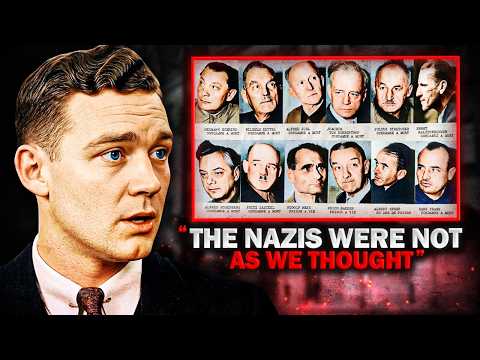
They were not mediocre men. The intelligence tests Gilbert administered revealed an average IQ of 129—nearly two standard deviations above the general population. Hjalmar Schacht, the financial wizard, scored 143. Göring himself scored 138, tied with Admiral Dönitz. These were brilliant, cultured individuals who could discuss art, music, and philosophy with ease. And yet they had orchestrated the systematic extermination of millions.
Gilbert’s method was deceptively simple. He never took notes in the cells. He would chat, ask seemingly casual questions, then retreat to a private room and write down everything he remembered with clinical precision. Those notes became the Nuremberg Diary, a work that remains one of the most chilling primary sources on the psychology of totalitarianism.
Before the trial began, Gilbert used the period of solitary confinement to establish individual contact with each prisoner. He administered intelligence tests and asked them to sign a copy of the indictment with a spontaneous commentary. These first answers turned out to be instant portraits of character. Göring reacted to the test like a smug schoolboy, clapping his hands when he solved the hardest puzzles and tapping the bed impatiently when he failed. Keitel, the Prussian field marshal, tidied his cell and cleaned the table before starting, declaring the test superior to the “silly nonsense” German psychologists used.
But the most disturbing revelation was yet to come. When Gilbert informed Göring that he had one of the highest scores in the group—without mentioning that Schacht had beaten him—Göring decided that American psychologists really had something there. The news that his lifelong rival had outscored him would later fuel a silent, bitter hostility.
Gilbert’s conclusion was unequivocal: Intelligence does not protect against evil. It is not a shield against fanaticism. Men perfectly capable of abstract reasoning and strategic planning can also organize the murder of millions. That was, in his view, the most disturbing truth Nuremberg produced.
As the trial progressed, Gilbert would probe deeper into each defendant’s psyche—Göring’s amiable psychopathy, Hess’s hysterical amnesia, Ribbentrop’s moral vacuum. And what he found would force the world to reconsider the nature of evil itself.
Hermann Wilhelm Göring arrived in Nuremberg as the highest-ranking defendant—Reichsmarschall, head of the Luftwaffe, president of the Reichstag, plenipotentiary of the Four-Year Plan, and Hitler’s designated successor. The list of his charges occupied more than three lines in the indictment. He was, in all senses, the de facto head of the group of defendants, and he knew it. He exercised that authority with the arrogance of someone who still believed in power.
When Göring arrived at Mondorf prison in Luxembourg before being transferred to Nuremberg, he brought two suitcases full of paracodine pills. He had been addicted to opiates for years, an addiction that prison doctors had been reducing with decreasing doses. Colonel Andrus, the prison commander, was pleased to refer to this trial: “When Göring came to me in Mondorf, I was a servile scumbag with two suitcases full of paracodine. I thought he was a drug dealer, but we took him off his drug and turned him into a man.”
Detoxified, Göring was a first-rate psychological specimen. Gilbert described him with clinical precision in a 1948 paper titled Hermann Göring, Amiable Psychopath. The combination of terms was not accidental. Göring was genuinely affable, humorous, widely informed, able to converse about art, music, military history, and international politics with the ease of a man of the world. And at the same time, his inability to acknowledge guilt, his pathological egotism, his constant manipulation of other prisoners to maintain a coherent party line, and his utter indifference to the human suffering his decisions had caused, constituted the classic picture of severe antisocial personality disorder.
When Gilbert informed him of Robert Ley’s suicide, Göring showed no emotion. His response was calculated: “It’s okay that he’s dead because I had my doubts about how he would behave in the trial. He has always been so absent-minded, always making those fantastic and bombastic speeches. I’m sure he would have made a fool of himself at the trial. Well, I’m not surprised he’s dead because he was killing himself drinking anyway.”
In the first weeks of the trial, Göring sought to establish his de facto leadership over the group of defendants in a way that Gilbert found clinically revealing. In the dining room where the prisoners had lunch together, Göring set up a command table and waited for the other higher-ranking defendants to take their positions with respect to him. Frank described how even in prison, Göring stopped before going out for a walk and waited for Frank to place himself on his left in the position of subordinate officer. “Can you imagine it even now in this prison?” Frank said to Gilbert, shaking his head. “I don’t bother with him anymore.”
But Göring’s tactics were more complex than the simple exercise of rank. Göring actively attempted to maintain what Gilbert called a united front among the defendants—a collective stance of cynicism toward judgment, of denial of collective guilt, and of defending the historical reputation of the Third Reich and Hitler in particular. To maintain that front, Göring pressured, flattered, threatened covertly, and controlled the conversations in the dining room with the same political instinct that had brought him to power in Germany.
His attitude toward judgment was one of open cynicism. From day one, and no matter how much documentary evidence was presented against him, Göring maintained the position that the trial was a political matter of the victors and that he could answer for all that he had done, but not for what he had not done. In private conversations with Gilbert, he was noticeably more blunt: “Naturally, do you think it would rebuild again? Of course I would rearm. I would rearm Germany until it was full of arms. I’m just sorry I didn’t rebuild even more.” And on international treaties: “As for international treaties, naturally I considered them among us as mere dead paper.”
His reaction when he saw the concentration camp film screened in the courtroom on November 29, 1945, was characteristic. Uncomfortable because of the effect the film had on the other defendants, rather than because of the content itself. “It was such a good afternoon until they showed that movie,” he told Gilbert that night. “They were reading my phone conversations about the Austrian affair, and everyone was laughing with me. And then they showed that horrible movie and it ruined everything.”
In Göring, during the whole year of the trial, there was no genuine sign of remorse. His suicide, committed on the night of October 15, 1946, a few hours before the death sentence by hanging was to be carried out, was the last act of control that was available to him.
Rudolf Hess arrived at Nuremberg prison from England in a state of apparent total amnesia. He didn’t recognize anyone. He didn’t remember anything from the past. Among his belongings were small packages of food samples that he had wrapped, sealed, and labeled during a period of paranoid delusions about poisoning his food. He sat in his cell in a state of apathetic absence, giving no sign of familiarity with any mentioned subject of the past, including his own flight to Scotland on May 10, 1941.
Hess had arrived in Scotland alone, piloting a Messerschmitt Bf 110 without authorization and without warning, in a seemingly personal attempt to negotiate peace with Britain. The impact on the Nazi hierarchy had been devastating. Hitler was enraged. Göring had to publicly declare that one of the highest leaders in the Reich was insane. It was a political humiliation of the first order, and Göring never forgave it. “Does Hitler believe that he would have sent the third man of the Reich on a solo mission to England without the slightest preparation?” Göring asked Gilbert indignantly. “Hitler was furious when he found out. Do you think it was a pleasure for us to have to publicly declare that one of our top leaders was crazy?”
Hess’s amnesia at Nuremberg was subjected to exhaustive psychiatric scrutiny. An American commission examined him in his cell with Gilbert as his interpreter. The conclusion was that Hess was not legally insane, although his amnesia seemed genuine. When he was shown a Nazi film in which his own image appeared, he showed no reaction.
The revelation came on November 30, 1945, during a closed session of the court convened to determine whether Hess was competent to defend himself. When his defense attorney began arguing that Hess was incompetent, Hess wrote a note and asked that it be turned over to his attorney, who ignored it. Then Hess interrupted the proceedings with a statement: “My memory is back in order. The reasons I simulated memory loss were tactical.”
The court dissolved in chaos. The defense attorney was completely taken aback, not knowing whether his client had faked amnesia before or was faking it now. Göring, when he heard about it, roared with pleasure, believing that Hess had played a masterful joke on the psychiatrists. Von Schirach said, eyes wide with amazement, “Well, that’s the end of scientific psychology.”
When Gilbert visited Hess in his cell that night, Hess’s memory was perfectly in order. He was able to answer questions about his imprisonment, about his flight to Scotland, about his role in the party. When Gilbert asked him what Hitler had said when he learned of the flight, Hess bristled: “I don’t know what he said, and I don’t want to know. I’m not interested.”
Repeated intelligence tests showed a moderate improvement in memory, but Hess made some of the same mistakes as before. His contention that he could have gotten better results if he had tried harder was not supported by the evidence of the tests. What Gilbert interpreted clinically was this: Hess had a hysterical personality. The amnesia had been, at least in part, a defensive response to the greatest humiliation of his life—Hitler’s publicly declaring him insane. When he arrived in Nuremberg, surrounded by his former teammates, the risk of that same rejection was once again unbearable. When Gilbert warned him that he probably wouldn’t be let back on trial if he continued to appear incompetent, Hess decided it was time to end the game.
During the trial, Hess manifested continuous paranoid tendencies. Göring said that Hess made comments about a machine installed under his cell to drive him crazy with the noise of the engine, that when the coffee was too hot, he assumed they wanted to burn him. When he was cold, they wanted to disturb him. The only prisoner who had arrived in Nuremberg with sealed food parcels to prevent poisoning. The sentence imposed in the end was life imprisonment.
Hess would die on August 17, 1987, at the age of 93 in Spandau Prison in West Berlin, the last prisoner of that facility.
Joachim von Ribbentrop, the hollow diplomat, wept not from remorse but from longing when Hitler’s image appeared on screen. “Even with everything I know, if Hitler came to me right now, I simply could not give him up,” he confessed to Gilbert. In him, Gilbert saw a man with no autonomous self—only borrowed convictions that collapsed when the scaffolding fell.
Hans Frank, the Governor-General of occupied Poland, offered the most theatrical repentance. “If only one of us had had the courage to shoot him dead,” he told Gilbert, describing Hitler as “the gaze of an insensitive psychopath.” The remorse was genuine—but so was the performance of remorse.
On October 16, 1946, ten men were hanged in the Nuremberg gymnasium. Göring had cheated the gallows hours earlier with a cyanide capsule. The rest died one by one.
Gilbert died in 1977, but his question endures: If ordinary, intelligent men can commit such evil, what protects us from becoming them?
Report this article
Select a reason for reporting:






