Captain Roy Decker had smelled many things in Vietnam, but nothing like this. It was August 1968, and the six men standing outside the operations tent at Nui Dat carried an odor that was not sweat or dirt or fear—it was the jungle itself, green and old and alive, as if they had been grown from the soil rather than merely walking on it. Decker, a Marine Infantry commander from Rockford, Illinois, with 214 men under his command, had never encountered anything that defied his training so completely.
He had been told they were good soldiers, these Australians. “Good jungle men, different methods,” his battalion commander had said. But nothing could have prepared him for the quiet certainty that would unravel everything he thought he knew about war.
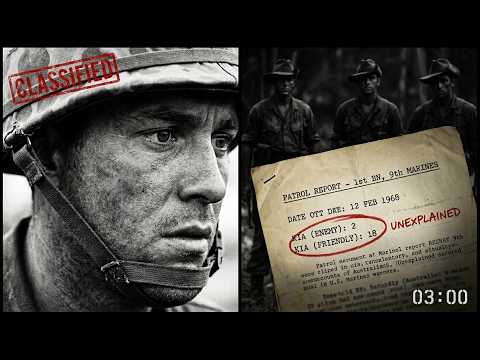
The first fracture appeared during a briefing when Major Gareth Sorrow, the Australian patrol commander, looked at Decker’s meticulously prepared map assessment and said nothing for a long, uncomfortable moment. Then, with a politeness that somehow made it worse, he pointed out that the main resupply element Decker had placed at grid 4721 hadn’t been there in eleven days of watching. “The element is moving through 4892,” Sorrow said. “Has been since the 7th. They changed the route because something disturbed them on the 6th. We don’t know what yet.” And just like that, Decker’s confidence—the kind that had kept his men alive—began to crack.
Intrigued and unsettled, Decker extended his liaison assignment. He spent the next eleven days watching the Australians prepare for patrol, and what he saw rewired his understanding of soldiering. The silence they produced wasn’t the disciplined quiet of Marines suppressing noise; it was the natural stillness of a library closed for decades. Their equipment wasn’t light because they lacked supplies, but because every ounce had been weighed against a single question: Will this prevent me from becoming what I need to become in there?
The L1A1 rifle they carried—semi-automatic, heavy, seemingly outdated—became a symbol of their philosophy. “We don’t suppress,” Sorrow explained. “We fire when we have a target and we hit the target and we stop firing because there is no further requirement to fire.” Decker wrote it down verbatim, each word reorienting his understanding of a firefight.
Then came the face paint. Not the regulation camouflage patterns he knew, but something primal—one man with half his face black, another with white curves under his eyes that made him look predatory. They checked each other’s work like surgeons, and when they were done, what looked back from the mirrors was not a human face but a weapon. They moved to the wire without a signal, and in four seconds, the jungle received them as if they were always meant to be there. The insects resumed their chorus, and Decker sat in the dark, his pencil still, realizing his competence had a ceiling he’d never known.
When the patrol returned five days later, they looked exactly the same—not tired, not relieved, simply unchanged. Sorrow handed Decker a single sheet: three kills, one confirmed NVA logistics officer, eleven days of supply, two extraction routes, and a disrupted enemy rotation. From six men. Without air support or artillery. Decker thought of his own last operation: 140 men, helicopters, artillery—eleven enemy confirmed, two Americans wounded. The arithmetic was brutal.
Over the following weeks, Decker sat in on planning sessions that reorganized his understanding of intelligence. The Australians planned from observation to comprehension, not from information to action. He filled fourteen pages of notes, dense with urgency, recognizing that what he was witnessing was not a technique but a philosophy—one that could only be transferred through patient observation, not briefing slides.
He returned to his company and began making quiet adjustments: smaller patrols, longer observation, measuring success by intelligence return rather than contact rate. The friction was real, but so was the shift. In November, he wrote to Sorrow, thanking him and admitting that the most transferable thing was not the technique but the premise—and that arriving at it required a professional honesty the American system wasn’t structured to demand.
Sorrow’s reply arrived in Rockford in January 1969. “The thing you observed is not technique,” he wrote. “It is what remains when you have removed from a soldier everything that is not essential… Most people never see it.” Decker put the letter down, finished his cold coffee, and sat in silence. He had seen it—the underneath—and it would change him quietly, the way water changes stone.
But the letter was not the end of it. Decker discovered this in stages, the way a man discovers that a house he has lived in for years has a room he never opened.
The first stage was the debriefing at Quantico the following week. He sat across from three intelligence officers and a lieutenant colonel who had never spent a night outside a firebase, and he translated what could be translated. Patrol size. Observation windows. The shift from contact rate to comprehension. He watched them write it down in the language of recommendations, and he understood that the words were landing in a filing system designed to shelve them rather than act on them. “So you’re recommending we reduce patrol strength on recon tasking,” the lieutenant colonel said, not as a question. “That’s a hard sell, Captain. We’re measured on coverage.”
Decker nodded. He had known it would be. What he had not expected was how the knowing would feel—not like defeat, but like the first clear sight of a wall he would spend years learning to work around rather than through.
The second stage came in the summer of 1969, when he was a major with a new command and a new set of lieutenants fresh from Quantico, their confidence as yet unmarked by anything the jungle had to say about it. He took them to the field for a week and did not run a single assault problem. Instead he had them sit in the tree line at dawn and watch a trail for six hours without moving, and afterward he asked them what they had seen. Most of them had seen nothing. One of them, a quiet kid from Oregon named Pruitt, had seen a pattern in the way the birds moved and had written it down without being told to. Decker looked at the notebook and felt something settle in his chest. “You’ll do,” he said, and Pruitt, who did not understand what he had done to earn it, would spend the rest of his career trying to.
The third stage was harder, and it came without warning, the way the important ones always do. It was 1971, and Decker was back in the States, and a young captain from another battalion sought him out at a training conference because he had heard, through a chain of officers that had grown loose and imprecise in the retelling, that Decker had once spent a month with the Australians and had come back different. The captain wanted to know what he had learned.
Decker looked at him for a long moment. The captain was eager and sharp and had the particular hunger of a man who believed the answer could be handed over, and Decker recognized the hunger because he had felt it himself, standing at twenty meters from a staging area with a notebook in his sweating hand. He thought about the letter in his desk drawer in Rockford. He thought about Sorrow’s two paragraphs and the word underneath.
“I can tell you what I saw,” Decker said finally. “I can’t tell you what it meant. That part you’ll have to go and stand in yourself.”
The captain waited, expecting more. When more did not come, he thanked him politely and left, and Decker watched him go and knew, with a certainty that carried no bitterness, that the young man had heard a door close and had mistaken it for a wall.
He took out his notebook that night—the same one, the pages soft at the corners now, the pencil marks faded where his hand had rested on them—and he read the entry from the first night at Nui Dat. The one where he had written silence and underlined it and failed to find the better word. He had never found the better word. He had found, instead, a way of living without needing it, which he had come to understand was the only translation that ever truly held.
He closed the notebook and put it back in the drawer, and that might have been the end of it, except that the story did not stop with him. It never does.
In 2008, forty years after the smell of the jungle first hit him at Nui Dat, Roy Decker’s son found the notebook in a storage unit in Rockford, along with the letter from Sorrow and a photograph of six men whose faces he could not make out. He read the entries about silence and the L1A1 and the face paint, and he understood for the first time why his father had spent a career asking young officers to wait before they acted.
He sat on the concrete floor of that storage unit for an hour, reading. When he finished, he did not feel that he had learned a technique. He felt that he had been let into a room he had walked past his whole life without knowing it was there.
That is the thing about the underneath. It does not announce itself. It waits for someone to stand in the dark long enough to see it, and then it changes them quietly, the way water changes stone—patiently, without permission, and forever.
So here is the question I leave with you: what have you walked past a hundred times without ever opening the door—and what would it cost you to stand in the dark and wait?
Report this article
Select a reason for reporting:






