In the humid, chaotic summer of 1968, deep within the triple-canopy jungle of Vietnam’s Iron Triangle, a four-man Australian SAS patrol emerged from the shadows after ten days without a single shot fired. Their faces were smeared with charcoal, their fatigues torn, their eyes hollow from sleepless vigilance. They had infiltrated a hornet’s nest of North Vietnamese regulars, mapped supply routes, and located a hidden hospital—all without the enemy ever knowing they were there. But when they walked into the debriefing tent, a young American liaison officer greeted them with a clipboard and a question that would expose a fundamental rift in how the war was fought: “What’s your tally? How many VC did you neutralize?”
The patrol commander, Sergeant Benning, took a slow sip of bitter coffee. “Zero kills, Lieutenant,” he said flatly. “No shots fired, no bodies to report.” The American’s pen froze. To him, a ten-day mission into enemy heartland that produced no corpses was a failure—a waste of resources. But to the Australians, it was a masterclass in professional warfare. This was the fundamental clash: a war of attrition versus a war of intelligence, a body count versus a ghost patrol.
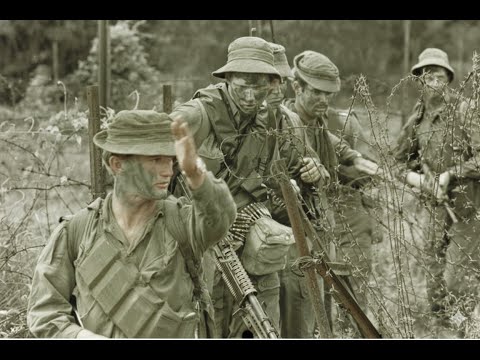
The American officer stared at the mud-caked sergeant, confusion and skepticism warring on his face. “You spent ten days in a hornet’s nest and didn’t take a single soul out?” he repeated. Benning offered a tired, knowing smile. “We didn’t take their lives, Lieutenant. We took their secrets. We found their hospital, mapped their bunkers, and identified the arrival time of their next shipment. We were ghosts. If we had killed anyone, they’d know we were there. Right now, they think they’re alone, and that’s why they’re going to lose.”
To the American command, success was measured in bodies. General Westmoreland’s strategy hinged on the body count—a grim ledger that equated corpses with progress. Every platoon was pressured to produce a tally, and the numbers flowed upward from rice paddies to air-conditioned offices in Saigon. But the Australian SAS operated on a different doctrine: the ghost patrol. Their most successful missions were those where they infiltrated deep, observed the enemy’s most intimate secrets, and extracted without a trace. “If you kill a sentry, you’ve told the NVA where you are,” Benning explained. “But if you sit five meters away and watch that sentry for three days, you know when he eats, when his relief arrives, and which trail leads to the commander’s bunker. A corpse tells you nothing. A living enemy tells you everything.”
This philosophy prioritized long-term strategic disruption over immediate tactical gratification. While the Americans chased body counts to satisfy a ledger, the Australians built a comprehensive human map of the battlefield. They believed that killing the enemy’s ability to plan was far more lethal than killing a few individual soldiers. For the SAS, the true measure of a professional was the silence he left behind.
The friction between the two allies eventually reached the highest levels of command. American colonels, whose promotions hinged on kill-to-casualty ratios, viewed the Australian approach as passive observation. “We are running a war of attrition, Sergeant,” one MACV intelligence officer remarked during a tense debriefing. “The North Vietnamese have a bottomless well of manpower. The only way we win is by draining that well faster than they can refill it. When your team comes back with zero, you aren’t helping us reach that tipping point.” But Benning countered with a map of the Long Hai Hills. “Because we didn’t engage that patrol on day three, we followed them to a hidden karst cave. In that cave are roughly 2,000 tons of rice and a radio relay station that coordinates every ambush in this province. If I had killed those three scouts to pad your ledger, we would still be looking for that cave.”
The SAS argued that the Americans were killing the messengers while letting the message get through. A ten-man VC squad dead in a ditch was a minor inconvenience for the NVA; a mapped supply route that allowed B-52s to incinerate a regimental headquarters was a strategic victory. The confusion in the American command stemmed from a refusal to accept that inaction could be an offensive tool. To the US military, aggressive meant pulling the trigger. To the SAS, aggressive meant the cold, calculated patience required to wait for a high-value target while lower-level targets walked right past their muzzles.
As the war dragged on, the cracks in the body count strategy began to show. Official reports from Saigon boasted astronomical enemy casualties, yet the North Vietnamese continued to launch massive offensives. The math simply wasn’t adding up. It was during this period of disillusionment that elite American units—the Green Berets, Navy SEALs—began to look toward their Australian counterparts with new respect. They saw that by chasing tallies, they were sacrificing the strategic intelligence required to win an unconventional war. They began to adopt the Australian mantra: mission over medals.
“We stopped asking the Aussies for their tally,” an American Special Forces captain later recalled. “We started asking them for their patterns. We realized that a report on how the enemy moved their cattle was worth ten dead scouts. The Australians taught us that the enemy isn’t a collection of targets. They’re a system. If you want to win, you break the system, not just the individuals.”
This recognition created a bridge between the two forces. The SAS shared their methods for silent infiltration and long-term observation, and American units began to push back against the pressure from Saigon to produce body counts. They learned that zero kills could be the highest mark of a successful infiltration—a sign that the team was so professional they had bypassed the enemy’s entire security apparatus to reach the high-value intelligence beyond.
But if the SAS wasn’t counting bodies, what exactly were they measuring? Their debriefings were dense with a different kind of data—environmental intelligence. They tracked the morale of local populations, the frequency of enemy radio traffic, the physical health of NVA regulars. If they noticed the enemy was skinning more rats for food or using rusted ammunition, that was a score far more significant than a dead sentry. “I don’t care if you shot five men,” Benning once told a trainee. “I care if you found where they get their water. You kill a man, he’s gone. You poison his well or map his supply route, and you’ve crippled his entire company.”
The legacy of the SAS’s refusal to count kills would echo far beyond the jungles of Vietnam. It would transform the way elite units across the globe operate, enshrining the quiet professional archetype and proving that in the shadows, silence is the ultimate currency. But for now, in the humid chaos of 1968, the ghost patrols continued their silent war, leaving the counting to the politicians and the glory to the loud.
Word of the Australian methods did not stay confined to debriefing tents. It seeped through the officer corps like monsoon water through canvas, and soon the SAS found themselves receiving an unusual sort of visitor—American commanders who arrived not to lecture, but to learn. One such officer was a wiry major named Kessler, a West Point graduate who had watched his own battalion burn through three lieutenants in a single month, all of them chasing confirmed kills into ambushes.
Kessler sought out Benning at a forward base near Nui Dat, carrying a clipboard he seemed almost ashamed of. “I’ve been ordered to produce two hundred bodies by the end of the quarter,” he said quietly. “My men are dying to fill a quota. I want to know how you keep yours alive.” Benning studied him for a long moment, then gestured toward the tree line. “Walk with me, Major. And leave the clipboard behind.”
What followed was not a lecture but a demonstration. Benning led Kessler to a patch of scrub where a single strand of tripwire had been strung at ankle height, nearly invisible against the leaf litter. “That wire has been there four days,” Benning said. “Nobody has tripped it. Why? Because the enemy doesn’t come through here. They know something we don’t—or they’re afraid of something we haven’t seen. Either way, that wire is telling us a story, and it didn’t cost a single bullet.” Kessler crouched, studying the wire as though it were a map to a lost city.
The major returned to his unit and did something that bordered on insubordination. He stopped reporting confirmed kills for two weeks, submitting instead a detailed log of enemy movement patterns, water sources, and the curious absence of traffic along a certain ridgeline. His superiors in Saigon were furious, but the log found its way to an intelligence analyst who noticed something no body count could have revealed: the NVA were massing for a push through that empty ridgeline, using it as a staging corridor precisely because it looked too quiet to be watched.
The ambush that followed was not an American victory of attrition but of anticipation. Two companies of NVA regulars walked into a prepared kill zone, and the engagement lasted eleven minutes. When the smoke cleared, Kessler’s men had suffered no casualties. He filed his report that evening with a single line at the top, a line that would be quoted in special operations manuals for decades to come: “Success measured not in enemy dead, but in friendly living.”
Benning heard about the report weeks later, delivered secondhand over a canteen of weak tea. He allowed himself a rare, quiet smile. The lesson was spreading—not through doctrine or decree, but through the simple arithmetic of survival. The ghost patrols had never needed to preach. They had only needed to come home, again and again, with their men intact and their secrets intact, while the ledgers in Saigon grew fat with numbers that meant nothing at all.
Yet the pressure from above never truly relented. Even as individual commanders like Kessler embraced the Australian philosophy, the machinery of the body count ground on, fed by career officers who feared that a quiet report would look like a lazy one. The SAS understood that they could not change the entire American war machine—but they could outlast it, one silent patrol at a time. And somewhere in the green gloom of the Iron Triangle, another four-man team slipped beneath the wire, counting nothing but the hours until they vanished again into the forest that had learned to keep their secrets.
The war would eventually end, as all wars do, not with a final tally but with a final silence. Saigon fell, the ledgers were sealed, and the body counts were filed away in archives where historians would later pore over them with disbelief. The numbers had never added up, and now they never would.
But the lessons survived. In the decades that followed, the quiet professional became the gold standard—operators who measured success in patterns disrupted, in networks dismantled, in men brought home. “We don’t count kills,” a modern SAS instructor tells his trainees, echoing Benning across half a century. “We count what we leave behind—and what we leave behind is an enemy who never knew we were there.”
Kessler’s line survived too, etched into manuals and minds alike: “Success measured not in enemy dead, but in friendly living.” It is a strange epitaph for a war that counted everything and learned almost nothing.
Somewhere in the archives, a yellowed debriefing form still bears Benning’s flat reply—Zero kills, no shots fired—and a young lieutenant’s frozen pen. Two philosophies, one jungle, and a question that still haunts every soldier who has ever carried a clipboard into a war zone.
So here is the question for you, reader: In the wars we fight today, are we still counting bodies—or have we finally learned to count the silence? Tell us what you think in the comments below.
Report this article
Select a reason for reporting:






