At 2100 hours on May 9th, 1940, the code word ‘Danzig’ crackled through the wires to every German division massed along the western border. For nearly three million men, the moment they had trained for had arrived. The invasion of Western Europe had begun. The Phoney War was over.
Within hours, the world would witness a new kind of warfare—one that would shatter assumptions, rewrite military doctrine, and ultimately trap the British Army on a beach with its back to the sea. This is the story of how it happened, and how a desperate gamble became a legend.
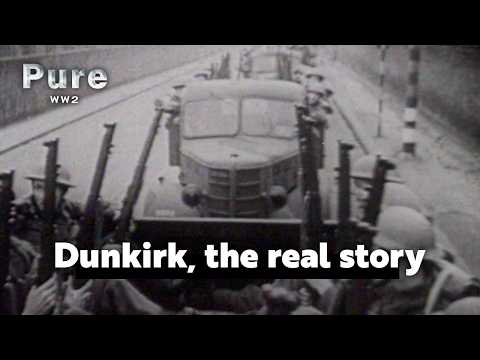
In the early hours of May 10th, nearly 30 divisions of Army Group B crossed the border into Holland, Belgium, and Luxembourg. Luxembourg fell quickly, but the neutral armies of Belgium and Holland were not about to stand aside. Holland, in particular, had strictly followed its policy of neutrality, leaving it with a small standing army and few tanks. Its landscape, crisscrossed with waterways, was supposed to provide an effective defense network—flooding the low-lying areas to stop any advance. But the Germans simply bypassed these obstacles or improvised new crossings.
The invaders in this part of the campaign were not the highly trained Panzer divisions that would soon follow. The attack through Holland was intended as a feint, a lure to draw the British and French forces north. Supporting Army Group B were nearly 2,500 combat, transport, and glider aircraft. Detailed reconnaissance had been carried out, and the Luftwaffe quickly destroyed the Dutch and Belgian air forces, establishing complete air superiority within the first 24 hours.
A decisive factor in the invasion’s early stages was the deployment of paratroopers and glider infantry. They landed far ahead of the main infantry, tasked with seizing and holding airfields and bridges until relieved. The fort at Eben-Emael on the Albert Canal in Belgium was a key defensive position. Paratroopers and gliders landed right on top of the fort, taking the defenders by surprise. This was the first time anywhere in the world that airborne forces had seen action. It was also the first time that hollow-charge explosives were used to blast through the casemates. Once the fort fell, the route into central Belgium was clear.
Strategically, it was important for the Germans to take Holland out of the war as quickly as possible. This would deny the Allies a valuable foothold on the continent from which they could threaten Germany’s industrial heartland in the Ruhr Valley. Confusion was sown in the minds of the Dutch when German bombers overflew the country before turning back out over the North Sea and beginning their bombing runs from the west.
Meanwhile, the airborne landings were having mixed success. The paratroops were unable to secure the main airfield at Ypenburg near The Hague, seat of the Dutch government. As a result, many transports were lost or dispersed. Around Rotterdam, things were going better. The Germans had landed seaplanes loaded with troops near the city center, from which they were able to secure a bridgehead. This position became stronger following the taking of an airfield to the south of the city. More troops were then sent to link up with the paratroops in the city. But progress was slow, and not all the bridges were intact.
Holland was an irritation in the great scheme of the attack on France. The sooner the Germans could take out Holland, the sooner they could concentrate all their resources on France. But the Dutch defenders of Rotterdam were proving difficult to dislodge. For this reason, they wanted to shock the Dutch politicians into surrendering. Rotterdam was to pay the price. The Germans decided to launch a ferocious attack that would have such an impact that the government of Holland would initiate a surrender. On May 14th, the attack on Rotterdam started—even though surrender negotiations had already begun.
Despite all their heroics, the Dutch Air Force had lost 62 aircraft out of 125 on May 10th alone. Despite such losses, they continued attacking the Germans and inflicting damage right up until Holland surrendered. For their valor, the Dutch Air Force was awarded the Military William Order, the Dutch equivalent of the Victoria Cross.
Eventually, around 100 tons of bombs were dropped, destroying around a square mile of the medieval city center and killing some 1,000 civilians. A further 80,000 were made homeless. The incident led to the immediate surrender of Rotterdam, and very shortly afterwards the Dutch government decided they could not risk other cities being bombed and sought an armistice.
Although the invasion had been expected, its timing caught the British by surprise. Prime Minister Neville Chamberlain had just resigned following a disastrous campaign in Norway in which around 4,000 men had been lost. On May 10th, a new wartime coalition government was formed, led by Winston Churchill. In the meantime, the British Expeditionary Force (BEF) had arrived in France in September 1939 under the command of General Gort and had taken up positions on the French-Belgian border as part of the Allied First Army Group.
Following the invasion, the BEF began its advance into Belgium to take up positions along the River Dyle as planned. On their immediate left was the Belgian army, and on their right the French First Army, as well as two mechanized divisions. But the inability of the French First Army to stall the Germans long enough in Holland meant that there was a danger the Allied flank could be exposed before the armies were properly dug in.
The Germans, meanwhile, had drafted in two Panzer divisions to increase the power of Army Group B. Between them, the two divisions could field around 620 tanks. The majority were light Panzer Mark I’s and IIs, which were no match for French tanks like the Somua S35. Even the gun of the main battle tank, the Panzer Mark III, could not penetrate the armor of the S35s. In fact, the only tank the Germans had at this point capable of holding its own in a tank-versus-tank confrontation was the Panzer Mark IV. But they only had 52 of these.
In accordance with French doctrine, the tanks were deployed along a defensive line with the village of Hannut in the middle. The terrain here is open plain, ideal for tanks and motorized infantry. And so it was vital the French armor stopped them. The stage was set for what was up to that point the largest tank battle in history.
On May 12th, the German Panzers broke through the Dutch and Belgian defenses and charged towards the French tanks. Over the next three days, nearly 1,200 tanks battled it out to gain control of the Belgian plain. French doctrine saw the tanks strung out in long lines, while the Germans concentrated theirs in order to punch holes in the defenders’ lines. The German tank crews could fight the French tanks only with personal resolution and courage, by flanking them and attacking weak points to their sides and rears. Due to the inferior firepower and armor on most of their tanks, the Germans suffered heavily. 160 German tanks were destroyed by French tanks. However, because the Germans took control of the battlefield in the end, most of their damaged and destroyed tanks were repaired and sent back into service.
Wireless was another key to German success. German tanks had radio receivers that allowed them to be directed by platoon command tanks, which in turn had voice communication with other units. Wireless allowed tactical control and far quicker improvisation than their opponents. Radio allowed German commanders to coordinate their formations, bringing them together to create greater firepower, whether in attack or defense. Most French tanks also lacked radio. Orders between infantry units were typically passed by telephone or verbally. The combat effectiveness of German armor was much higher as well because their tanks were manned by five crewmen. This reduced reaction time and spread out the stress placed on the tank crews. The French, on the other hand, stressed the importance of armor over mobility. Their vehicles were more suited to static defense. Although their heavy armor gave the German tank crews plenty of grief, they lost strategically because the Germans could control the battlefield and outflank them at every juncture. The French lost 30 S35 tanks in this battle, some of which were abandoned by their crews because they ran out of fuel. The insufficient combat radius was the main weakness in French tanks, but they managed to delay the German advance and bought the Allies valuable time.
What the Allies didn’t know was that the invasion through Holland and Northern Belgium was not the main attack. Operation Fall Gelb (Case Yellow) had two parts. The aim of the first part was to draw the best Allied units, including the BEF, north—which is exactly what happened. The second part was the main assault through an area the Allies were least expecting it: the Ardennes. There was an assumption that the Maginot Line and the steeply wooded hills and valleys of the Ardennes combined to form an impenetrable fortress. Consequently, the forces deployed in the border areas were weak. As the fighting in Holland progressed, nearly 46 divisions, including most of the Panzer divisions, were assembling in secrecy in the Ardennes.
On May 13th, they emerged from the forests. Their objective was to advance through France along the Somme Valley, isolating the British to the north and the bulk of the French army in the south. It was hoped that once surrounded on three sides and with their backs to the sea, the British would seek some sort of armistice. The way would then be clear for Germany to knock France out of the war.
German operational tactics relied on highly mobile offensive units with balanced numbers of well-trained artillery, infantry, engineer, and tank formations, all integrated into Panzer divisions. They relied on excellent communication systems which enabled them to break into a position and exploit it before the enemy could react. Panzer divisions could carry out reconnaissance missions, advance to make contact, defend and attack vital positions or weak spots. This ground would then be held by infantry and artillery as pivot points for further attacks. Although their tanks were not designed for tank-versus-tank combat, they could take ground and draw the enemy armor onto the division’s anti-tank lines. This conserved the tanks to achieve the next stage of the offensive. The units’ logistics were self-contained, allowing for three or four days of combat. The Panzer divisions would be supported by motorized and infantry divisions. The German communication system also enabled a degree of cooperation between land and air forces. Tactical air controllers were attached to the Panzer divisions who could call up Ju 87 Stuka dive bombers to provide air support. Typically, it took them about an hour to arrive overhead during the Battle of France.
The main opposition to the German advance through the Ardennes came from Belgian motorized infantry and French mechanized cavalry divisions. However, they were unable to delay the Panzers’ progress and so withdrew back to the River Meuse. Arguably a bigger obstacle was the poor road network through the forests and ravines. What routes there were became gridlocked due to the sheer number of vehicles trying to get through. The Panzer divisions had over 40,000 vehicles. And although these had been spotted by French reconnaissance flights right up to the night of May 10th, they were discounted by intelligence officers on the assumption that these were likely to be secondary attacks to the one in Holland.
In the northern part of the Ardennes, 7th Panzer Division, commanded by General Erwin Rommel, struggled to secure a bridgehead on the Meuse at Dinant. The French defenders had succeeded in blowing the bridges, and so improvised crossings had to be attempted under determined enemy fire. The river at this point is about 120 yards wide, which meant progress was slow. But the slow, ponderous communications of the French army were playing their part, and reinforcements simply did not arrive on time. Planned counterattacks were rescheduled and cancelled. By the morning of May 14th, German tanks were occupying the heights looking down on the defenders. Rommel was across the Meuse.
But the Germans’ main objective lay further south. Sedan was regarded as the gateway into France. Capture this, and the route across the plains of northern France would be clear all the way to the coast. Defenses at Sedan were weak and neglected. Half-hearted attempts had been made to reinforce the defenses in the winter of 1939, but the cold weather prevented the concrete from setting properly. The works that were carried out were photographed by Luftwaffe reconnaissance flights. To make matters worse, there were no mines, as most of the allocated stock had been used in defense of the Belgian border.
The attack was to be led by General Heinz Guderian’s 19th Panzer Corps. Ideally, Guderian wanted his artillery to soften up the bunkers and gun emplacements, but they were still struggling to get through the traffic backed up through the forests. But he did have the Luftwaffe. Over the next three days, the Luftwaffe launched nearly 4,000 sorties, more sorties than the world had yet seen. For the poorly trained defenders, this was morale-sapping warfare, and they were soon routed, allowing the Germans to consolidate their bridgehead. The inability of their commanders to make decisions only made matters worse, and any local advantages were soon squandered. By nightfall on May 12th, Sedan had fallen with little sign of the defenders. The battle was now on to secure the bridgehead so that they could break out.
French forces mounted repeated attacks. Although the French had 138 main battle tanks like the Char B1, which was far more powerful than anything in the German armory, they were unable to consolidate their positions due to the lack of infantry support. The capture of Sedan and the expansion of the bridgeheads alarmed the French, who called for a total effort against the bridgeheads at Sedan to isolate the three Panzer divisions. General Gaston-Henri Billotte, commander of the First French Army Group whose right flank pivoted on Sedan, urged that the bridges across the Meuse be destroyed by air attack. Convinced, he said, that over them will pass either victory or defeat.
On May 14th, an RAF bomber force took off with a fighter escort to attack the bridges. The fighters were soon tied up in battles with German fighters, leaving the Fairey Battles and Bristol Blenheims to soldier on alone. But their targets were already heavily defended. And so the bombers had to run the gauntlet of heavy flak as they approached their targets. So heavy was the defensive fire that the Allied bombers could not concentrate over the target. Allied bomber pilots called it ‘the hell along the Meuse.’ Out of 71 bombers dispatched, 40 to 44 bombers were lost, meaning a loss rate of 56 to 62%. The fighters fared little better. Greatly outnumbered, their losses were some 52%.
While the French struggled to regain some semblance of balance, Guderian ordered the 10th Panzer and the Grossdeutschland Infantry divisions to attack south to make the French think that they were going to outflank the Maginot Line and roll it up. To the south of Sedan lay the heavily fortified heights of Stonne. By capturing this area, the Germans were able to deny the French a vantage point that overlooked Sedan. Between the 15th and 17th of May, the town changed hands 17 times, finally in the Germans’ favor. But by then, Guderian was already on the move northwestwards. Speed was of the essence, and in that cause he was prepared to ignore orders emanating from his senior commanders back in Berlin.
The French defeat left the Allied army groups in Belgium with sparse flank protection. The German advance through France was so rapid that many French soldiers were in such shock that they were taken prisoner before they could offer resistance. On May 15th, Rommel’s 7th Panzer Division encountered the French First Armored Division, but rather than engage in a lengthy delaying battle, they simply drove through them and left the 5th Panzer Division to finish the job. By the next day, the French First Armored Division had just 17 serviceable tanks. At the same time, Guderian’s 1st and 2nd Panzer divisions broke out of their Sedan bridgehead. The French divisions were scattered and finding it difficult to form a coherent defense against the rapidly advancing German mobile units. But Hitler was unnerved by his Panzers’ success and ordered them to halt so that they could be reinforced by the slower-moving infantry divisions and their flanks strengthened. As a result, Guderian threatened to resign, but a compromise was reached which enabled him to carry on as a reconnaissance in force. By May 18th, Guderian was on the move again. The next day, the French collapse on the Meuse was complete when General Corap, commander of the 9th Army, was captured and his army surrendered en masse. Although the French expected the Germans to drive south and take Paris, they didn’t. Their trajectory was towards the north coast of France.
On May 20th, units of the 2nd Panzer Division reached the Channel coast at Noyelles. They were now barely 80 miles away from the Channel ports, but their advance had stretched their supply lines to the point that they were extremely vulnerable to an Allied offensive. If successful, the Germans would be completely isolated. General Maxime Weygand was now overall commander of the Allied forces, although his plan of attack was much the same as his predecessors’. A French force was to attack the corridor from the Somme Valley to the south, while a British force was to attack at Arras. The attack was codenamed Frank Force after its commander, Major General Franklyn. It was supposed to be executed by two divisions in two columns, but in the end, the attack was made by only two battalions of the Durham Light Infantry supported by 58 tanks. These were machine-gun-armed Matilda I’s and two-pounder-armed Matilda IIs of the 4th and 7th Battalions of the Royal Tank Regiment. The attack began on May 21st, and both columns initially made good progress, advancing up to 10 miles. The heavy armor of the Matilda IIs made them virtually impervious to German anti-tank weapons, their shells bouncing off the flanks with little effect. But the attack lacked any air support because of poor communications as well as manpower to consolidate any gains. Rommel subsequently made a counterattack that evening and recovered the situation, but it had cost 7th Panzer Division heavy casualties.
It was now clear to General Gort that France was all but lost and that he must try and save the BEF. Planning for what became Operation Dynamo now began in earnest. Vice Admiral Bertram Ramsay was given the task of putting the plan together from his bunker in Dover Castle. The BEF now had no other option but to fall back on Dunkirk. However, the attack at Arras did have one positive outcome: the German high command were unnerved by the fact that the attack so nearly succeeded. The engagement later partly influenced them to halt the Panzers before Dunkirk, giving the Allies more time to evacuate their armies.
One of the problems that had dogged the Allies throughout the campaign was the huge number of refugees on the road that held up movement of men and material. Their misery was compounded further by frequent air attacks designed to sow more confusion than panic and slow the army’s progress still further. For now, it seemed that all roads led to the coast as General Gort ordered a retreat from Arras. As Guderian’s Panzers headed towards the Channel ports, Boulogne was reinforced by the 20th Guards Brigade, consisting of Irish and Welsh Guards who were shipped over from Dover during the night of May 22nd to join the French units already in the old part of the town. The guards had barely disembarked when the 2nd Panzer Division began its attack, but they were made to fight for every street and every house. And it was not until May 25th that the port finally surrendered. During that time, Royal Navy destroyers managed to rescue over 4,000 troops, even though they were under fire from German artillery. But at least that number were also taken prisoner. It was a similar story at Calais. Except for the Rifle Brigade defending, there was to be no evacuation attempt. Despite being besieged by 10th Panzer Division and the Grossdeutschland Infantry Division, they held on until May 26th before surrendering. Both these actions were to give the French and British a little but much-needed time to finish preparations of the defensive perimeter around Dunkirk.
French and British preparations were given a further helping hand when the Panzers were ordered to stop. The attack at Arras had badly shaken German high command, and they were convinced that the long corridor created by the rapid advance was too vulnerable to further attacks. Also, the Panzers needed to pause so that they could be replenished after weeks on the move. To complicate matters, Hermann Göring had convinced Hitler that the Luftwaffe could finish the British off while the Panzers prepared themselves for the push south to defeat the rest of France. It wasn’t until May 26th that Hitler changed his mind and let the Panzers attack once more. But the Allies had been given the time they needed to get the defense organized and the evacuation planned and underway.
Just before 7:00 p.m. on May 26th, Winston Churchill gave the order for Operation Dynamo to begin. The hope was to rescue around 40 to 45,000 soldiers in two days. A defensive perimeter had been formed around Dunkirk with the French holding the west and the British the east up to Nieuport, but the French were hoping to hold out in some sort of bridgehead while the British were intending to evacuate. Neither party quite understood the other’s plans. Around the Dunkirk beachhead, conditions were chaotic with abandoned vehicles and fleeing refugees blocking the roads. Over 20,000 non-essential personnel had already been evacuated since May 20th. But getting the troops out while under constant aerial attack was going to be dangerous work for the 850 or so Royal Navy, Dutch, French, and Belgian ships allocated to the task. The bombing attacks on the harbor meant that progress was slow. Only just over 7,000 men were evacuated on the first day. A further 15,000 were taken out on the next day, the 27th. With the port now all but unusable, attention moved to the outer walls or moles of the harbor. The east mole was long enough and the water deep enough for destroyers and transports to moor either side, dramatically speeding up the evacuation. But the ships were too vulnerable to continue with daylight evacuations, and so reverted to nighttime operations. The solution was to take as many troops as possible off the nearby beaches. But large vessels could not get in close enough to the shore because of the shallow water. Smaller vessels were therefore needed to ferry the troops from the shore to the larger ships.
An armada of small vessels was hastily assembled around Britain’s south coast. Some were requisitioned and crewed by Navy personnel, but others were manned by their civilian owners and crews. The first of these ‘little ships,’ as they became known, arrived on the beaches on the morning of May 28th. But even these vessels could not get right up to the shore, and so men had to wade out with water up to their necks to get aboard. Although the men generally formed orderly queues and awaited their turn, discipline did break down at times, and men attempting to rush the boats in panic had to be ordered back at gunpoint. In a remarkable moment of ingenuity, vehicles were driven out at low tide and lined up to make improvised jetties.
But on May 28th, the whole evacuation operation nearly came unraveled when the Belgian king surrendered his army without consulting his allies. It left a wide gap to the east of Dunkirk that required two divisions to block. Meanwhile, to the south at Lille, the remnants of the French First Army were fighting a bitter battle with seven German divisions, including some armored. They held out until May 31st, by which time their ammunition and food had run out. But the delay had bought yet more valuable time. It was a similar story in the villages and towns that formed the perimeter. British and French units fought side by side, aware that any breakthrough would spell disaster. Many fought right to the end, only surrendering when their ammunition had run out.
Overhead, the RAF was doing what it could to delay, if not stop, the Luftwaffe from reaching the beaches. In the immediate aftermath, many soldiers felt they had been let down by the RAF, that they had not done enough to protect the soldiers being bombed or strafed on the beaches. The reality was somewhat different in that most of the dogfights took place inland, away from the beaches. Indeed, over 3,500 sorties were flown during Operation Dynamo. But the cost had been high. 177 aircraft had been lost, including 6 fighter aircraft which would be sorely missed as the Battle of Britain began.
The tempo of the evacuation improved significantly over the next few days. On May 29th, over 47,000 British troops were rescued. The next day, over 53,000, including the first French soldiers. On May 31st, 68,000 made it back, followed by a further 64,000 on June 1st. Increasing air attacks meant that any further evacuations would have to take place at night. The British rear guard of 4,000 men left on the night of June 2nd to 3rd, and an additional 75,000 French troops were retrieved on the nights of June 2nd to 4th before the operation finally ended. By June 4th, when the operation ended, 198,000 British and 140,000 French and Belgian troops had been saved, but virtually all of their heavy equipment had been abandoned. Eight destroyers had been sunk along with eight troop ships and around 200 small craft from a total of around 860 vessels of all sizes.
The German troops who occupied the town on June 4th could not have believed that the war would last another five years, nor that they would be on the losing side. But the battle for France was still far from over. Around 100,000 of the French troops evacuated at Dunkirk were simply transported back to western France to continue the fight. Also, three British divisions and a host of logistic and labor troops were cut off to the south of the Somme by the Germans’ race to the sea. At the end of May, a further two divisions, the 52nd Division and the 1st Canadian Division, were moved to France with the hope of establishing a second BEF. This included the 51st Highland Division which had been detached from the BEF and sent to positions on the Maginot Line. In the withdrawal westwards, they found themselves trapped in Normandy facing Rommel’s 7th Panzer Division. On June 12th, the 51st Highland Division surrendered, so ending Allied operations in France.
Although the French were making a firm stand along the Somme Valley, the Luftwaffe enjoyed almost complete supremacy in the air; their ability to strike artillery and armored positions prevented the French from mounting any substantial counterattacks. With so many fighting men still in France, Churchill was persuaded to authorize more evacuations from ports in Normandy, Brittany, and Western France. Operations Cycle and Ariel succeeded in evacuating over 190,000 men. On June 22nd, negotiations took place at Compiègne and the armistice was put into practice on June 25th, effectively ending the Battle of France.
Today, the beaches around Dunkirk are a popular tourist spot. The East Mole is still there, or at least part of it, but there is little to remind people strolling along the miles of sandy beach of the momentous events of 1940 as men sought refuge amongst the sand dunes and waded chest-deep into the water to be rescued by a fleet of small boats. But as the tide recedes, it reveals the past. The skeletons of several little ships can still be seen, their bones jutting up out of the sand. The remains of the Devonia are easily recognized at Bray-Dunes. Before the war, she was a paddle steamer providing excursions in the Bristol Channel. During May 30th, she was damaged by bombs and beached, which is where she remained until broken up for scrap by the Germans during 1941. Further west along the beach are the remains of the Crested Eagle. Like the Devonia, she was also a paddle steamer that saw service on the Thames. Late in the afternoon of May 30th, the Crested Eagle was moored alongside the eastern mole in Dunkirk. With around 600 soldiers on board, she began her journey home, following the coast as far as Bray-Dunes before heading northeast and then turning west towards Dover. But the Crested Eagle never made it. She was attacked by dive bombers and set ablaze. In order to try and save as many men as possible, the skipper decided to beach her. In spite of his efforts, around 300 men died in the inferno.
Wormhout is a small town to the south of the beaches. As part of the British Expeditionary Force’s retreat to Dunkirk, the 144th Infantry Brigade of the 48th South Midland Infantry Division was holding the road that runs southward from Bergues through Wormhout to delay the German advance. Having exhausted their ammunition supplies, the troops at Wormhout surrendered, assuming that they would be taken prisoner and treated according to the rules of war. Instead, around 100 men of the 2nd Royal Warwickshire and 4th Cheshire regiments, as well as some Royal Artillery gunners and French soldiers, were herded into a small cowshed and murdered by their SS guards. Incredibly, there were survivors. Today, the restored cowshed still stands. It serves as a memorial to those that lost their lives to this particularly brutal war crime.
The evacuation of so many troops from Dunkirk using small boats crewed by civilians quickly became part of the national folklore. The operation united the population in a shared moment of peril. The fact that the population now knew it stood alone seemed to lift morale. Even Churchill referred to the outcome as a miracle. But 3,500 British servicemen were killed between May 10th and the French surrender on June 22nd, and a further 64,000 captured, wounded, or missing. What’s more, the BEF had been chased out of continental Europe without its equipment. It was to be four long years before they would return. Only this time, it would be as liberators.
As the last ships slipped away on June 4th, the beaches fell silent save for the wind and the distant bark of German orders. In London, Churchill rose in the Commons to deliver a speech that would echo through the ages, though he never spoke the words most remember. “Wars are not won by evacuations,” he warned the House, refusing to dress defeat in triumph’s clothing.
Yet he also spoke of a strange paradox—that in the rubble of France, something had been salvaged. “We shall fight on the beaches, we shall fight on the landing grounds… we shall never surrender.” The words were not a boast. They were a promise forged in the smoke of Dunkirk.
For the men who waded chest-deep toward the little ships, the war was far from over. They would return four years later—this time as liberators. But for now, Britain stood alone, and the world held its breath.
What would you have done, standing on that beach with the enemy closing in?
Report this article
Select a reason for reporting:






