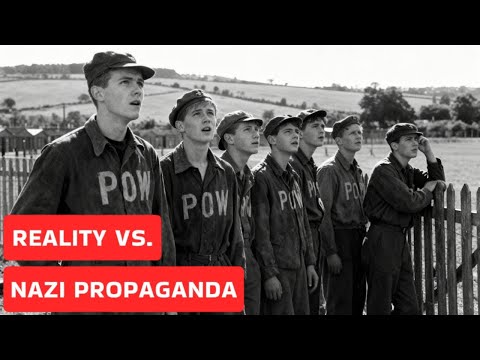
May 1945. The war in Europe was over, and over 400,000 German soldiers sat in prisoner-of-war camps, waiting to learn their fate. Among them was Hans Weber, a 24-year-old from Essen who had believed every word of Hitler’s propaganda for twelve years. He had been told that Britain was on its knees, bombed into submission, its people starving. He had seen the rubble of his own city and expected the same across the Channel. But as the British military truck rumbled north through England, a gap in the canvas cover revealed something that would crack his entire world open.
Hans leaned forward and peered through the flapping tear. What he saw made him blink hard and rub his eyes. Rolling green hills stretched in every direction, stone cottages sat peacefully in villages, and children played laughing in a square. A church steeple stood tall and whole, not a single stone missing. Everything looked clean, intact, and prosperous. This was not the broken, starving enemy he had been promised. This was a paradise untouched by war.
Other prisoners pressed their faces to the gap. One man from Munich began to cry silently. Another whispered a single word: “Impossible.” But it was real. The truck kept moving, and the countryside kept rolling past, village after village, all functioning, all normal. Hans felt something crack inside his chest—the first hint that everything he had believed might be wrong.
The trucks arrived at Eden Camp in North Yorkshire, a compound of metal huts surrounded by barbed wire. Hans expected watery soup and stale bread. Instead, the mess hall served white bread, margarine, strawberry jam, and hot stew with real potatoes. Each prisoner received 2,900 calories a day—more than German soldiers had gotten even in 1944. An older prisoner named Friedrich voiced what everyone was thinking: “They feed us better than we fed ourselves before the war started.” Nobody argued. It was simply true.
Assigned to work on local farms, Hans was struck by the tractors, the electric lights in the barns, the neatly maintained fences. Mr. Thompson’s wife brought hot tea to the prisoners and smiled with simple kindness. “You boys must be thirsty,” she said. Hans accepted the cup with both hands, unable to speak but understanding her gesture. She saw them as human beings, not monsters.
On Sundays, villagers waved at the prisoners as they walked to church. Children were curious, not afraid. Hans noticed electric streetlights, trains running on schedule, shops delivering goods. The war had touched Britain, but the country was unbroken. At night, lying in his bunk, Hans wrote on a scrap of paper hidden under his mattress: If they lied about Britain, what else was a lie?
Six months later, the camp commander ordered all prisoners to gather in the largest hut. A film projector whirred to life, and images of Bergen-Belsen appeared on screen—piles of skeletal bodies, bulldozers pushing corpses into pits, living people with hollow eyes and stick-thin arms. Hans’s stomach twisted. Around him, men sobbed quietly. The film showed Auschwitz, Dachau, Buchenwald—ovens, gas chambers, warehouses full of stolen shoes and human hair. Millions murdered, not soldiers, but ordinary people killed for no reason except hatred.
When the lights came back on, Hans could not move. His hands shook. He had heard rumors during the war but had dismissed them as enemy propaganda. Now he understood: the propaganda had been on the other side. That night, he lay staring at the curved metal ceiling, thinking of the farmer’s wife who brought tea, the nurse who bandaged his hand, the minister who nodded with kindness. The British had every reason to hate Germans, yet they fed them, housed them, treated them like men. Hans whispered into the darkness: “We were told we were the master race, but they treat us with more humanity than we treated anyone.”
Spring 1946 brought new work in Sheffield, rebuilding houses destroyed by German bombs. Hans worked alongside a British construction worker named George, who shared cigarettes and taught him English words for tools. One day, Hans asked why George was kind to German prisoners. George was quiet, then said, “My son died at Normandy. A German bullet killed him.” Hans felt hot shame, but George held up his hand. “War’s over, mate. You’re just a bloke now. Just a man. No point in hating you for what’s already done.”
Just a man. The words cut through everything Hans had been taught. At the camp library, he read about democracy and the Nuremberg trials, seeing once-heroes for what they were: criminals. Everything was turning upside down, and he was rebuilding himself, one new thought at a time.
August 1948. Hans stood on a railway platform with dozens of other prisoners finally going home. Britain had kept them working for three years to rebuild what the war destroyed. In his cloth bag were a bar of soap, a tin of English breakfast tea from the farmer’s wife, and a set of carpentry tools Mr. Thompson had pressed into his hands. “You’ll need these more than I will,” the farmer had said. Hans also carried invisible things—memories of kindness from people who should have hated him.
The train rolled south through England one last time. Hans looked out at fields full of crops, peaceful villages in the summer sunshine, everything still quietly beautiful. He wondered if Germany would ever look like this. At Aachen, the change began. Bomb craters appeared beside the tracks. Burned-out tanks rusted in fields. Buildings stood as empty shells. This was Germany in 1948, three years after the war ended, and it still looked like the war had happened yesterday.
When Hans finally reached Essen, he barely recognized it. The station roof was gone. The factory where his father worked was still a skeleton of twisted metal. He climbed stairs that smelled of damp and rot and knocked on what used to be his family’s apartment. His mother opened the door—52 years old but looking 70, her hair completely gray. “Hans,” she sobbed, pulling him close. “You’re alive. You’re home.”
The apartment was one room now. A single bed, a small table, a hot plate. The window was covered with cardboard because there was no glass. That evening she made a thin soup from potatoes and a tiny bit of bacon fat, apologizing that there was not more. The ration was still only 1,550 calories a day. Hans ate slowly, making it last.
His mother watched him with worried eyes. “Was it terrible? In the prison camp, did they hurt you?” Hans set down his spoon. He thought about the warm hut, the white bread and jam, the farmer’s wife bringing hot tea, George who lost his son but still called him just a man. “Mutti,” he said quietly, “they fed us better than we are eating right now. They treated us like men, not animals. And we—we believed we were gods.” His mother was silent for a long time. Then she said, “We were lied to, all of us, for so many years.”
In the years that followed, Hans became part of the generation that rebuilt Germany—the Wirtschaftswunder, the economic miracle. He used his carpentry skills to help build millions of new houses. In 1950, he began writing letters to Margaret, the secretary from Sheffield. They exchanged letters for two years, carefully and shyly. In 1952, Hans traveled back to England and married her. They returned to Germany and built a life in the new country rising from the ashes.
Hans and Margaret had three children. When they were old enough to ask questions, Hans told them everything—the propaganda and the lies, the concentration camps and the evil. But he also told them about the British countryside and the kindness he received as a prisoner. “I learned more about civilization in a Yorkshire prisoner-of-war camp than in twelve years of the Third Reich,” he told them.
Years later, when researchers asked former German prisoners about their experiences, 67 out of every 100 men held in Britain said they were treated well. Many said their time in British camps had changed their lives. They learned about democracy and human rights and brought those lessons home to build a better Germany.
Hans lived to be an old man. In his final years, when his grandchildren asked about the war, he always returned to the same memory—the moment the canvas flap blew open on that truck in May 1945, revealing green hills rolling away forever, stone cottages with smoke rising, children playing without fear. “Those green hills were not just land,” he told them. “They were proof. Proof that you do not need to conquer to be prosperous. You do not need to be cruel to be strong. You do not need lies to have pride.”
He paused and looked out the window of his comfortable home in the rebuilt city of Essen. “I went to war for a lie, but I was captured by the truth. And the truth was green and rolling and kinder than anything I had been told to believe. That truth saved me. It gave me a second chance to be human, and I have tried every day since then to deserve that chance.”
Hans Weber died in 2005, surrounded by children and grandchildren, in a country that had learned to look at its past without flinching—a country rebuilt not just with bricks and mortar, but with the hard-won knowledge that humanity’s greatest strength lies not in domination, but in mercy. And so the question remains for every generation that follows: when the canvas flap of your own beliefs blows open and reveals a truth you never expected—will you have the courage to look?
Report this article
Select a reason for reporting:






